Raw Snickers Bars
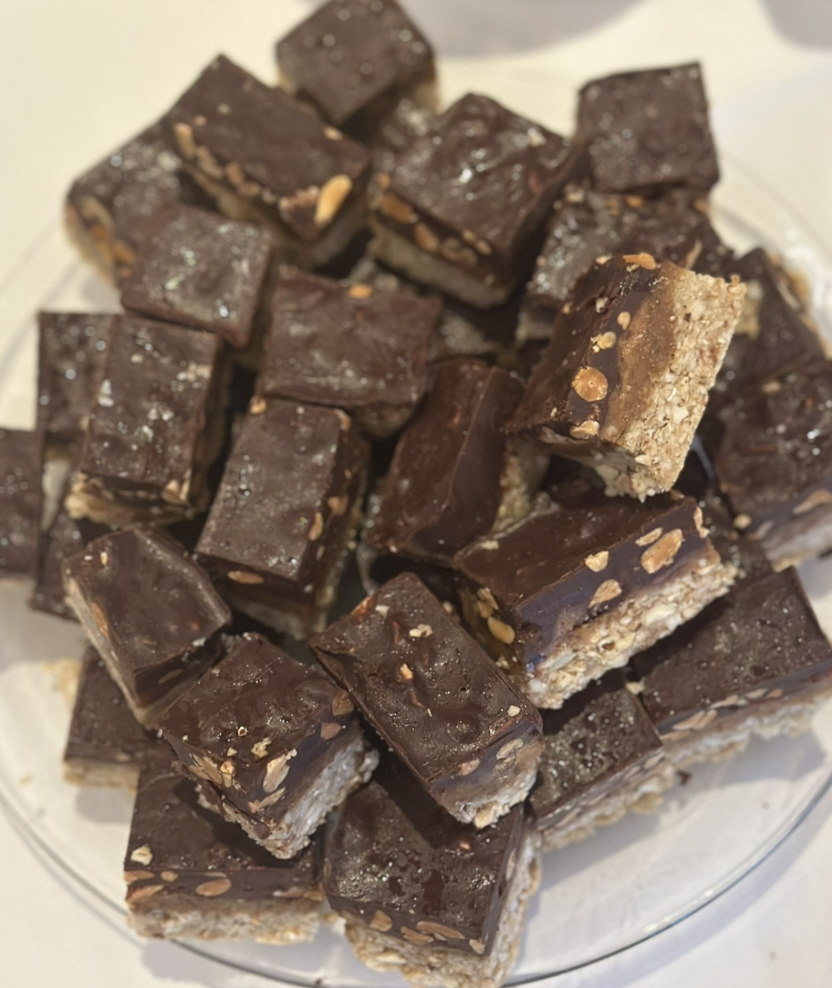
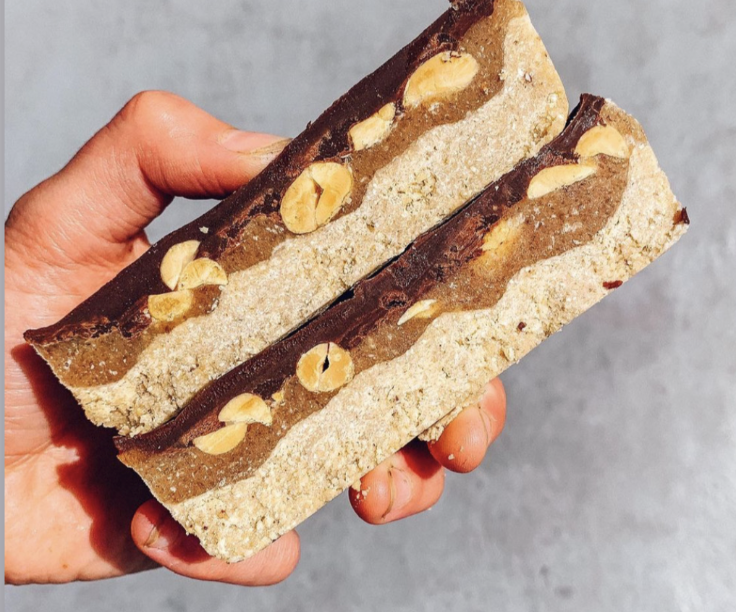
The candy bar, returned to its ancestral bones — sprouted oats, dates, peanut butter, tahini, raw cacao
Season: Winter · Cuisine: Modern Raw / Plant-based · Yield: 16 bars · Active: 30 min · Total: 3 hr (with freezer set times) · Best eaten: afternoon
Ingredients
Coconut-Oat Crust
3 cups sprouted rolled oats (thick-cut, old-fashioned)
½ cup coconut flour
½ cup unsweetened shredded coconut
½ cup coconut oil, melted
4 tbsp pure maple syrup
pinch sea salt
2–3 tbsp filtered water, as needed to bind
Date-Caramel Peanut Layer
15 medjool dates, pitted (soaked 15 min in warm water if firm)
1 cup organic Valencia peanut butter (only peanuts + sea salt — no hydrogenated oils)
2 tbsp raw stone-ground tahini
½ cup pure maple syrup
¾ cup full-fat coconut milk (Native Forest Organic Simple, no guar gum)
½ cup coconut oil, melted
1 tsp pure vanilla bean powder (or seeds of 1 fresh vanilla bean)
½ tsp sea salt
¾ cup raw or dry-roasted peanuts, kept whole (for folding into caramel)
½ cup raw peanuts, roughly chopped (for scattering on top)
Raw Chocolate Coating
¾ cup raw cacao powder
½ cup cacao butter, melted
¼ cup coconut oil, melted
¼ cup pure maple syrup
pinch sea salt
To finish: flaky sea salt (Maldon)
Sub for chocolate coating: 1 cup raw cacao wafers (or 85%+ dark chocolate) melted with ¼ cup coconut oil — faster, glossier, single-step. Pascha, Eating Evolved, or Raaka are the genuinely high-quality dark chocolate options.
Sub for peanut-free version: replace peanut butter with raw stone-ground tahini or sunflower seed butter, and the peanuts with sunflower seeds. Earthier and less candy-bar-like, but the texture and indulgence are similar.
Method
Line an 8×8-inch baking pan with parchment, leaving overhang on two sides for lifting later.
Crust. In a food processor, pulse the oats until roughly broken down but not flour-fine — visible oat texture is good. Add coconut flour, shredded coconut, and salt; pulse briefly to combine. Add melted coconut oil and maple syrup; pulse until the mixture holds together when pinched. If dry, add water 1 tbsp at a time. Press firmly and evenly into the pan, using the flat bottom of a measuring cup to compact into a level base. Freeze while you make the caramel.
Date-caramel peanut layer. In the same food processor (no need to wash), combine the dates, peanut butter, tahini, maple syrup, coconut milk, melted coconut oil, vanilla, and salt. Process 2–3 minutes, scraping down the sides, until completely smooth and glossy. The caramel should be thick, rich, and uniformly colored.
Transfer caramel to a bowl. Fold in the ¾ cup whole peanuts by hand. Folding whole peanuts into the caramel — rather than scattering only on top — distributes the textural crunch through every bite, structurally closer to the original Snickers architecture.
Pour the caramel over the chilled crust, smoothing with a spatula. Scatter the chopped peanuts across the top, pressing gently so they adhere. Freeze 60–90 minutes, until the caramel is firm.
Raw chocolate coating. Melt cacao butter and coconut oil together in a double boiler over very low heat (under 110°F to preserve raw integrity). Whisk in cacao powder, maple syrup, and salt until completely smooth and glossy. Do not overheat — raw cacao loses its living compounds above 110°F.
Pour the warm chocolate over the set caramel layer, tilting the pan to spread evenly. Finish with a generous pinch of flaky sea salt while the chocolate is still soft.
Freeze 20–30 minutes, until the chocolate is firm but not rock-hard. Lift the slab out by the parchment and slice into 16 rectangles with a sharp warm knife (run under hot water and dried between cuts).
Variation — Dipped Bars (chocolatier-style finish). For a more polished restaurant look: skip step 7. Lift the caramel slab from the pan, slice into 16 bars, then dip each bar fully into the warm chocolate. Place on parchment-lined tray. After all bars are coated, dip each one a second time for full coverage. Freeze 15 minutes. The double-dip technique is borrowed from professional chocolatiers — a single dip leaves thin spots; the second dip after the first has set produces a thick, even shell that snaps cleanly when bitten. This is the same technique used for enrobed Belgian truffles.
Storage: Refrigerated in a sealed container up to 1 week. Frozen up to 2 months. Best eaten slightly chilled — not frozen — so remove from the freezer 10 minutes before serving.
Nourishment Notes
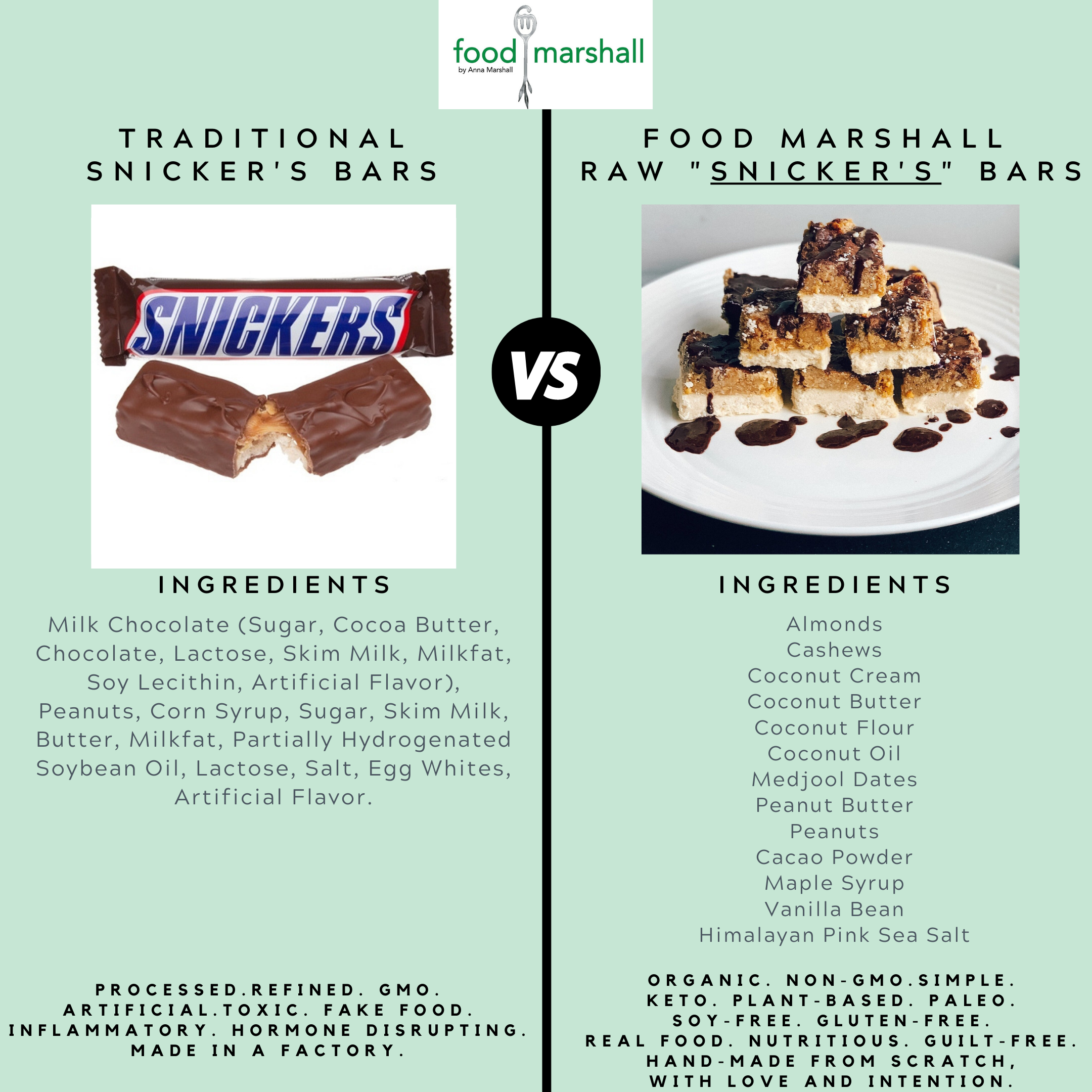
This is an indulgent dessert, and worth honoring directly — it is rich, dense, and sweet, and should be eaten in moderate portion. But what it contains is a genuine departure from what a commercial Snickers bar contains, and that difference matters. A standard Snickers contains high-fructose corn syrup, sugar, partially hydrogenated soybean oil, skim milk powder from confined-dairy cows, TBHQ and PGPR (petroleum-derived additives), and artificial flavor — engineered to produce a specific dopamine response and a specific blood sugar curve. By any ancestral measure, it is not food. This bar walks the candy-bar architecture backward, rebuilding it from whole ingredients the body actually recognizes. The deeper roots run to the ancient Middle East and Mediterranean, where halva and halawa (ground sesame or nuts with honey or syrup, sometimes layered with chocolate) have been traditional foods for six thousand years. The raw layered bar is not a new idea — it is an old idea served in a new silhouette.
Medjool dates are the structural ingredient that makes the middle layer work without refined sugar. A medjool date is a whole dried fruit — fiber and sugar and minerals and phenolic compounds all present together. When blended with fat (coconut oil, coconut milk) and nut butter, dates produce a true caramel texture and flavor — not a substitute, but the original Middle Eastern caramel that predates cane-sugar caramel by thousands of years. Fifteen dates in this recipe is a meaningful load of potassium, magnesium, copper, and B vitamins, delivered in whole-food form that the body processes gracefully. Tahini in the caramel is the structural flavor element that distinguishes this bar from a pure peanut-butter version. Sesame seeds carry a slight bitterness and savoriness that pure peanut butter lacks, and the combination sits closer to the Middle Eastern halawa-with-pistachios tradition than to American peanut butter candy. The tahini is invisible at small amounts but pulls the whole flavor profile a step away from one-note sweetness.
Peanuts deserve honest discussion: they are technically legumes, not nuts, and are nutrient-dense (substantial protein, vitamin E, niacin, magnesium, resveratrol) but prone to aflatoxin contamination from improper storage. Organic Valencia peanuts are traditionally the cleanest variety. Look for peanut butter with only peanuts and sea salt — commercial brands with hydrogenated oils, sugar, and preservatives defeat the point. Raw cacao preserves the polyphenols, theobromine, magnesium, and mineral complexity that commercial processed chocolate has lost — raw cacao carries one of the highest antioxidant loads measured in any common food. Melted gently below 110°F, it produces a coating the body reads as plant medicine rather than confection.
As a circadian and seasonal food, this bar belongs to winter afternoons. The body's preference for richer, denser, more grounding food rises as the light drops; fats become more metabolically welcome; sugars are handled more gracefully when delivered within a fat-and-fiber matrix. A raw chocolate bar in February is not a transgression against ancestral eating — it is the philosophy applied correctly. The natural sugars in dates and maple, though delivered within substantial fat and fiber, still metabolize best when eaten in daylight. A slice around three or four in the afternoon with a strong cup of tea is the ideal placement; late-night sweet eating, of any kind, pushes the body's cooling and melatonin curve back. The bar is rich enough that one square satisfies; this is not a dessert that demands a second helping. Eat it as a planned afternoon pleasure rather than an unconscious snack.
Storage: Refrigerator 1 week, freezer 2 months. Remove 10 minutes before serving — best eaten slightly chilled, not frozen.
Sourcing: Sprouted rolled oats: One Degree Organic Foods (the genuinely small-batch sprouted oats) or Lindley Mills (small-batch sprouted grain mill); avoid commodity rolled oats which lack the structural advantages of sprouting (reduced phytic acid, improved mineral absorption). Coconut flour and shredded coconut: Big Tree Farms or Bob's Red Mill organic. Coconut oil: Nutiva (organic, virgin, single-source) or Dr. Bronner's. Coconut milk: Native Forest Organic Simple (guar-gum-free, the gold standard) or Aroy-D pure coconut milk in cartons (Thai, single-ingredient). Medjool dates: Bautista Family Organic Date Ranch or Joolies (small Coachella Valley producer); avoid commercial bulk dates which are often pasteurized. Organic Valencia peanut butter: small-batch from Crazy Richard's (single-ingredient — only peanuts) or Big Spoon Roasters (small-batch North Carolina); freshly ground at a local co-op grocery is also excellent. Avoid commercial peanut butters with hydrogenated oils, added sugars, or preservatives. Look specifically for organic Valencia peanuts which are the cleanest variety for aflatoxin concerns. Raw stone-ground tahini: Soom (Israeli small-batch, single-origin Ethiopian sesame) or Seed + Mill (Brooklyn small-batch, single-origin) — both restaurant-quality and dramatically more flavorful than mass-market brands. Pure maple syrup from a local sugarbush or small Vermont/Quebec producer — Crown Maple, Runamok, or any small-scale producer at the farmers' market. Raw cacao powder and cacao butter: Sunfood, Navitas Organics, or Big Tree Farms — all ethically sourced, raw-processed (kept under 115°F to preserve enzymes and polyphenols), and traceable to specific cacao-growing cooperatives. For the dark chocolate sub: Pascha (organic, allergen-free, single-source Peruvian cacao), Eating Evolved (real ingredients, low-sugar), or Raaka (small-batch Brooklyn, unroasted cacao). Raw cacao wafers (alternative): Sunfood or Big Tree Farms. Vanilla bean powder: Singing Dog Vanilla (single-origin Madagascar). Flaky sea salt: Maldon (English flake salt, widely available and genuinely high-quality) or a small-batch hand-harvested option like Jacobsen Salt Co. (Oregon) or Amagansett Sea Salt (New York).