Roasted Baby Potato, Radish, and Pickle Salad with Mayo-Dijon Dressing
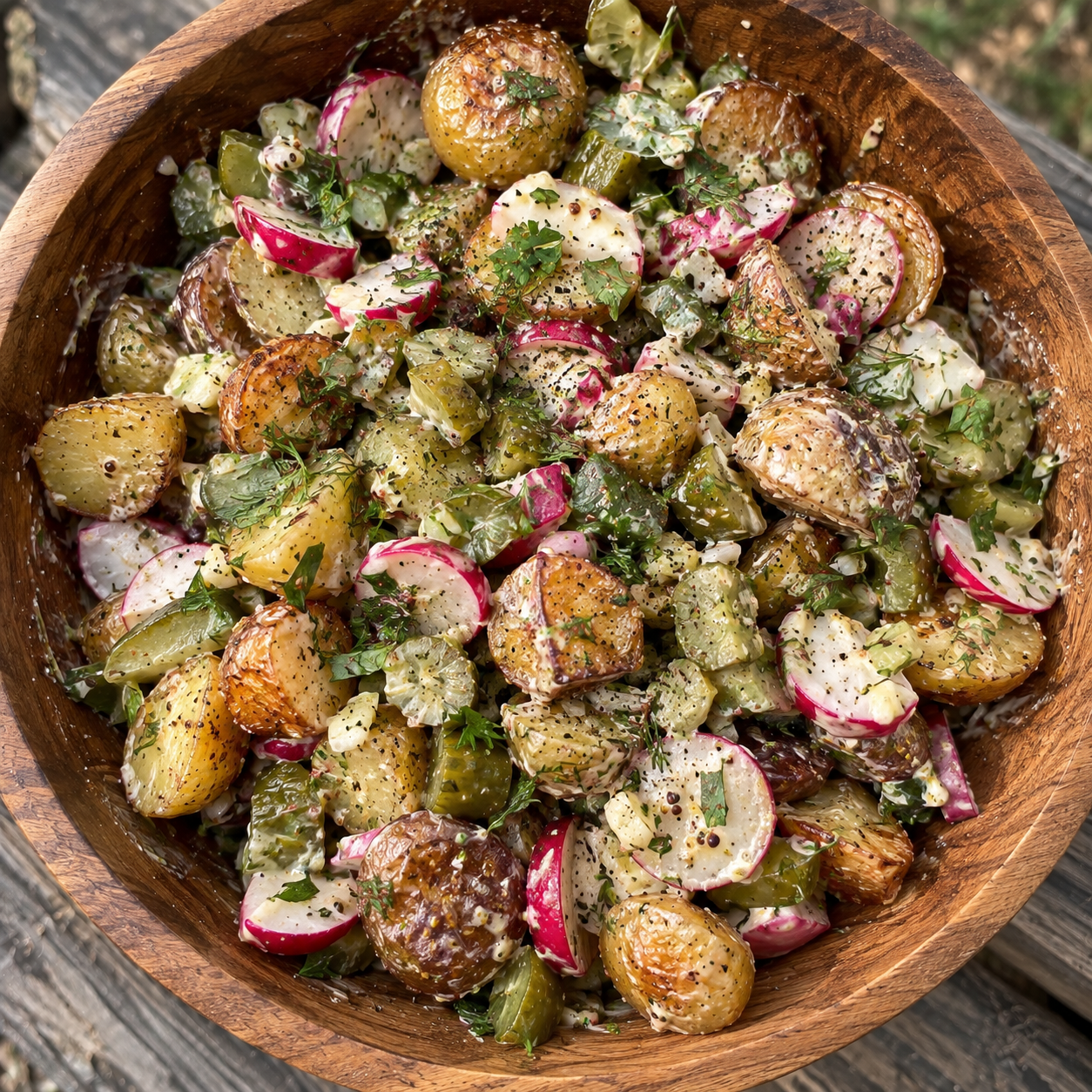
The reliable spring side: caramelized roasted baby potatoes, crisp radishes, tangy fermented pickles, and fresh herbs, tossed in a creamy, mustardy dressing made with real mayonnaise and a splash of pickle brine.
Yield: Serves 6–8 as a side, or 4 as a light main · Active: 20 min · Total: 1 hour (including a 15-minute rest) · Best in North America in late spring and early summer, when new potatoes and radishes are harvested · Best eaten: midday or early afternoon
Ingredients
Salad
1½–2 lb baby potatoes (Yukon Gold, red, fingerlings, or a colorful mix)
2 tbsp extra virgin olive oil (or duck fat, lard, or ghee, for deeper flavor)
1 tsp fresh thyme leaves
Baja Gold sea salt and freshly ground black pepper
1 bunch radishes (6–8 small), thinly sliced, greens reserved
Optional: 1 small watermelon radish, thinly sliced, for color
½ cup naturally fermented dill pickles, roughly chopped
3 green onions, thinly sliced (or 1 small shallot, minced)
1 small red onion, finely diced
2 tbsp fresh dill, chopped
2 tbsp fresh flat-leaf parsley, chopped
Optional: 1 tbsp capers, drained
Optional: 4 hard-boiled pasture-raised eggs, halved or quartered, to make it a meal
Mayo-Dijon dressing
⅓ cup real mayonnaise (homemade, see my House Mayo, or Primal Kitchen avocado oil mayo)
2 tbsp Dijon mustard
1 tbsp whole-grain mustard
1 tbsp raw apple cider vinegar (or white wine vinegar)
1 tbsp pickle brine, from your pickle jar (the secret ingredient)
1 tbsp fresh lemon juice
Optional: 1 tsp raw honey, to balance the acidity
1 small garlic clove, finely grated
½ tsp Baja Gold sea salt and black pepper, to taste
To garnish: extra dill, chives, and parsley, torn radish greens, and flaky sea salt
About the pickles: Any pickles work, but naturally fermented pickles transform this salad. Look for "naturally fermented" on the label in the refrigerated section; the brine should look slightly cloudy. Shelf-stable vinegar pickles don't contain live cultures, and they lack the same depth.
Method
Roast the potatoes. Heat the oven to 425°F. Scrub the potatoes well, leaving the skins on. Halve any larger ones, and leave the small ones whole. Toss them with the olive oil, thyme, a generous pinch of salt, and pepper, and spread them cut-side down on a parchment-lined sheet pan. Roast 25–30 minutes, until deeply golden underneath and tender. Don't skip the deep browning; that's where the flavor is.
Cool until warm. Let them cool until warm, not hot. Warm potatoes soak up the dressing, hot potatoes can break the mayo, and cold potatoes resist it.
Make the dressing. Whisk all the dressing ingredients until smooth and glossy. Taste and adjust: it should be bright, tangy, and mustardy, with just a hint of sweetness. If it's too thick, loosen it with a little more pickle brine.
Toss. In a large bowl, combine the warm potatoes, radishes, pickles, red onion, green onions, capers (if using), and most of the herbs. Add half the dressing and toss gently, then add the rest and toss again.
Rest 15 minutes, so the flavors meld. Taste and adjust the salt; it almost always needs a little more.
Serve. Pile it on a platter, and top with the eggs (if using), the remaining herbs, torn radish greens, and a pinch of flaky salt. It's lovely warm, at room temperature, or cold.
Homemade mayo: Make your own in 5 minutes with an immersion blender. See my House Mayo. For this salad, a mild, buttery extra virgin olive oil or avocado oil works beautifully.
Storage
Refrigerated up to 3 days. The radishes soften slightly, but the flavor improves. It's a great make-ahead dish: roast and refrigerate the potatoes up to 2 days ahead, and make the dressing up to 3 days ahead. Assemble the salad up to 4 hours before serving, and add the fresh herbs and radish greens just before it goes to the table. Leftovers are wonderful over greens or with a poached egg.
A note on honey: The raw honey in the dressing stays raw, since it's never heated. Honey shouldn't be given to babies under 12 months.
Nourishment Notes
Two ingredients make this salad special: the mayonnaise and the pickles. Most commercial mayonnaise is made with soybean or canola oil, plus preservatives like calcium disodium EDTA. It's hiding in nearly every potato salad at every barbecue. Real mayonnaise is one of the great French sauces: egg yolk, mustard, lemon or vinegar, and good oil, nothing else. Made with pasture-raised egg yolks and good olive or avocado oil, it brings choline, lutein, and vitamins A, D, E, and K2.
The same goes for pickles. Most supermarket pickles are cucumbers preserved in vinegar, sometimes dyed and stabilized with additives like polysorbate 80, so they contain no live cultures. Naturally fermented pickles are made the way people made pickles for most of history: cucumbers submerged in salty brine for a few weeks, while wild lactic acid bacteria turn their natural sugars into tangy lactic acid. The result is deeply sour, full of live cultures, and wonderful for digestion, and in many traditional kitchens, the brine itself was sipped as a digestive tonic.
New potatoes, harvested young and small, have thin, tender skins and a creamy, nutty sweetness. Like all potatoes, they develop more resistant starch as they cool, a prebiotic fiber that feeds beneficial gut bacteria, so this salad is even better for you the next day. The potato is an ancient food, cultivated in the Andes for at least 8,000 years, with more than four thousand varieties still grown there. Its bad reputation comes mostly from what we do to it (deep-frying it in seed oils, turning it into chips) rather than from the potato itself. Roasted whole in good fat and served with real pickles, it's a traditional food at its best.
Baby potatoes — potassium, vitamin C, B6, and fiber (with a good share of the fiber in the skins).
Radishes — glucosinolates, the same compounds found in broccoli and kale, which give radishes their peppery bite. Their greens are even more nutritious than the roots, with more vitamin C, calcium, and iron, so don't throw them away.
Naturally fermented pickles — live cultures and lactic acid.
Pasture-raised eggs and mayo — choline, lutein, and vitamins A, D, E, and K2.
Dijon mustard — a style of mustard made from brown or black mustard seeds ground with verjuice (unripe grape juice), wine, or vinegar. Its sharp heat comes from isothiocyanates, the same family of compounds found in radishes.
Dill, parsley, and green onions — vitamin K (parsley is one of the richest food sources), vitamin C, and aromatic compounds traditionally used to support digestion.
As a circadian and seasonal food, this salad belongs at midday or in the early afternoon, when your body handles carbohydrates best. And it belongs to spring, when radishes are the first crunchy vegetables of the year, new potatoes are freshly dug, and appetites coming out of winter welcome sharp flavors like radish, pickle, and mustard.
For your cycle: The potatoes' steady carbohydrates and the eggs' choline make this especially satisfying in the luteal phase, and the fermented pickles support healthy digestion in every phase.
Sourcing
Baby potatoes, radishes, onions, garlic, herbs, and lemons — organic, from a farmers' market in spring (look for radishes with their greens attached)
Pickles — naturally fermented, from the refrigerated section, like Bubbies, Olive My Pickle, or Real Pickles
Mayonnaise — homemade with pasture-raised eggs, or an avocado oil mayo with no seed oils, like Primal Kitchen
Dijon and whole-grain mustard — organic, with no preservatives or sugar; Delouis Fils or Maison Orphée
Eggs (optional) — organic and pasture-raised
Capers (optional) — salt-packed Sicilian capers, rinsed
Raw apple cider vinegar — organic, with the mother (Bragg)
Raw honey (optional) — organic, local, and unfiltered
Duck fat, lard, or ghee (optional) — from pasture-raised animals, or grass-fed ghee
Extra virgin olive oil — organic, single-estate, harvest-dated, in dark glass
Salt — Baja Gold sea salt; Maldon for finishing
— Anna aka Food Marshall