Roasted Brassicas: A Foundation Guide
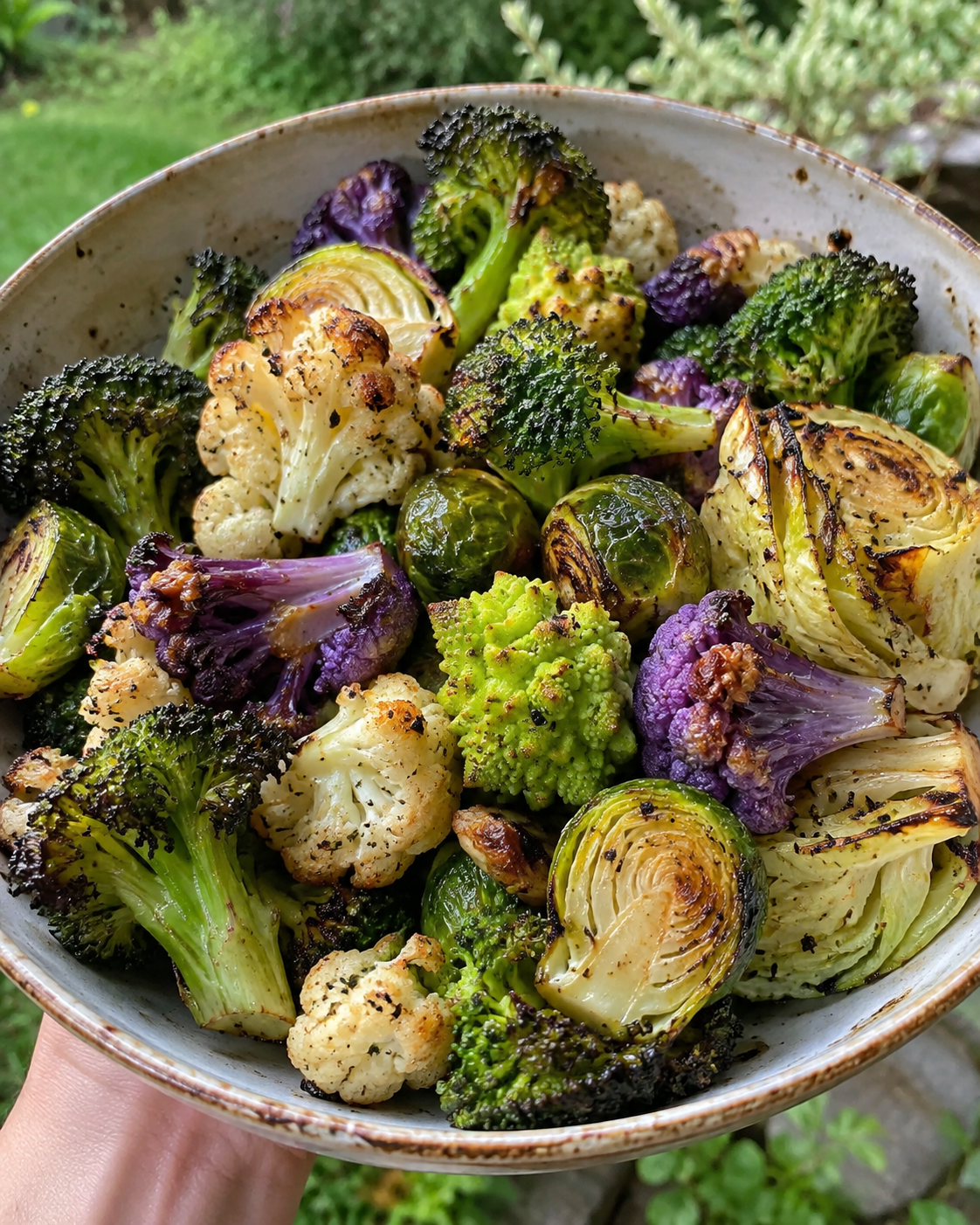
Broccoli, cauliflower, Brussels sprouts, cabbage, and their cousins transform in a hot oven: their edges caramelize, their bitterness mellows into sweetness, and they turn crisp outside and tender within. Here's everything you need to roast any brassica perfectly, plus four finishing sauces to make them sing.
Yield: Serves 4 · Active: 10 min · Total: 20–40 min · Year-round (most brassicas are at their sweetest in North America from fall through spring, after cool nights and frost) · Best eaten: midday or early evening
The Brassica Family
Brassicas (also called cruciferous vegetables) include broccoli, broccolini, cauliflower, romanesco, Brussels sprouts, cabbage, kale, kohlrabi, bok choy, and collards. They're some of the most nourishing vegetables there are, thanks to compounds called glucosinolates. When you chop or chew a brassica, an enzyme called myrosinase turns glucosinolates into isothiocyanates like sulforaphane, which supports your body's own detoxification pathways.
Chop and Wait: The Secret to Getting the Most from Brassicas
High heat destroys myrosinase, which means roasting can reduce how much sulforaphane forms. Two simple tricks help:
Chop and wait. Cut your brassicas 30–40 minutes before roasting. This gives myrosinase time to start converting glucosinolates into sulforaphane, which is more stable once formed.
Add a pinch of mustard. Mustard seeds contain their own myrosinase. Research has shown that sprinkling a little mustard powder over cooked broccoli can boost sulforaphane formation, so a mustard-based sauce or a pinch of mustard powder after roasting puts the enzyme back to work.
The Golden Rules of Roasting
High heat: 425°F is the sweet spot for caramelization.
Dry vegetables: Pat them dry after washing, since moisture makes them steam instead of brown.
Plenty of space: Spread them in a single layer with room between pieces, and use two pans if needed.
Cut sides down: Flat surfaces touching the pan get the deepest browning.
Enough fat: Toss well with olive oil, ghee, or tallow, about 2–3 tbsp per sheet pan.
Salt before roasting, and finish with acid (lemon or vinegar) after.
Roasting Times at 425°F
Broccoli — florets with 2 inches of stem; peel and slice the stems · 18–22 minutes
Broccolini — whole, trimmed · 12–15 minutes
Cauliflower — bite-size florets or ¾-inch "steaks" · 25–30 minutes
Romanesco — bite-size florets · 20–25 minutes
Brussels sprouts — halved, cut-side down · 20–25 minutes
Cabbage — 1½-inch wedges through the core · 30–35 minutes, flipping once
Kohlrabi — peeled, ¾-inch cubes · 25–30 minutes
Bok choy — baby, halved lengthwise · 8–10 minutes
Kale chips — torn leaves, stems removed · 12–18 minutes at 300°F, until crisp
Four Finishing Sauces
Lemon-Garlic Tahini: Whisk ⅓ cup tahini, the juice of 1 lemon, 1 grated garlic clove, and ¼ tsp salt, then whisk in 4–6 tbsp cold water until pourable. Beautiful on cauliflower, broccoli, and cabbage.
Brown Butter-Hazelnut: Brown 4 tbsp grass-fed butter until nutty and golden, then stir in 3 tbsp toasted chopped hazelnuts, a squeeze of lemon, and a pinch of salt. Gorgeous on Brussels sprouts and romanesco.
Mustard Vinaigrette: Whisk 1 tbsp Dijon, 1 tbsp raw apple cider vinegar, 1 tsp raw honey, ¼ cup extra virgin olive oil, and a pinch of salt. The mustard's own myrosinase gives your brassicas a sulforaphane boost. Lovely on broccoli and Brussels sprouts.
Chile-Lime: Whisk 3 tbsp extra virgin olive oil, the zest and juice of 1 lime, ½ tsp Aleppo pepper or chile flakes, 1 grated garlic clove, and a pinch of salt. Bright on broccolini, cauliflower, and cabbage.
Nourishment Notes
All brassicas bring glucosinolates (the precursors to sulforaphane and DIM), vitamin C, vitamin K, folate, and fiber. Broccoli is one of the best food sources of glucosinolates. Cauliflower offers choline. Brussels sprouts bring vitamin C. Cabbage offers vitamin C and, in red cabbage, anthocyanins. Bok choy brings calcium. Kale offers vitamin K and lutein.
For your cycle: Brassicas' glucosinolates support estrogen metabolism through Phase 2 liver detoxification, which makes them supportive in every phase, especially the luteal phase.
Storage
Roasted brassicas keep up to 4 days refrigerated. Reheat at 425°F for 5–8 minutes to recrisp them; the microwave makes them soggy. Sauces keep up to 5 days (tahini, mustard, and chile-lime) or 3 days (brown butter, rewarmed gently).
Sourcing
Brassicas — organic, from a farmers' market, ideally after the first frosts for the sweetest flavor
Tahini — organic when available, 100% sesame; Al Arz, a family business in Nazareth, makes its tahini from Ethiopian Humera sesame
Dijon mustard — organic, with no preservatives or sugar; Delouis Fils or Maison Orphée
Hazelnuts — organic Oregon hazelnuts, or Nocciola Piemonte IGP
Grass-fed butter, ghee, and tallow — organic, cultured butter from 100% grass-fed cows; grass-fed ghee; tallow rendered from grass-fed suet
Raw honey — organic, local, and unfiltered
Raw apple cider vinegar — organic, with the mother (Bragg)
Garlic, lemons, limes, and Aleppo pepper — organic and non-irradiated
Extra virgin olive oil — organic, single-estate, harvest-dated, in dark glass
Baja Gold sea salt
— Anna aka Food Marshall