Roasted Fall Squash, Braised Radishes, and Asparagus with Hazelnut-Herb Sauce
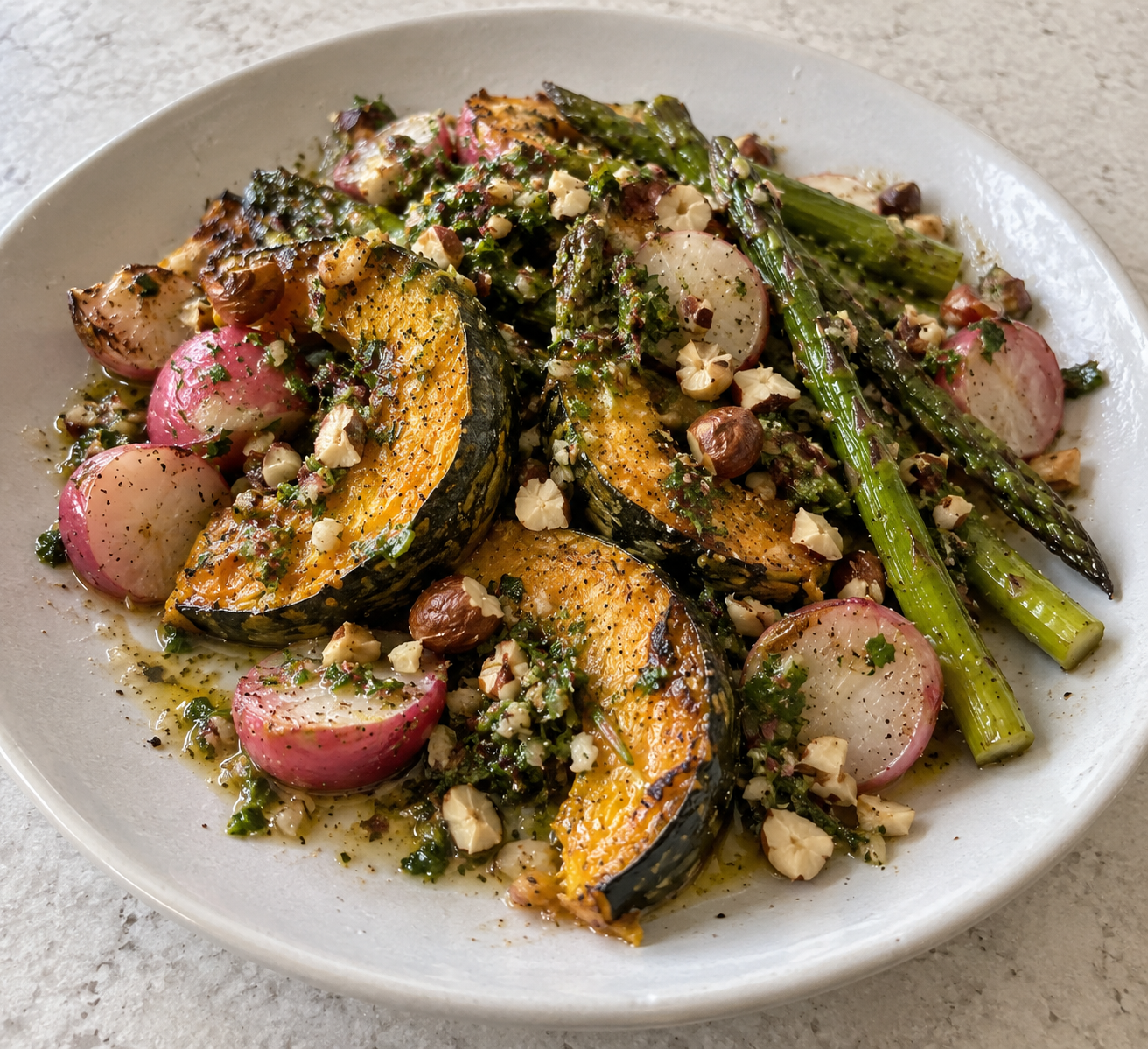
A beautiful cold composed vegetable plate: caramelized wedges of delicata or kabocha squash, butter-braised radishes, and tender roasted asparagus, all cooled and arranged on a platter, then spooned with a bright, loose herb sauce and scattered with toasted hazelnuts and shaved fennel. It's perfect for gatherings, since everything is made ahead.
Yield: Serves 4 as a side, or 2 as a light main · Active: 30 min · Total: 1 hr 15 min (including cooling) · Winter squash is harvested in fall in North America and keeps well into spring, while asparagus is a spring crop; in fall and winter, swap the asparagus for broccolini or green beans · Best eaten: midday or early evening
Complete Menu
Roasted Delicata or Kabocha Squash
Butter-Braised Radishes
Roasted Asparagus (or Broccolini)
Loose Herb Sauce
Toasted Hazelnuts and Shaved Fennel
Your Game Plan
About 1 hr 15 min out (or up to a day ahead): Heat the oven to 425°F. The squash goes in.
About 1 hr out: Braise the radishes.
About 50 min out: The asparagus goes in. Toast the hazelnuts.
About 40 min out: Let everything cool completely.
Just before serving: Make the herb sauce, shave the fennel, and assemble the platter.
Recipe 1 — Roasted Squash Wedges
Ingredients
1 medium delicata or small kabocha squash
2 tbsp extra virgin olive oil
½ tsp Baja Gold sea salt
Method
Cut. Halve the squash, scoop out the seeds, and slice into 1-inch wedges. No need to peel: delicata skin is thin and tender, and kabocha skin softens nicely as it roasts.
Roast. Toss the wedges with the olive oil and salt, spread them on a parchment-lined sheet pan, and roast at 425°F for 25–30 minutes, flipping once, until caramelized but still holding their shape.
Recipe 2 — Butter-Braised Radishes
Ingredients
1 bunch radishes (about 12), trimmed and halved
½ cup chicken or vegetable broth
1 tbsp grass-fed butter or extra virgin olive oil
¼ tsp Baja Gold sea salt
Method
Braise. Put the radishes, broth, butter, and salt in a skillet in a single layer. Bring to a simmer, cover, and cook over medium-low heat 8–10 minutes, until the radishes are just tender.
Glaze. Uncover and simmer 2–3 minutes more, until the liquid reduces to a glossy glaze. Braising mellows the radishes' peppery bite and turns them sweet and tender, with a pretty pink blush.
Recipe 3 — Roasted Asparagus (or Broccolini)
Ingredients
1 bunch asparagus, tough ends snapped off (or 1 bunch broccolini, trimmed)
1 tbsp extra virgin olive oil
Pinch of Baja Gold sea salt
Method
Toss with the olive oil and salt and roast at 425°F for 8–10 minutes (12–15 for broccolini), until just tender and bright green. Pull it while it still has a little snap, since it softens as it cools.
Recipe 4 — Loose Herb Sauce
Keep this one loose and bright, more like a chimichurri than a creamy dressing.
Ingredients
½ cup fresh flat-leaf parsley, finely chopped
2 tbsp fresh dill, finely chopped
2 tbsp fresh chives, finely sliced
1 tbsp fresh mint, finely chopped
Zest of ½ lemon, plus 2 tbsp juice
1 tsp Dijon mustard
⅓ cup extra virgin olive oil
¼ tsp Baja Gold sea salt
Method
Stir everything together in a bowl, or pulse briefly in a food processor, just until combined. Taste and adjust the lemon and salt. Make it shortly before serving so the herbs stay bright green.
To Finish
⅓ cup hazelnuts, toasted and chopped (or roasted chestnuts)
½ small fennel bulb, shaved into thin ribbons with a peeler or mandoline, tossed with a squeeze of lemon and a pinch of salt
Flaky sea salt
Toast the hazelnuts in a dry skillet over medium heat 3–5 minutes, stirring, until fragrant and golden. If they have skins, rub them off in a towel while warm, then chop roughly. Hazelnuts are the top pick here, since their crunch contrasts beautifully with the soft squash and radishes. Roasted chestnuts make a softer, sweeter alternative.
Assembling the Platter
Let the squash, radishes, and asparagus cool completely, then arrange them on a large platter. Serve it chilled or let it come to room temperature first, which brings out the flavors even more. Spoon the herb sauce generously over everything, then scatter with the toasted hazelnuts, shaved fennel ribbons, and a pinch of flaky salt.
Storage
Roasted squash, radishes, and asparagus: Refrigerated up to 4 days, which makes this an easy make-ahead platter
Herb sauce: Refrigerated up to 2 days (the herbs darken over time, so it's brightest fresh)
Toasted hazelnuts: In an airtight jar up to 2 weeks
Assembled platter: Best the day it's made
Support for the Female Infradian Rhythm
This colorful plate supports every phase of your cycle. Winter squash brings beta-carotene and steady, satisfying carbohydrate, especially welcome in the luteal phase. Radishes deliver glucosinolates, which support estrogen metabolism through Phase 2 liver detoxification, and asparagus brings folate and prebiotic fiber. Hazelnuts add vitamin E and magnesium, and fennel has long been used to ease bloating and digestive discomfort.
Nourishment Notes
Delicata and kabocha squash — beta-carotene (fat-soluble, so roasting with olive oil helps you absorb it), potassium, vitamin C, and fiber. The skins add even more fiber.
Radishes — vitamin C and glucosinolates. Braising softens their bite into gentle sweetness.
Asparagus — folate (one of the best food sources), vitamin K, and inulin, a prebiotic fiber that feeds your gut bacteria.
Broccolini (if using) — glucosinolates, vitamin C, and vitamin K.
Fresh herbs (parsley, dill, chives, mint) — vitamin K, chlorophyll, apigenin (parsley), carvone (dill), and menthol (mint), which soothes digestion.
Hazelnuts — vitamin E, manganese, copper, and oleic acid.
Fennel — anethole, vitamin C, and fiber, traditionally used to ease bloating.
Dijon mustard and lemon — glucosinolates, vitamin C, and d-limonene.
Extra virgin olive oil — oleic acid and polyphenols, which help you absorb the meal's fat-soluble nutrients.
Sourcing
Delicata or kabocha squash — organic, heavy for its size, with a matte, unblemished skin
Radishes, asparagus, broccolini, and fennel — organic, from a farmers' market in season
Hazelnuts — organic Oregon hazelnuts, or Nocciola Piemonte IGP from Italy
Chestnuts (optional) — organic, roasted and peeled
Fresh parsley, dill, chives, mint, and lemons — organic
Broth — homemade from pasture-raised bones or organic vegetables, or Bonafide Provisions (organic, sold frozen)
Grass-fed butter — organic, cultured butter from 100% grass-fed cows, or raw butter from a local dairy
Dijon mustard — organic, with no preservatives or sugar; Delouis Fils and Maison Orphée both make organic Dijon from just mustard seeds, vinegar, water, and salt
Extra virgin olive oil — organic, single-estate, harvest-dated within the past year, in dark glass
Salt — Baja Gold sea salt; Maldon or fleur de sel de Guérande for finishing
— Anna aka Food Marshall