Kabocha, Caramelized Onion, and Swiss Chard Tart with Ricotta and a Savory Walnut Crust
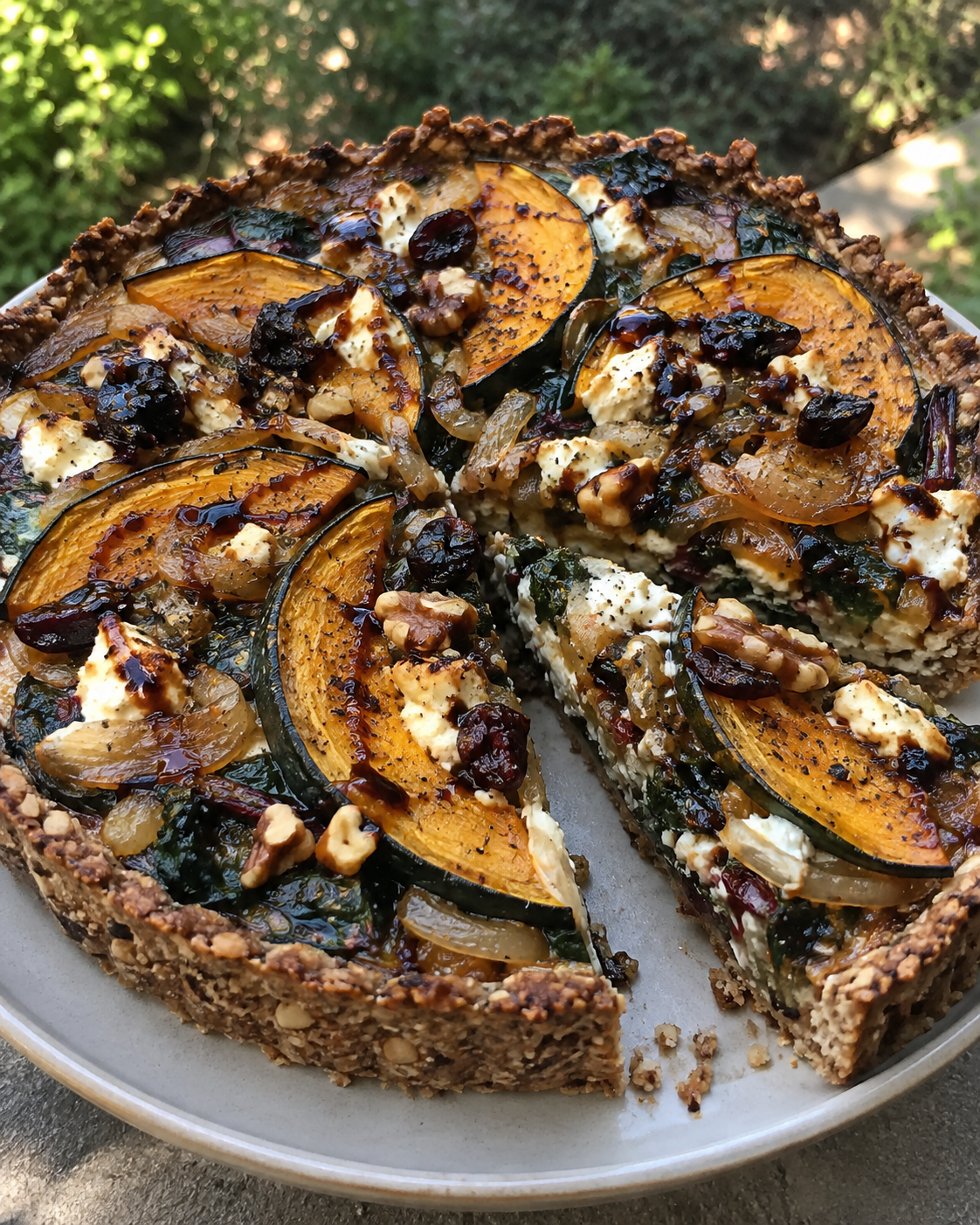
Roasted kabocha squash, slowly caramelized onions, garlicky Swiss chard, and creamy grass-fed ricotta, studded with dried cherries and walnuts, in a savory walnut-and-seed crust, then finished with a drizzle of aged balsamic.
Yield: One 9-inch tart, serves 8 · Active: 1 hr 15 min · Total: 1 hr 45 min · Best in North America in fall, when kabocha squash and chard are harvested · Best eaten: midday or early evening
Ingredients
Savory walnut crust
2 cups walnuts (or a mix of walnuts, pecans, almonds, and cashews)
½ cup sunflower or pumpkin seeds
1 pasture-raised egg, lightly beaten
2 tbsp unfortified nutritional yeast
2 tbsp extra virgin olive oil
½ tsp Baja Gold sea salt
Freshly cracked black pepper
Egg-free option: Use 2 tbsp ground flaxseed mixed with 3 tbsp water, left to sit 5 minutes until gel-like, in place of the egg.
Filling
1 medium kabocha squash (about 2 lb), halved, seeded, and cut into ½-inch wedges (no need to peel)
3½ tbsp extra virgin olive oil, divided
1½ tsp Baja Gold sea salt, divided
2 medium yellow onions (about 1 lb), quartered and thinly sliced
2 large garlic cloves, finely chopped
2 bunches Swiss chard (about 1 lb), stems sliced and leaves roughly chopped
1 cup whole-milk grass-fed ricotta
¼ cup fresh herbs (parsley, sage, thyme, and rosemary), chopped
3–4 tbsp dried tart cherries or golden raisins
¼ cup walnuts, chopped
1 tbsp fresh lemon juice
Freshly cracked black pepper
Aged balsamic vinegar, for drizzling
Method
Roast the squash. Heat the oven to 400°F. Toss the kabocha wedges with 1½ tbsp olive oil and ½ tsp salt, spread them on a parchment-lined sheet pan, and roast 35 minutes, turning halfway, until tender and lightly browned.
Caramelize the onions. Meanwhile, heat 1 tbsp olive oil in a large cast iron or stainless skillet over high heat. Add the onions and ½ tsp salt, and cook 5 minutes. Lower the heat, cover, and cook 30 minutes, stirring occasionally, until deeply golden and jammy.
Cook the chard. Push the onions to the edges of the pan, add the remaining 1 tbsp olive oil, and raise the heat to medium. Cook the garlic 1 minute, then add the chard stems, cover, and cook 3 minutes. Add the chard leaves and the remaining ½ tsp salt, and toss over medium-high heat for about 5 minutes, until wilted and the excess moisture has cooked off.
Finish the filling. Take the pan off the heat, and stir in the ricotta, herbs, dried cherries, walnuts, lemon juice, and pepper.
Make the crust. Pulse the walnuts, seeds, nutritional yeast, salt, and pepper in a food processor to a coarse crumb, then add the egg and olive oil and pulse until the mixture holds together when pressed. Press it firmly into the bottom and up the sides of a 9-inch tart or springform pan.
Pre-bake the crust at 400°F for 10 minutes, until set and lightly golden. This keeps it crisp under the moist filling.
Fill. Set aside 6 or 7 of the prettiest kabocha wedges. Cut the rest into 1-inch pieces and gently fold them into the filling. Spoon the filling into the crust, and arrange the reserved wedges on top.
Bake 25–30 minutes, until heated through and golden at the edges. If the crust browns too quickly, cover the edges loosely with foil.
Serve. Let it cool slightly, then drizzle with aged balsamic.
Storage: Refrigerated up to 4 days. Reheat at 300°F for 10 minutes.
Nourishment Notes
Kabocha squash, sometimes called Japanese pumpkin, is different from the sugar pumpkins and butternut squash of most American fall cooking. Its flesh is denser and drier, with a sweetness closer to chestnut than to pumpkin pie, and its thin skin is edible and holds its shape in a hot oven. That's why it works so well in a baked tart, where it holds its shape even better than butternut. In Japan, kabocha is beloved in simmered dishes (nimono) and tempura.
Slowly caramelizing the onions for 30 minutes is what gives this tart its sweetness. Quickly sautéed onions stay crisp and sharp, while slowly caramelized onions turn deep brown, sweet, and jammy as their natural sugars brown. It's the same technique behind French onion soup and the slow-cooked onion base of countless Mediterranean dishes, and skipping it makes a noticeably flatter tart.
The dried cherries and walnuts nod to Italian agrodolce, the sweet-and-sour pairing of dried fruit with savory and slightly bitter flavors that's a beloved part of fall cooking, used to balance rich, roasted vegetables and meats. The cherries' sweetness also balances the chard's slight bitterness, and the balsamic ties it all together.
Kabocha squash — beta-carotene, vitamin C, potassium, and fiber (especially in the skin).
Swiss chard — vitamin K, magnesium, potassium, and betalains in the colorful stems.
Onions and garlic — quercetin, allicin, and prebiotic fibers.
Grass-fed ricotta — protein, calcium, and vitamins A and K2.
Pasture-raised egg — choline, lutein, and vitamins A, D, E, and K2.
Walnuts — ALA omega-3s and polyphenols.
Sunflower and pumpkin seeds — vitamin E, magnesium, and zinc.
Dried tart cherries — anthocyanins and naturally occurring melatonin.
For your cycle: The chard's magnesium, the seeds' zinc, and the squash's steady carbohydrates make this especially grounding in the luteal phase.
Sourcing
Kabocha squash, Swiss chard, onions, garlic, herbs, and lemons — organic, from a farmers' market in fall
Ricotta — whole-milk ricotta from grass-fed milk, with no gums or stabilizers, or homemade (see my Garden Ribbon Salad for the method)
Eggs — organic and pasture-raised, from a local farm or Alexandre Family Farm
Walnuts, sunflower seeds, and pumpkin seeds — organic and raw, kept in the fridge
Nutritional yeast — unfortified, like Sari Foods
Flaxseed (egg-free option) — organic, ground fresh
Dried tart cherries or golden raisins — organic and unsulfured, sweetened with apple juice rather than sugar (or unsweetened)
Aged balsamic vinegar — Aceto Balsamico di Modena IGP, or aged Tradizionale DOP, made from just grape must
Extra virgin olive oil — organic, single-estate, harvest-dated, in dark glass
Salt — Baja Gold sea salt
— Anna aka Food Marshall