Salmon Cakes with Avocado Cream
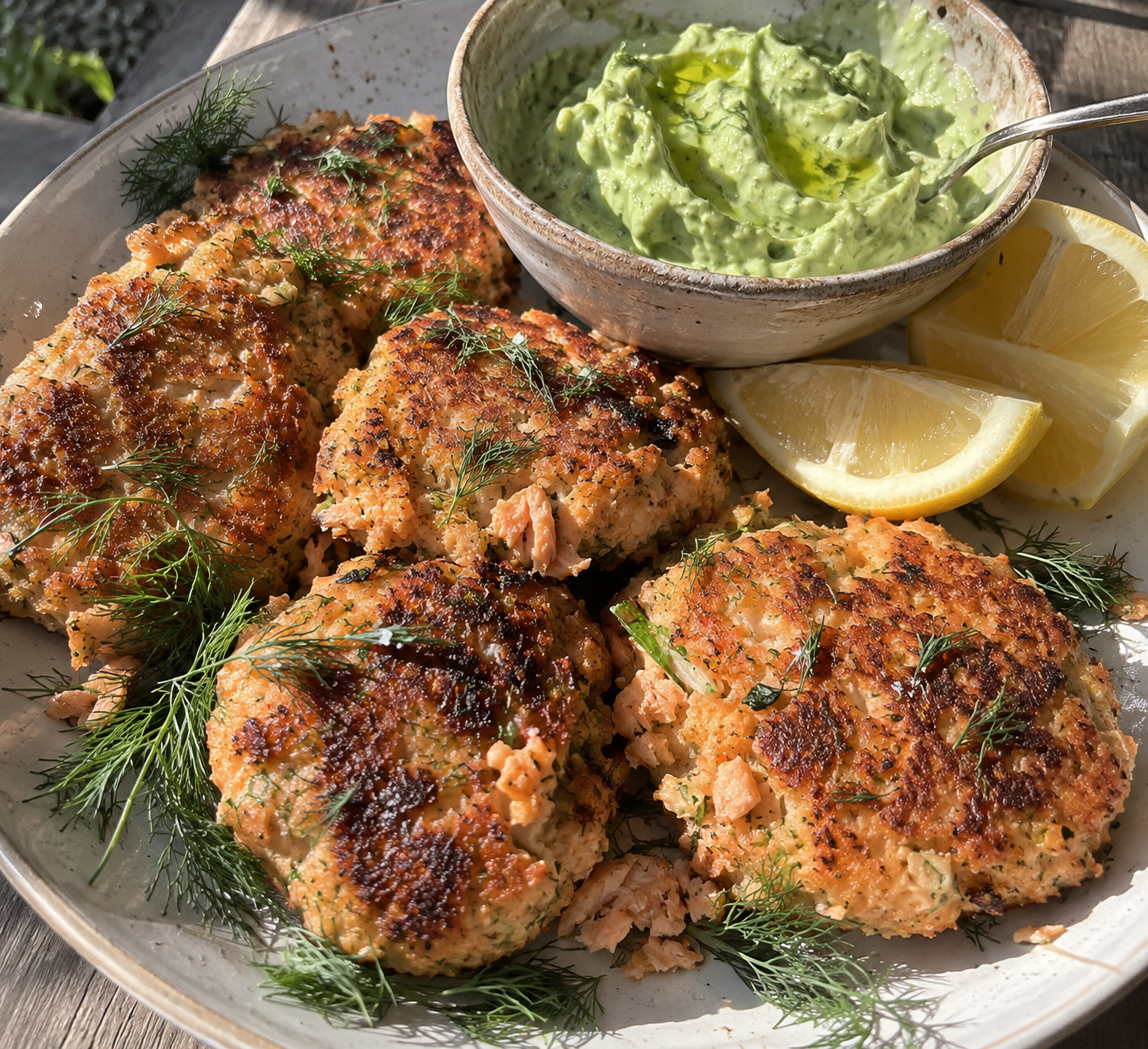
Pan-seared wild salmon cakes with a tangy avocado-kefir sauce
Serves 4 · 30 min active · 45 min total · wild Alaskan salmon is in season May through September; frozen-at-sea or canned wild salmon makes it year-round · early evening
Ingredients
Salmon cakes
1 ½ lb wild-caught salmon fillet (skin removed)
1 tbsp grass-fed butter
½ small red onion, finely diced
1 leek, white and pale green parts only, well rinsed and finely diced
½ red bell pepper, finely diced
¼ cup homemade mayonnaise (or a store-bought mayo made with avocado or olive oil and pasture-raised eggs)
2 tbsp fresh dill, finely chopped
2 tbsp fresh parsley, finely chopped
juice of 1 lemon
1 pasture-raised egg
½ tsp Baja Gold sea salt
¼ tsp freshly ground black pepper
2 tbsp ghee, beef tallow, or pure avocado oil, for searing
Budget swap: Use 2 (6-oz) cans wild salmon, drained, in place of the fresh salmon. Mash the soft bones right in for extra calcium.
Avocado Cream
2 ripe avocados
½ cup raw kefir (or whole-milk yogurt thinned with a splash of water)
2 tsp Dijon mustard
1-2 garlic cloves, peeled
½ tsp smoked paprika
juice of half a lemon
pinch of sea salt and black pepper
To serve
lemon wedges
mixed greens or arugula
extra fresh dill and parsley
Method
Sauté the vegetables. Melt the butter in a skillet over medium heat. Add the red onion, leek, and bell pepper and cook 5–7 minutes, until softened and translucent. Set aside to cool slightly.
Prep the salmon. Cut the salmon into chunks. Pulse about a third of it in a food processor into a smooth paste, then pulse or chop the rest into small ½-inch pieces. The paste binds the cakes together, so there's no need for breadcrumbs.
Make the salmon mixture. In a large bowl, combine the salmon, sautéed vegetables, mayonnaise, dill, parsley, lemon juice, egg, salt, and pepper. Mix gently until just combined.
Shape. With damp hands, form 8 patties about ¾ inch thick.
Chill. Refrigerate the patties 15 minutes before cooking, which helps them hold together.
Make the avocado cream. Blend the avocados, kefir, Dijon, garlic, paprika, lemon juice, salt, and pepper in a food processor until completely smooth. Adjust the seasoning.
Sear the salmon cakes. Preheat the oven to 350°F. Heat the fat in a large oven-safe skillet over medium-high heat. Add the patties and sear 3 minutes per side, until golden, flipping them gently with a thin spatula.
Check doneness. Check the center of one cake. If it reads 140°F, they're done. If not, slide the skillet into the oven for 5-8 minutes, just until they reach 140°F. Don't overbake, or they'll dry out.
Serve over a bed of mixed greens with a generous dollop of avocado cream, lemon wedges, and extra fresh herbs.
Nourishment Notes
Wild-caught salmon is one of the most nutrient-dense proteins on the modern American plate, rich in the omega-3 fatty acids EPA and DHA, vitamin D, selenium, and astaxanthin (the antioxidant pigment that gives wild salmon its deep red-orange color). Farm-raised salmon, by contrast, carries much more omega-6 from its soy- and grain-based feed, gets its color from astaxanthin added to that feed, and has been found in studies to carry higher levels of PCBs and other pollutants than wild salmon. The salmon-cake format here keeps the wild salmon as the star ingredient, with vegetables and herbs as accents rather than fillers. Many commercial "salmon cakes" are mostly breadcrumbs and only nominally salmon.
The avocado cream is a creamy, tangy twist on a classic remoulade, with avocado standing in for most of the mayonnaise. Avocado works because its monounsaturated fat blends into the same creamy, scoopable consistency. The kefir adds the tangy note that makes a great sauce instead of a heavy one, and since it's never heated, raw kefir's live cultures stay intact. Fish with a creamy, herby sauce is a pairing loved everywhere from the Pacific Northwest to Scandinavia.
The leek, red pepper, and onion base is what gives these salmon cakes their depth. Plain salmon-and-egg cakes can taste flat; the sautéed vegetables bring sweetness, savory depth, and moisture that keeps the cakes tender.
Leeks and red onion — prebiotic fibers, quercetin, and organosulfur compounds.
Red bell pepper — vitamin C and beta-carotene.
Avocado — monounsaturated fats, potassium, folate, and fiber.
Raw kefir — live probiotic cultures, calcium, and K2.
Fresh dill and parsley — vitamin K, chlorophyll, and aromatic oils.
Pasture-raised egg — choline, B12, and fat-soluble vitamins.
Lemon — vitamin C and d-limonene.
Storage: Cooked salmon cakes keep refrigerated up to 3 days. Reheat at 300°F for 8 minutes. The avocado cream keeps refrigerated up to 2 days but darkens at the surface; a thin layer of olive oil or a piece of wrap pressed right on top slows browning. Uncooked patties freeze well for up to 3 months; thaw them in the fridge before searing.
Sourcing
Wild salmon — wild Alaskan sockeye or coho, from Vital Choice or a trusted fishmonger. Frozen-at-sea is excellent year-round. For the budget swap, canned wild Alaskan salmon in BPA-free cans (wild seafood can't be certified organic)
Mayonnaise — homemade with pasture-raised egg yolks and extra virgin olive oil or avocado oil is the gold standard. If buying, choose one made with organic, pasture-raised eggs and no seed oils
Cooking fat — organic ghee (Ancient Organics) or grass-fed beef tallow. If using avocado oil, buy organic from a producer that tests for purity; lab tests have found many store-bought avocado oils rancid or mixed with cheaper oils
Leeks, red onion, red bell pepper, and garlic — organic, from a farmers' market
Avocados — organic Hass, ripe (they should yield to gentle pressure)
Raw kefir — from a local dairy; or organic, grass-fed whole-milk yogurt
Pasture-raised eggs — organic, from a local farm where the hens truly range on pasture, or Alexandre Family Farm (Regenerative Organic Certified)
Grass-fed butter — organic, cultured butter from 100% grass-fed cows, or raw butter from a local dairy
Dijon mustard — organic, with no preservatives or sugar. Many Dijons, including classic French brands, add potassium metabisulfite (a sulfite preservative), so check the label. Delouis Fils, in France, and Maison Orphée, in Quebec, both make organic Dijon from just mustard seeds, vinegar, water, and salt (Maison Orphée adds organic spices)
Smoked paprika — organic Pimentón de la Vera DOP
Fresh dill and parsley — organic
Lemons — organic
Mixed greens or arugula — organic
Baja Gold sea salt
Recipe credit: Adapted from Apricot Lane Farms
— Anna aka Food Marshall