Seared Scallops with Sautéed Vegetables, Lemon Parmesan Sauce, and Almond Crumble
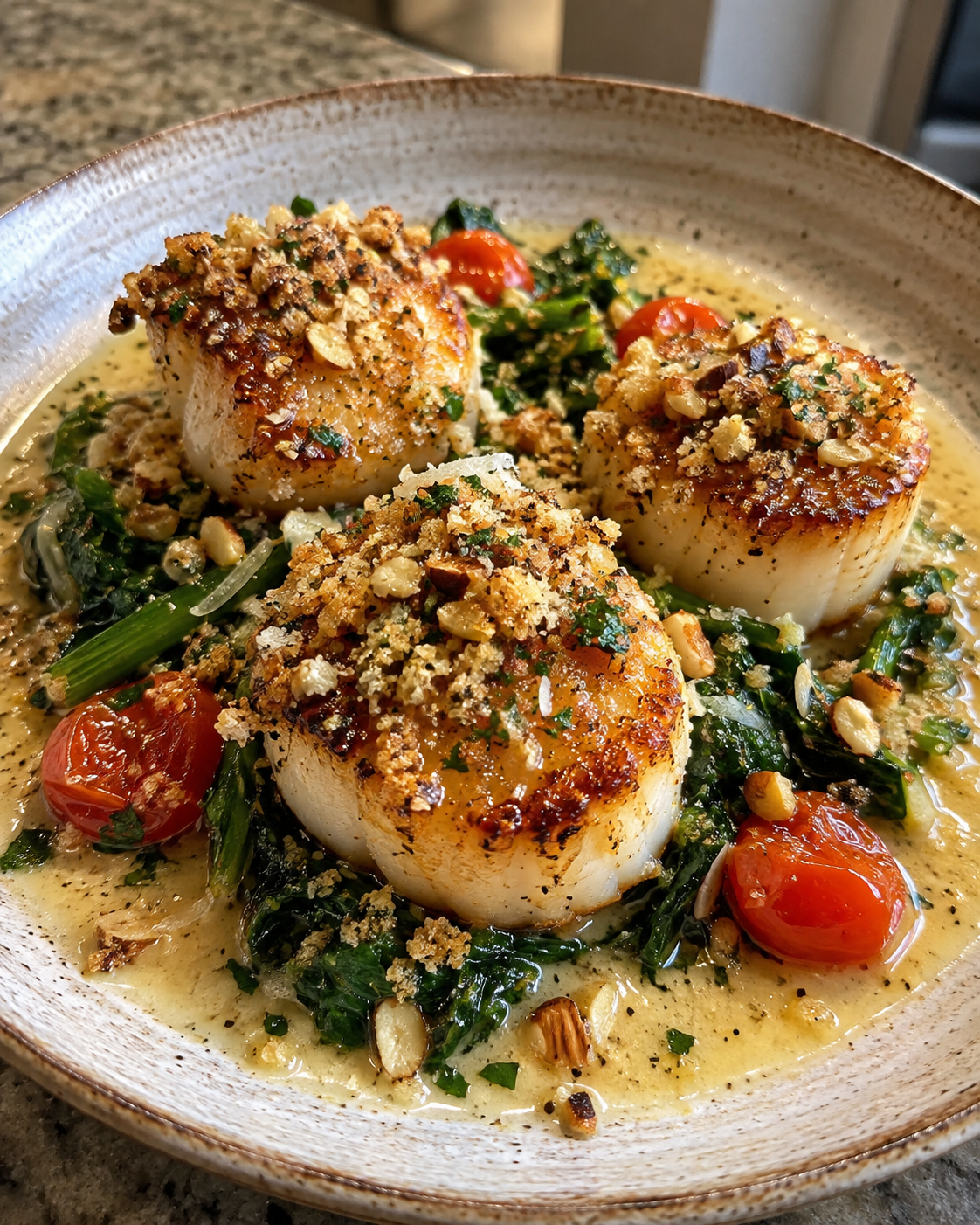
Seared Scallops with Sautéed Vegetables, Lemon Parmesan Sauce, and Almond Crumble
Pan-seared scallops over a bed of garlicky sautéed greens with a creamy lemon-parmesan sauce and a buttery almond crumble
Serves 4 · 30 min active · 45 min total · year-round · early evening
Ingredients
Scallops
12 large hand-dived sea scallops (or large dry-packed scallops, about 1 lb)
1 tsp Baja Gold sea salt
½ tsp freshly ground black pepper
2 tbsp ghee or duck fat (for searing)
1 tbsp grass-fed butter
1 garlic clove, smashed
3 sprigs fresh thyme
juice of half a lemon (for finishing)
Sautéed vegetables (sprouted or gluten-free pasta, zucchini noodles, or sautéed greens)
Option A: With pasta or zucchini noodles
8 oz sprouted whole wheat or sprouted spelt pasta (or, if you avoid gluten, brown rice, cassava, or chickpea pasta) OR 4 zucchini, spiralized
2 tbsp grass-fed butter
3 garlic cloves, sliced
1 small shallot, thinly sliced
1 cup cherry tomatoes, halved
1 cup mushrooms (cremini or shiitake), sliced
1 small bunch lacinato kale, stems removed, chopped
pinch of red pepper flakes
pinch of sea salt and black pepper
Option B: Sautéed greens only
2 large bunches Swiss chard, lacinato kale, or spinach (stems removed, chopped)
2 tbsp grass-fed butter
3 garlic cloves, sliced
1 small shallot, thinly sliced
1 cup cherry tomatoes, halved
pinch of red pepper flakes
pinch of sea salt and black pepper
Lemon parmesan sauce
2 tbsp grass-fed butter
2 garlic cloves, finely grated
½ cup heavy cream (raw if available)
½ cup grated Parmigiano-Reggiano DOP
juice of 1 lemon
zest of half a lemon
pinch of sea salt and white pepper
splash of dry white wine (optional)
Almond crumble
½ cup blanched almond flour
2 tbsp grass-fed butter, melted
2 tbsp grated Parmigiano-Reggiano DOP
1 garlic clove, finely grated
1 tsp fresh thyme leaves
1 tsp lemon zest
pinch of sea salt
Garnish
extra grated Parmigiano-Reggiano
fresh basil or parsley leaves
lemon wedges
microgreens (optional)
Method
Make the almond crumble. Combine all the crumble ingredients in a small bowl and mix until clumpy.
Heat a small dry skillet over medium heat. Add the crumble and toast 4–5 minutes, stirring constantly, until golden and fragrant. Watch closely, because it burns quickly. Set aside.
Prep the scallops. Let them sit out about 15 minutes to take the chill off, and pull off the small, tough side muscle if it's still attached. Pat them very dry with paper towels (essential for a proper sear). Season generously with salt and pepper. Set aside while you prepare the other components.
Make the lemon parmesan sauce. In a small saucepan, melt 2 tbsp butter over medium heat. Add the grated garlic and cook 30 seconds (don't let it brown).
If using wine, add a splash and cook 30 seconds to reduce.
Add the heavy cream. Bring it to a gentle simmer (don't boil) and cook 2–3 minutes until slightly thickened.
Reduce the heat to low. Whisk in the Parmigiano gradually, then add the lemon juice, zest, salt, and white pepper. Cook 1 minute more, until smooth. Keep warm.
Cook the vegetables.
For Option A (pasta or zucchini noodles): Bring a pot of salted water to a boil. Cook the pasta according to package instructions until al dente, then drain. Zucchini noodles don't need precooking. While the pasta cooks, melt 2 tbsp butter in a large skillet over medium heat. Add the garlic, shallot, mushrooms, and red pepper flakes. Cook 4 minutes, until softened. Add the kale and cherry tomatoes. Cook 3 minutes, until the kale wilts and the tomatoes burst slightly. Add the cooked pasta to the skillet and toss to combine. If using zucchini noodles, toss them in for just the last 1-2 minutes so they stay crisp-tender instead of turning watery. Season with salt and pepper. Keep warm.
For Option B (sautéed greens only): Melt 2 tbsp butter in a large skillet over medium heat. Add the garlic and shallot, and cook 1 minute. Add the cherry tomatoes and red pepper flakes; cook 2 minutes. Add the chard or kale, and cook 4–5 minutes until wilted. Season.
Sear the scallops. Heat the ghee in a large heavy skillet (cast iron or stainless) over medium-high heat until very hot but not smoking.
Add the scallops in a single layer, leaving space between them. Don't crowd the pan. Cook 1½ minutes without moving them, until a deep golden crust forms.
Flip the scallops. Add the butter, smashed garlic, and thyme sprigs to the pan. Cook 1 minute more, basting the scallops with the foaming butter. Drizzle with lemon juice. Remove from the heat.
Plate. Spoon a generous amount of vegetables (or pasta) onto each plate.
Drizzle with the lemon parmesan sauce.
Top with 3 scallops per plate.
Sprinkle the toasted almond crumble across the plate.
Garnish with extra Parmigiano, fresh basil or parsley, microgreens, and lemon wedges.
Serve immediately.
Nourishment Notes
Hand-dived scallops are a different thing entirely from commodity dredged scallops. Divers pick mature scallops by hand and leave the young ones to grow, while dredges (heavy metal frames dragged along the seabed) can disturb the seafloor. The flavor is sweeter, the texture firmer, and the price reflects the more careful practice. Farmed scallops are another excellent choice, and among the most sustainable seafood you can buy. For grocery store scallops, look for "dry-packed": these haven't been treated with sodium tripolyphosphate (STP), which causes scallops to absorb water, swell during shipping, and release that water during cooking (preventing a proper sear).
The sear technique for scallops comes down to three things: a dry surface, a hot pan, and no movement. The "dry" part is critical. Wet scallops steam rather than sear, and they end up with a flat, pale exterior. The pan should be hot, just below smoking, and leaving the scallops alone allows the proteins to develop the deep golden crust that defines a properly cooked scallop. The total cooking time is brief: about 1½ minutes on the first side and 1 minute on the second for a thick scallop. The interior should still be slightly translucent in the center when you take it from the heat, since carryover cooking finishes the job during the brief rest.
The almond crumble is inspired by Italian pangrattato (toasted breadcrumbs), an ingredient with deep roots in Sicilian and Southern Italian cooking, where it was once called "poor man's Parmesan." Traditional pangrattato uses stale bread crumbled and toasted in olive oil with garlic and herbs; the gluten-free version here uses almond flour to mimic the same crispy, savory finish. Scattered over the smooth lemon-parmesan sauce, it adds the crunch that keeps every bite interesting.
A creamy lemon, garlic, and Parmesan sauce is an Italian-American seafood favorite. (In Italy itself, cheese and seafood rarely meet, but this pairing earns its place.) Raw or low-temp pasteurized cream brings a rich, complex flavor, and Parmigiano-Reggiano DOP, made from raw milk in a defined region of northern Italy, brings deep umami without any additives. Keeping the simmer gentle and adding the lemon at the end is what makes the sauce silky rather than heavy.
Scallops — lean complete protein, B12, selenium, zinc, magnesium, and some omega-3s.
Swiss chard, kale, and spinach — folate, magnesium, vitamin K, and chlorophyll.
Cherry tomatoes — lycopene and vitamin C. Cooking them with butter makes their lycopene more absorbable.
Mushrooms — B vitamins, selenium, and ergothioneine, an antioxidant found in mushrooms in far higher amounts than in any other food.
Sprouted wheat or spelt pasta — easier to digest than conventional pasta for many people, since sprouting breaks down phytic acid (improving mineral absorption) and partially breaks down gluten. It still contains gluten, so choose a gluten-free pasta if you need to avoid it.
Almond flour — vitamin E, magnesium, and monounsaturated fats.
Parmigiano-Reggiano DOP — concentrated calcium, K2, and complete protein.
Grass-fed butter, ghee, and cream — fat-soluble vitamins A, D, E, and K2, plus butyrate and CLA.
Fresh garlic, shallot, and thyme — allicin, quercetin, and thymol.
Fresh lemon — vitamin C and d-limonene.
Storage: The sauce keeps refrigerated 3 days; reheat it gently. The almond crumble keeps at room temperature 1 week, sealed. Cooked scallops should be eaten the same day, since they don't reheat well.
Sourcing
Scallops — dry-packed (never "wet" or treated with STP). Look for scallops that are ivory to pale peach rather than bright white, without a milky liquid around them. Hand-harvested diver scallops from Maine (in season roughly December through April) are a special treat, and farmed scallops are an excellent, sustainable year-round choice
Ghee — Ancient Organics, or homemade from grass-fed butter
Duck fat (optional) — rendered from pasture-raised ducks
Grass-fed butter — cultured butter from 100% grass-fed cows, or raw butter from a local dairy
Heavy cream — raw cream from a small pasture-raised dairy, or Kalona SuperNatural (grass-fed, low-temp vat-pasteurized, non-homogenized)
Parmigiano-Reggiano DOP — aged 24+ months, made from raw milk by law
Almond flour — organic, finely ground, and fresh (keep it in the fridge). U.S. almonds are pasteurized by law, so the gold standard is blanching and grinding your own from organic, unpasteurized Spanish almonds, like Terrasoul's
Pasta (optional) — organic pasta made from 100% sprouted whole wheat or sprouted spelt, such as Govinda's sprouted spelt pasta (available in Europe). For gluten-free, Jovial organic brown rice or cassava pasta
Dry white wine (optional) — organic and dry, low in added sulfites
Swiss chard, kale, spinach, zucchini, mushrooms, cherry tomatoes, and shallots — organic, from a farmers' market
Fresh thyme, basil, parsley, garlic, and lemons — organic (you're using the lemon zest)
Microgreens (optional) — organic, or grown at home
Baja Gold sea salt; whole black and white peppercorns, ground fresh
— Anna aka Food Marshall