Slow-Braised Grass-Fed Beef Brisket with Golden Beet, Fennel, and Celery Salad
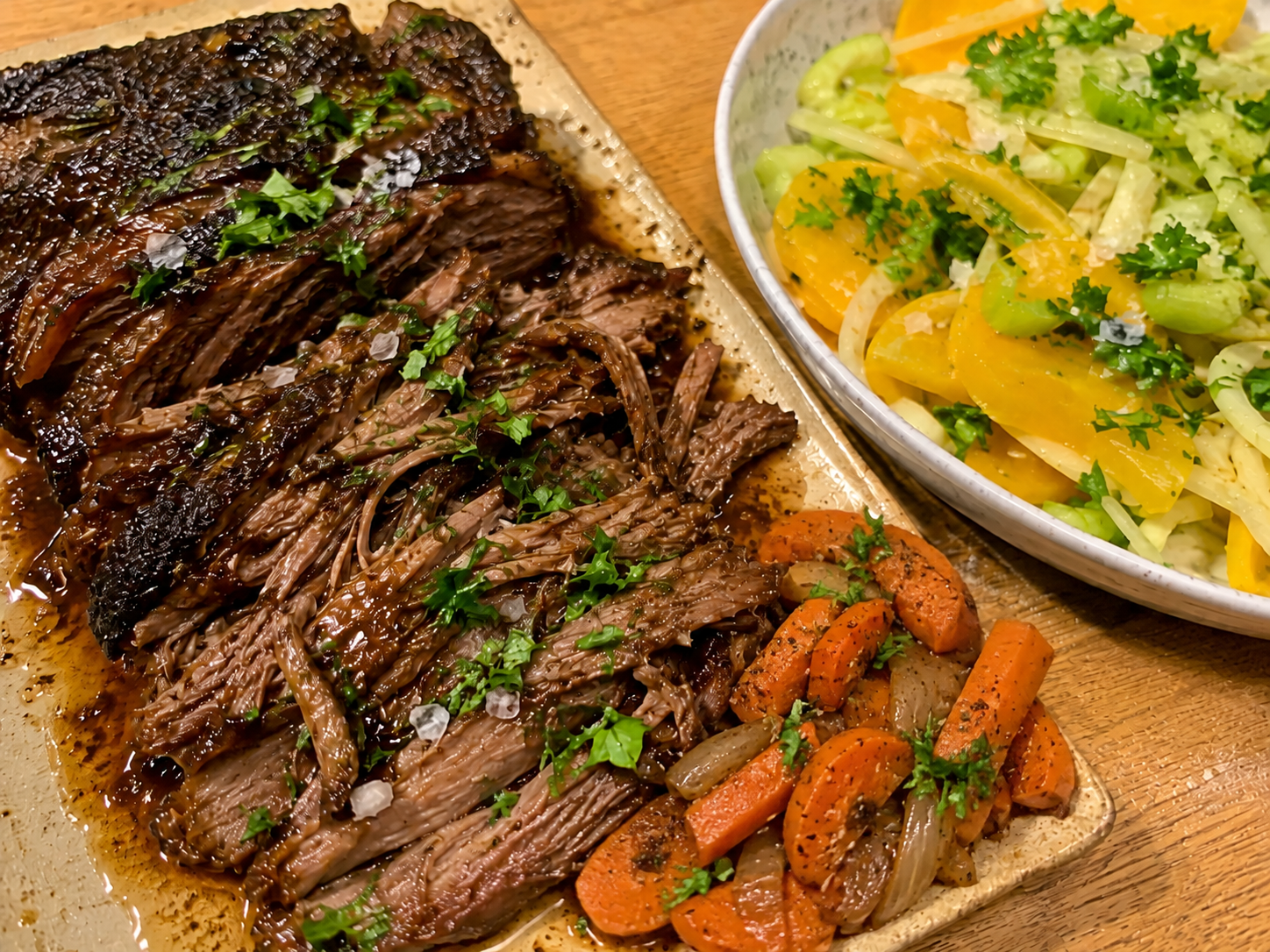
Yield: 6-8 servings · Active: 45 min · Total: 5-6 hr · Autumn through winter · Best eaten: early evening
Recipe 1 — Slow-Braised Grass-Fed Beef Brisket
Yield: 6-8 servings · Active: 25 min · Total: 4½-5 hr (plus optional overnight dry brine)
Ingredients
Brisket
1 grass-fed beef brisket (4-5 lb) — flat cut or point cut; point has more marbling and richer flavor
2 tbsp Baja Gold sea salt (for dry brine, day before)
Spice rub
2 tbsp sweet paprika
1 tbsp pimentón de la Vera (Spanish smoked paprika)
1 tbsp ground cumin
1 tbsp ground coriander
2 tsp ground black pepper
1 tsp ground ginger
1 tsp red pepper flakes (or more for heat)
1 tsp ground allspice
½ tsp ground cinnamon
½ tsp ground cloves
Braising liquid
3 tbsp grass-fed tallow (for searing)
2 large yellow onions, thickly sliced
3 medium carrots, cut into thick chunks
3 celery stalks, cut into thick chunks
8 garlic cloves, smashed
3 tbsp tomato paste (single-ingredient)
2 tbsp Dijon mustard
2 tbsp raw honey
¼ cup raw apple cider vinegar
4 cups beef bone broth (or a mix of beef and chicken)
3 sprigs fresh rosemary
5 sprigs fresh thyme
3 bay leaves
Method
Day before serving:
Dry brine. Pat brisket completely dry. Rub 2 tbsp of sea salt evenly over all surfaces. Place on a wire rack over a sheet pan, uncovered, in the refrigerator for 12-24 hours. Dry-brining meaningfully improves the crust and flavor.
Braising day:
Bring to room temperature. Remove brisket from refrigerator 60 minutes before cooking.
Preheat the oven. Heat to 300°F.
Make the spice rub. In a small bowl, combine sweet paprika, pimentón, cumin, coriander, black pepper, ginger, chili flakes, allspice, cinnamon, and cloves.
Rub the brisket. Pat dry again. Rub the spice mixture generously all over the brisket.
Sear. Heat 3 tbsp grass-fed tallow in a large heavy Dutch oven or roasting pan over medium-high heat. Sear the brisket on all sides until deeply browned, about 4-5 minutes per side. Transfer to a plate.
Build the braising base. In the same pan, add sliced onions, carrot chunks, celery chunks, and smashed garlic. Sauté 6-8 minutes until softened and lightly browned.
Add tomato paste, mustard, honey. Stir in tomato paste, Dijon mustard, and raw honey. Cook 1-2 minutes to caramelize slightly.
Deglaze with vinegar. Pour in raw apple cider vinegar and let it bubble 30 seconds. Add bone broth, rosemary, thyme, and bay leaves.
Return the brisket. Nestle the seared brisket back into the Dutch oven. The liquid should come about halfway up the sides. Bring to a gentle simmer.
Braise covered. Cover tightly (parchment under the lid helps seal). Transfer to the 300°F oven. Braise 4-4½ hours, until the meat is fork-tender and the internal temperature reads 200-205°F.
Rest in the liquid. Turn off the oven. Leave the brisket in the braising liquid for 20-30 minutes with the lid on — this keeps it tender and lets the juices redistribute.
Strain and reduce the liquid. Remove the brisket to a cutting board. Strain the braising liquid into a saucepan (discard the vegetables and herbs, or reserve them as a side). Simmer the liquid over medium heat 15-20 minutes to reduce and concentrate. Taste — adjust with salt, pepper, or a splash of raw ACV for brightness.
Slice or shred. For thick-sliced presentation: slice the brisket against the grain into ½-inch thick slices. For shredded: use two forks to shred into large chunks.
Return to the reduced liquid. Toss the sliced or shredded meat with the reduced braising liquid to coat.
Plate. Transfer to a large warm platter. Spoon extra reduced liquid over the top. Garnish with fresh parsley and flaky sea salt.
Recipe 2 — Golden Beet, Fennel, and Celery Salad with Apple Cider Vinaigrette
Yield: 6-8 servings · Active: 25 min · Total: 1 hr (including beet roasting)
Ingredients
4 medium golden (yellow) beets, scrubbed
1 large fennel bulb, thinly shaved (fronds reserved)
3 celery stalks, thinly sliced on a bias
1 small red onion, thinly sliced
¼ cup fresh flat-leaf parsley, roughly chopped
2 tbsp fresh mint leaves (optional), torn
Apple cider vinaigrette
¼ cup extra virgin olive oil
3 tbsp raw apple cider vinegar
1 tbsp fresh lemon juice
1 tbsp Dijon mustard
1 tsp raw honey
1 small garlic clove, finely grated
½ tsp sea salt
¼ tsp freshly cracked black pepper
To finish
Flaky sea salt
A drizzle of high-quality olive oil
Optional: crumbled sheep's milk feta, toasted hazelnuts, or shaved Parmigiano
Method
Roast the golden beets first (can be done 24 hours ahead):
Preheat the oven to 400°F.
Prep and roast. Scrub the beets. Wrap each in parchment paper (or foil-free options). Place on a sheet pan. Roast 45-60 minutes, until a knife slides into the beet with no resistance. Time varies by beet size.
Cool and peel. Let cool 10-15 minutes. Rub off the skins with paper towels or a kitchen towel (they slip off easily when warm).
Slice or dice. Cut the peeled beets into thin wedges or ½-inch dice. Set aside.
Prep the vegetables:
Shave the fennel. Trim the fennel bulb (reserve fronds for garnish). Shave into paper-thin slices using a mandoline or sharp knife.
Combine. In a large bowl, combine shaved fennel, sliced celery, sliced red onion, roasted beets, and chopped parsley. Add optional mint leaves.
Make the vinaigrette:
Whisk. In a small bowl or jar, whisk together olive oil, ACV, lemon juice, Dijon mustard, honey, grated garlic, salt, and pepper.
Dress and finish:
Dress. Pour vinaigrette over the salad. Toss gently to coat.
Rest briefly. Let sit 5-10 minutes at room temperature — the flavors meld.
Serve. Transfer to a serving platter. Scatter reserved fennel fronds. Optional: crumble sheep's milk feta or scatter toasted hazelnuts on top. Finish with flaky sea salt and a drizzle of high-quality olive oil.
Plating the Complete Meal
Present family-style on a large warm platter or serving board: pile the sliced or shredded brisket in the center, moistened with the reduced braising liquid. Serve the golden beet-fennel-celery salad in a separate bowl at the table (the salad's acid would wilt the other components on the same platter). Garnish everything with fresh parsley and flaky sea salt.
Sourcing
Grass-fed beef brisket — from a local butcher, farmers' market, or shipped grass-fed producer. Point cut has more marbling and richer flavor; flat cut is leaner. Look for deep red color and clean smell
Fresh golden beets — organic, firm bulbs with fresh green tops attached (indicates recent harvest). The tops are excellent sautéed like Swiss chard
Fresh fennel — firm bulb, no browning at the base, fresh green fronds
Fresh celery — organic, crisp stalks. Farmers' market when possible
Red onion, garlic — organic, hardneck garlic
Fresh herbs (parsley, mint, rosemary, thyme) — windowsill pot or farmers' market
Bone broth — homemade or shipped from a producer clearly labeled 100% grass-fed. Gelatinous when cold indicates proper collagen extraction
Tomato paste, Dijon mustard, raw ACV, raw honey — all single-ingredient
Whole and ground spices (organic, non-irradiated, single-origin) — paprika, cumin, coriander, allspice, cinnamon, cloves, chili flakes. Ground fresh from whole seeds for meaningfully brighter flavor and bioactive compound retention
Pimentón de la Vera — Spanish smoked paprika, oak-smoked in Extremadura. Adds authentic smoky depth
Fresh lemon — organic
Sheep's milk feta or Parmigiano-Reggiano (optional) — traditional Bulgarian or Greek sheep feta; 24+ month aged Parm DOP
Toasted hazelnuts (optional) — organic, single-ingredient
Single-estate extra virgin olive oil — for cooking and finishing
Baja Gold sea salt for cooking; fleur de sel or Maldon for finishing
Storage
Cooked brisket in liquid: Refrigerated up to 5 days, sealed. Reheat gently. Freezes up to 3 months
Braising liquid alone: Refrigerated up to 5 days. Excellent base for soups
Golden beet salad (dressed): Refrigerated up to 2 days. Actually improves after several hours as flavors meld
Undressed salad components: Refrigerated up to 3 days. Dress just before serving
Roasted beets alone: Refrigerated up to 5 days in a sealed container
Leftover brisket transformations: Slice cold onto salads with the ACV vinaigrette; shred into butter lettuce cups with fresh parsley for grain-free wraps; add to a simple soup with bone broth and roasted root vegetables; slice cold onto grain-free flatbread with horseradish for open-face sandwiches.
Support for the Female Infradian Rhythm
This Sunday supper is deeply restorative for the menstrual and luteal phases of the female cycle (Days 18-5), when warming, iron-rich, grounding foods are most nourishing. Grass-fed beef brisket delivers exceptional bioavailable heme iron (essential for menstrual iron replenishment), B12, zinc, and complete protein. The bone-in slow-braise adds glycine, proline, and gelatin from collagen breakdown — supporting joint health, skin, and gut lining. Warming spices (allspice, cinnamon, cloves, ginger, cumin, coriander) support circulation during phases when metabolism slows. Golden beets deliver betalains (unique to beets) and nitrates supporting nitric oxide production and healthy blood flow — meaningful during heavier menstrual bleeding. Fennel's anethole supports female cycle balance. Fresh raw apple cider vinegar's acetic acid supports blood-sugar regulation and provides live cultures. Hemp seeds in the greens deliver magnesium for luteal-phase mood support. The whole meal is warm, deeply satisfying, and grounding — real ancestral Sunday supper.
Nourishment Notes
Grass-fed beef brisket — heme iron, B12, zinc, and CLA. Grass-fed beef delivers concentrated heme iron (highly bioavailable — 15-35% more efficient absorption than plant iron), B12, zinc, and conjugated linoleic acid. Point cut brisket specifically has more marbling and higher CLA content. Grass-fed brisket has a fundamentally different fatty acid profile than commodity feedlot beef — meaningfully more omega-3s and lower inflammatory omega-6. The slow braise breaks down collagen into gelatin, glycine, and proline — supporting joint health, skin resilience, gut lining, and sleep quality.
Warming brisket spices — anti-inflammatory aromatic oils and antimicrobial compounds. Allspice's eugenol (traditional across Caribbean cooking); cinnamon's cinnamaldehyde (blood-sugar supportive); cloves' eugenol (antimicrobial); cumin's cuminaldehyde; coriander's linalool; ginger's gingerols; pimentón de la Vera's capsanthin and oak-smoke compounds. Together delivering an exceptional load of bioactive compounds through the long slow braise.
Bone broth (braising liquid) — collagen, glycine, and mineral extraction. Rich concentration of collagen breakdown products, glucosamine, and bioavailable minerals from the bones.
Golden beets — betalains, nitrates, and folate. Golden beets deliver betaxanthins (the yellow pigment in the betalain family, with documented antioxidant effects), dietary nitrates (which support nitric oxide production and healthy blood flow), folate, potassium, and manganese. Beets have been prized across ancestral cultures for blood-supportive properties — particularly meaningful during heavier menstrual bleeding when blood volume is naturally lower.
Fennel — anethole, vitamin C, and digestive support. Anethole delivers estrogen-modulating and digestive-soothing effects. Fennel has been used across Mediterranean traditions as both food and medicine, particularly for female cycle balance.
Celery — apigenin, potassium, and hydration. Celery delivers apigenin (a flavonoid with documented anti-inflammatory and gentle sedative effects), plus exceptional potassium and phthalides that support cardiovascular function.
Raw apple cider vinegar — acetic acid and live cultures. Both in the braise (deglazing) and the salad vinaigrette. Blood-sugar regulation and gentle probiotic support.
Dijon mustard — glucosinolates and pungent aromatics. Whole seed mustard delivers sinigrin (a glucosinolate that converts to isothiocyanates supporting Phase 2 detoxification) and traditional pungent aromatics that stimulate digestion.
Raw honey — trace minerals and antimicrobial enzymes. Used moderately in both the brisket and vinaigrette as a gentle cofactor sweetener.
Optional sheep's milk feta or Parmigiano-Reggiano — concentrated calcium, K2, A2 casein (feta specifically). Adds saltiness and calcium to the salad.
Extra virgin olive oil — oleic acid and polyphenols. Amplifies fat-soluble compound absorption throughout the meal.
— Anna aka Food Marshall