Tabil-Spiced Slow-Roasted Grass-Fed Lamb Shoulder with Roasted Rainbow Carrots and Purple Cabbage Slaw
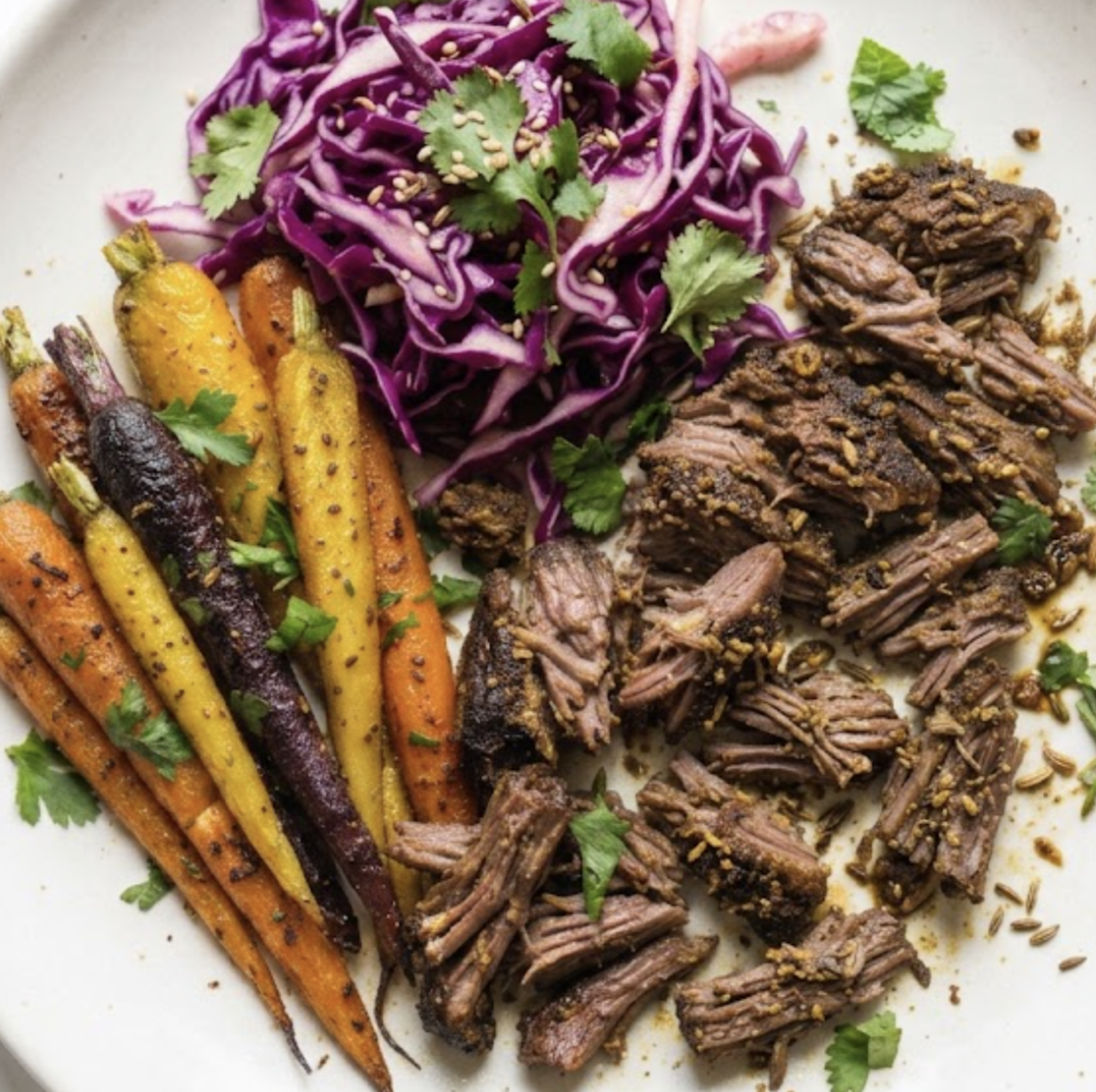
Yield: 6-8 servings · Active: 40 min · Total: 6-7 hr (including yogurt marinade time and slow roasting) · Autumn through winter · Best eaten: early evening
Complete Menu
Tabil-Spiced Slow-Roasted Grass-Fed Lamb Shoulder (with tabil-yogurt sauce)
Roasted Rainbow Carrots with Cumin, Coriander, and Fresh Herbs
Purple Cabbage Slaw with Coconut Aminos, Lime, and Cilantro
Optional accompaniments: butter lettuce cups, extra lemon wedges, fresh mint and cilantro, flaky sea salt.
Recipe 1 — Slow-Roasted Grass-Fed Lamb Shoulder
Yield: 6-8 servings · Active: 25 min · Total: 5-6 hr (plus overnight marinade)
Ingredients
The lamb
1 bone-in grass-fed lamb shoulder (4-5 lb)
2 tbsp Baja Gold sea salt (for the day-before dry brine)
Tabil yogurt marinade
Tabil (pronounced "TAH-beel," meaning "seasoning" in Arabic) is the foundational spice blend of Tunisian cooking. Centered on caraway seeds, coriander, garlic, and chili (sometimes with cumin, cinnamon, or dried mint added), tabil is focused and direct — it lets each spice read clearly on the palate. Caraway is the distinguishing ingredient
1 cup thick whole-milk grass-fed sheep or goat yogurt
6 garlic cloves, peeled
1 small yellow onion, peeled and quartered
3 tbsp extra virgin olive oil
2 tbsp fresh lemon juice
Zest of 1 lemon
2 tsp ground coriander
2 tsp whole caraway seeds
1 tsp ground cumin
1 tsp red chili flakes (Aleppo pepper or harissa flakes work beautifully)
1 tsp sweet paprika (or pimentón de la Vera for smoky depth)
½ tsp ground black pepper
½ tsp ground Ceylon cinnamon (optional but on-brand)
¼ cup fresh mint leaves, packed
¼ cup fresh flat-leaf parsley leaves, packed
1½ tsp sea salt
For roasting
2 tbsp extra virgin olive oil
1 large yellow onion, thickly sliced
6 garlic cloves, lightly smashed
3 sprigs fresh rosemary
4 sprigs fresh thyme
1 whole lemon, halved
2 cups bone broth or filtered water
Tabil-yogurt sauce (for serving)
1 cup thick sheep or goat yogurt
2 tbsp extra virgin olive oil
1 small garlic clove, finely minced
1 tsp fresh lemon juice
½ tsp ground cumin
¼ tsp caraway seeds, toasted and lightly crushed
2 tbsp fresh mint, finely chopped
2 tbsp fresh parsley, finely chopped
Pinch of sea salt
Optional drizzle of raw honey
Method
Day before serving:
Salt the lamb. Pat the lamb shoulder completely dry with paper towels. Rub 2 tbsp of Baja Gold sea salt evenly over the surface. Place on a wire rack over a sheet pan, uncovered, in the refrigerator for 12-24 hours. Dry-brining draws moisture out and produces a meaningfully better crust when roasting.
Make the tabil marinade. In a food processor or high-speed blender, combine the yogurt, garlic cloves, quartered onion, olive oil, lemon juice, lemon zest, ground coriander, whole caraway seeds, ground cumin, chili flakes, paprika, black pepper, optional cinnamon, mint leaves, parsley leaves, and salt. Process until smooth, thick, and deeply green-flecked.
Marinate the lamb. After the dry-brine period, remove the lamb from the refrigerator. Spread the tabil-yogurt marinade generously all over the shoulder, working it into any creases and folds. Cover with parchment or place in a large glass container. Refrigerate at least 4 hours (12-24 hours is ideal — the yogurt tenderizes the meat and the spices penetrate).
Roasting day:
Bring to room temperature. Remove the lamb from the refrigerator 60-90 minutes before roasting.
Preheat the oven. Heat to 300°F.
Set up the roasting pan. Place the thickly sliced yellow onion in the bottom of a heavy roasting pan or Dutch oven. Add the smashed garlic cloves, rosemary sprigs, thyme sprigs, and halved lemon (squeeze the lemon over first, then drop in the halves). Drizzle with 2 tbsp olive oil (or grass-fed tallow or ghee).
Add the lamb. Place the marinated lamb shoulder on top of the onion bed. Pour the 2 cups of bone broth or water around the shoulder (not over the top — you don't want to wash off the marinade).
Roast covered. Cover the pan tightly with parchment paper (crumpled and pressed down) then a heavy lid. Roast at 300°F for 3½-4 hours. Don't lift the lid during this time.
Uncover and brown. After 3½-4 hours, uncover the lamb. Increase the oven temperature to 425°F. Roast an additional 25-35 minutes, uncovered, until the top is deeply golden brown and slightly crispy. Baste once or twice with the pan juices.
Check for doneness. The lamb is ready when the meat pulls away from the bone with almost no resistance and reads 195-200°F internal at the thickest part. For a shoulder cut, this higher temperature is where the collagen breakdown happens for fall-off-the-bone texture.
Rest. Transfer the lamb to a warm serving platter or cutting board. Tent loosely with parchment. Rest 20-25 minutes.
Make the tabil-yogurt sauce during resting. In a small bowl, combine the yogurt, olive oil, minced garlic, lemon juice, ground cumin, toasted crushed caraway seeds, chopped mint, chopped parsley, salt, and optional honey. Whisk until smooth. Refrigerate until ready to serve.
Shred and plate. Use two forks to shred the lamb into large chunks, discarding the largest pieces of fat and any bone. Return the shredded meat to the roasting pan and toss with the pan juices — this coats every piece of meat with the concentrated tabil-flavored liquid. Season with additional flaky sea salt as needed.
Serve. Transfer the tabil-lamb mixture to a large warm platter. Garnish with additional fresh mint, fresh parsley, and a squeeze of fresh lemon juice. Serve immediately with the tabil-yogurt sauce alongside.
Recipe 2 — Roasted Rainbow Carrots with Cumin, Coriander, and Fresh Herbs
Yield: 6-8 servings · Active: 10 min · Total: 40 min
Ingredients
2 lb rainbow carrots (purple, orange, yellow, red — mixed varieties)
3 tbsp extra virgin olive oil
1 tsp ground cumin
1 tsp ground coriander
¼ tsp ground turmeric
½ tsp Baja Gold sea salt
¼ tsp freshly cracked black pepper
Pinch of chili flakes (optional)
3 garlic cloves, thinly sliced
Zest of ½ lemon
2 tbsp fresh flat-leaf parsley, finely chopped
2 tbsp fresh cilantro, finely chopped
1 tbsp fresh mint, finely chopped
Fresh lemon wedge for serving
Flaky sea salt for finishing
Method
Prep the carrots. If large (thicker than ¾ inch), halve or quarter lengthwise so all pieces are roughly the same thickness. Smaller carrots can be left whole. Rinse and pat dry.
Preheat the oven to 425°F. Line a large sheet pan with parchment.
Toss with spices. In a large bowl, toss the carrots with olive oil, ground cumin, ground coriander, ground turmeric, sea salt, black pepper, optional chili flakes, and sliced garlic. Coat every carrot.
Roast. Spread on the parchment-lined sheet pan in a single layer. Roast 30-35 minutes, turning once, until tender when pierced with a fork and deeply caramelized at the edges.
Finish with herbs and lemon. Sprinkle with lemon zest, chopped parsley, cilantro, and mint. Squeeze fresh lemon juice over. Finish with flaky sea salt.
Serve immediately.
Recipe 3 — Purple Cabbage Slaw with Coconut Aminos, Lime, and Cilantro
Yield: 6-8 servings · Active: 10 min · Total: 15 min
Ingredients
1 small purple cabbage, thinly shredded (about 4-5 cups)
4-5 scallions, thinly sliced (whites and greens)
½ cup fresh cilantro, finely chopped
3 tbsp extra virgin olive oil
2 tbsp raw rice vinegar (unseasoned)
2 tbsp coconut aminos
1 tbsp fresh lime juice
Zest of ½ lime
½ tsp Baja Gold sea salt
¼ tsp freshly cracked black pepper
Optional: 1 tsp raw honey (to balance the acid)
Optional: 1 tsp toasted sesame oil (for depth)
Method
Shred the cabbage. Using a sharp knife or mandoline, thinly shred the purple cabbage into fine ribbons. Transfer to a large bowl.
Add the aromatics. Add sliced scallions and chopped cilantro.
Whisk the dressing. In a small bowl, whisk together olive oil, rice vinegar, coconut aminos, lime juice, lime zest, sea salt, black pepper, and optional honey and sesame oil. Taste and adjust.
Toss. Pour the dressing over the cabbage mixture. Toss until every strand is coated.
Rest briefly. Let sit 5-10 minutes at room temperature before serving. Don't let it sit too long — you want the cabbage to retain its crunch.
Serve at room temperature or slightly chilled.
Plating the Complete Meal
Present the whole feast on a large platter or serving board for a family-style presentation. Pile the shredded tabil-lamb in the center of a large warm platter, moistened with the reduced pan juices. Arrange the roasted rainbow carrots alongside, showing off the color variety. Serve the purple cabbage slaw in a separate ceramic bowl (not directly on the platter — the acid would wilt the other components). Scatter fresh cilantro and mint leaves across the platter. Add lemon wedges. Serve the tabil-yogurt sauce in a small ceramic dish for drizzling; grain-free flatbread or butter lettuce cups for those who want to eat with their hands. Everyone builds their own plate with lamb + carrots + slaw + yogurt sauce.
Variations for the Whole Meal
With cauliflower rice base: Serve everything over cauliflower rice or cauliflower couscous for a more substantial bowl format
With crumbled feta or Parmigiano-Reggiano: Add crumbled Bulgarian sheep's milk feta over the shredded lamb for salty umami depth
With ground beef or other grass-fed/pasture-raised meat: The tabil marinade works beautifully on bone-in grass-fed beef chuck roast, pasture-raised pork shoulder, or a whole pasture-raised chicken (adjust cooking times)
Sourcing (essential picks)
Grass-fed lamb shoulder — heritage-breed (Icelandic, Katahdin, Dorper, or Welsh Mountain) when possible. Look for a farmers' market, local pasture-raised producer, or a shipped source clearly labeled 100% grass-fed. Bright red color, not pale pink. Clean smell, not gamy.
Thick sheep or goat yogurt — traditionally strained, live cultures, no added stabilizers. Sheep and goat yogurt deliver A2 casein, easier to digest than A1 cow dairy
Whole and ground spices (caraway, coriander, cumin, cinnamon, Aleppo pepper or harissa flakes, pimentón de la Vera if used) — always choose organic, non-irradiated, single-origin whole spices when possible. Ground fresh from whole seeds for meaningfully brighter flavor and bioactive compound retention. Look for suppliers who harvest-date their products and source directly from farmers. Caraway is the distinguishing tabil spice — European or Middle Eastern-sourced caraway carries more concentrated character than commodity supermarket versions.
Rainbow carrots — from a farmers' market. Heirloom varieties carry distinct flavor profiles. Bunched with tops attached indicates recent harvest
Purple cabbage — firm, dense, vibrant. Farmers' market or organic produce section
Fresh herbs (mint, parsley, cilantro) — windowsill pot or farmers' market. Fresh is essential
Fresh lemons and limes — organic when using zest
Bone broth — homemade is best; look for shipped options clearly labeled 100% grass-fed and gelatinous when cold
Fresh garlic — hardneck varieties from a farmers' market for more complex flavor
Coconut aminos — single-ingredient (fermented coconut sap and sea salt), no soy, no additives
Raw rice vinegar — single-ingredient (rice, no added sugar or MSG)
Toasted sesame oil (optional) — cold-pressed, single-ingredient, in a dark glass bottle
Single-estate extra virgin olive oil — Tunisian or North African is authentic to tabil cooking; Portuguese, Italian, or Spanish single-origin also excellent. Harvest-dated within the last 12 months, in a dark glass bottle
Baja Gold sea salt for cooking; fleur de sel or Maldon for finishing
Storage
Cooked shredded lamb: Refrigerated up to 4 days, sealed with pan juices. Reheat gently in a covered skillet with a splash of bone broth. Freezes up to 3 months
Roasted carrots: Refrigerated up to 4 days. Reheat at 400°F for 5-7 minutes to recrisp, or serve at room temperature
Purple cabbage slaw: Best eaten within 4-6 hours of dressing. Undressed shredded cabbage keeps 3 days
Tabil-yogurt sauce: Refrigerated up to 5 days
Leftover lamb transformations: Over cauliflower rice with yogurt sauce for lunch bowls; into butter lettuce cups with cilantro and lime for grain-free tacos; scrambled with pastured eggs and fresh herbs for Middle Eastern breakfast; added to a simple soup with bone broth and roasted vegetables; cold over greens as a leftover salad.
Support for the Female Infradian Rhythm
This meal is particularly restorative for the menstrual and luteal phases (Days 18-5). Grass-fed lamb delivers exceptional bioavailable heme iron (about 2.7mg per 3.5 oz serving), essential for iron replenishment during menstruation. Warming tabil spices (cumin, coriander, caraway, cinnamon) support circulation and digestion during a phase when many women feel colder and slower. Turmeric's curcumin (activated by black pepper's piperine for up to 2000% better absorption) is a documented anti-inflammatory that can help ease menstrual cramping. Rainbow carrots deliver about 950mg of potassium across a serving — essential for fluid balance and cramp relief. Purple cabbage delivers anthocyanins with anti-inflammatory support and sulforaphane for estrogen metabolism during follicular phase. Warm, cooked, grounding foods overall fit the menstrual-phase preference for nourishment that soothes.
Nourishment Notes
Grass-fed lamb — complete protein, heme iron, B12, and CLA. Grass-fed pasture-raised lamb delivers concentrated complete protein, vitamin B12 (essential for nerve and cognitive function), heme iron (15-35% more bioavailable than plant iron), zinc, selenium, and conjugated linoleic acid. Lamb also has a distinctive fatty acid profile — higher omega-3 content than beef, with the branched-chain fatty acids characteristic of ruminant animals raised on pasture.
Sheep or goat yogurt marinade — probiotic cultures, A2 casein, enzymatic tenderizing. Traditional sheep or goat yogurt delivers live probiotic cultures (Lactobacillus, Bifidobacterium), easily digestible protein, calcium, phosphorus, and vitamins A, D, K2. Sheep's and goat's milk contain only A2 beta-casein — not the A1 variant that can trigger inflammatory responses. The lactic acid in yogurt also tenderizes the lamb at a cellular level.
Warming tabil spices — anti-inflammatory aromatic oils. Caraway delivers carvone (digestive support); coriander delivers linalool and pinene; cumin delivers cuminaldehyde and thymoquinone; chili delivers capsaicin; cinnamon delivers cinnamaldehyde (blood-sugar supportive). Black pepper's piperine amplifies the absorption of turmeric's curcumin. Traditional Mediterranean and North African cooking has used these as both flavor and medicine for thousands of years.
Rainbow carrots — full-spectrum carotenoids. Purple carrots concentrate anthocyanins; orange carrots deliver beta-carotene; yellow carrots deliver lutein; red carrots deliver lycopene. Eating a rainbow captures all four pigment families. Roasting caramelizes natural sugars and develops Maillard-reaction flavor compounds while preserving carotenoids (fat-soluble, better absorbed with olive oil).
Purple cabbage — anthocyanins, sulforaphane, vitamin K. Anthocyanins (same pigments as in blueberries) support antioxidant and anti-inflammatory status. Sulforaphane supports estrogen metabolism through Phase 2 liver detoxification. Vitamin K supports calcium metabolism.
Coconut aminos — subtle umami with lower glycemic impact than soy sauce. Fermented coconut sap and sea salt — no soy, no additives.
Fresh herbs (cilantro, mint, parsley) — vitamin K, chlorophyll, detoxification support. Cilantro binds heavy metals; parsley delivers exceptional vitamin K; mint delivers menthol.
Extra virgin olive oil — oleic acid and polyphenols. Amplifies absorption of fat-soluble compounds throughout the meal.
Lime and lemon — d-limonene, vitamin C. Support liver detoxification.
Bone broth (roasting liquid) — collagen, glycine, mineral extraction. Enriches pan juices with concentrated collagen, glycine, proline, glucosamine, and bioavailable minerals from the bones.
— Anna aka Food Marshall