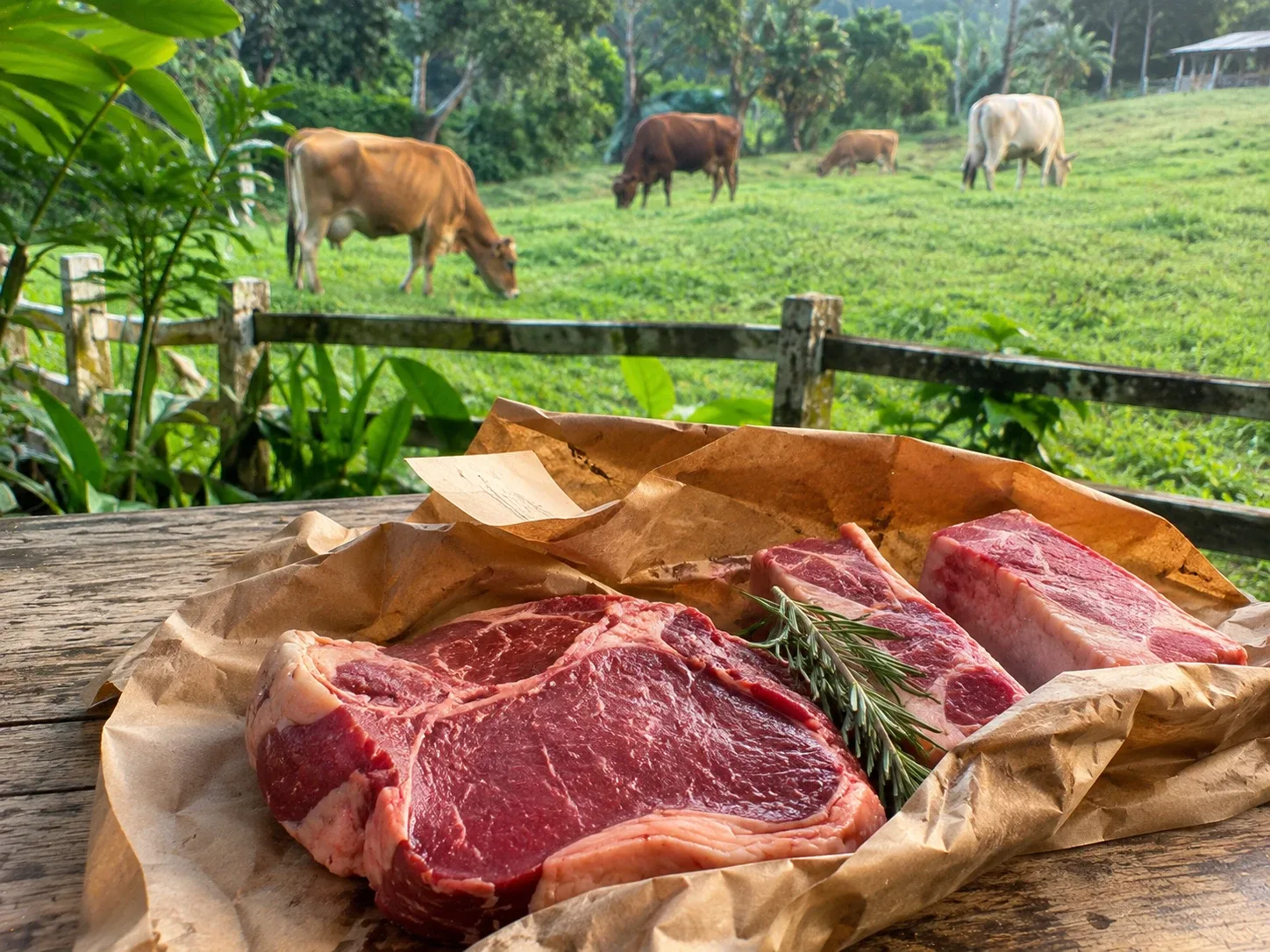
We Are What Our Meat Eats: How to Read Meat Labels and Source the Best
Every steak, chicken thigh, and pork chop carries the story of how that animal lived. Once you can read that story on a label, and find the farmer behind it, you can bring home meat that feeds you as deeply as nature intended.
TL;DR
- An animal’s diet and life end up in your meat. Grass, pasture, sunlight, and movement make it more nourishing.
- Best: local, regenerative, grass-fed and grass-finished beef and lamb; pasture-raised chicken and pork.
- Good: certified organic. Avoid: grain-fed, feedlot (CAFO) meat.
- Trust third-party seals like Animal Welfare Approved, American Grassfed, Certified Humane “Pasture Raised,” Global Animal Partnership Step 4 and up, and Regenerative Organic over vague words like “natural.”
- “No hormones added” on chicken or pork means nothing. Hormones are already banned for them.
- Eat the whole animal (fat, bones, and organs), and buy in bulk from a farmer you know to fill your freezer.
Three Questions That Decide What Lands on Your Plate
We are what we eat, and we are also what our meat eats. An animal’s muscle, fat, and organs are built from the grass, bugs, grain, or feed pellets it ate, the sun it stood in (or never saw), and the way it was handled at the end of its life. When we eat that animal, we take all of it in with every bite.
So when I stand at a meat counter, or talk with a rancher at the farmers market, I’m asking three things.
- How was the animal raised? Did it live outside on pasture, moving, grazing, and soaking up sunlight? Or was it packed into a barn or a dirt feedlot for months?
- What did the animal eat? Grass and forage for cattle, sheep, and goats? Bugs, greens, and scraps alongside grain for chickens and pigs? Or a steady ration of corn, soy, and processing byproducts?
- How was the animal processed? Is this a whole cut with nothing added? Or has it been injected, flavored, cured with additives, or bulked up with fillers?
Most labels answer only part of one question. Some answer none of them while sounding like they answer all three. The rest of this post will help you tell the difference.
Best, Good, and What to Leave on the Shelf
This covers fresh or frozen beef, poultry, lamb, veal, goat, pork, venison and other game, and organ meats.
| What It Looks Like | Why It Matters | |
|---|---|---|
| BEST | Locally sourced from a regenerative, sustainable farm. Cattle, sheep, and goats graze on grass their entire lives (grass-fed and grass-finished). Animals live outdoors in sunlight. Chickens and pigs forage on pasture, with soy-free and non-GMO feed when they need extra. Nothing added to the meat, including “natural flavorings.” | The animal ate what its body was designed for, lived the way it was meant to live, and its fat carries the nutrients of that life. You can ask the farmer anything. |
| GOOD | Certified organic. Grass-fed beef that may not be third-party verified. “Naturally raised” or humane-certified meat from a grocery store. | A real step up from conventional. Organic rules out antibiotics, added hormones, and GMO feed. A plain “grass-fed” claim on beef, on its own, does not rule out antibiotics or hormone implants. |
| NOT IDEAL / AVOID | Grain-fed (a diet of corn, soy, and other byproducts). Raised in CAFOs (concentrated animal feeding operations) and industrial farms. Given hormones (beef), ractopamine, or routine antibiotics. Processed meats with MSG, “flavorings,” and additives. | These animals live without sunlight, pasture, or room to move, and their fat reflects a feedlot diet. Your body pays for those shortcuts. |
A CAFO is a large industrial livestock operation. The U.S. Environmental Protection Agency defines an animal feeding operation as a place where animals are confined and fed for at least 45 days a year, on ground where no grass or crops grow (U.S. Environmental Protection Agency [EPA], n.d.). The “concentrated” version is simply a big one. If you picture a crowded dirt lot or a windowless barn, you’ve got it.
Federal law already bans hormones in chickens, turkeys, and pigs, so the hormone caveat in the GOOD tier is about beef (and lamb). The U.S. Food and Drug Administration has approved steroid hormone implants to speed growth in beef cattle and sheep, and none for pigs or poultry (U.S. Food and Drug Administration [FDA], n.d.). A “grass-fed” claim describes diet only. It doesn’t promise the animal was never given antibiotics or a hormone implant, and it doesn’t promise the animal never saw a feedlot (ASPCA, n.d.). Organic closes the antibiotic and hormone gap, since organic livestock must be raised without antibiotics and without added growth hormones (USDA Agricultural Marketing Service [AMS], n.d.-a). Organic beef can still spend its last months eating organic grain, though, because finishing cattle are exempt from the pasture-feeding minimum for the final fifth of their lives or 120 days, whichever is shorter (AMS, n.d.-a; AMS, n.d.-c). The very best grass-fed beef carries both promises, through a third-party certification like American Grassfed or a farmer you know.
Decoding the Label So You Never Pay for an Empty Promise
Here is what each claim and certification means right now, as of late 2026. I’ve marked how much weight I give each one.
| Label or Seal | What It Actually Means | How Much to Trust It |
|---|---|---|
| Grass-fed | A diet claim. Under U.S. Department of Agriculture label guidance, an unqualified “grass-fed” claim is supposed to mean a 100% grass and forage diet with pasture access, backed by the producer’s own signed paperwork. Lesser claims like “80% grass-fed” can also be approved. | Medium. Diet only, self-reported, and it says nothing about antibiotics or hormones. |
| Grass-finished / 100% grass-fed | The animal ate grass and forage all the way to the end, with no grain “finishing” period to fatten it up quickly. | Higher, especially with a third-party seal. |
| Pasture-raised (meat) | No federal definition for meat. The producer describes its practices and the USDA approves the wording. | Depends entirely on who is behind it. Look for a certification or ask the farmer. |
| Free-range (poultry) | The bird had “access to the outdoors.” The size and quality of that outdoor space aren’t regulated. | Low on its own. That outdoor space can be small and bare. |
| USDA Organic | 100% organic feed, no GMOs, no antibiotics, no added growth hormones. Cattle, sheep, and goats must graze pasture for the whole grazing season (at least 120 days a year) and get at least 30% of their food from it during that time, though cattle may be grain-finished on organic feed at the end (for up to 120 days, or one-fifth of their life if that’s shorter). Newer organic poultry rules require real outdoor space with soil and plants, but farms certified before 2025 have until 2029 to comply. | Good and legally enforced. Welfare and outdoor quality still vary by farm. |
| Natural | No artificial ingredients or added color, and only minimally processed. It says nothing about how the animal was raised. | Very low. Nearly all fresh meat qualifies. |
| No hormones added | On chicken, turkey, or pork, this is meaningless, because hormones are already illegal for them. The label must even say “Federal regulations prohibit the use of hormones.” On beef, it can mean something, if documented. | Zero for poultry and pork. Useful for beef. |
| No Antibiotics Ever / Raised Without Antibiotics | The producer says the animal never received antibiotics. A federal study found antibiotic residues in about 1 in 5 samples from this market, so the agency now urges testing or third-party certification. | Medium. Stronger with a certifier’s seal on the package. |
| Nitrate-free / Uncured | Cured without synthetic sodium nitrite, but almost always cured with celery powder or celery juice, which are natural sources of nitrate. The fine print usually reads “except those naturally occurring in celery powder.” The USDA said in 2020 it planned to ban “uncured” and “no nitrate or nitrite added” on celery-cured meats, but as of late 2026 that rule still hasn’t been proposed. | Better than synthetic additives, and still a cured product. Read the ingredient list. |
| Heritage breed | No legal definition. The Livestock Conservancy defines a heritage chicken as a recognized traditional breed that mates naturally, lives long outdoors, and grows slowly (16 weeks or more to market weight). | A good sign of slower-growing, hardier animals. Ask which breed. |
| Product of USA | Since January 1, 2026, this voluntary claim requires the animal to be born, raised, slaughtered, and processed in the United States. | Tells you origin, not farming practice. |
| Animal Welfare Approved (A Greener World) | Continuous pasture or range access for every animal, family farms, no beak trimming or tail docking. Add-on “Certified Grassfed by AGW” requires a 100% grass and forage diet. | Highest. |
| American Grassfed Association | Grass and forage only from weaning to harvest, no antibiotics, no hormones of any kind, born and raised in the U.S. Its pork and poultry standards require pasture and non-GMO feed. | Highest for grass-fed beef, lamb, bison, and goat. |
| Certified Humane | No cages or crates and more indoor space and enrichment. Outdoor access is required only under its “Free Range” or “Pasture Raised” add-on wording. | Good. Look for “Pasture Raised” on the seal. |
| Global Animal Partnership (Steps 1 to 5+) | A step ladder. Step 3 adds outdoor access, Steps 4 and up require pasture, and Steps 5 and 5+ ban physical alterations. Lower steps can be entirely indoors. | Step 4 and higher is excellent. Steps 1 to 2 are only modestly better than conventional. |
| Regenerative Organic Certified | Must already be USDA Organic, plus a recognized animal-welfare certification, plus soil health and fair-labor standards, in Bronze, Silver, and Gold levels. | High. |
| Land to Market (Savory Institute) | Verifies measured improvements in soil health, biodiversity, and water on the land, using a monitoring method built on Holistic Management, the Savory Institute’s planned-grazing approach. | High for the land, and a strong signal for the animals. |
Sources for the table (Food Safety and Inspection Service [FSIS], n.d.; FSIS, 2024a; FSIS, 2024b; FSIS, 2020; National Agricultural Law Center, 2016; Farm Progress, 2016; AMS, n.d.-a; AMS, n.d.-c; AMS, n.d.-d; ASPCA, n.d.; Animal Welfare Institute [AWI], 2022; American Grassfed Association, n.d.; Civil Eats, 2018; Davis Wright Tremaine, 2024; Savory Institute, 2020; Savory Institute, 2021; Central Florida Ag News, 2026; Policy Canary, 2026; Provisioner, 2026).
A bit of history explains why grass-fed is such a muddle. The USDA once had an official grass-fed marketing standard, and its Agricultural Marketing Service withdrew it in January 2016, along with its “naturally raised” standard (National Agricultural Law Center, 2016). The Food Safety and Inspection Service (FSIS, the branch that approves meat labels) now handles these claims case by case. In 2024, FSIS updated its guidance on animal-raising claims, “strongly encouraging” third-party certification and recommending antibiotic testing, after a joint study found residues in about 20% of samples from the “raised without antibiotics” market (FSIS, 2024a). That guidance isn’t binding law (Perkins Coie, 2024). For your shopping cart, a certifier’s seal or a farmer’s handshake is still worth more than any word printed on its own.
Chickens and Pigs Want Bugs, Not Just Bags of Feed
Cattle, sheep, goats, and bison are ruminants, meaning they have a multi-chambered stomach built to turn grass into nourishment. For them, grass-fed and grass-finished is the gold standard.
Chickens, turkeys, ducks, and pigs are different. They are omnivores, which means they naturally eat both plants and animals. Left to forage, a chicken scratches for worms, beetles, and grubs, and a pig roots for roots, nuts, fallen fruit, and whatever crawls. Since “grass-fed chicken” isn’t really a thing, what you want for these animals is pasture-raised, with room to roam and forage outdoors.
Even pastured chickens and pigs eat supplemental feed, so the feed matters a great deal. Unlike cattle, whose stomachs remake much of what they eat, the fat of a pig or chicken tends to mirror its diet. Research at Kansas State University found that the amount of linoleic acid (an omega-6 fat abundant in corn and soy) in a pig’s feed predicted how soft and unsaturated its body fat became (Benz et al., 2011). A pig raised on corn and soy carries that corn and soy in its lard and bacon. This is why I look for soy-free, non-GMO feed for poultry and pork, and why I ask the farmer what’s in the scoop.
One more thing worth knowing about pork. Hormones are banned in pigs, yet conventional U.S. pork, beef, and turkey can still be raised with ractopamine, a feed additive in the beta-agonist family that promotes lean muscle. It isn’t a hormone, so a “no hormones added” label doesn’t exclude it, and more than 160 countries, including the European Union and China, have banned it (Ohio State University Extension, n.d.). Pasture-raised, organic, and certified farms are your way around it.
Fat, Skin, Bones, and Organs: Where the Deepest Nourishment Lives
It is important to eat meat with its fat, skin, bones, and organs. Eating only lean meats can leave you short on nutrients, and lean cuts are nowhere near as flavorful as the juicier, fattier ones.
Our great-grandparents ate nose-to-tail, meaning every part of the animal, and they weren’t being thrifty for nothing. Each part brings something different to the table.
- Fat carries the fat-soluble vitamins A, D, E, and K, which your body can only absorb alongside fat. Grass-finished beef fat is richer in carotenoids (plant pigments like beta-carotene, which your body turns into vitamin A and which give grass-fed fat its buttery yellow color), plus more omega-3s and CLA. CLA, or conjugated linoleic acid, is a naturally occurring fat in meat and dairy from grazing animals that researchers have studied for its health effects (Daley et al., 2010).
- Skin, bones, and joints give you collagen and gelatin, the proteins that make a good broth jiggle when it cools. They’re full of glycine, an amino acid that nose-to-tail cooks say our muscle-meat-heavy diets shortchange. Start with my Broths 101 — A Foundation, or roast a bone-in cut like my Grass-Fed Ribeye or Lamb with Marrow Butter.
- Organ meats are the most nutrient-dense foods on the animal. Three ounces of beef liver holds about 6,582 micrograms of vitamin A, more than seven times the daily value, along with B12, folate, copper, and iron (National Institutes of Health, Office of Dietary Supplements [NIH ODS], n.d.). Heart is a hard-working muscle that cooks up like a lean, tender steak. Ease in with my Chicken Liver Pâté or Beef Liver Pâté with Sage, Nutmeg & Egg, try my Beef Heart Stew with Bone Broth, or go all in with Offal — Five Traditional Preparations for Brain, Sweetbreads, Heart & Liver.
Buying the whole animal also honors it. When we only want boneless, skinless breasts, the rest of the bird becomes waste. When we eat all of it, one animal feeds us far more completely.
Find Your Farmer, Fill Your Freezer
The single best label is a farmer you can talk to. When you know who raised your food, you can ask the three questions directly, and a good rancher will be proud to answer. Many small farms raise animals beyond organic standards and simply can’t afford the certification fees.
Start here.
- Eatwild lists pasture-based farms by state, along with information on grass-fed meat (Eatwild, n.d.).
- LocalHarvest lets you search by zip code for farms, CSAs (community supported agriculture, where you buy a seasonal share of a farm’s harvest), and farmers markets (LocalHarvest, n.d.; AMS, n.d.-b).
- Farmers markets. Ask how the animals are raised, what supplemental feed they get, and whether you can visit.
- Buy a share. A quarter, half, or whole cow (or a whole lamb or pig) is often the most affordable way to eat grass-finished meat. You’ll usually pay by the “hanging weight,” the weight of the carcass before cutting, and take home roughly 55 to 75% of that as cuts, depending on how lean the animal is and how many boneless cuts you order (Oklahoma State University Extension, n.d.; Washington State University Extension, 2020). Ask for the bones, fat, and organs too, since they’re often free or close to it.
- Make room in the freezer. Plan on about 1 cubic foot of freezer space for every 35 to 40 pounds of cut and wrapped meat. A chest freezer pays for itself fast. Beef keeps well for about 9 to 12 months, and ground beef for 3 to 4 (Oklahoma State University Extension, n.d.).
How we spend our food dollars shapes how animals are raised, how our soil is cared for, and how our own bodies are built. When you choose the farmer, you choose all three.
Want the brands and farms I trust for meat, poultry, and every other aisle of the store? My Shopping Guide rates every food category as Best, Good, or Avoid. Find it in the Health Marshall Library: Well Sourced: The Food Marshall Sourcing & Shopping Guide.
With Love, Light, and Health,
Anna (aka Food Marshall)
Resources
- American Grassfed Association. (n.d.). Our standards. https://www.americangrassfed.org/about-us/our-standards
- Animal Welfare Institute. (2022). A consumer’s guide to food labels and animal welfare. https://www.awionline.org/sites/default/files/publication/digital_download/AWI-Consumers-Guide-Food-Labels-Animal-Welfare-Pocket-22.pdf
- ASPCA. (n.d.). Certification and label guide. https://www.aspca.org/shopkind/guide/food-certification-label-guide
- Benz, J. M., et al. (2011). Dietary linoleic acid content can predict carcass fat quality [Summary]. The Pig Site. https://thepigsite.com/articles/dietary-linoleic-acid-content-can-predict-carcass-fat-quality
- Central Florida Ag News. (2026). New labeling rule brings clarity to the meat case. https://centralfloridaagnews.com/new-labeling-rule-brings-clarity-to-the-meat-case/
- Civil Eats. (2018). Who gets to define heritage breed chickens? https://civileats.com/?p=29032
- Daley, C. A., et al. (2010). A review of fatty acid profiles and antioxidant content in grass-fed and grain-fed beef. Nutrition Journal, 9, 10. https://doi.org/10.1186/1475-2891-9-10
- Davis Wright Tremaine. (2024). Primer on regenerative agriculture certifications. https://www.dwt.com/insights/2024/09/primer-on-regenerative-agriculture-certifications
- Eatwild. (n.d.). Eatwild directory of farms. https://www.eatwild.com/
- Farm Progress. (2016). FSIS issues guidance on grass fed label. https://www.farmprogress.com/livestock/fsis-issues-guidance-on-grass-fed-label
- Food Safety and Inspection Service. (n.d.). Meat and poultry labeling terms. https://www.fsis.usda.gov/es/node/3311
- Food Safety and Inspection Service. (2020, December 10). Response to petition 19-03 on nitrate and nitrite labeling. https://www.fsis.usda.gov/sites/default/files/media_file/2021-04/19-03-fsis-final-response.pdf
- Food Safety and Inspection Service. (2024a, August 30). Constituent update. https://www.fsis.usda.gov/news-events/news-press-releases/constituent-update-august-30-2024
- Food Safety and Inspection Service. (2024b, March 18). Voluntary labeling of FSIS-regulated products with U.S.-origin claims [Final rule]. Federal Register, 89, 19470. https://www.govinfo.gov/content/pkg/FR-2024-03-18/html/2024-05479.htm
- LocalHarvest. (n.d.). Find local farms, CSAs, and farmers markets. https://www.localharvest.org/
- National Agricultural Law Center. (2016). USDA’s AMS pulls standard for grass fed, naturally raised meat. https://nationalaglawcenter.org/usdas-ams-pulls-standard-grass-fed-naturally-raised-meat/
- National Institutes of Health, Office of Dietary Supplements. (n.d.). Vitamin A and carotenoids: Fact sheet for consumers. https://ods.od.nih.gov/factsheets/VitaminA/
- Ohio State University Extension. (n.d.). Ractopamine [Brochure]. https://extension.vet.osu.edu/files/documents/extension/Brochure_Ractopamine.pdf
- Oklahoma State University Extension. (n.d.). Buying beef for home freezers. https://extension.okstate.edu/fact-sheets/buying-beef-for-home-freezers.html
- Perkins Coie. (2024). USDA FSIS updates substantiation guideline for animal-raising and environment-related claims. https://perkinscoie.com/insights/update/usda-fsis-updates-substantiation-guideline-animal-raising-and-environment-related
- Policy Canary. (2026). Sodium nitrite. https://policycanary.io/ingredients/sodium-nitrite
- Provisioner. (2026, June 29). Catalina Food Solutions introduces new ingredient for nitrite-free meat products. https://www.provisioneronline.com/articles/120833-catalina-food-solutions-introduces-new-ingredient-for-nitrite-free-meat-products
- Savory Institute. (2020). Ecological Outcome Verification: Chapter 1 summary. https://savory.global/wp-content/uploads/2020/08/CHAPTER_1_-_SUMMARY-1.pdf
- Savory Institute. (2021). Land to Market unveils new verification seal and logo. https://savory.global/land-to-market-unveils-new-verification-seal-and-logo/
- U.S. Department of Agriculture, Agricultural Marketing Service. (n.d.-a). Organic livestock requirements. https://www.ams.usda.gov/sites/default/files/media/Organic%20Livestock%20Requirements.pdf
- U.S. Department of Agriculture, Agricultural Marketing Service. (n.d.-b). Local food directories: Community supported agriculture (CSA) directory. https://www.ams.usda.gov/local-food-directories/csas
- U.S. Department of Agriculture, Agricultural Marketing Service. (n.d.-c). Access to pasture: Frequently asked questions. https://www.ams.usda.gov/sites/default/files/media/Organic-AccesstoPastureFAQ.pdf
- U.S. Department of Agriculture, Agricultural Marketing Service. (n.d.-d). Organic Livestock and Poultry Standards final rule [Fact sheet]. https://www.ams.usda.gov/sites/default/files/media/OLPS_Fact_Sheet.pdf
- U.S. Environmental Protection Agency. (n.d.). Animal feeding operations (AFOs). https://www.epa.gov/npdes/animal-feeding-operations-afos
- U.S. Food and Drug Administration. (n.d.). Steroid hormone implants used for growth in food-producing animals. https://www.fda.gov/AnimalVeterinary/SafetyHealth/ProductSafetyInformation/ucm055436.htm
- Washington State University Extension. (2020). Consumers want to buy an animal and have it butchered for home use. https://wpcdn.web.wsu.edu/extension/uploads/sites/39/2020/07/ConsumersWanttoBuyanAnimalandHaveitButcheredforHomeUse07.13.2020.pdf
More Articles & Other Posts


Get new recipes and essays
Seasonal recipes and writing on light, circadian health, and living with nature.
Subscribe on Substack