Why Pastured Eggs Are Worth It (and How to Read the Carton)
Fresh, pastured eggs beat conventional supermarket eggs in taste and nutrition, and you can see it the moment you crack one open. This is what makes them different, and how to make sense of every word on the carton.
TL;DR
- A hen’s life shapes her egg. Hens on pasture eating bugs and greens in the sun lay eggs with deeper orange yolks and more nutrients.
- On the carton: “cage-free” still means indoors, and “free-range” can mean a small fenced yard.
- The best seals: Certified Humane “Pasture Raised” and Animal Welfare Approved.
- “Hormone-free” is meaningless. Hormones are banned for all poultry.
- The yolk was never the villain. Eating up to an egg a day isn’t linked to heart disease.
- Keep store-bought eggs cold. Unwashed farm eggs can sit out. Fresh eggs sink in water.
- Try duck and quail eggs too, and find a local farm for the freshest eggs.
A Hen’s Life Shapes the Egg You Crack
An egg is a little package of everything a hen needs to build a chick, so it can only be as nourishing as the hen who laid it. A hen’s life ends up in every yolk.
A pastured hen spends her days outside. She scratches through grass and clover, chases beetles and grasshoppers, pulls up worms after a rain, dust-bathes in the dirt to clean her feathers, and stands in full sunlight. At night she heads into a coop or a mobile henhouse that the farmer rolls onto fresh ground every so often, which keeps the pasture healthy and gives the flock new greens and bugs to find.
A conventional hen lives very differently. She usually spends her whole laying life indoors, often in a cage, eating a ration built mostly on corn and soy. She never feels the sun or touches a blade of grass.
So when I shop for eggs, I’m looking for hens that are:
- Pasture-raised and free to roam outside with full access to sunlight, not confined indoors or crowded into a barn for months on end
- Raised free of pesticides and antibiotics (hormones are already banned for all U.S. poultry, so that one comes standard)
- Fed GMO-free grain, ideally soy- and corn-free (the Araucana eggs I buy come from a soy- and corn-free farm)
Crack One Open and You’ll Taste the Difference
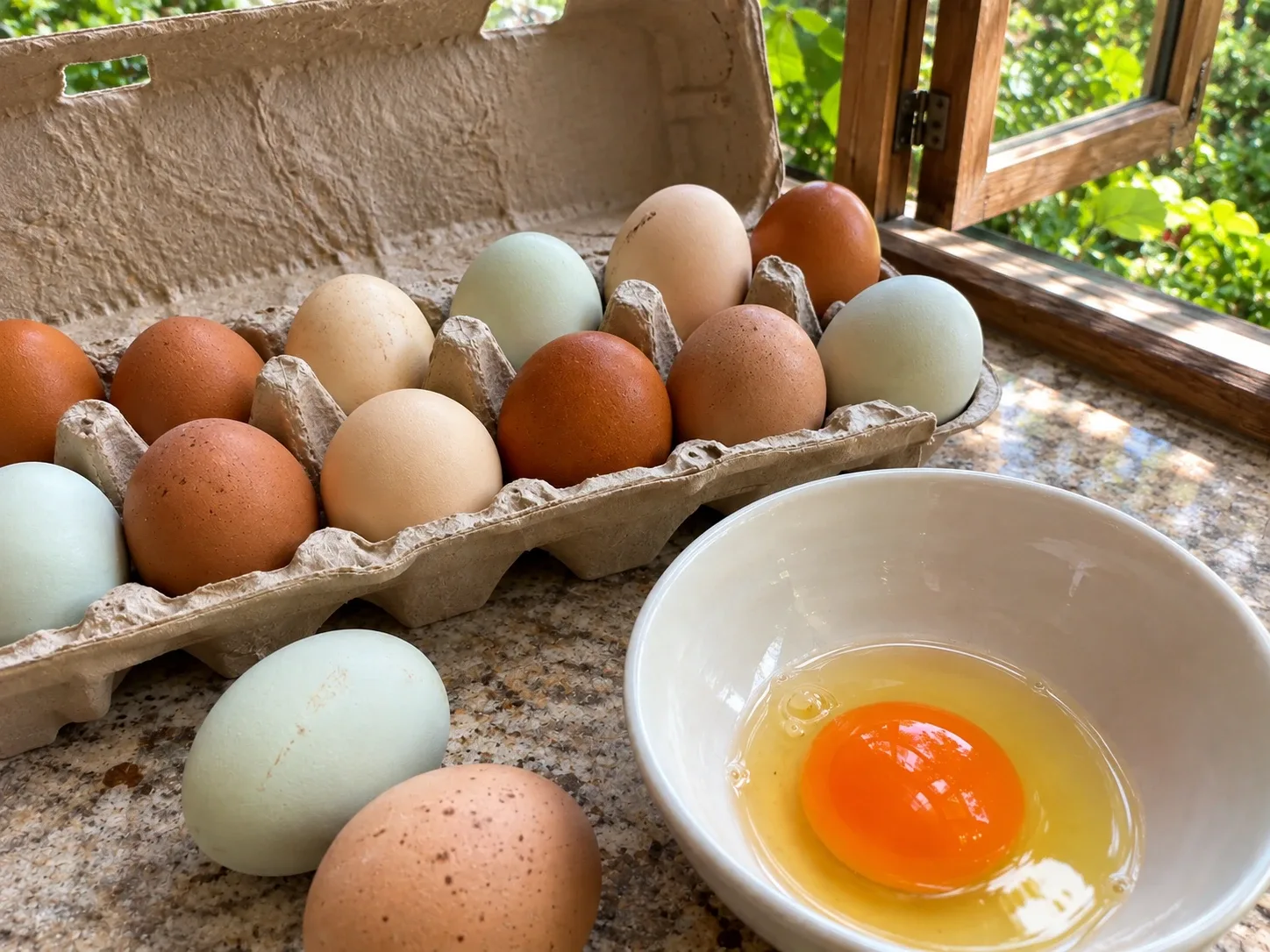
You don’t need a lab to spot a great egg. Crack a fresh pastured egg into a pan and the yolk sits up tall and round. It’s sturdy and strong, so you can poke and poke at it and it won’t break. A firm, high-standing yolk is also a sign of freshness, because the thin membrane around a yolk weakens as an egg ages.
The color is a deep orange, and the flavor is rich and almost buttery. That orange comes from carotenoids, the yellow-orange plant pigments a hen picks up from grass, greens, and bugs.
Yolk color depends entirely on what the hen eats, and commercial producers can deepen it by adding marigold or paprika extract to feed (Lohmann Breeders, 2026). A bright orange yolk from a caged hen isn’t the same as an orange yolk from a hen on grass. Color is a lovely clue, and it’s the farm behind the egg that tells you the truth.
Small Shell, Big Nourishment
Whole pastured eggs are rich in protein, brain-loving cholesterol, omega-3 fatty acids, choline, vitamins (A, D, E, K, and the B-complex), and minerals (iron, phosphorus, potassium, and calcium). The yolk is where most of the vitamins, minerals, and healthy fats live, so please, eat the whole egg.
The table below shows what one large egg (about 50 grams, or a little under 2 ounces) holds, using the U.S. Department of Agriculture’s standard values for a conventional egg.
| Nutrient (1 large egg) | Amount | What It Does for You |
|---|---|---|
| Protein | 6.3 g | Builds and repairs muscle, skin, hair, and enzymes |
| Fat | 4.8 g | Carries the fat-soluble vitamins A, D, E, and K |
| Cholesterol | 186 mg | Raw material for hormones, vitamin D, and every cell membrane, and a big part of the brain |
| Choline | 147 mg | Feeds memory, mood, and liver health |
| Vitamin A | 80 mcg | Supports vision, skin, and immunity |
| Vitamin D | 1 mcg (40 IU) | Supports bones, mood, and immunity |
| Vitamin E | 0.5 mg | Protects fats in your cells from damage |
| Vitamin B12 | 0.45 mcg | Supports energy, nerves, and red blood cells |
| Riboflavin (B2) | 0.23 mg | Helps turn food into energy |
| Folate | 24 mcg | Supports cell growth and repair |
| Selenium | 15 mcg | Supports thyroid health and antioxidant defenses |
| Lutein + zeaxanthin | 252 mcg | Gather in the eye and help protect it |
| DHA (an omega-3) | 29 mg | Builds brain and eye tissue |
| Iron, phosphorus, potassium, calcium | 0.9 mg, 99 mg, 69 mg, 28 mg | Smaller amounts that add up across the day |
Values from USDA FoodData Central (SR Legacy #171287) via GetFoodFacts (n.d.-a); choline from the National Institutes of Health (NIH Office of Dietary Supplements, n.d.).
Protein. About 6 grams per large egg, complete with all the essential amino acids your body can’t make on its own.
Cholesterol. About 186 milligrams per large egg (GetFoodFacts, n.d.-a), a little lower than the 200 milligrams often quoted, after USDA testing found eggs carry less cholesterol than earlier estimates (WATTAgNet, n.d.). Your body uses cholesterol to make vitamin D and hormones like estrogen and testosterone, and your brain is especially rich in it.
Choline. Choline is a nutrient your body uses to build cell membranes and to make acetylcholine, a brain chemical involved in memory, mood, and muscle control. It also helps your liver move fat out so it doesn’t build up there. One egg gives you about 147 milligrams, roughly a third of the 425 milligrams women need each day and over a quarter of the 550 milligrams men need, and pregnant and breastfeeding women need even more, 450 and 550 milligrams (NIH Office of Dietary Supplements, n.d.).
Lutein and zeaxanthin. These are carotenoids, the golden pigments that collect in the macula, the small part of your eye responsible for sharp, central vision. Leafy greens like kale and spinach actually contain far more lutein by amount, but the yolk delivers it in a form your body absorbs especially well, thanks to the fats packed around it. In a small Tufts University study of ten men using lutein-enriched eggs (from hens fed marigold petals), the men absorbed lutein from the eggs much better than from cooked spinach or lutein supplements, with blood levels about three times higher (Chung et al., 2004). A 2021 review of clinical trials, most using concentrated doses, found that carotenoids as a group help skin resist sunburn redness (Baswan et al., 2021). Enjoy your eggs with a pile of greens and you get the best of both.
The Yolk Was Never the Villain
For decades we were told to toss the yolk and eat the whites, as if the most nourishing part of the egg were a threat to the heart. Your body makes most of its own cholesterol, largely in the liver, and it relies on it to build every cell membrane, make hormones and bile (the digestive juice that breaks down fats), and turn sunlight into vitamin D in your skin.
In 2015, the government’s own Dietary Guidelines Advisory Committee dropped the long-standing 300-milligram daily limit on cholesterol. It found no meaningful link between the cholesterol you eat and the cholesterol in your blood, and declared it “not a nutrient of concern for overconsumption” (Dietary Guidelines Advisory Committee, 2015). Five years later, Harvard researchers followed more than 215,000 nurses and health professionals for up to 32 years and pooled 28 studies covering up to 1.7 million people. Eating up to one egg a day was not linked to heart disease, and in Asian populations it was tied to possibly lower risk (Drouin-Chartier et al., 2020). Even the American Heart Association now says a whole egg a day fits a healthy diet, and up to two a day for older adults with normal cholesterol (Carson et al., 2020).
The honest note is that people respond differently. In tightly controlled feeding studies, more dietary cholesterol does push up LDL, the cholesterol carrier most tied to heart disease, and the AHA advises extra care for people with diabetes, very high cholesterol, or heart failure risk (Carson et al., 2020). If that’s you, work with a practitioner who looks at your whole picture.
Why Pastured Hens Lay Richer Eggs
Researchers at Penn State compared eggs from hens rotated on pasture with eggs from sister hens kept in cages on commercial feed. The pastured hens still ate some of that same commercial mash, so the pasture made the difference. The pastured hens’ eggs had twice the vitamin E, 2.5 times the total omega-3 fats, double the long-chain omega-3s, and an omega-6 to omega-3 ratio less than half that of the caged hens’ eggs (Karsten et al., 2010; Penn State News, 2010). Omega-3s are the anti-inflammatory fats your brain, eyes, and heart rely on, and most of us eat far too few of them compared with omega-6 fats from seed oils and grain.
Vitamin A was more concentrated in the pastured eggs too, by 38%, though the total vitamin A per egg came out about the same (Karsten et al., 2010).
Sunlight matters as much as grass. Hens make vitamin D when UV light reaches them, and they pass it into their yolks. German researchers found that giving indoor hens six hours of UV light a day raised the vitamin D in their eggs three- to four-fold within three weeks (Kühn et al., 2019). A hen living under the open sky gets that light for free.
Hens keep time by the sun, too. A hen’s pineal gland, the small light-sensing gland that runs her internal clock, reads the length of the day and switches her laying on and off. She starts laying when spring days stretch to about 14 hours of light and peaks around 16 (Michigan State University Extension, n.d.). As fall and winter days shorten, she slows down or stops to rest and regrow her feathers, and it’s the dark, not the cold, that does it (University of Arizona Cooperative Extension, n.d.). Big egg operations get around this with artificial lights that keep hens laying year-round (Penn State Extension, 2025). So if a farmer who lets her hens follow natural light runs short on eggs in December, that’s a hen living by the sun.
What Belongs in a Hen’s Feeder
Chickens are omnivores, which means they naturally eat both plants and animals. The ideal diet for a laying hen is a combination of organically grown grains and legumes, grasses, greens, worms, and insects. Less ideal is a ration built on corn, soy, and commercial lay pellets. Even on pasture, hens eat some feed, so what’s in that feed matters for the egg.
This is why a carton that brags “vegetarian-fed” makes me pause. A hen that ate only plants wasn’t foraging for the worms and bugs she was built to eat, which usually means she lived indoors. The label speaks to diet only and says nothing about her living conditions (ASPCA, n.d.).
Antibiotics should be strictly avoided. USDA Organic hens are raised without antibiotics (USDA Agricultural Marketing Service [AMS], n.d.), and Animal Welfare Approved prohibits routine low-dose antibiotic use (ASPCA, n.d.).
I love Araucana eggs, the lovely blue ones. The soy- and corn-free feed comes from the farm, not the breed, though, and blue shells don’t carry special nutrition on their own. University of Florida poultry scientists found no evidence for the popular claim that Araucana eggs are lower in cholesterol, and in their comparisons Araucana yolks actually ran a bit higher in cholesterol than white Leghorn yolks (University of Florida IFAS Extension, n.d.). Choose the farm first, and the shell color is a bonus.
Reading the Carton Without Getting Fooled
When shopping, look for Animal Welfare Approved, Certified Humane (with “Pasture Raised” on the seal), Certified Organic, Pasture-Raised, and GMO-free. American Humane Certified is better than nothing, though watchdog groups rate it only slightly above conventional practice (Animal Welfare Institute [AWI], 2022). A local farmer you trust beats every seal.
| Carton Claim | What It Actually Means | My Take |
|---|---|---|
| Cage-free | Hens live indoors without cages and can move around a barn, with litter, perches, and nests. Multi-tier aviaries count. No outdoor access required. | A step up from cages. Still indoors. |
| Free-range | Cage-free, plus continuous access to the outdoors during the laying cycle. That outdoor area may be fenced or netted, and its size isn’t set by USDA. Certified Humane “Free Range” requires 2 square feet per bird and at least 6 hours outside a day, weather permitting. | Better. Outdoor space can still be small. |
| Pasture-raised | No single USDA definition. Under current USDA grading policy, graded eggs labeled pasture-raised must be certified by a recognized program such as Certified Humane or American Humane. | Only as strong as the seal beside it. |
| Certified Humane Pasture Raised | 108 square feet of rotated pasture per hen (1,000 hens per 2.5 acres), outdoors at least 6 hours a day year-round, with shelter at night. | Excellent. |
| Animal Welfare Approved (A Greener World) | Continuous pasture or range access, family farms, no beak trimming. | Excellent. The highest-welfare seal. |
| USDA Organic | Organic, non-GMO feed, no antibiotics, and outdoor access required. Stricter rules on outdoor space and vegetation for laying hens phase in through January 2029. | Good for feed. Outdoor quality varies by farm until 2029. |
| Vegetarian-fed | No animal ingredients in the feed. Hens are natural omnivores. | Usually a sign of indoor hens. |
| Hormone-free / No hormones added | Meaningless. Hormones are already banned for all poultry in the U.S. | Ignore it. |
| Antibiotic-free | The producer says hens weren’t given antibiotics. | Trust it most when it comes with Organic or Animal Welfare Approved. |
Sources for the table (AMS, 2025; Pete and Gerry’s, n.d.; The Poultry Site, 2014; AWI, 2022; ASPCA, n.d.; National Organic Coalition, 2023; U.S. Food and Drug Administration [FDA], n.d.; Food Safety and Inspection Service [FSIS], n.d.-a).
The “hormone-free” claim means nothing because no steroid hormone implants are approved for poultry at all (FDA, n.d.), and federal rules ban hormones in raising chickens, so every producer could print it. On chicken meat, the government even requires the label to add “Federal regulations prohibit the use of hormones” (FSIS, n.d.-a). When you see it on a carton, it’s marketing, not a mark of quality.
Keep Them Fresh, Test Them Fast
- Refrigerate store-bought eggs. U.S. eggs are washed and sanitized before sale, which removes the cuticle (also called the bloom), a natural coating that seals the shell’s tiny pores against bacteria. Without it, eggs belong in the fridge (StateFoodSafety, n.d.).
- Farm-fresh unwashed eggs keep their bloom. Many small farmers sell them this way, and across much of Europe and many other parts of the world, eggs aren’t washed and are stored at room temperature (StateFoodSafety, n.d.). Once eggs have been chilled, keep them chilled. Wash an unwashed egg right before you use it, not before storing.
- Store them well. Keep eggs at 40°F or below, in the coldest part of the fridge rather than the door. Refrigerated eggs stay fresh about 3 to 5 weeks from the day you bring them home (FSIS, n.d.-b).
- Try the float test. Gently set an egg in a bowl of cold water. As an egg ages, air seeps in through the shell and the air pocket inside grows. A fresh egg sinks and lies flat on its side, an older one stands up on its end, and a very old egg floats. A floater isn’t automatically unsafe, so crack it into a separate bowl and trust your nose (Medical News Today, n.d.).
Duck Eggs and Quail Eggs Belong on Your Table Too
Duck eggs are bigger and richer than hen eggs. One duck egg (about 70 grams) has around 9 grams of protein, nearly twice the fat of a hen egg, and about eight times the vitamin B12. They’re also much higher in cholesterol, around 619 milligrams each (GetFoodFacts, n.d.-b). Their big, creamy yolks make silky custards and luxurious scrambles.
Quail eggs are tiny, about 9 grams each, so five or six equal roughly one hen egg (GetFoodFacts, n.d.-c). Their speckled shells make them a beautiful appetizer, soft-boiled and halved with flaky salt, and kids love them.
Put Your Pastured Eggs to Work
Eggs are the backbone of so many dishes in my kitchen.
- Seasonal Frittatas: One Method, Four Seasons
- Tomato, Basil, and Goat Cheese Frittata & Quiche
- Ancestral Quiches: Six Seasonal Variations with Three Crust Options
- Goat Cheese, Caramelized Onion & Bacon Quiche
- Tortilla Española (Spanish Potato Omelette)
- Beef Liver Pâté with Sage, Nutmeg & Egg
- The Mayo That Doesn’t Betray You (and Two Chicken Salads Built On It)
- Spring Chicken Salad Platter with Pickled Beet Deviled Eggs
- Grass-Fed Ribeye Steak with Hollandaise or Béarnaise
- Alentejo Purslane Soup with Crispy Cured Pork and Poached Eggs
- Little Pots: Vanilla Gelatin Pots, Chocolate Custard Pots, and Dulce de Leche
A pastured egg costs a little more than a conventional one, and it gives you more vitamin E, more omega-3s, more vitamin D from the sun, and a hen who lived a real life. That’s one of the best deals in the whole grocery store. Or better yet, find a local farmer :) Farmers markets, LocalHarvest.org, Eatwild.com, and your local Weston A. Price Foundation chapter are good places to start.
Want the brands and farms I trust for meat, poultry, and every other aisle of the store? My Shopping Guide rates every food category as Best, Good, or Avoid. Find it in the Health Marshall Library: Well Sourced: The Food Marshall Sourcing & Shopping Guide.
With Love, Light, and Health,
Anna (aka Food Marshall)
Resources
- Animal Welfare Institute. (2022). A consumer’s guide to food labels and animal welfare. https://www.awionline.org/sites/default/files/publication/digital_download/AWI-Consumers-Guide-Food-Labels-Animal-Welfare-Pocket-22.pdf
- ASPCA. (n.d.). Certification and label guide. https://www.aspca.org/shopkind/guide/food-certification-label-guide
- Baswan, S. M., et al. (2021). Role of ingestible carotenoids in skin protection: A review of clinical evidence. Photodermatology, Photoimmunology & Photomedicine, 37(6), 490–504. https://nutrition-evidence.com/article/397947/role-of-ingestible-carotenoids-in-skin-protection-a-review-of-clinical-evidence
- Carson, J. A. S., Lichtenstein, A. H., Anderson, C. A. M., et al. (2020). Dietary cholesterol and cardiovascular risk: A science advisory from the American Heart Association. Circulation, 141(3), e39–e53. https://professional.heart.org/en/science-news/dietary-cholesterol-and-cardiovascular-risk/top-things-to-know
- Chung, H.-Y., Rasmussen, H. M., & Johnson, E. J. (2004). Lutein bioavailability is higher from lutein-enriched eggs than from supplements and spinach in men. Journal of Nutrition, 134(8), 1887–1893. Summarized by USDA Agricultural Research Service: https://www.ars.usda.gov/IS/pr/2004/040818.htm
- Dietary Guidelines Advisory Committee. (2015). Scientific report of the 2015 Dietary Guidelines Advisory Committee. U.S. Department of Agriculture & U.S. Department of Health and Human Services. https://health.gov/sites/default/files/2019-09/Scientific-Report-of-the-2015-Dietary-Guidelines-Advisory-Committee.pdf
- Drouin-Chartier, J.-P., Chen, S., Li, Y., et al. (2020). Egg consumption and risk of cardiovascular disease: Three large prospective US cohort studies, systematic review, and updated meta-analysis. BMJ, 368, m513. https://pubmed.ncbi.nlm.nih.gov/32132002/
- Food Safety and Inspection Service. (n.d.-a). Meat and poultry labeling terms. https://www.fsis.usda.gov/food-safety/safe-food-handling-and-preparation/food-safety-basics/meat-and-poultry-labeling-terms
- Food Safety and Inspection Service. (n.d.-b). Shell eggs from farm to table. https://www.fsis.usda.gov/food-safety/safe-food-handling-and-preparation/eggs/shell-eggs-farm-table
- GetFoodFacts. (n.d.-a). Egg, whole, raw, fresh (USDA FoodData Central SR Legacy 171287). https://getfoodfacts.com/food/egg-whole-raw-fresh-171287
- GetFoodFacts. (n.d.-b). Egg, duck, whole, fresh, raw (USDA FoodData Central SR Legacy 172189). https://getfoodfacts.com/food/egg-duck-whole-fresh-raw-172189
- GetFoodFacts. (n.d.-c). Egg, quail, whole, fresh, raw (USDA FoodData Central SR Legacy 172191). https://getfoodfacts.com/food/egg-quail-whole-fresh-raw-172191
- Karsten, H. D., Patterson, P. H., Stout, R., & Crews, G. (2010). Vitamins A, E and fatty acid composition of the eggs of caged hens and pastured hens. Renewable Agriculture and Food Systems, 25(1), 45–54. https://www.cambridge.org/core/journals/renewable-agriculture-and-food-systems/article/abs/vitamins-ae-and-fatty-acid-composition-of-the-eggs-of-caged-hens-and-pastured-hens/552BA04E5A9E3CD7E49E405B339ECA32
- Kühn, J., et al. (2019). Feasibility of artificial light regimes to increase the vitamin D content in indoor-laid eggs. Poultry Science. https://pubmed.ncbi.nlm.nih.gov/31041442/ (summary at https://www.sciencedaily.com/releases/2019/06/190624111502.htm)
- Lohmann Breeders. (2026). Egg yolk color. https://lohmann-breeders.com/?p=105871
- Medical News Today. (n.d.). How to tell if an egg is bad. https://www.medicalnewstoday.com/articles/325210.php
- Michigan State University Extension. (n.d.). Decreasing daylight and its effect on laying hens. https://www.canr.msu.edu/news/decreasing-daylight-and-its-effect-on-laying-hens
- National Organic Coalition. (2023). New organic animal welfare rules are now final. https://www.nationalorganiccoalition.org/blog/2023/12/13/new-organic-animal-welfare-rules-are-now-final
- NIH Office of Dietary Supplements. (n.d.). Choline: Fact sheet for health professionals. https://ods.od.nih.gov/factsheets/Choline-HealthProfessional/
- Penn State Extension. (2025). Artificial lighting for winter egg production. https://extension.psu.edu/artificial-lighting-for-winter-egg-production
- Penn State News. (2010). Research shows eggs from pastured chickens may be more nutritious. https://www.psu.edu/news/agricultural-sciences/story/research-shows-eggs-pastured-chickens-may-be-more-nutritious
- Pete and Gerry’s. (n.d.). Free range vs. pasture raised. https://www.peteandgerrys.com/blog/free-range-not-pastured-raised
- StateFoodSafety. (n.d.). Why do Americans put eggs in the fridge? https://www.statefoodsafety.com/Resources/Articles/why-do-americans-put-eggs-in-the-fridge
- The Poultry Site. (2014). “Free range,” “pasture raised” officially defined. https://www.thepoultrysite.com/news/2014/01/free-range-pasture-raised-officially-defined
- University of Arizona Cooperative Extension. (n.d.). Lighting schedules for Arizona backyard laying flocks. https://extension.arizona.edu/publication/lighting-schedules-arizona-backyard-laying-flocks
- University of Florida IFAS Extension. (n.d.). Araucana and Ameraucana chickens (PS01300). https://ufdcimages.uflib.ufl.edu/IR/00/00/42/61/00001/PS01300.pdf
- U.S. Department of Agriculture, Agricultural Marketing Service. (n.d.). Organic livestock requirements. https://www.ams.usda.gov/sites/default/files/media/Organic%20Livestock%20Requirements.pdf
- U.S. Department of Agriculture, Agricultural Marketing Service. (2025, April 22). QAD 709 policy update memo (shell egg specialty housing claims). https://www.ams.usda.gov/sites/default/files/media/QAD%20709%20Policy%20Update%20Memo%204-22-25.pdf
- U.S. Food and Drug Administration. (n.d.). Steroid hormone implants used for growth in food-producing animals. https://www.fda.gov/animal-veterinary/product-safety-information/steroid-hormone-implants-used-growth-food-producing-animals
- WATTAgNet. (n.d.). USDA: Eggs 14% lower in cholesterol, 64% higher in vitamin D than previously thought. https://wattagnet.com/home/article/15492607/usda-eggs-14-lower-in-cholesterol-64-higher-in-vitamin-d-than-previously-thought
More Articles & Other Posts


Get new recipes and essays
Seasonal recipes and writing on light, circadian health, and living with nature.
Subscribe on Substack