Collagen Chocolate Chip Banana Bread
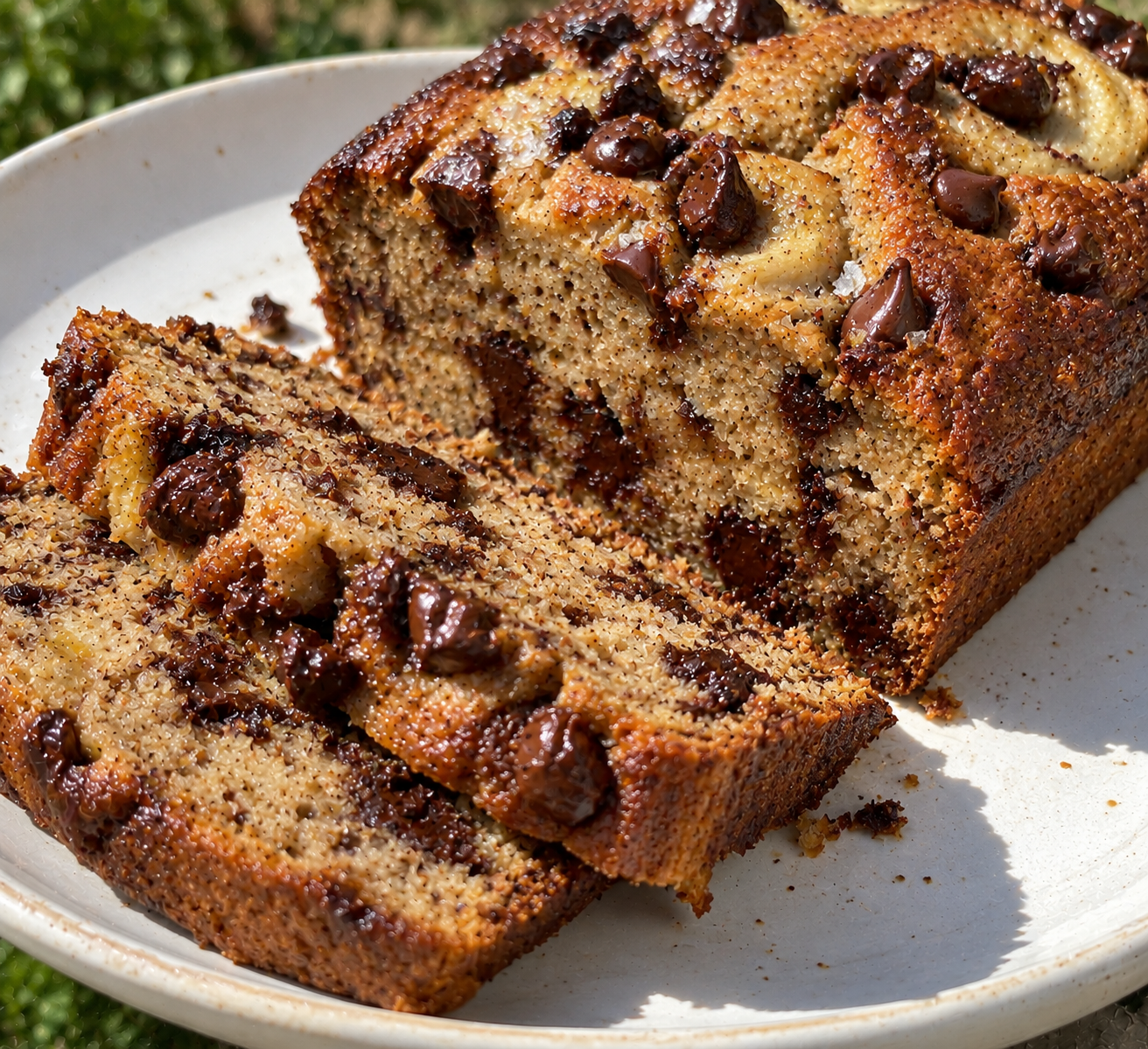
A grain-free, refined-sugar-free banana bread made with cassava and coconut flours, grass-fed collagen for extra protein, ripe bananas for natural sweetness, and dark chocolate chips throughout. The kind of bread that earns its place on the breakfast table, the after-school plate, and the post-workout snack.
Adapted from Crosby Tailor's clean banana bread, refined through my own kitchen testing with adjusted ratios and sourcing standards.
Yield: One 9x5-inch loaf (10 slices) · Active: 15 min · Total: 50 min, plus 1 hour cooling · Year-round (bananas grow year-round in tropical regions) · Best eaten: morning or early afternoon
A Note from the Kitchen
Banana bread earns its place in the kitchen rotation through sheer reliability. The bananas are always a little riper than they should be. The protein needs to come from somewhere when you're not making eggs. The kids need something for the after-school plate. And the post-workout snack needs to actually nourish you, not just spike and crash your blood sugar.
This banana bread answers all of those calls. The combination of cassava and coconut flours gives it a texture that's remarkably close to the real thing: soft and tender like a classic wheat banana bread, without the heavy density that all-almond-flour baking sometimes has. The grass-fed collagen adds about 4 grams of protein per slice without changing the texture or flavor. The ripe bananas provide nearly all the sweetness the bread needs, with a small assist from coconut sugar for caramelization. And the dark chocolate chips are non-negotiable.
This is a recipe for the regular rotation, not the special occasion. It keeps for a week, freezes beautifully, toasts well, and pairs with butter, raw honey, almond butter, or fresh berries. It's the kind of bread that quietly makes the week easier.
Ingredients
Bowl 1 (dry)
A little less than ½ cup coconut flour (about 7 tbsp)
A little less than ½ cup cassava flour (about 7 tbsp)
½ cup grass-fed collagen peptides
½ cup coconut sugar or date sugar
½ tsp baking soda
¼ tsp cream of tartar
¼ tsp Baja Gold sea salt
½ tsp ground Ceylon cinnamon (optional, but it adds lovely warmth)
Bowl 2 (wet)
3 large pasture-raised eggs, at room temperature
1½ tsp pure vanilla extract
½ cup grass-fed butter, melted and slightly cooled
3 ripe bananas, mashed (the spottier the better)
To finish
½ cup dark chocolate chips (sweetened with coconut sugar, or 100% cacao), plus 2 tbsp for the top
Optional: 2 tbsp chopped walnuts or pecans
Method
Prep. Heat the oven to 350°F. Line a 9x5-inch loaf pan with parchment, leaving an overhang on the long sides for easy lifting.
Whisk the dry ingredients. In a medium bowl, whisk the coconut flour, cassava flour, collagen, coconut sugar, baking soda, cream of tartar, salt, and cinnamon (if using). Whisk well to break up any clumps of collagen.
Whisk the wet ingredients. In a larger bowl, whisk the eggs and vanilla, then whisk in the melted butter. Stir in the mashed bananas: smooth, or a little chunky if you like bits of banana in the finished bread.
Combine. Add the dry ingredients to the wet and stir gently with a spatula, just until combined. Don't overmix; coconut flour absorbs moisture quickly, and overmixing makes a tough crumb.
Fold in the chocolate. Fold in ½ cup chocolate chips (and the nuts, if using).
Fill and top. Pour the batter into the pan (it should fill it about three-quarters full), smooth the top, and sprinkle with the remaining chocolate chips.
Bake 35–45 minutes (35 minutes for a standard loaf pan, 40–45 for a larger or wider one), until a toothpick inserted in the center comes out with just a few moist crumbs, not wet batter.
Cool. Let it cool in the pan 15 minutes, then lift it out by the parchment and cool completely on a wire rack, at least 1 hour, before slicing. The bread firms up as it cools, and slicing it warm makes the crumb gummy.
Slice and serve with a sharp serrated knife. Enjoy it plain, with grass-fed butter, raw honey, almond butter, or fresh berries. It toasts beautifully in a dry skillet or toaster oven.
About Cassava and Coconut Flours
The pairing of cassava and coconut flours is the secret to this bread. Cassava flour, made from the tropical cassava root (also called yuca), has a mild, neutral flavor and a texture remarkably close to wheat flour in baked goods. It's been a staple in South American and West African kitchens for centuries.
Coconut flour, on the other hand, is very high in fiber and absorbs far more liquid than wheat or almond flour. On its own, it can make a dense, dry crumb. But combined with cassava flour at about 1:1, the two balance each other beautifully: the cassava gives the bread body and a wheat-like tenderness, while the coconut adds fiber and absorbs the moisture from the bananas and butter without making the bread heavy.
The result is a grain-free bread that doesn't taste like a substitute. It tastes like real banana bread.
About the Collagen
The ½ cup of grass-fed collagen peptides adds roughly 36 grams of protein to the loaf, about 4 grams per slice (about 6 grams per slice with the eggs). Collagen is the most abundant protein in the body, concentrated in the skin, joints, tendons, ligaments, and gut lining. Modern diets tend to be low in it, since most of us have moved away from the bone-in, skin-on, nose-to-tail foods that were once its traditional sources.
Collagen isn't a complete protein on its own (it's missing the amino acid tryptophan), but it's rich in glycine, proline, and hydroxyproline, the building blocks of connective tissue. Baking it into bread is one of the easiest ways to enjoy it every day: it mixes invisibly into the batter and doesn't change the flavor. For active people, growing children, postpartum mothers, and aging adults alike, it's a small, sustainable habit that adds up over time.
For a collagen-free version: Leave out the collagen and add 2 extra tablespoons of cassava flour. The bread will have a little less protein, but it'll be just as tender.
Substitutions
Sweeter: Add ¼ cup raw honey or maple syrup to the wet ingredients, and reduce the coconut sugar to ⅓ cup.
Nut-free: It's already nut-free as written; just skip the walnuts or pecans.
Dairy-free: Use melted coconut oil in place of the butter. The flavor will be a little more coconutty.
Lower-sugar: Reduce the coconut sugar to ¼ cup and use 2 medium bananas, plus ¼ cup unsweetened applesauce to keep it moist.
More chocolate: Increase the chocolate chips to ¾ cup.
Warmer spice: Add ½ tsp pumpkin pie spice or a pinch of cardamom to the dry ingredients, for a fall version.
More crunch: Add ¼ cup chopped walnuts, pecans, or sliced almonds.
Storage
Refrigerated up to 1 week, in a glass container or wrapped tightly in beeswax wrap, or frozen up to 3 months. Slice it before freezing, so you can grab individual servings. To reheat, toast slices in a dry skillet or toaster oven for 2–3 minutes.
The bread is even better after the first day, once the flavors settle and the crumb firms up.
Pairs Well With
Breakfast: a smear of grass-fed butter, raw honey, or almond butter, with fresh berries and a side of pasture-raised eggs. Coffee or a matcha latte for grown-ups, and a glass of raw milk or kefir for kids.
After-school snack: a slice with almond butter and a sliced apple.
Post-workout: a slice with a mug of hot cacao made with raw milk and collagen, to replenish both carbohydrates and protein.
Dessert: warm a slice and top it with a scoop of homemade vanilla ice cream or whipped raw cream, plus a drizzle of my coconut caramel sauce.
Travel: slices wrapped in parchment or beeswax wrap travel beautifully, for road trips, flights, hikes, and lunchboxes.
Why This Banana Bread
Conventional banana bread is built on refined wheat flour, white sugar, vegetable oil, and conventionally raised eggs. Even homemade, it delivers a sugar load that tends to spike and crash your energy, with little protein, fiber, or real nourishment.
This banana bread is the rebuild: cassava and coconut flours instead of refined wheat, grass-fed collagen and pasture-raised eggs for protein, coconut sugar instead of refined cane sugar, grass-fed butter instead of seed oils, real dark chocolate instead of milk chocolate chips made with palm oil and refined sugar, and real vanilla instead of synthetic vanillin.
Make a loaf on Sunday afternoon, slice it, and wrap individual slices in parchment, for breakfasts, after-school snacks, post-workout fuel, and lunchboxes all week long. It keeps beautifully, freezes beautifully, toasts beautifully, and quietly nourishes you and the people you feed.
Real food is how you send it.
Nourishment Notes
Cassava flour — gluten-free carbohydrate, plus some resistant starch, a prebiotic fiber that forms especially as the bread cools.
Coconut flour — fiber, which helps slow the absorption of the bread's natural sugars.
Grass-fed collagen — glycine, proline, and hydroxyproline, the building blocks of skin, joints, and the gut lining.
Pasture-raised eggs — complete protein, choline, lutein, and vitamins A, D, E, and K2.
Ripe bananas — potassium, B6, and natural sweetness. As bananas ripen, more of their starch turns to sugar, which is why spotty bananas make the sweetest, most flavorful bread.
Grass-fed butter — vitamins A, D, E, and K2. Pasture-raised animal fats are among the best food sources of K2, along with fermented foods like natto and aged cheese.
Dark chocolate — flavanols, magnesium, and theobromine, a gentle stimulant.
Coconut sugar — unrefined, with trace minerals and a small amount of inulin, a prebiotic fiber. It's often cited as lower-glycemic than cane sugar, though estimates vary. Date sugar, which is simply dried, ground dates, is an even less processed 1:1 alternative.
The combination of fat, protein, and fiber in this bread helps avoid the spike and crash of conventional banana bread, so a slice gives you real satiety and steady energy. It's especially good for breakfast, after-school snacks, or as a post-workout food with a glass of raw milk or kefir.
Sourcing
Cassava flour — organic, finely ground, with nothing added; Otto's Naturals makes one
Coconut flour — organic and finely ground
Collagen peptides — from grass-fed, pasture-raised cattle, with nothing added, like Perfect Supplements or Naked Collagen
Coconut sugar and date sugar — organic coconut sugar, like Madhava or Wholesome; organic date sugar, like Date Lady
Eggs — organic and pasture-raised, from a local farm when you can (deep orange yolks are a sign of real foraging)
Grass-fed butter — organic, cultured butter from 100% grass-fed cows
Bananas — organic and very ripe. Stash overripe bananas in the freezer, then thaw and drain them before mashing.
Dark chocolate chips — organic, sweetened with coconut sugar, like Hu, or 100% cacao, like Pascha's chips; ideally tested for heavy metals
Vanilla — organic pure vanilla extract, or whole vanilla beans
Cream of tartar and baking soda — aluminum-free baking soda
Walnuts or pecans (optional) — organic and raw, kept in the fridge
Salt — Baja Gold sea salt (unlike table salt, which is refined and stripped of its trace minerals)
Loaf pan — stainless steel, glass, or stoneware, with no nonstick coating
— Anna aka Food Marshall