Banana Egg Cake with Baked Nectarines and Plums
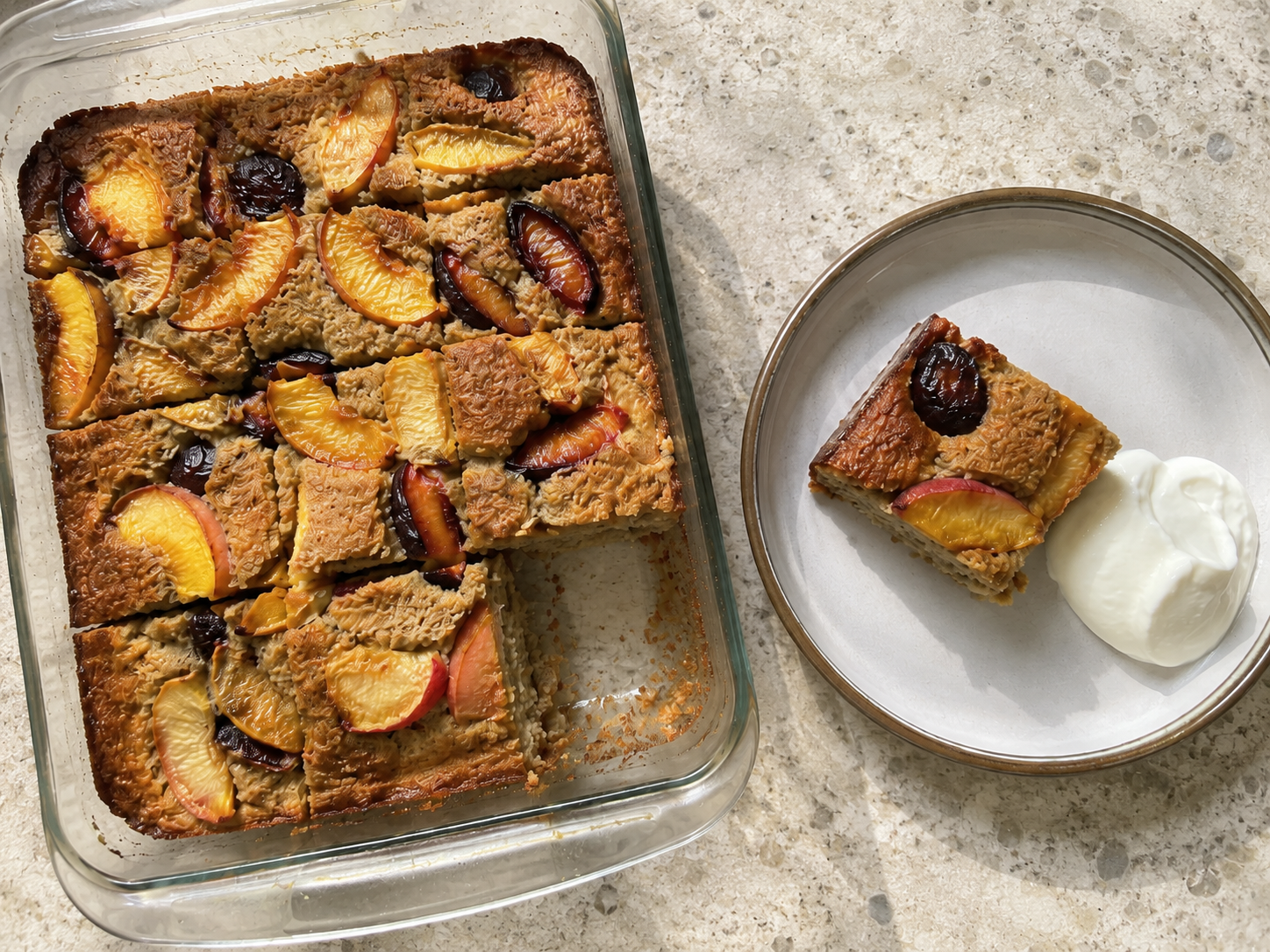
A simple grain-free, flourless summer cake — blended banana and egg baked into a soft custard-like cake, studded with sliced nectarines and plums, served with grass-fed yogurt. Naturally gluten-free, grain-free, dairy-free (in the cake itself), refined-sugar-free, and built around peak summer stone fruit.
Yield: 6-8 servings (one 8×8 or 9-inch round baking dish) · Active: 10 min · Total: 35 min · Late summer (peak nectarine and plum season) · Best eaten: warm from the oven, midday or early afternoon
A note from the kitchen
This is the simplest possible summer cake — three ingredients in the batter (bananas, eggs, vanilla), a scatter of peak-season stone fruit on top, and about 10 minutes of active time. No flour of any kind. No added sweetener beyond the natural sugars in the bananas. No dairy required in the cake itself (though the yogurt on top brings dairy back).
The technique is basically a baked custard — bananas provide natural sweetness and body, eggs bind everything into a tender cake-like texture, vanilla adds fragrance and depth. Ripe or slightly overripe bananas are essential; underripe bananas won't produce the sweetness or the soft, silky crumb. Think of it as somewhere between banana bread and clafoutis (the French baked custard with fruit).
Peak nectarines and plums are the summer version; you can substitute with fresh berries (blueberries, raspberries, blackberries) in any season, or ripe stone fruit (peaches, apricots, cherries) when they're at their best. The cake works with almost any fruit that's at peak ripeness.
Best made when nectarines and plums are fragrant and just yielding to gentle pressure (mid-summer through early autumn in most growing zones — July through September). Out of season, use frozen berries or thawed frozen stone fruit.
Ingredients
Cake batter
4 ripe bananas (yellow with brown spots — the riper the better)
5 pasture-raised eggs
1 tbsp pure vanilla extract
Pinch of sea salt (optional but recommended)
Coconut oil, for greasing the baking dish
Optional add-in: ½ cup grass-fed greek yogurt (cow, goat, or sheep)
Fruit topping (summer stone fruit version)
2 ripe nectarines, pitted and thinly sliced
2 ripe plums, pitted and thinly sliced
Fruit topping (berry version, alternative)
1½ cups mixed berries (blueberries, raspberries, blackberries, or a combination)
To serve
1-2 cups thick grass-fed yogurt (Greek-style, Bulgarian, sheep, or goat)
A drizzle of raw honey or pure maple syrup (optional)
Fresh mint leaves (optional, for garnish)
Ground Ceylon cinnamon (optional, for dusting)
Method
Preheat the oven. Heat the oven to 350°F.
Prepare the baking dish. Generously coat an 8×8-inch glass baking dish or a 9-inch round glass baking dish with coconut oil, covering the bottom and sides. This prevents sticking and helps the edges caramelize slightly.
Blend the batter. In a high-speed blender or food processor, combine the bananas, eggs, vanilla extract, greek yogurt, and pinch of salt. Blend until completely smooth and uniform, about 30-45 seconds. The batter will be thin and pourable — that's correct. It looks more like a custard than a traditional cake batter.
Pour into the baking dish. Pour the batter into the prepared baking dish.
Arrange the fruit. Scatter the sliced nectarines and plums (or the mixed berries) evenly across the top of the batter. Press them gently into the batter so they sink slightly but remain visible from above. Don't overcrowd — the fruit should be a beautiful pattern, not a fruit blanket.
Bake. Bake at 350°F for 25-30 minutes, until the cake is set in the center (a toothpick inserted between the fruit should come out mostly clean) and the top is lightly golden. The edges will pull away slightly from the dish.
Cool briefly. Remove from the oven and let cool 5-10 minutes in the dish. The cake will continue to set as it cools.
Serve. Cut into squares or wedges. Serve warm from the dish with a generous dollop of thick grass-fed yogurt on top or alongside. Optional: drizzle with raw honey or pure maple syrup, scatter fresh mint leaves, or dust with a pinch of Ceylon cinnamon.
Variations
With mixed berries instead of stone fruit: Substitute the nectarines and plums with 1½ cups fresh blueberries, raspberries, blackberries, or a combination. Works year-round with fresh or frozen berries.
With cherries and apricots: Substitute with 1 cup pitted fresh cherries plus 2 sliced apricots for a different summer stone fruit combination.
With autumn fruit (pears and figs): Substitute with 2 sliced ripe pears and 4-6 sliced fresh figs for an autumn variation.
With ground cinnamon and cardamom in the batter: Add ½ tsp ground Ceylon cinnamon and ¼ tsp ground cardamom to the blender before blending for a warming spiced version.
With chopped nuts on top: Scatter 2-3 tbsp chopped raw walnuts, pecans, or almonds over the fruit before baking for crunch.
Make ahead: The cake can be baked up to 2 days ahead and refrigerated. Reheat gently in a 300°F oven for 8-10 minutes, or serve at room temperature.
Sourcing
Ripe bananas. Look for bananas that are yellow with distinct brown spots — this indicates full ripeness and maximum natural sweetness. Green-tinged bananas are underripe and won't produce the same sweet, silky texture. Organic when possible.
Pasture-raised eggs. Yolks should be deep orange. Vital Farms, Pete & Gerry's, or a local farmers' market. The eggs are doing significant work in this cake (both binder and flavor); quality matters.
Ripe nectarines and plums. Fragrant and yielding slightly to gentle pressure at the stem end. Heirloom varieties (Elberta or Suncrest nectarines; Santa Rosa or Damson plums) carry meaningfully more flavor than commodity supermarket fruit. From a farmers' market or CSA share at peak season (July-September).
Fresh berries (alternative). Local, in-season when possible. Organic when possible (berries are among the most pesticide-exposed produce). Frozen organic berries work as an off-season substitute.
Pure vanilla extract. Single-ingredient (just vanilla and alcohol or vegetable glycerin), no added sugars. Singing Dog Vanilla (single-origin Madagascar), Heilala, or Frontier Co-op. Real vanilla extract makes a meaningful difference in this recipe since it's one of only three batter ingredients.
Coconut oil. Cold-pressed, unrefined, organic. Nutiva, Garden of Life, or Dr. Bronner's. Should smell distinctly of fresh coconut.
Thick grass-fed yogurt. Bellwether Farms sheep yogurt (A2 casein, exceptional), Redwood Hill Farm goat yogurt (A2 casein, tangy), Maple Hill grass-fed cow yogurt, or homemade from raw milk. Look for traditionally strained yogurt with live cultures and no added stabilizers.
Raw honey (optional). Local, unfiltered, single-origin from a beekeeper or farmers' market.
Pure maple syrup (optional). Grade A dark or amber. Crown Maple, Hidden Springs Maple, or Coombs Family Farms.
Ground Ceylon cinnamon. True Ceylon cinnamon (not Cassia). Burlap & Barrel or Diaspora Co.
Sea salt. Baja Gold mineral sea salt.
Storage
Whole baked cake: Refrigerated up to 3-4 days, sealed. The texture becomes denser and slightly more custard-like as it chills.
Reheating: Reheat gently in a 300°F oven for 8-10 minutes, or serve at room temperature. Not recommended to reheat in a microwave (uneven heating affects the delicate egg custard texture).
Frozen: Up to 2 months, well-wrapped. Thaw overnight in the refrigerator before serving.
Cake batter (before baking): Best baked immediately — the eggs begin to separate from the banana if the batter sits.
Support for the Female Infradian Rhythm
This cake is particularly well-suited to the follicular and luteal phases of the female cycle. The bananas deliver about 420mg of potassium each (with 4 bananas in the recipe, that's roughly 1,680mg across 6-8 servings — meaningful for fluid balance and cramp prevention during luteal and menstrual phases). Bananas also deliver tryptophan (a serotonin precursor that supports luteal-phase mood), magnesium, and vitamin B6 (essential for progesterone synthesis). Pasture-raised eggs deliver choline, complete protein, and the fat-soluble vitamins A, D, E, K2 that support hormone synthesis across all phases. Fresh stone fruit and berries provide vitamin C, quercetin, and anthocyanins that support antioxidant status during peak estrogen (ovulatory phase). The grass-fed yogurt on top delivers live probiotic cultures that support the estrobolome — the gut bacteria that help metabolize estrogen. The natural sweetness from bananas is fiber-bound and slower-burning than refined sugar, supporting the blood-sugar stability that becomes especially important during the luteal phase.
Nourishment Notes
Ripe bananas — potassium, tryptophan, and fiber-bound natural sugars. Ripe bananas deliver about 420mg of potassium each (higher than a serving of yogurt or a cup of orange juice), along with vitamin B6, vitamin C, magnesium, manganese, and 3g of fiber per banana. The natural sugars in ripe bananas are fiber-bound and slower-burning than refined sugar — the body reads them as food rather than as pure glucose. Bananas also deliver tryptophan, the amino acid precursor to serotonin, which supports mood and sleep.
Pasture-raised eggs — choline, lutein, and complete fat-soluble vitamins. The 5 eggs in the cake deliver substantial choline (essential for brain and liver function), lutein and zeaxanthin (eye-supporting compounds), complete protein, and the fat-soluble vitamins A, D, E, and K2 in the deep orange yolks. Eggs also bind the flourless batter and provide the structural protein that grain flour typically provides in conventional cakes. Pasture-raised eggs specifically deliver meaningfully more nutrition than commodity eggs — up to 10 times more omega-3, 3 times more vitamin E, and 6 times more beta-carotene.
Nectarines and plums — vitamin C, fiber, and polyphenols. Fresh ripe stone fruit delivers vitamin C, fiber, potassium, and a range of polyphenols. Nectarines carry beta-carotene and chlorogenic acid; plums carry anthocyanins (in the red-blushed skin) and chlorogenic acid. Both are relatively low-glycemic when eaten with the fiber and skin intact.
Fresh berries (alternative) — anthocyanins and quercetin. Berries deliver exceptional anthocyanin content (the same class of pigments that give them their deep blue, red, or purple color) with documented antioxidant and anti-inflammatory effects. Blueberries specifically are one of the highest antioxidant food sources measured. Berries also deliver vitamin C, fiber, and manganese.
Pure vanilla extract — vanillin and aromatic oils. Real vanilla extract delivers vanillin (the primary aromatic compound in vanilla) along with over 250 other aromatic compounds developed during the fermentation and drying of vanilla beans. These aromatic oils have documented mood-supporting effects and add substantial flavor complexity with almost no calories.
Coconut oil — medium-chain triglycerides and lauric acid. The coconut oil greasing the baking dish delivers medium-chain triglycerides (MCTs) and lauric acid (antimicrobial). Small amounts, but they contribute to the browning at the edges of the cake and add subtle coconut aroma.
Grass-fed yogurt — probiotic cultures, calcium, and A2 casein. The yogurt topping delivers live probiotic cultures (Lactobacillus, Bifidobacterium), easily digestible protein, calcium, phosphorus, and the fat-soluble vitamins A, D, K2. Sheep and goat yogurts specifically have only A2 beta-casein, which doesn't trigger the inflammatory response that A1 cow casein can in sensitive individuals.
Why this kind of cake matters. Most flourless "healthy" cakes rely on almond flour, coconut flour, or oat flour — grain-adjacent flours that are still processed. This cake is flour-free — the only "flour" is the natural body of blended banana. The result is a soft, custard-like cake that reads as dessert while being closer nutritionally to a fruit-and-egg breakfast. Three ingredients in the batter (bananas, eggs, vanilla) plus fruit on top is a testament to how honest, whole-food cooking can produce satisfying celebration food without complexity or specialty ingredients. Perfect for those who want something naturally sweet without refined sugar, grain-free without specialty flours, and truly simple without sacrificing pleasure.
— Anna aka Food Marshall