Pan-Seared Golden Crispy Scallops with Sweet Potato Cake (Four European Traditions) and Basil-Parsley Sauce
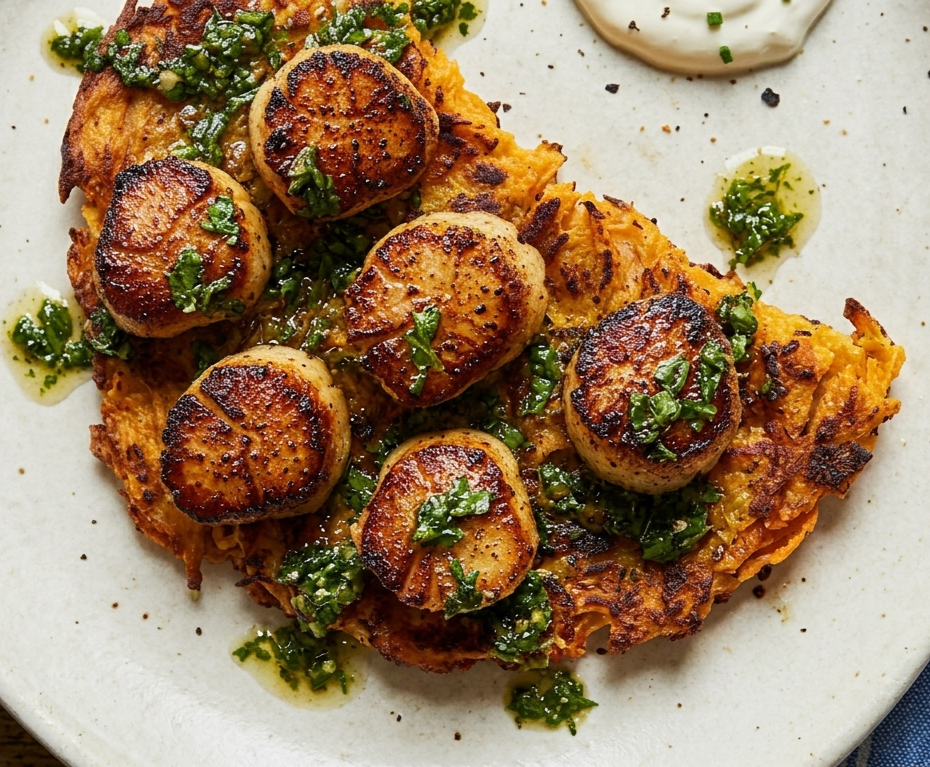
Diver-caught wild scallops seared until deeply golden, plated over a sweet potato cake prepared in one of four traditional European styles — Swiss Rösti, French Pommes Darphin, Italian Frittata di Patate, or Spanish Tortilla de Patatas. Finished with a vivid basil-parsley sauce and an optional dollop of crème fraîche. A composed coastal Mediterranean plate that honors four related but distinct culinary traditions.
Yield: 4 servings · Active: 40 min · Total: 1 hr · Late summer through early autumn (peak sweet potato season) · Best eaten: midday or early evening
A note from the kitchen
This is a composed plate that lets you honor one of four related European traditions for shredded or layered potato cakes, adapted here for grain-free cooking with white sweet potatoes. Each technique produces a distinctly different texture and cultural experience:
Swiss Rösti — the most rustic. Grated potato pressed into a single large flat cake, pan-fried in butter until deeply golden and crispy on both sides. Traditional Swiss farm cooking; served in Alpine restaurants as a substantial breakfast or lunch anchor with eggs, sausage, or fried herring. Thick (about ½ inch), simple, and satisfying.
French Pommes Darphin — the most refined. Grated potato pressed into a thin, elegant round cake, cooked in butter until deeply golden. A classical French bistro preparation; the technique demands attention but produces a beautifully composed presentation. Thinner than the Rösti (about ¼ inch) and more delicate.
Italian Frittata di Patate — the most substantial. Thinly sliced potatoes cooked with eggs into a thick, cake-like frittata. Traditional Italian home cooking; served hot or at room temperature, sliced into wedges. Egg-heavy and family-style.
Spanish Tortilla de Patatas — the most iconic. Thinly sliced potatoes and slow-cooked onions bound with eggs, cooked slowly in generous Spanish olive oil to produce a thick, creamy interior with a golden exterior. One of the great foundational dishes of Spanish tapas cuisine.
All four use white sweet potato (Hannah or Boniato) instead of conventional potato — the dry, dense flesh mimics waxy potato behavior beautifully. The basil-parsley sauce is folded into the batter for the Rösti and Pommes Darphin and drizzled over the plate for all four. The scallops are the same across all four presentations.
Pick whichever fits your kitchen, your equipment, and your occasion. The Rösti is easiest; the Tortilla is most iconic; the Frittata is most substantial; the Pommes Darphin is most refined.
Best made when scallops are freshly harvested (fall through spring for U.S. Atlantic scallops; year-round for wild diver-caught) and white sweet potatoes are at peak (September through December). The whole plate comes together in about 60 minutes.
Ingredients
Scallops (same across all four options)
12 large diver-caught wild sea scallops (about 1½ lb), 1½-2 oz each
2 tbsp extra virgin olive oil OR grass-fed butter (for searing)
1 tbsp grass-fed butter (added at the end for finishing)
Sea salt and freshly cracked black pepper
1 lemon, halved (for finishing)
Basil-parsley sauce (same across all four options)
1 cup fresh flat-leaf parsley leaves, packed
¼ cup fresh basil leaves, packed
1 tbsp coconut aminos
3 tbsp raw apple cider vinegar (with the mother — Bragg's)
½ cup extra virgin olive oil
Juice of 1 lemon
Optional: 1 small garlic clove
Pinch of sea salt
Sweet potato base — 1½ lb white sweet potatoes (Hannah or Boniato — about 2 medium), peeled
(Preparation varies by tradition — see method below.)
For all four options
1 tsp sea salt (divided across preparation and salting)
½ tsp freshly cracked black pepper
Optional: ¼ tsp ground Ceylon cinnamon (enhances sweet potato)
Optional: ¼ tsp ground turmeric (for golden color)
For Rösti and Pommes Darphin
2 pasture-raised eggs, lightly beaten
3 tbsp basil-parsley sauce (reserved from the batch above)
3-4 tbsp grass-fed butter (for pan-frying)
For Frittata di Patate (Italian)
6 pasture-raised eggs, lightly beaten
½ cup grated Parmigiano-Reggiano (24+ months aged)
3 tbsp fresh flat-leaf parsley, finely chopped
3 tbsp extra virgin olive oil (for cooking)
1 small yellow onion, thinly sliced (optional but traditional)
For Tortilla de Patatas (Spanish)
6 pasture-raised eggs, lightly beaten
1 medium yellow onion, thinly sliced
½ cup Spanish extra virgin olive oil (yes — Spaniards use significant olive oil; this is essential to the tortilla's creamy interior)
1 tsp Baja Gold sea salt
Garnish (same across all four options)
Lemon wedges
Flaky sea salt (Maldon or fleur de sel)
A drizzle of high-quality olive oil
Fresh basil leaves and micro herbs
Optional: dollop of crème fraîche or thick raw yogurt
Optional: fresh baby arugula or watercress alongside
Method
Make the basil-parsley sauce (start first — same for all options)
Blend the sauce. In a food processor or high-speed blender, pulse the parsley, basil, coconut aminos, apple cider vinegar, olive oil, lemon juice, optional garlic, and pinch of salt until finely chopped but still vibrant green. Don't over-process — leave some visible herbal texture. Reserve 3 tbsp for the Rösti or Pommes Darphin batter; refrigerate the rest until serving.
Prep the sweet potatoes (varies by tradition)
For Rösti (grated, single large thick cake):
2a. Grate in food processor. Fit the food processor with the grating disc. Peel and cut the sweet potatoes to fit through the feed tube. Grate the sweet potatoes — this produces uniform shreds in about 30 seconds.
3a. Salt, drain, press. Toss the grated sweet potato with ½ tsp sea salt. Let sit 10-15 minutes in a colander over a bowl. Working in batches, transfer to a clean kitchen towel and squeeze firmly to remove excess moisture. This step is non-negotiable — wet shreds produce a soggy rösti.
For Pommes Darphin (grated, thin refined cake):
2b. Grate in food processor. Same technique as Rösti — fit the food processor with the grating disc, peel and cut the sweet potatoes to fit through the feed tube, and grate. The classical French technique used julienned potato, but grated works beautifully and is much faster — the finished cake is slightly softer in texture but the flavor and function are the same.
3b. Salt, drain, press. Toss with ½ tsp sea salt. Let sit 10-15 minutes in a colander. Transfer to a kitchen towel and squeeze firmly to remove excess moisture.
For Frittata di Patate (thinly sliced):
2c. Slice thinly. Use a mandoline (or a sharp knife) to slice the sweet potatoes into thin rounds, about 1/8-inch thick.
3c. Pre-cook the slices. In a large skillet, warm 3 tbsp olive oil over medium heat. Add the sliced sweet potato and optional sliced onion. Cover and cook 12-15 minutes, stirring occasionally, until tender. Season with ½ tsp salt.
For Tortilla de Patatas (thinly sliced, slow-cooked in olive oil):
2d. Slice thinly. Slice the sweet potatoes into thin rounds, about 1/8-inch thick.
3d. Confit slowly in olive oil. In a heavy skillet or Dutch oven, warm ½ cup of Spanish olive oil over medium-low heat. Add the sliced sweet potato and sliced onion. Cover and cook 20-25 minutes, stirring gently every 5 minutes, until the potatoes are meltingly tender but not falling apart. They should not brown deeply — you're confiting them, not frying them. Reserve 3 tbsp of the used olive oil for cooking the tortilla; drain the potato-onion mixture from the rest.
Mix the batter (varies by tradition)
Rösti and Pommes Darphin:
4a. Mix. To the drained sweet potato, add 2 beaten eggs, 3 tbsp reserved basil-parsley sauce, remaining ½ tsp salt, pepper, optional cinnamon, and optional turmeric. Mix gently until just combined. The green flecks of the basil-parsley sauce visible throughout the batter are beautiful.
Frittata di Patate:
4b. Mix in eggs. In a large bowl, whisk 6 eggs with the grated Parmigiano, chopped parsley, and a pinch of salt and pepper. Add the pre-cooked sweet potato and onion mixture. Stir gently to combine.
Tortilla de Patatas:
4c. Mix in eggs. In a large bowl, whisk 6 eggs with 1 tsp sea salt. Add the confited sweet potato and onion mixture. Let stand 10 minutes so the potatoes absorb the egg mixture — this is essential to the tortilla's characteristic creamy interior.
Cook the sweet potato cake (varies by tradition)
Rösti (single large thick cake — 10-11 inch skillet):
5a. Heat 3 tbsp grass-fed butter in a well-seasoned cast iron or nonstick skillet over medium heat until shimmering and foaming.
6a. Form the rösti. Add the entire sweet potato mixture to the pan. Using a wooden spatula, press firmly into a single flat cake covering the pan bottom evenly (about ½-inch thick). Press the edges neatly.
7a. Cook the first side. Cook 12-15 minutes over medium-low heat without moving. When you can lift an edge and see a deep golden crust, it's ready to flip.
8a. Flip. Use the plate-flip method (slide onto plate, cover with second plate, flip, slide back into pan) or the spatula method (two large spatulas, quick flip). Add 1 tbsp additional butter before flipping.
9a. Cook the second side. 10-12 minutes over medium-low heat, until deeply golden.
10a. Rest. Slide onto a warm platter. Rest 2-3 minutes. Slice into 4 wedges.
Pommes Darphin (thin refined cake — 8-9 inch skillet works well):
5b. Heat 3-4 tbsp grass-fed butter in a nonstick or well-seasoned cast iron skillet over medium-high heat until shimmering and foaming. Watch carefully — butter can brown quickly at higher heat.
6b. Form the darphin. Add the grated sweet potato mixture to the pan. Press firmly with a spatula into a thin cake (about ¼-inch thick — thinner than the rösti). The Darphin's signature is its refinement, so keeping it thin is important. Press the edges neatly for a clean round shape.
7b. Cook the first side. Cook 8-10 minutes over medium heat, until deeply golden brown on the bottom. Press down periodically with the spatula to encourage the crust and keep the cake compact. If the butter starts to darken, reduce heat.
8b. Flip. Slide onto a plate, cover with a second plate, and flip. Slide back into the pan. Add 1 tbsp additional butter to the pan before returning the darphin.
9b. Cook the second side. 6-8 minutes over medium heat, until deeply golden and crispy.
10b. Rest and slice. Slide onto a warm platter. Rest 2 minutes. Slice into 4 wedges.
Frittata di Patate (pan-fried, stovetop-only):
5c. Heat the skillet. Heat 2 tbsp olive oil in a 10-inch cast iron or nonstick skillet over medium heat.
6c. Pour the mixture. Pour the egg-and-potato mixture into the skillet. Distribute evenly. Cook 8-10 minutes over medium-low heat, until the bottom is set and lightly golden. The top will still be slightly wet — that's normal.
7c. Flip the frittata. Use the plate-flip method: slide the frittata onto a large plate, cover with a second plate, and flip. Slide back into the pan uncooked-side down.
8c. Cook the second side. 4-5 minutes on the second side over medium-low heat, until the frittata is fully set (no wet egg visible in the center).
9c. Rest and slice. Let cool 5 minutes. Slice into 4-6 wedges. Serve warm or at room temperature.
Alternative oven-finish for Frittata di Patate: Start the frittata on the stovetop as described (steps 5c-6c). Once the bottom is set, transfer the pan to a preheated 375°F oven and bake 12-15 minutes until the top is set and lightly golden. Less flipping, more even set. Good if you have oven space.
Tortilla de Patatas (traditional Spanish stovetop technique):
5d. Heat the skillet. Heat 2 tbsp of the reserved olive oil in a 9-10 inch heavy skillet over medium heat.
6d. Pour the egg mixture. Pour in the egg-and-potato mixture. Reduce heat to medium-low. Cook 8-10 minutes, occasionally running a spatula around the edges to loosen. The bottom should be golden brown; the top should still have some uncooked egg visible.
7d. Flip. Slide the tortilla onto a large plate, cover with a second plate, and flip. Slide back into the skillet uncooked-side down.
8d. Cook the second side. 5-7 minutes over medium-low heat, until just set. The interior should still be slightly creamy — this is the classic Spanish tortilla texture, not fully firm.
9d. Rest. Slide onto a warm platter. Rest 3-5 minutes. Slice into 4-6 wedges.
Sear the scallops (same across all four options)
Dry the scallops. Pat completely dry with paper towels — critical for a proper sear.
Remove the side muscle. Check each scallop for the small tough rectangular side muscle. Peel off and discard.
Season. Season both flat sides with sea salt and freshly cracked black pepper just before searing.
Heat the pan. Heat 2 tbsp extra virgin olive oil OR grass-fed butter in a heavy stainless steel or cast iron skillet over medium-high heat until shimmering. If using butter, watch carefully — butter can brown quickly at high heat; you want the foam to subside but not burn.
Which fat to choose:
Extra virgin olive oil — more traditional Mediterranean, higher smoke point, produces a beautifully golden crust
Grass-fed butter — richer, more classical French bistro style. If using butter, keep heat at medium-high but not screaming hot.
Sear the first side. Place scallops flat-side down, spaced apart. Don't move for 2-3 minutes until deeply golden. If using butter, the pan should be foaming actively but not smoking.
Add finishing butter. Flip each scallop, add 1 tbsp grass-fed butter (even if you started with butter — this is the finishing butter that bastes the tops). Sear 1-2 minutes on the second side, basting with the melted butter using a large spoon. Interior should read 130°F.
Rest. Transfer to a warm plate. Squeeze fresh lemon juice over the scallops. Rest 1 minute.
Plate the dish
Build the plate. Place a wedge of the sweet potato cake (Rösti, Pommes Darphin, Frittata, or Tortilla) on each warm plate. Arrange 3 seared scallops alongside or on top.
Add the crème fraîche dollop (optional). Place a small dollop of crème fraîche or thick raw yogurt alongside the scallops — the cool tangy richness plays beautifully against the seared scallops and the warm sweet potato cake.
Add the sauce. Drizzle the basil-parsley sauce generously around and over the scallops. Some sauce should touch the sweet potato cake — the herbal brightness balances the sweetness beautifully.
Garnish. Add a lemon wedge to the side, scatter fresh basil leaves and any additional micro herbs. Add fresh baby arugula or watercress alongside if using. Drizzle with a thread of high-quality olive oil and finish with a pinch of flaky sea salt.
Serve immediately.
Variations
With crumbled feta or grated Parmigiano-Reggiano: Add small crumbles of grass-fed feta or a light shaving of aged Parmigiano-Reggiano over the finished plate for salty umami depth.
With ground beef or other grass-fed/pasture-raised meat (instead of scallops): Substitute the scallops with 1½ lb pan-seared grass-fed skirt steak, ribeye, or pasture-raised chicken thighs. The sweet potato cakes and basil-parsley sauce work beautifully with all of them.
Sourcing
Wild diver-caught sea scallops. Look for dry-packed (not treated with sodium tripolyphosphate — STPP), sustainable wild-caught scallops. Sources: Vital Choice (Alaska), Sea to Table (New England), Wild Alaskan Company, or local fishmongers carrying dry-packed U.S. Atlantic scallops. Diver-caught scallops are hand-harvested by divers — meaningfully less environmental impact and typically fresher. Avoid wet-packed scallops (treated with STPP).
Alternative meats (for variations): Grass-fed beef from White Oak Pastures, Crowd Cow, US Wellness Meats. Pasture-raised chicken thighs from same sources.
White sweet potatoes (Hannah or Boniato). Look for firm sweet potatoes with pale beige to white skin and dense flesh. Hannah is widely available; Boniato at Latin American grocers is exceptional for the traditional preparations. From a farmers' market, Latin American grocery, or specialty produce section.
Fresh basil and parsley. From a windowsill pot, farmers' market, or organic produce section. Fresh is essential — dried doesn't work in the sauce.
Pasture-raised eggs. Yolks should be deep orange. Vital Farms, Pete & Gerry's, or a local farmers' market.
Grass-fed butter and Parmigiano-Reggiano. Vital Farms, Organic Valley Pasture Butter, or Kerrygold Reserve for butter. For 24+ months aged Parmigiano-Reggiano DOP: local Italian cheese counter, La Tienda, or Buon Italia.
Single-estate extra virgin olive oil. Harvest-dated within the last 12 months, in a dark glass bottle. Italian or Portuguese single-origin works beautifully for general cooking and the basil-parsley sauce.
Spanish extra virgin olive oil (for Tortilla de Patatas specifically). Traditional Spanish tortilla uses generous Spanish olive oil — this is essential to the creamy interior. Castillo de Canena, Núñez de Prado, or Casa de Mouraz.
Coconut aminos. Single-ingredient (fermented coconut sap + sea salt). Coconut Secret is the benchmark; Big Tree Farms and Bragg's also make quality versions.
Raw apple cider vinegar. With the mother — Bragg's is the benchmark.
Crème fraîche. Vermont Creamery (widely available), Kalona Organic (small dairy), or Bellwether Farms sheep's milk crème fraîche (exceptional). Homemade: 1 cup heavy cream + 2 tbsp buttermilk in a glass jar, cover loosely, room temperature 24-48 hours.
Sea salt. Baja Gold mineral sea salt for cooking, fleur de sel or Maldon for finishing.
Storage
Whole assembled plate: Best the moment it's made.
Cooked scallops: Refrigerated up to 2 days, sealed. Excellent cold over greens with basil-parsley sauce the next day.
Sweet potato cake (any format): Refrigerated up to 3 days, sealed. Reheat at 400°F for 6-8 minutes to recrisp. The Rösti and Pommes Darphin lose crispness quickest; the Frittata and Tortilla hold well cold or reheated.
Basil-parsley sauce: Refrigerated up to 7 days in a sealed jar with a thin layer of olive oil on top. The vinegar and coconut aminos act as natural preservatives.
Crème fraîche (dollop): Refrigerated up to 2-3 weeks in a sealed container.
Sweet potato batter (before cooking): Best cooked immediately.
Support for the Female Infradian Rhythm
This plate is particularly well-suited to the follicular and ovulatory phases of the female cycle (Days 6-17) — when energy is rising, digestion is at its peak, and the body benefits from bright, herb-forward, mineral-rich foods. It also works beautifully for the luteal phase (Days 18-28) when magnesium and potassium needs are elevated. The scallops deliver highly bioavailable protein and the trace minerals iodine and selenium — both essential for healthy thyroid function, which supports the metabolic rise of the follicular phase. White sweet potato delivers substantial potassium (about 400mg per cup cooked) that supports fluid balance and reduces the water retention progesterone can cause. The complex carbohydrates support serotonin production for luteal-phase mood support. Fresh basil, parsley, and lemon provide the antioxidants and aromatic oils that support liver function across the cycle. The optional crème fraîche and Parmigiano-Reggiano (in the Frittata and Tortilla options) deliver additional calcium and A2 casein compounds.
Nourishment Notes
Wild diver-caught sea scallops — complete protein, iodine, and selenium. Scallops deliver about 20g of complete protein per 3.5-oz serving, along with concentrated iodine (essential for thyroid function and hormone production), selenium (a critical antioxidant cofactor), zinc, B12, phosphorus, and omega-3 fatty acids. Wild diver-caught scallops specifically deliver a meaningfully different mineral profile from farmed or dredged scallops. The bioactive compound taurine (concentrated in shellfish) supports cardiovascular function, bile production, and the parasympathetic nervous system.
White sweet potatoes (Hannah or Boniato) — potassium, fiber, and slow-burning carbohydrate. White sweet potatoes deliver about 400mg of potassium per cup cooked, along with vitamin C, manganese, copper, and fiber. Unlike orange sweet potatoes (which are dominant in beta-carotene), white sweet potatoes deliver a broader mineral profile with less concentrated pro-vitamin A. The high fiber content (about 4g per cup) supports slow-burning energy without blood-sugar spikes. The four traditional European preparations each preserve the sweet potato's nutrition slightly differently — the Rösti and Pommes Darphin retain the most direct sweet potato character; the Frittata and Tortilla integrate the sweet potato into the egg custard for a more complete meal architecture.
Pasture-raised eggs — choline, lutein, and complete fat-soluble vitamins. The eggs in all four preparations deliver choline (essential for brain and liver function), lutein and zeaxanthin (eye-supporting carotenoids), complete protein, and the fat-soluble vitamins A, D, E, and K2 in the deep orange yolks. Eggs also bind the shredded or sliced sweet potato and provide the structural protein that grain flour typically provides in conventional preparations. The Frittata and Tortilla use 6 eggs each — meaningfully more protein than the Rösti or Pommes Darphin.
Fresh basil and parsley — chlorophyll, vitamin K, and volatile oils. Basil delivers eugenol, linalool, and citronellol (volatile oils with documented antimicrobial and anti-inflammatory effects), along with vitamin K, folate, and vitamin A. Parsley delivers exceptional vitamin K, chlorophyll, vitamin C, and folate. Used generously in the sauce, herbs are doing real nutritional work.
Grass-fed butter and Spanish olive oil — CLA, K2, and oleic acid. Grass-fed butter delivers conjugated linoleic acid (CLA), butyrate, beta-carotene, and vitamin K2 (essential for calcium metabolism and arterial health). Spanish extra virgin olive oil — used generously in the Tortilla — delivers oleic acid, olive polyphenols, and squalene. The generous fat content in the Tortilla specifically is traditional; Spaniards consume more olive oil per capita than any other culture globally and have some of the best cardiovascular health outcomes.
Aged Parmigiano-Reggiano and crème fraîche — calcium, K2, and cultured dairy compounds. The optional Parmigiano-Reggiano in the Frittata delivers concentrated calcium, K2, B12, and umami compounds. The optional crème fraîche dollop delivers live cultured dairy compounds — probiotic support, easily digestible protein, and fat-soluble vitamin cofactors. Both are traditional in their respective culinary heritages.
Coconut aminos — subtle umami with lower glycemic impact than soy sauce. Fermented coconut sap with sea salt — provides the umami depth that soy sauce delivers, but without soy (which is inflammatory for many people) and with a lower glycemic load. Used in the basil-parsley sauce to add complexity.
Aged apple cider vinegar and lemon juice — organic acids and polyphenols. Raw apple cider vinegar with the mother delivers acetic acid, live cultures, and the polyphenol compounds from fermentation. Fresh lemon juice adds citric acid, vitamin C, and d-limonene. Together they balance the herbal richness of the sauce with bright acidity.
Why this kind of cooking matters. Honoring four related but distinct European traditions in a single recipe is what culturally-respectful ancestral cooking looks like. Rösti is Swiss farm cooking; Pommes Darphin is French bistro cooking; Frittata di Patate is Italian home cooking; Tortilla de Patatas is Spanish tapas cooking. Each tradition developed its own approach to the same basic ingredients (potato + egg + fat) based on the geography, ecology, and cultural priorities of its home region. Each produces a meaningfully different texture and flavor experience. Presenting all four side-by-side lets readers understand that "shredded potato cake" isn't one thing but four related traditions — and choose the version that matches their equipment, occasion, and mood. This is what respectful cross-cultural food education looks like.
— Anna aka Food Marshall