Curried Lamb Patties with Crispy Sweet Potato Matchsticks, Broccolini, Yogurt and Parsley Sauces, and Purple Cabbage Slaw
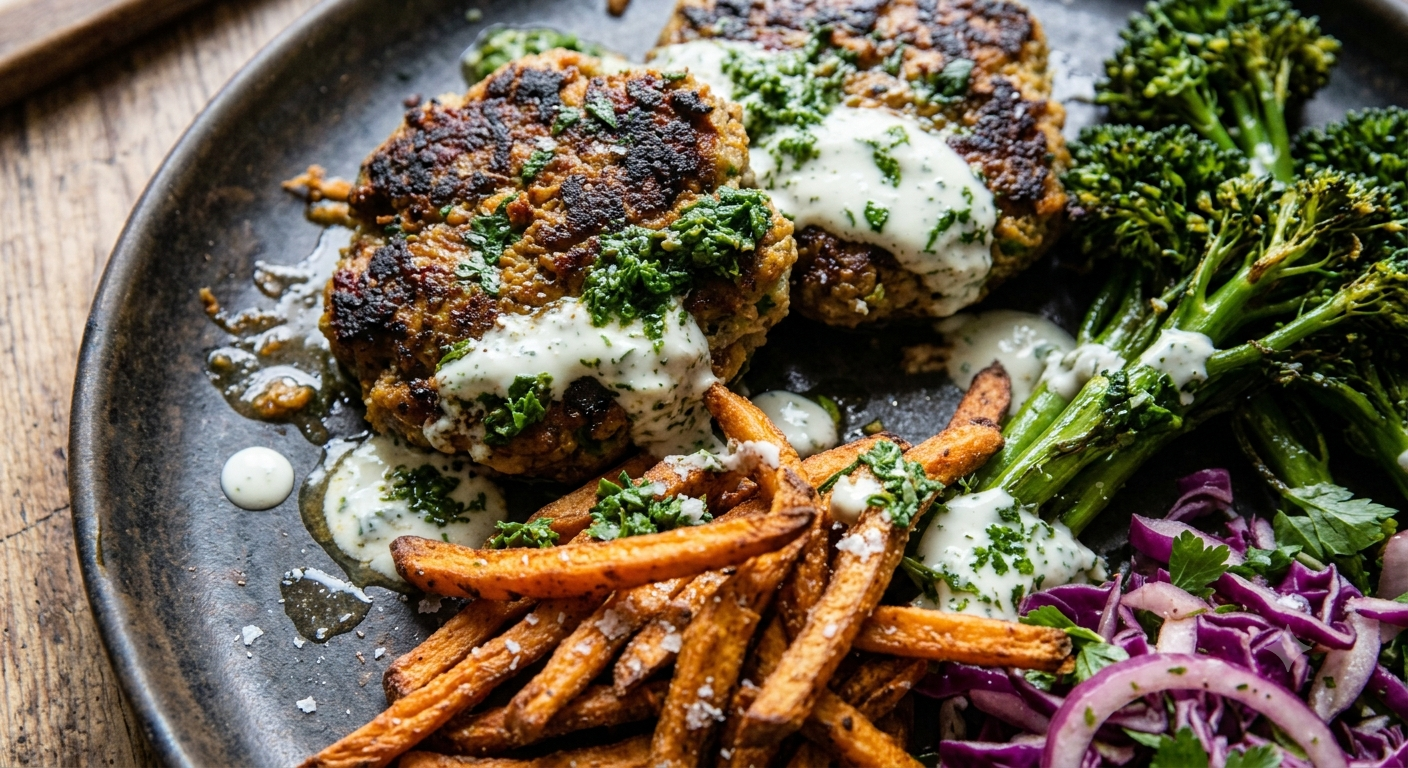
Ground pasture-raised lamb patties spiced with warming curry aromatics, plated with crispy purple and orange sweet potato matchsticks, charred broccolini, silky yogurt sauce, vivid parsley-preserved lemon sauce, and a raw purple cabbage slaw with beet, apple, and quick-pickled red onion — plus a spoonful of real raw sauerkraut on the side.
Yield: 4 servings · Active: 45 min · Total: 1 hr 15 min · Autumn-winter (peak root vegetable and cabbage season) · Best eaten: early evening
Ingredients
Curried lamb patties (makes 8 patties, 2 per serving)
1½ lb ground pasture-raised lamb
4 garlic cloves, finely minced
1 tbsp fresh ginger, finely grated (essential for anti-nausea, anti-inflammatory support and traditional across every ancestral cycle-support tradition)
2 tsp curry powder (mild or hot, your preference)
1½ tsp ground cumin
1 tsp ground coriander
½ tsp ground Ceylon cinnamon
¼ tsp ground cardamom
¼ tsp ground turmeric
¼ cup fresh cilantro, finely chopped
2 tbsp fresh parsley, finely chopped
1½ tsp sea salt
½ tsp freshly cracked black pepper
2 tbsp pastured lard, tallow, or ghee (for pan-searing)
Crispy sweet potato matchsticks (purple + orange)
1 large orange sweet potato (Hannah, Garnet, or Beauregard), cut into ¼-inch matchsticks
1 large purple sweet potato (Japanese purple-skinned or Stokes Purple), cut into ¼-inch matchsticks
3 tbsp extra virgin olive oil or duck fat
1 tsp sea salt
½ tsp freshly cracked black pepper
½ tsp ground cumin
½ tsp ground Ceylon cinnamon
Pinch of ground turmeric
Broccolini
2 bunches broccolini (about 1 lb), trimmed
2 tbsp extra virgin olive oil
3 garlic cloves, thinly sliced
½ tsp sea salt
Squeeze of fresh lemon juice
Yogurt sauce
1 cup thick whole-milk grass-fed yogurt (Greek-style or Bulgarian; sheep or goat for A2 casein)
2 tbsp extra virgin olive oil
1 small garlic clove, finely minced or grated
Zest of ½ lemon
1 tbsp fresh lemon juice
2 tbsp fresh dill, finely chopped
1 tbsp fresh mint, finely chopped
¼ tsp sea salt
Pinch of freshly cracked black pepper
Parsley-preserved lemon sauce
1 cup fresh flat-leaf parsley leaves, packed
2 tbsp fresh mint leaves
1 preserved lemon, seeds removed, finely chopped (see homemade recipe below, or use store-bought)
1 small garlic clove
3 tbsp extra virgin olive oil
1 tbsp fresh lemon juice
¼ tsp sea salt
Pinch of freshly cracked black pepper
Optional: 1 tsp toasted cumin seeds
Purple cabbage slaw with beet, apple, and quick-pickled red onion
½ small purple (red) cabbage, thinly shredded (about 3 cups)
1 medium raw red beet, peeled and coarsely grated
1 small green apple (Granny Smith or Honeycrisp), thinly sliced or cut into matchsticks
½ small red onion, thinly sliced
2 tbsp apple cider vinegar (with the mother — Bragg's)
1 tbsp raw honey
2 tbsp extra virgin olive oil
2 tbsp fresh cilantro (or fresh dill), chopped
2 tbsp toasted pumpkin seeds
½ tsp sea salt
Pinch of freshly cracked black pepper
½ tsp toasted caraway or fennel seeds (optional)
Raw sauerkraut (served on the side as a fermented garnish)
½ cup real raw sauerkraut, store-bought or homemade (see note below)
Garnish
¼ cup toasted slivered almonds or chopped pistachios
Fresh pomegranate arils (optional, seasonal)
Additional fresh cilantro sprigs
Lemon wedges
Flaky sea salt
A drizzle of high-quality olive oil
Homemade Preserved Lemons
Preserved lemons are one of the great pantry investments — a jar keeps in the refrigerator for a year, and a single lemon transforms any Mediterranean, North African, or Middle Eastern dish. The process is fermentation, not preservation-with-vinegar — just lemons, salt, and time.
Ingredients (makes 1 quart jar):
6-8 organic Meyer lemons or regular lemons (Meyer lemons are ideal — thinner skin, more floral)
½ cup coarse sea salt (Baja Gold or another mineral sea salt)
Additional lemon juice, as needed to cover
Optional: 2 bay leaves, 6 whole black peppercorns, 1 dried chili
Method:
Wash the lemons thoroughly. Scrub with a stiff brush under hot water. Dry completely.
Cut the lemons. Quarter each lemon lengthwise, but don't cut all the way through — leave the lemon attached at the stem end so the quarters fan open like a flower.
Salt the lemons generously. Rub the interior of each lemon with a generous amount of sea salt (about 1 tbsp per lemon). Really pack the salt into the flesh.
Pack into a clean glass jar. Layer the salted lemons in a clean 1-quart glass jar, pressing down firmly with a wooden spoon or your fist as you go to release the lemon juices. Add 1 tbsp of additional salt between the layers. If using, tuck in bay leaves, peppercorns, and dried chili.
Add juice if needed. The lemons should be fully submerged in their own juice within 24 hours. If they're not fully submerged after a day, add freshly squeezed lemon juice until they're covered.
Ferment. Cap the jar and leave at room temperature for 3-4 weeks, shaking gently every few days. The lemons will soften, the peel will become tender and edible, and the flavor will deepen into something salty-briny-citrus-floral.
Store. Once fermented, refrigerate. Keeps up to 1 year.
How to use: Rinse briefly, remove the seeds, and finely chop the peel and flesh together. Add to sauces, dressings, tagines, roasted vegetables, or any dish that would benefit from concentrated bright lemon.
A note on real raw sauerkraut
Real sauerkraut is one of the simplest fermented foods to make and one of the most nutritionally valuable — but most commercial "sauerkraut" isn't real sauerkraut. Read labels carefully.
What to look for:
Ingredients: Just cabbage and salt. Sometimes caraway seeds, dill, or other spices. Nothing else.
Raw and unpasteurized: Sold in the refrigerated section (not shelf-stable). If it's shelf-stable, it's been pasteurized and the live cultures are dead.
Live cultures: Look for language like "raw," "unpasteurized," "live cultures," or "probiotic."
Trusted brands: Farmhouse Culture, Wildbrine, Cleveland Kitchen, Hawthorne Valley Farm, Fab Ferments, Ozuke, or local artisan fermenters.
To make your own (about $3 for a quart):
Finely shred 1 medium head of green or purple cabbage (about 2 lb).
Place in a large bowl and add 1½-2 tbsp coarse sea salt (about 2% of the cabbage weight).
Massage the cabbage with the salt for 5-10 minutes until it releases significant liquid.
Pack tightly into a clean glass jar, pressing down firmly so the cabbage is submerged in its own liquid. Leave 1 inch of headspace at the top.
Weight the cabbage down (a smaller jar filled with water, or a fermentation weight) so it stays submerged.
Cover loosely (a cloth held with a rubber band, or a fermentation lid) and leave at room temperature (65-72°F) for 1-4 weeks. Taste weekly — the longer it ferments, the tangier it gets.
Once it's tangy enough for your taste, cap tightly and refrigerate. Keeps 6+ months.
Avoid: Any sauerkraut with vinegar (that's pickled cabbage, not fermented), sugar, preservatives, or listed as "pasteurized" — all of these destroy or bypass the live cultures that make sauerkraut nutritionally valuable.
Method
Quick-pickle the red onion (start first)
Pickle the onion. In a small bowl, combine the thinly sliced red onion with 2 tbsp apple cider vinegar and a pinch of salt. Let sit at room temperature 20-30 minutes while you prep everything else. The onion will turn bright pink and lose its harshness.
Preheat and prep the sweet potato matchsticks
Preheat the oven. Heat the oven to 425°F (220°C). Line a large sheet pan with parchment paper (or use two sheet pans if you need to keep the purple and orange sweet potatoes separate for cleaner presentation — the purple can bleed slightly onto the orange).
Toss the sweet potato matchsticks. In a large bowl, toss the orange and purple sweet potato matchsticks with 3 tbsp olive oil (or duck fat), salt, pepper, cumin, cinnamon, and turmeric. Spread on the sheet pan in a single layer — not crowded, so they crisp instead of steaming.
Roast until crispy. Roast 25-30 minutes, turning once halfway through, until the edges are deeply crispy and the centers are tender. The matchsticks should look like proper oven fries — golden orange and deep purple, with crisp edges.
Make the patties
Mix the patties. In a large bowl, combine the ground lamb, minced garlic, grated ginger, curry powder, cumin, coriander, cinnamon, cardamom, turmeric, chopped cilantro, chopped parsley, salt, and pepper. Mix gently with your hands until just combined — don't overmix or the patties will be tough.
Form the patties. Divide the mixture into 8 equal portions. Form each into a flat patty about ½-inch thick and 3 inches wide. The thinner shape cooks faster and produces a better sear-to-interior ratio than a meatball.
Sear the patties. Heat the pastured lard, tallow, or ghee in a large cast iron skillet over medium-high heat until shimmering. Add the patties in a single layer (work in two batches if needed — don't crowd the pan). Sear 3-4 minutes per side until deeply browned and cooked through to 155°F internal.
Rest the patties. Transfer to a paper towel-lined plate. Cover loosely with parchment to keep warm.
Cook the broccolini
Sauté the broccolini. Return the skillet to medium-high heat (with the residual patty fat). Add the trimmed broccolini and sliced garlic. Sauté 4-5 minutes, tossing occasionally, until the broccolini is bright green and tender-crisp with charred edges. Season with salt and a squeeze of lemon juice.
Make the yogurt sauce
Whisk the yogurt sauce. In a small bowl, whisk together the yogurt, olive oil, garlic, lemon zest, lemon juice, dill, mint, salt, and pepper until smooth. Taste and adjust seasoning. Refrigerate until ready to serve.
Make the parsley-preserved lemon sauce
Blend the sauce. In a food processor, pulse the parsley, mint, preserved lemon, garlic, olive oil, lemon juice, salt, pepper, and optional toasted cumin seeds until finely chopped but still vibrant green. Don't over-process to a smooth purée — you want visible texture.
Assemble the slaw
Combine the slaw. In a large bowl, combine the shredded purple cabbage, grated beet, sliced apple, and drained quick-pickled red onion (reserve the pickling liquid). Add 1 tbsp raw honey, 2 tbsp olive oil, 1 tbsp of the reserved pickling liquid, chopped cilantro, toasted pumpkin seeds, salt, pepper, and optional toasted caraway or fennel seeds. Toss to combine. Taste and adjust seasoning.
Plate the dish
Build the plate. Spoon a generous swoosh of yogurt sauce across one side of each warm plate. Place 2 lamb patties alongside.
Add the sweet potato and broccolini. Pile the crispy purple and orange sweet potato matchsticks and broccolini alongside the patties.
Add the slaw and sauerkraut. Place a small mound of the purple cabbage slaw on the plate. Add a small spoonful of real raw sauerkraut alongside — this is the live fermented element.
Finish with parsley sauce. Drizzle the parsley-preserved lemon sauce generously over the patties and across the plate.
Garnish. Scatter toasted almonds or pistachios, fresh pomegranate arils (if using), and additional cilantro sprigs across the plate. Add a lemon wedge to the side. Drizzle with high-quality olive oil and finish with a pinch of flaky sea salt.
Serve immediately.
Variations
With cauliflower rice base: Serve the patties and vegetables over a bed of cilantro-coconut cauliflower rice for a more substantial dinner (see Tikka Masala over Cilantro Coconut Cauliflower Rice recipe for the base). This turns the plate into a bowl and adds a mild grain-free starch that soaks up the sauces.
With grilled halloumi or feta: Add cubes of grilled halloumi or large crumbles of grass-fed feta to the plate for additional protein and salty richness. Bulgarian or Greek sheep's milk feta is exceptional.
With ground beef or other grass-fed/pasture-raised meat: Substitute the lamb with grass-fed ground beef, pasture-raised ground turkey (dark meat), pasture-raised ground pork, or a blend. Each has slightly different flavor characteristics — beef is milder and richer, turkey is lighter, pork is subtly sweet. Same spice blend works across all of them.
Sourcing
Pasture-raised ground lamb. From a farmers' market, pasture-raised meat CSA, or specialty butcher. Reliable shipped sources: White Oak Pastures, Grass Roots Farmers' Cooperative, US Wellness Meats, Shepherd Song Farm, Fossil Farms. Heritage breeds (Icelandic, Katahdin, Dorper) are exceptional when accessible. Look for a bright red color and clean smell — not gamy or off-scented.
Alternative meats (for variations): For grass-fed beef — White Oak Pastures, Crowd Cow, US Wellness Meats. For pasture-raised turkey or pork — same sources. Heritage-breed producers deliver meaningfully more flavor than commodity meat.
Sweet potatoes (purple and orange). Hannah (creamy, less sweet), Japanese purple-skinned (dense, sweet), Stokes Purple (deep purple flesh throughout), Garnet (moist, orange), or Beauregard (classic orange). From a farmers' market or organic produce section. Look for firm potatoes with no soft spots.
Broccolini. Look for bright green stems and tightly-closed florets. From a farmers' market or organic produce section. Substitute broccoli rabe (rapini, slightly more bitter) or gai lan (Chinese broccoli) if broccolini isn't available.
Whole-milk grass-fed yogurt. Bellwether Farms sheep yogurt (A2 casein, exceptional), Redwood Hill Farm goat yogurt (A2 casein, tangy), Maple Hill grass-fed cow yogurt, or homemade from raw milk. Look for traditionally strained yogurt with live cultures. Avoid low-fat or "Greek-style" yogurt with added stabilizers.
Fresh herbs (cilantro, parsley, mint, dill). From a farmers' market or windowsill pot for the freshest aromatic oils. Fresh is essential — dried doesn't work in the sauces.
Purple (red) cabbage. Firm, heavy heads with tight leaves and vibrant color. From a farmers' market or organic produce section.
Raw red beet. Small-to-medium beets with firm flesh and no soft spots. If tops are still attached, the beets were recently harvested (good sign). Reserve beet tops for another use (sauté like chard).
Real raw sauerkraut. Refrigerated section only — never shelf-stable. Look for ingredients that are just cabbage and salt (sometimes caraway, dill, or other spices are fine). Trusted brands: Farmhouse Culture, Wildbrine, Cleveland Kitchen, Hawthorne Valley Farm, Fab Ferments, Ozuke. Or make your own from the recipe above (about $3 for a quart jar).
Preserved lemon. Traditional Moroccan-style. Look for single-ingredient preserved lemons (just lemons and salt). Sources: New York Shuk (small-batch), or homemade from the recipe above (best option — a single jar lasts a year).
Curry powder. Look for artisanal single-blend curry powders. Diaspora Co. is the benchmark for single-origin spice quality; their turmeric-forward blends are exceptional. Burlap & Barrel and Spicewalla are also excellent. Freshly ground from whole spices is even better.
Whole Indian spices (cumin, coriander, cardamom, turmeric). Diaspora Co. (single-origin), Burlap & Barrel, or Spicewalla. Freshly ground from whole spices is meaningfully brighter than pre-ground.
Ground Ceylon cinnamon. True Ceylon cinnamon (not Cassia). Burlap & Barrel or Diaspora Co.
Pastured lard, tallow, or ghee. Rendered fat from pasture-raised animals. Fatworks, Epic Provisions, US Wellness Meats, or homemade. Ghee: 4th & Heart, Ancient Organics, or Pure Indian Foods.
Raw honey. Local, unfiltered, single-origin from a beekeeper or farmers' market.
Apple cider vinegar. Raw, unfiltered, with the mother. Bragg's is the benchmark.
Green apple. Granny Smith or Honeycrisp from a farmers' market or organic produce section.
Toasted pumpkin seeds (pepitas). Big Tree Farms, Anthony's Goods, or Terrasoul. Look for raw pumpkin seeds and toast them yourself in a 325°F oven for 4-5 minutes.
Toasted slivered almonds or pistachios. Sicilian Bronte pistachios are the benchmark when accessible; California-grown raw pistachios from Anthony's Goods work as a widely accessible substitute. For almonds, Living Tree Community or local California growers.
Single-estate extra virgin olive oil. Harvest-dated within the last 12 months, in a dark glass bottle. Greek, Lebanese, Portuguese, or Spanish single-origin works beautifully.
Sea salt. Baja Gold mineral sea salt for cooking, fleur de sel or Maldon for finishing.
Storage
Whole assembled plate: Best the moment it's made.
Cooked patties: Refrigerated up to 4 days, sealed. Freeze up to 2 months. Reheat gently in a covered skillet with a splash of bone broth, or in a 350°F oven for 8-10 minutes.
Crispy sweet potato matchsticks: Best the day cooked. Refrigerated up to 3 days but lose crispness. Reheat at 400°F for 6-8 minutes to recrisp.
Broccolini: Best the day cooked. Refrigerated up to 2 days.
Yogurt sauce: Refrigerated up to 4 days in a sealed jar. Stir before using.
Parsley-preserved lemon sauce: Refrigerated up to 5 days in a sealed jar with a thin layer of olive oil on top to prevent oxidation.
Purple cabbage slaw: Best within 4 hours of dressing (the beet and apple lose their crispness). Undressed components (cabbage, grated beet, sliced apple, pickled onion) keep refrigerated separately up to 3 days.
Real raw sauerkraut: Refrigerated up to 6 months (the fermentation continues slowly at cold temperatures — the tanginess deepens over time).
Homemade preserved lemons: Refrigerated up to 1 year in a sealed glass jar.
Meatball mixture (before cooking): Refrigerate up to 24 hours (the spices integrate more deeply). Freeze uncooked patties up to 2 months, well-wrapped between parchment sheets.
Nourishment Notes
Pasture-raised lamb — complete protein, B12, and CLA. Grass-fed pasture-raised lamb delivers concentrated complete protein, vitamin B12 (essential for nerve and cognitive function), heme iron, zinc, selenium, and conjugated linoleic acid (CLA — the fatty acid that's substantially higher in grass-fed vs. grain-fed animals). Lamb also has a distinctive fatty acid profile — higher omega-3 content than beef, with the branched-chain fatty acids characteristic of ruminant animals raised on pasture. The medium-chain fats in lamb are one of the reasons traditional cultures have prized it as a restorative food.
Warming curry spices — anti-inflammatory plant medicine. The curry powder, cumin, coriander, cinnamon, cardamom, and turmeric together deliver an exceptional load of bioactive compounds — curcumin (turmeric), cinnamaldehyde (cinnamon), cardamom's terpinene, cumin's thymoquinone, and coriander's linalool. Black pepper (in the curry blend) contains piperine, which enhances curcumin absorption by up to 2000% — this is why traditional Indian cooking always pairs turmeric with black pepper. All of these compounds have documented anti-inflammatory, digestive-supporting, and antimicrobial effects.
Sweet potatoes (orange and purple) — diverse carotenoids and anthocyanins. Orange sweet potatoes deliver exceptional beta-carotene (converted in the body to vitamin A), vitamin C, potassium, magnesium, and fiber. Purple sweet potatoes deliver a fundamentally different pigment profile — anthocyanins (the same class of compounds in blueberries and elderberries) with documented antioxidant and anti-inflammatory effects. Together they cover a wider spectrum of plant compounds than either alone. Cutting into matchsticks and roasting until crispy produces a texture that's honest fun to eat — vegetable-based "fries" that satisfy the same crispy-golden craving as commercial French fries without the industrial seed oils or refined starch.
Broccolini — sulforaphane and vitamin K. Broccolini delivers sulforaphane (the cruciferous compound with documented anti-inflammatory effects), vitamin K, vitamin C, folate, and the broader cruciferous family of plant compounds. The tender-crisp preparation preserves the sulforaphane more effectively than long roasting or boiling.
Whole-milk grass-fed yogurt — probiotic cultures and A2 casein. Traditional yogurt from grass-fed animals delivers live probiotic cultures (Lactobacillus, Bifidobacterium), easily digestible protein, calcium, phosphorus, and the fat-soluble vitamins A, D, K2. Sheep and goat yogurts specifically have only A2 beta-casein, which doesn't trigger the inflammatory response that A1 cow casein can in sensitive individuals.
Fresh parsley, cilantro, mint, and dill — vitamin K, chlorophyll, and detoxification support. Fresh herbs deliver exceptional vitamin K, chlorophyll, vitamin C, folate, and specific compounds — parsley's chlorophyll, cilantro's heavy metal binding compounds, mint's menthol (antimicrobial and digestive), and dill's carvone (antispasmodic). Used generously across the yogurt sauce, parsley-preserved lemon sauce, and the slaw, herbs are doing real nutritional work here — not just flavoring.
Preserved lemon — concentrated d-limonene and fermented citrus benefits. Preserved lemons deliver concentrated d-limonene (the essential oil that supports liver detoxification), plus the benefits of fermentation — live cultures, softened texture, and more bioavailable nutrients than fresh lemon. The 3-4 week fermentation process breaks down the harsh raw compounds while concentrating the beneficial ones.
Purple cabbage and beet — anthocyanins and betalains. Purple cabbage delivers anthocyanins (the same class of pigments in blueberries and elderberries) with documented antioxidant and anti-inflammatory effects. Red beets deliver betalains (unique to the amaranth family) — the pigments give beets their vivid color AND support nitric oxide production and vascular function. Both delivered raw here to preserve maximum bioactive compound density.
Real raw sauerkraut — live probiotic cultures and bioavailable minerals. Raw sauerkraut delivers Lactobacillus plantarum and other beneficial bacteria that support gut microbiome diversity. Fermentation also increases bioavailability of the cabbage's B vitamins, vitamin C, and mineral content. Traditional Eastern European, Korean, and Germanic cultures have relied on fermented cabbage as a winter probiotic source for thousands of years. The key is that it's truly raw — commercial pasteurized sauerkraut has dead cultures and delivers meaningfully less nourishment.
Apple, red onion, cilantro, and pumpkin seeds in the slaw. Green apple contributes quercetin (a polyphenol concentrated in the skin) and pectin fiber. Quick-pickled red onion contributes sulfur compounds, anthocyanins, and the softened enzymatic character of light fermentation. Cilantro contributes chlorophyll and heavy-metal-binding compounds. Toasted pumpkin seeds contribute zinc, magnesium, and the vegetable protein that complements the animal protein on the plate.
Extra virgin olive oil — oleic acid and polyphenols. Used generously across the sauces, the roasted vegetables, and the finishing drizzle, quality olive oil delivers oleic acid, olive polyphenols (hydroxytyrosol, oleuropein, oleocanthal with documented anti-inflammatory effects), and squalene. The fat also amplifies absorption of the fat-soluble compounds throughout the plate — the beta-carotene in the sweet potato, the curcumin in the patties, the anthocyanins in the cabbage, and the fat-soluble vitamins in the yogurt.
Support for the Female Infradian Rhythm
The female body operates on two overlapping biological rhythms — the daily 24-hour circadian rhythm, and the roughly 28-day infradian rhythm that governs the menstrual cycle. Both rhythms have distinct nutritional needs, and traditional food cultures across the world have honored these differences for thousands of years — feeding women specific warming, iron-rich, mineral-dense foods during menstruation, and restorative herbs during luteal phases.
This plate is deeply supportive of the female infradian rhythm, and particularly well-suited to the menstrual phase (Days 1-5 of the cycle). Here's what each phase gains from this plate:
Menstrual phase (Days 1-5) — deeply restorative. The lamb delivers highly bioavailable heme iron (2.7mg per 3.5-oz serving), which the body absorbs 15-35% more efficiently than plant iron — essential for replenishing iron stores lost through menstruation. Warming spices (turmeric, ginger, cinnamon, cardamom, cumin) support circulation and digestion during a phase when many women feel colder and slower. Turmeric's curcumin — activated by the piperine in black pepper for up to 2000% better absorption — is a documented anti-inflammatory that can help ease menstrual cramping. Fresh ginger is one of the best-studied natural anti-inflammatories for menstrual pain, with some studies showing it comparable to over-the-counter NSAIDs for dysmenorrhea. Sweet potato delivers slow-burning carbohydrates and about 950mg of potassium per serving (higher than a banana) — essential for fluid balance, muscle relaxation, and reducing menstrual cramping. Red beet supports nitric oxide production and healthy blood flow during the phase of active blood loss. Warm, cooked, grounding foods overall fit the menstrual-phase preference for nourishment that soothes rather than stimulates.
Follicular phase (Days 6-14) — supports rising energy. Cruciferous vegetables (broccolini, purple cabbage) deliver sulforaphane and DIM precursors that support Phase 2 liver detoxification — helping the liver metabolize and clear the estrogen that rises through this phase. Preserved lemon's d-limonene also supports liver detoxification. Fresh herbs (parsley, cilantro, mint, dill) support the liver and provide chlorophyll cofactors. The colorful raw slaw fits the follicular preference for fresh, bright, energizing foods.
Ovulatory phase (Days 15-17) — antioxidant support. The rainbow of pigments (beta-carotene in orange sweet potato, anthocyanins in purple sweet potato and purple cabbage, betalains in beet, chlorophyll in herbs) delivers dense antioxidant support during peak estrogen. Raw sauerkraut's live probiotic cultures support the estrobolome — the gut bacteria that metabolize estrogen.
Luteal phase (Days 18-28) — blood sugar stability and PMS support. Sweet potato's complex carbohydrates and potassium (about 950mg per serving) support the serotonin production that helps with luteal-phase mood. Pumpkin seeds in the slaw deliver about 156mg of magnesium per ounce — one of the highest food sources — supporting PMS relief, sleep quality, and cramp prevention. Lamb's B12 and B6 support progesterone synthesis. Yogurt's live cultures support gut serotonin production (95% of the body's serotonin is produced in the gut). Cinnamon and turmeric support blood-sugar regulation during a phase when progesterone increases insulin resistance.
The plate is particularly restorative during menstruation. If you're building a cycle-supportive meal rotation, this is one of the recipes to lean on during Days 1-5 — the combination of iron, warming spices, anti-inflammatory compounds, potassium, and grounding cooked vegetables is honestly what ancestral food cultures have always offered women during their moon-time.
— Anna aka Food Marshall