Blackberry Muffins with Cardamom & Cinnamon
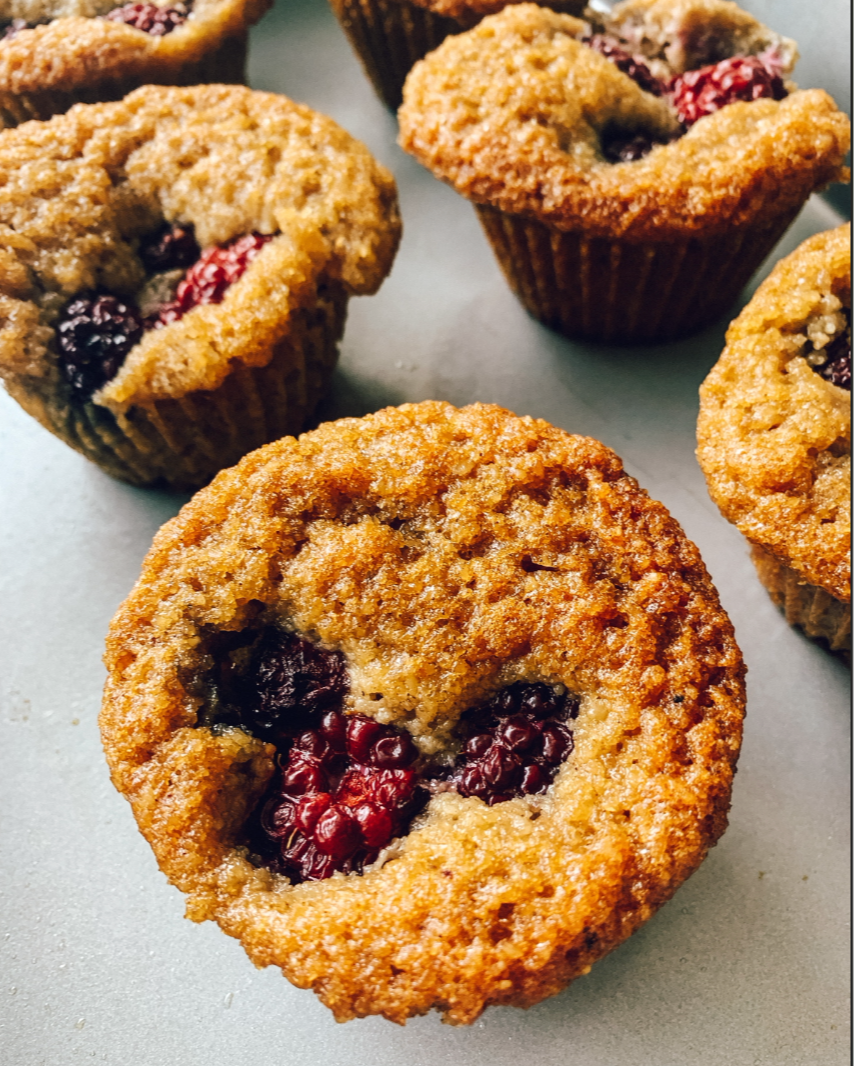
Tender grain-free muffins built around almond flour, real maple syrup, and grass-fed butter — warmed with cardamom and cinnamon and crowned with fresh blackberries that burst into jammy pools as they bake.
Yield: 9 muffins · Active: 15 min · Total: 40 min · Spring into late summer (peak blackberry season: June–September) · Cuisine: Grain-free, ancestral baking
A note from the kitchen
Cardamom and cinnamon are two of the oldest medicinal spices in the human kitchen — used for thousands of years across South Asian, Middle Eastern, and European traditions to support digestion, regulate blood sugar, and warm the body during cooler mornings. Layered into a tender almond-flour batter sweetened with real maple syrup, they turn what could be a generic muffin into something gently herbal and deeply warming.
As the muffins bake, the blackberries soften and release their dark, mineral-rich juice into the batter just beneath them, creating jammy pools that become the structural heart of each bite. Choose berries that are fully ripe — slightly soft to the touch, deep purple-black, almost dropping off the cane on their own. Underripe blackberries are sour and stay firm; fully ripe ones melt into the muffin perfectly.
Ingredients
For the muffins (makes 9):
2⅓ cups almond flour (finely-ground, blanched)
⅓ cup pure maple syrup (Grade A Dark Robust — see sourcing)
⅓ cup melted grass-fed butter (cooled slightly so it doesn't scramble the eggs)
2 large pasture-raised eggs (room temperature)
1 tsp ground cinnamon
½ tsp ground cardamom
½ tsp baking soda
¼ tsp sea salt
1 tsp pure vanilla extract (optional but recommended)
18–27 fresh blackberries (2–3 per muffin, for the topping)
For finishing (optional):
A small drizzle of raw honey over the warm muffins
A pinch of flaky sea salt
Fresh lemon zest
Method
Preheat the oven to 350°F. Line a 12-cup muffin tin with parchment paper liners or unbleached cupcake liners — you'll likely only fill 9 of the cups.
Melt the butter gently. In a small saucepan over low heat, melt the grass-fed butter. Let cool 5 minutes so it's warm but not hot — pouring hot butter into eggs will scramble them.
Mix the dry ingredients. In a large bowl, whisk together the almond flour, cinnamon, cardamom, baking soda, and sea salt until evenly combined. Break up any almond flour clumps with the back of a spoon.
Mix the wet ingredients. In a separate medium bowl, whisk together the eggs, maple syrup, cooled melted butter, and vanilla extract until smooth and glossy.
Combine. Pour the wet mixture into the dry mixture. Stir gently with a wooden spoon or spatula until just combined. The batter will be thick — closer to cookie dough than pourable batter. Don't overmix; almond flour develops a gummy texture when overworked.
Fill the liners. Using a large spoon or ice cream scoop, divide the batter evenly among 9 lined muffin cups. Each cup should be about ¾ full. Smooth the tops gently with the back of a spoon.
Top with blackberries. Press 2–3 fresh blackberries gently into the top of each muffin. They'll sink slightly as the muffins bake. If your blackberries are very large, halve them and use the cut sides facing up for prettier jammy pools.
Bake. Place the muffin tin in the preheated oven and bake 22–25 minutes, until the tops are deeply golden brown, the muffins have risen and set, and a toothpick inserted in the center comes out with just a few moist crumbs (not wet batter).
Cool completely in the pan. Remove the tin from the oven and place on a wire rack or the stovetop. Let the muffins cool completely in the pan, 30–40 minutes. This is structurally important — almond flour muffins firm up as they cool, and removing them too early will cause them to crumble. If you're in a hurry, place the entire muffin tin in the freezer for 10–15 minutes to speed up the cooling.
Finish (optional). Once cooled, drizzle each muffin with a tiny amount of raw honey, a few flakes of finishing sea salt, and a small grating of fresh lemon zest if you want to brighten the warm spice notes.
Serve warm or at room temperature.
Variations
Honey-sweetened version: Substitute the maple syrup with ⅓ cup + 1 tbsp raw honey. Add 3 tbsp full-fat coconut milk and 1 tbsp apple cider vinegar to the wet ingredients (the vinegar reacts with the baking soda for extra lift).
Halve the blackberries and fold ¾ cup into the batter rather than topping with whole berries. Bake at 350°F for 22–25 minutes.
Orange-cardamom variation: Add the zest of 1 organic orange to the wet ingredients. The citrus brightens the cardamom beautifully. Especially lovely in winter when oranges are at peak season.
Lemon-blackberry version: Add the zest of 1 organic lemon and 1 tbsp fresh lemon juice to the wet ingredients. Bright, summery, lovely with afternoon tea.
Different berries: Substitute the blackberries with raspberries, blueberries, or chopped strawberries — all at peak ripeness. Mixed berries also work beautifully. Frozen berries can be used (don't thaw) but increase bake time by 3–5 minutes.
Dairy-free variation: Substitute the grass-fed butter with extra-virgin olive oil or melted coconut oil. The olive oil version is slightly more savory and Mediterranean; the coconut oil version is sweeter and softer.
With added warming spices: Add ¼ tsp freshly grated nutmeg, ¼ tsp ground ginger, or a pinch of ground clove for deeper autumn-winter warmth.
Mini muffins: Use a mini muffin tin lined with mini parchment liners. Bake at 350°F for 15–18 minutes. Makes about 24 mini muffins — perfect for kids or a brunch board.
With chia seeds: Stir 1 tbsp chia seeds into the dry ingredients for extra structure, fiber, and omega-3s.
Sourcing
The best version of any ingredient comes from a producer you know personally — a local farmer, grower, beekeeper, or maple-syrup producer whose name you can speak.
Almond flour: What to look for:
Finely-ground, blanched almond flour (not almond meal — which is coarser and contains the skins, structurally different for baking).
Organic when possible — almonds are a heavily-sprayed crop conventionally.
Recently milled (almond flour goes rancid faster than people realize — smell test: should smell sweet and faintly nutty, never musty or bitter).
Stored cool in the refrigerator or freezer once opened — extends shelf life dramatically.
Avoid pre-mixed "almond flour blends" with added starches, gums, or non-almond fillers.
Pure maple syrup: What to look for:
100% pure maple syrup — the only ingredient on the label should be "maple syrup."
Grade A Dark or Grade A Very Dark (Robust or Strong flavor) — these have deeper maple flavor and slightly higher mineral content than the lighter grades. The deeper grades are also less expensive, despite carrying more nutrient density.
From a small producer or sugar shack you can trace — Vermont, New Hampshire, Maine, upstate New York, Wisconsin, Quebec, or local farmers' market vendors during sugaring season (February–April).
In a glass bottle when possible (extends shelf life and avoids plastic leaching).
Refrigerate after opening.
Avoid "pancake syrup" or "maple-flavored syrup" — these are corn syrup with artificial flavoring, structurally nothing like real maple.
Grass-fed butter: What to look for:
From cows on pasture year-round when possible (grass-fed in spring/summer and hay-fed in winter is acceptable).
Cultured (fermented before churning) for the deepest flavor — but uncultured works too.
Deep yellow color — this is the visual indicator of grass-fed butter (yellow comes from beta-carotene in fresh grass; pale white butter indicates grain-fed cows).
High butterfat percentage (84%+ is European-style; 80% is standard American).
A small local farm or creamery you know is the gold standard. Ask whether the cows graze on pasture year-round.
Avoid commercial supermarket butter from confined-feedlot dairies (typically pale, lower butterfat, lower mineral content).
Pasture-raised eggs: What to look for:
"Pasture-raised," not "free-range" or "cage-free." "Pasture-raised" means the hens foraged on grass, bugs, and seeds outdoors. "Free-range" and "cage-free" are weaker industry terms that often mean very little real outdoor time.
Deep orange yolks — this is the visual indicator that the hens actually foraged. Pale yellow yolks indicate a confined hen on commercial feed.
From a local farmer at the farmers' market when possible — ask about the hens' diet, breed, and outdoor access.
Brown, blue, green, or speckled shells are signs of heritage hen breeds (though shell color alone isn't a quality indicator).
Avoid generic supermarket eggs, anything labeled only "natural," and eggs with weak, watery whites.
Fresh blackberries: What to look for:
Deep purple-black, plump, fully ripe — slightly soft to the touch but not mushy.
A visible bloom (the slight dusty coating) is a sign of freshness — washing removes it, so wash just before eating.
Local farmers' market or wild-foraged during peak season (June–September depending on your region).
Heirloom variety if available — flavor is dramatically deeper than commercial Marion or Boysenberry varieties.
Avoid berries with red or green tips (not fully ripe), white mold (spoiled), or visible bruising (won't hold up in baking).
Frozen organic blackberries are an excellent off-season substitute — don't thaw before adding to batter.
Cinnamon and cardamom: What to look for:
Ceylon cinnamon (also called “true cinnamon”) over cassia cinnamon — Ceylon has a more delicate flavor and dramatically lower coumarin content (cassia cinnamon contains compounds that can stress the liver in high doses). The bark of Ceylon cinnamon is paper-thin and curls into multiple layers; cassia is thicker and hollow.
Green cardamom pods (the most common, gentle floral-citrus flavor) over the less common black cardamom (smokier, more savory). Whole pods stored in an airtight container keep their oils far longer than pre-ground.
Freshly ground when possible — grind cardamom seeds and cinnamon sticks in a spice grinder or mortar and pestle just before using. The volatile oils that carry the flavor degrade fast once ground.
Single-origin and organic when possible.
Avoid pre-ground spices that have been sitting in pantries for years — they lose potency quickly. Smell test: should smell intensely aromatic, not flat.
Pure vanilla extract: What to look for:
“Pure vanilla extract” — never “imitation vanilla” or “vanilla flavoring” (these are synthetic vanillin from petroleum or wood pulp).
Madagascar Bourbon vanilla beans are the classic — rich, deep, classic vanilla flavor. Tahitian beans are more floral; Mexican beans are spicier.
In a dark glass bottle.
Alcohol-based (vodka, rum, or grain alcohol) is traditional; the alcohol burns off during baking. Alcohol-free vanilla extracts use glycerin and are an option for those avoiding alcohol entirely.
Avoid “natural vanilla flavor” — this is industrial vanillin derived from wood pulp, lignin, or castoreum.
Sea salt: What to look for:
Unrefined, solar-dried or hand-harvested. No anti-caking agents, no bleaching, no chemical processing.
Naturally moist — this is the visual indicator of preserved minerals.
Lower sodium content (under 35% sodium chloride) — mineral-rich sea salts have lower sodium and higher trace mineral content than refined varieties.
For baking: Baja Gold mineral sea salt — fine grain, mineral-rich
For finishing: fleur de sel — hand-harvested by skimming the delicate top layer of French salt pans (traditionally from Guérande, Île de Ré, or Camargue).
Avoid iodized table salt, anything with “anti-caking agents,” and mass-produced “Pink Himalayan” (often counterfeited and dyed).
Raw honey (for the variation and optional drizzle): What to look for:
Raw, unfiltered, and unheated (high heat destroys the enzymes and pollen that make raw honey medicinal).
Beeswax-capped or with visible pollen in the jar — signs of minimal processing.
From a local beekeeper at the farmers' market is the gold standard. Local honey carries pollen from your immediate region, which supports seasonal allergen adaptation.
Crystallization is normal and a sign of real raw honey — gentle warming in a hot water bath (never microwaved) returns it to liquid.
Avoid commercial supermarket honey labeled only “honey”— much of it has been ultra-filtered to remove pollen (so origin can't be traced) and may be cut with corn syrup.
Coconut milk (for the variation): What to look for:
Full-fat coconut milk in BPA-free cans or glass.
The shortest possible ingredient list — ideally just coconut and water, or coconut, water, and a small amount of guar gum (acceptable but not ideal).
Avoid coconut milk with carrageenan, gellan gum, polysorbate 80, or “natural flavors.”
Cartons of "coconut beverage" are not coconut milk — they're heavily diluted, sweetened, and structurally different from canned coconut milk.
Apple cider vinegar (for the variation): What to look for:
Raw, unfiltered, with the mother (the cloudy strands of natural fermentation cultures at the bottom of the bottle).
From whole pressed apples, not from concentrate.
Organic when possible — apples are a heavily-sprayed crop conventionally.
In a dark glass bottle.
Extra-virgin olive oil (for the variation): What to look for:
First cold-pressed (the only legitimate EVOO designation).
Harvest-dated within the last 12 months — this is the most important indicator of quality. EVOO degrades over time, and most rancid olive oils on shelves are simply old.
In a dark glass bottle (light degrades oil rapidly).
For baking, a milder, fruitier olive oil works better than peppery or intensely grassy varieties. The flavor of olive oil carries through into the muffin.
Avoid “light” or “extra-light” olive oil (refined) and any oil in clear plastic bottles.
Storage
Room temperature: Store in an airtight glass container at room temperature for 2 days.
Refrigerator: Up to 1 week, sealed in a glass container. The muffins firm up slightly when cold; bring to room temperature or warm gently in a low oven (250°F for 5 minutes) before eating.
Freezer: Up to 3 months. Wrap individual muffins in parchment paper, then place in a sealed glass container or freezer bag. Thaw at room temperature for 1 hour, or warm directly from frozen in a low oven for 8–10 minutes.
Pairs Well With
For the table: A cup of hot herbal tea (chamomile, rooibos, lemon balm, lavender, or a spiced chai with real cinnamon and cardamom) mirrors the spice notes of the muffin beautifully. For something colder, fresh-pressed lemonade with mint, or sparkling water with a slice of orange and a few crushed cardamom pods.
For a complete breakfast or brunch: Serve alongside soft-boiled or scrambled pasture-raised eggs, a small dollop of raw goat or sheep yogurt, fresh fruit (sliced peaches, figs, or whole berries depending on season), and a strong cup of coffee or matcha. The muffin becomes the carbohydrate-and-fat anchor of a complete grain-free brunch.
For an afternoon snack: One muffin alongside a small handful of raw nuts and a cup of bone broth or herbal tea makes a satisfying mid-afternoon pause without spiking blood sugar.
For the gathering: These are beautiful on a brunch board with a small bowl of raw goat yogurt, a drizzle of raw honey, fresh berries, sliced peaches, and a small wedge of raw cheese. The muffins travel well wrapped in parchment for picnics, hikes, or beach mornings.
Why This Muffin
The conventional bakery muffin has become a problematic breakfast in modern eating — refined wheat flour, industrial seed oils, white sugar, and “natural flavors” combined into something that spikes blood sugar dramatically, leaves the body inflamed, and disconnects entirely from any real seasonal or ancestral food tradition.
This is the same beloved muffin format, rebuilt with what the body actually recognizes as nourishment. Almond flour for protein, fat, and fiber. Real maple syrup for gentle sweetness without refined sugar. Grass-fed butter (or cold-pressed olive oil) for fat-soluble vitamins. Pasture-raised eggs for complete amino acids and choline. Real cinnamon and cardamom for warming spice medicine. Fresh seasonal blackberries for antioxidants and color.
Make them once and you'll understand why grain-free baking, done well, can be more satisfying than any conventional version.
— Anna aka Food Marshall