Fudge Balls and Squares: Six varieties of flavors
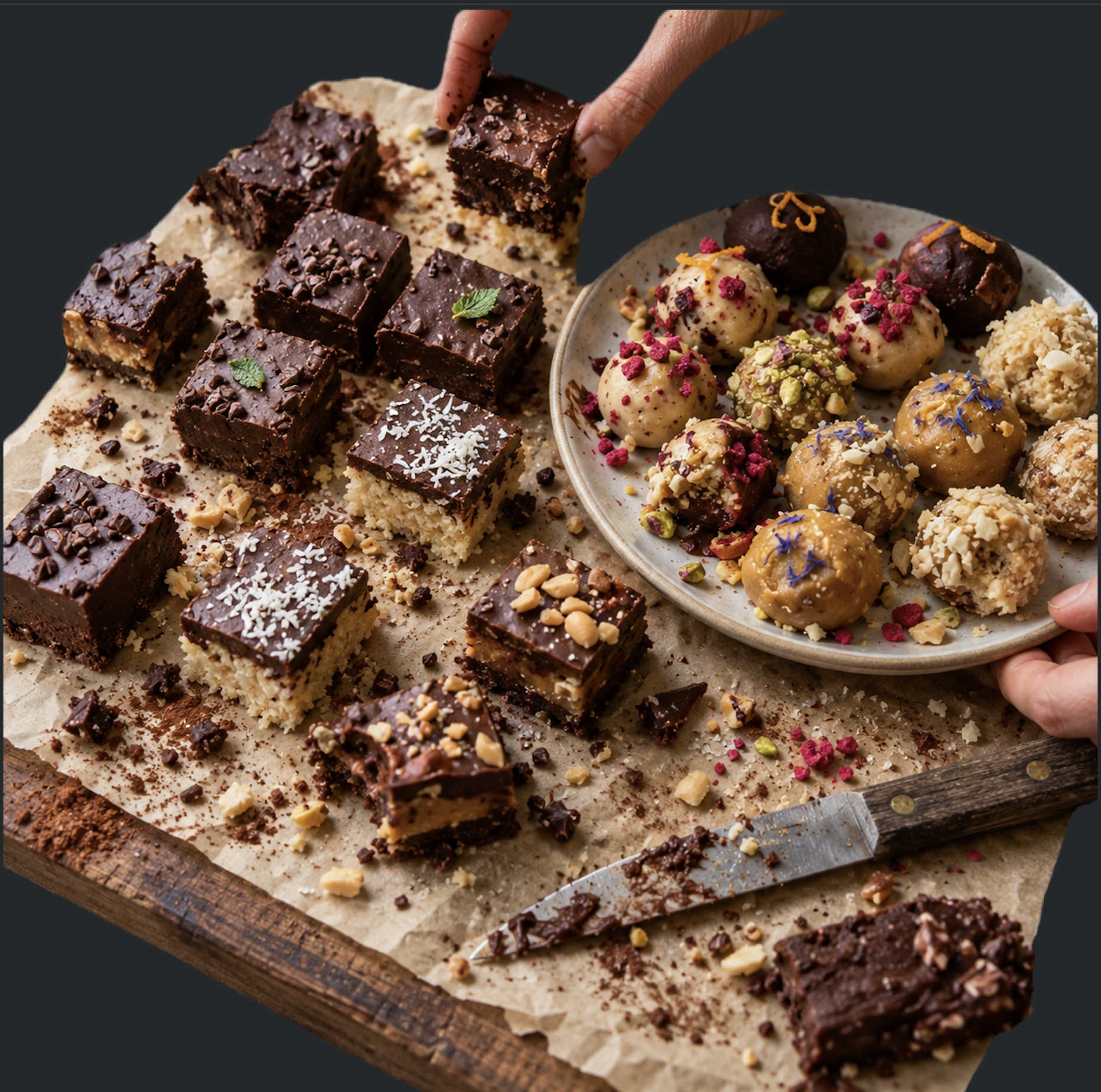
Yield: 12-16 pieces per recipe · Active: 15 min · Total: 45 min for Recipes 1-6 (including chilling); about 1½ hours for the layered Recipes 7 and 8 · Season: Foundational (year-round) · Best eaten: as an afternoon treat, post-workout snack, or midday dessert while the sun is up
One Method, Six Fudges (Recipes 1-6)
The layered Recipes 7 and 8 have their own method below.
Prepare a lined pan. Line an 8x8 baking pan (for squares) with parchment paper. For balls, prepare a plate or platter lined with parchment. If dates are dry or firm, soak in warm water for 5-10 minutes and drain thoroughly before using.
Pit the dates. Slice each date in half lengthwise and remove the pit. Discard pits.
Blend the base. In a high-speed blender or food processor, combine dates, coconut manna (or cocoa butter), and any liquid additions. Blend on high 60-90 seconds, scraping down the sides, until a smooth, thick paste forms. If the mixture is too thick, add a splash of filtered water (1-2 tbsp) to help it blend.
Add powders and flavorings. Add cacao powder (or omit for white chocolate versions), vanilla, sea salt, and any spices or medicinal powders. Blend another 30 seconds until fully incorporated.
Fold in mix-ins. Transfer to a bowl. Fold in nuts, dried fruits, petals, or any other add-ins by hand; you want the texture, not a puree.
Set. Press into the prepared 8x8 pan (for squares) or roll into 1-inch balls (for balls). Refrigerate at least 30 minutes before slicing or serving.
Storage. See Keeping Your Fudge Fresh at the end of the post for fridge, freezer, and countertop times.
Recipe 1: Vanilla Cacao Fudge
Yield: 12-16 pieces
Ingredients
1½ cups whole Medjool dates, pitted (about 12-15 dates)
½ cup coconut manna (softened, see note)
⅓ cup raw cacao powder
2 tsp pure vanilla extract (or the scraped seeds of ½ vanilla bean)
½ tsp Baja Gold sea salt
Optional additions
1 tbsp raw honey (if dates aren't quite sticky enough)
2 tbsp raw cacao nibs (fold in at the end for texture)
Pinch of Ceylon cinnamon
Method
Follow the master method above. This is your foundational fudge recipe, the base that every other flavor variation builds on.
Coaxing Coconut Manna Soft
Coconut manna is solid at room temperature. To soften: place the jar in a bowl of warm (not hot) water for 5-10 minutes, or gently warm in a low oven. Never microwave; it heats unevenly and can damage the fats.
Recipe 2: Orange Medicinal Fudge with Reishi and Cardamom
Yield: 12-16 pieces
Ingredients
1½ cups whole Medjool dates, pitted
½ cup coconut manna, softened
⅓ cup raw cacao powder
1½ tsp pure orange extract (or 1 tbsp fresh orange zest)
½ tsp ground cardamom
1-2 tsp reishi mushroom powder (start with 1 tsp; add more for deeper medicinal support)
2 tsp pure vanilla extract
½ tsp Baja Gold sea salt
Optional additions
Zest of 1 organic orange (fresh, in addition to extract)
2 tbsp raw cacao nibs
Pinch of Ceylon cinnamon
1 tbsp raw honey (optional)
Method
Follow the master method. Add all powders (cacao, cardamom, reishi) and extracts (orange, vanilla) at Step 4.
Reishi Brings the Deep Calm
Reishi (Ganoderma lucidum) is one of the most studied medicinal mushrooms, traditional in Chinese medicine for thousands of years for immune modulation, stress adaptation, and sleep support. The flavor is bitter-earthy, which the cacao and dates in this fudge balance beautifully. Look for organic single-ingredient reishi powder from producers like Sun Potion, Four Sigmatic, Om Mushrooms, or Real Mushrooms. Start with 1 tsp for gentle daily support; increase to 2 tsp for deeper adaptogenic effect.
Recipe 3: Raspberry Rose White Chocolate Fudge (with Pistachios)
Yield: 12-16 pieces
Ingredients
1½ cups whole Medjool dates, pitted
½ cup coconut manna, softened
¼ cup cocoa butter, melted (see note below)
2 tsp pure vanilla extract
½ tsp Baja Gold sea salt
Fold-in mix-ins (after blending)
⅓ cup freeze-dried raspberries, roughly crumbled (or freeze-dried strawberries, see variation)
⅓ cup California pistachios, shelled and roughly chopped
2 tbsp edible rose petals (organic, culinary grade)
Optional: 1 tsp rose water (add at the blending stage)
Method
Melt the cocoa butter. In a small heatproof bowl set over gently simmering water (double-boiler style), melt cocoa butter until fully liquid. Alternatively, place the cocoa butter in a small saucepan over the lowest possible heat until melted. Never let it exceed 100°F; cocoa butter is delicate.
Follow the master method with the dates, coconut manna, melted cocoa butter, vanilla, salt, and optional rose water. Blend until smooth.
Fold in mix-ins. Transfer to a bowl. Fold in crumbled freeze-dried raspberries, chopped pistachios, and rose petals by hand.
Set. Press into an 8x8 pan or roll into 1-inch balls. Refrigerate 30 minutes.
Swap in Strawberries for a Sweeter Rose
Substitute freeze-dried strawberries for the freeze-dried raspberries. Everything else stays the same. Strawberries bring a slightly sweeter, more classic flavor profile; raspberries bring a sharper, more sophisticated tartness.
Rose Petals Carry Centuries of Persian Sweetness
Look for organic culinary-grade dried rose petals, with no pesticides and no additives. Good sources include Anima Mundi, Mountain Rose Herbs, Frontier Co-op, or specialty Middle Eastern grocers. Persian and Bulgarian rose petals carry the deepest aromatic complexity. Rose petals have been traditional in Persian, Middle Eastern, and Indian sweets for centuries.
Recipe 4: Pistachio Tahini Caramel Fudge with Mixed Flower Petals
Yield: 12-16 pieces
Ingredients
1½ cups whole Medjool dates, pitted
⅓ cup coconut oil (unrefined, cold-pressed)
⅓ cup tahini (100% ground sesame, stone-ground preferred)
2 tsp pure vanilla extract
½ tsp Baja Gold sea salt
Fold-in mix-ins (after blending)
½ cup California pistachios, shelled and roughly chopped
2 tbsp mixed edible flower petals (rose, calendula, lavender, cornflower, chamomile; see sourcing below)
Optional: additional pinch of flaky sea salt on top of each piece
Method
Follow the master method using coconut oil instead of coconut manna, plus tahini. Blend until smooth and caramel-colored.
Fold in mix-ins. Transfer to a bowl. Fold in chopped pistachios and mixed flower petals by hand.
Set. Press into an 8x8 pan or roll into 1-inch balls. Refrigerate 30 minutes.
Optional finish. Sprinkle each square (before slicing) or each ball with a small pinch of flaky sea salt for a real caramel-salted finish.
Coconut Oil Turns This One to Caramel
Coconut oil gives a smoother, more caramel-like texture that complements the tahini. Coconut manna would add more fiber and body. Both work, but coconut oil is the right choice for the caramel character.
A Garden of Petals in Every Square
Look for organic culinary-grade dried flower petals with no pesticides. Anima Mundi has a beautiful "Ceremonial Flower Blend"; Mountain Rose Herbs offers individual dried petals to blend your own. Rose, calendula (marigold), lavender, cornflower, and chamomile are the traditional Middle Eastern and Mediterranean flower petals for sweet preparations. Persian rose petals carry the deepest floral aroma.
Recipe 5: Macadamia White Chocolate Fudge
Yield: 12-16 pieces
Ingredients
1½ cups whole Medjool dates, pitted
½ cup coconut manna, softened
¼ cup cocoa butter, melted
2 tsp pure vanilla extract (or scraped seeds of ½ vanilla bean)
½ tsp Baja Gold sea salt
Fold-in mix-ins (after blending)
¾ cup raw macadamia nuts, roughly chopped
2 tbsp unsweetened coconut flakes (toasted, for depth)
Optional: 2 tbsp chopped raw cocoa butter wafers, for pockets of white chocolate richness
Method
Toast the coconut flakes. Spread unsweetened coconut flakes on a dry skillet. Toast over medium heat for 2-3 minutes, tossing frequently, until golden and fragrant. Cool.
Follow the master method with dates, coconut manna, melted cocoa butter, vanilla, and salt.
Fold in mix-ins. Transfer to a bowl. Fold in chopped macadamia nuts, toasted coconut flakes, and optional cocoa butter pieces.
Set. Press into an 8x8 pan or roll into 1-inch balls. Refrigerate 30 minutes.
Macadamias Bring the Richest Fat of Any Nut
Macadamia nuts carry the highest ratio of monounsaturated fat of any nut (about 80% monounsaturated, mostly oleic acid, the fat that defines olive oil, plus rare palmitoleic acid). Valuable for hormone synthesis and cellular membrane health. Look for organic raw macadamias from Hawaii, Australia, or Kenya/Africa. Producers like Meadow Ridge Farms, Living Tree Community, or smaller producers at farmers' markets offer exceptional quality.
Recipe 6: Cacao Mint Fudge
Yield: 12-16 pieces
Ingredients
1½ cups whole Medjool dates, pitted
½ cup coconut manna, softened
⅓ cup raw cacao powder
1 to 1½ tsp pure peppermint extract (start with 1 tsp; add more for stronger mint), OR 3-4 drops food-grade peppermint essential oil
2 tsp pure vanilla extract
½ tsp Baja Gold sea salt
Fold-in mix-ins (after blending)
3 tbsp raw cacao nibs (adds real crunch and echoes the chocolate)
Optional: 1 tbsp finely chopped fresh mint leaves (for real herbal depth)
Optional: flaky sea salt to finish each piece
Method
Follow the master method. Add peppermint extract with the vanilla and other flavorings at Step 4. Fold in cacao nibs and optional fresh mint by hand after blending.
Choosing a Mint That Tastes Like Mint
Pure peppermint extract (single-ingredient, just peppermint oil in alcohol or glycerin) gives clean, honest mint flavor. Look for Nielsen-Massey, Frontier Co-op, or Simply Organic.
Food-grade peppermint essential oil (from producers like doTERRA, Mountain Rose Herbs, or Plant Therapy) is far stronger; a few drops go a long way. Only use essential oils clearly labeled "food-grade" or "internal use approved." Most essential oils sold for aromatherapy are not appropriate for consumption.
Fresh Leaves Take the Mint Deeper
Adding 1 tbsp finely chopped fresh mint leaves brings a real herbal complexity that dried extract alone can't match. Peppermint has the sharpest mint flavor; spearmint is more subtle and traditional in Middle Eastern cooking. Both work beautifully.
Mint, Magnesium, and a Calmer Belly
Peppermint is rich in menthol, traditional in Middle Eastern, Persian, and European cultures for digestive comfort. Combined with cacao's magnesium and dates' potassium, this is one of the most cellular-nourishing dessert-format snacks you can make. Peppermint oil is one of the best-studied herbs for digestive cramping and bloating, and small trials show it easing menstrual cramps too.
Recipe 7: Coconut Bounty Fudge
Yield: 12-16 pieces
Ingredients
Coconut center layer
¾ cup whole Medjool dates, pitted (about 6-8 dates)
¾ cup coconut manna, softened
½ cup unsweetened shredded coconut (finely shredded, not flakes)
1 tsp pure vanilla extract
¼ tsp Baja Gold sea salt
Chocolate coating layer
¾ cup whole Medjool dates, pitted
¼ cup coconut manna, softened
¼ cup raw cacao powder
2 tbsp coconut oil, melted
1 tsp pure vanilla extract
¼ tsp Baja Gold sea salt
Optional finish
2 tbsp unsweetened shredded coconut for sprinkling on top
Flaky sea salt
Method
Make the coconut center layer:
Line the pan. Line an 8x8 baking pan with parchment paper.
Blend the coconut layer. In a food processor, blend the coconut center ingredients (dates, coconut manna, shredded coconut, vanilla, salt) until fully combined and forming a thick paste, about 60-90 seconds. You want the shredded coconut visible but well-distributed.
Press into pan. Transfer to the prepared pan. Press firmly into an even layer (about ¾-inch thick). Refrigerate 15 minutes to firm.
Make the chocolate coating layer:
Blend the chocolate layer. In the same food processor (no need to clean), blend the chocolate coating ingredients (dates, coconut manna, cacao powder, melted coconut oil, vanilla, salt) until smooth and thick, about 90 seconds.
Layer over the coconut base. Remove the pan from the refrigerator. Spread the chocolate layer over the coconut layer in an even layer (about ¼-inch thick).
Chill. Refrigerate at least 30 minutes, ideally 1 hour, until fully set.
Finish and slice. Remove from pan using the parchment overhang. Sprinkle with additional shredded coconut and flaky sea salt. Slice into 12-16 squares.
Roll Them into Bounty Bites
For balls instead of squares:
Roll the coconut mixture into 1-inch balls. Refrigerate 15 minutes to firm.
Make a dipping chocolate: gently melt ¼ cup cocoa butter (or coconut oil) over low heat, then whisk in 3 tbsp raw cacao powder, 1-2 tbsp raw honey, and a pinch of Baja Gold until glossy and smooth.
Dip each ball into the chocolate coating using a fork. Transfer to a parchment-lined plate.
Sprinkle with shredded coconut immediately (before the chocolate sets).
Refrigerate 30 minutes to fully set.
Better Than Anything in the Checkout Aisle
Commercial Bounty bars are built on refined sugar, palm oil, hydrogenated fats, and industrial cocoa. This version brings Medjool dates' fiber-bound sweetness with cofactor minerals, coconut manna's medium-chain triglycerides (MCTs) and lauric acid, raw cacao's flavonoids and magnesium, and shredded coconut's traditional Southeast Asian and Caribbean cellular support. Coconut has been a daily food for centuries across Kerala, Sri Lanka, and the Pacific Islands.
Recipe 8: Peanut Snickers Fudge
Yield: 12-16 pieces
Ingredients
Caramel-peanut center layer
1½ cups whole Medjool dates, pitted (about 12-15 dates); these function as caramel
½ cup organic natural peanut butter (single-ingredient, just peanuts and salt if any)
¼ cup coconut manna, softened
1 tsp pure vanilla extract
¼ tsp Baja Gold sea salt
½ cup roasted unsalted organic peanuts, roughly chopped (fold in at the end for crunch)
Chocolate coating layer
¾ cup whole Medjool dates, pitted
¼ cup coconut manna, softened
¼ cup raw cacao powder
2 tbsp coconut oil, melted
1 tsp pure vanilla extract
¼ tsp Baja Gold sea salt
Optional finish
2 tbsp roasted chopped peanuts, for sprinkling on top
Flaky sea salt
Method
Make the caramel-peanut center layer:
Line the pan. Line an 8x8 baking pan with parchment paper.
Blend the caramel-peanut layer. In a food processor, blend the caramel ingredients (dates, peanut butter, coconut manna, vanilla, salt) until fully combined and forming a thick, caramel-like paste, about 90 seconds. You want it smooth and spreadable.
Fold in chopped peanuts. Transfer to a bowl. Fold in the chopped roasted peanuts by hand.
Press into pan. Press firmly into an even layer (about ¾-inch thick). Refrigerate 15 minutes to firm.
Make the chocolate coating layer:
Blend the chocolate layer. In the same food processor, blend the chocolate coating ingredients (dates, coconut manna, cacao powder, melted coconut oil, vanilla, salt) until smooth and thick.
Layer over the caramel-peanut base. Remove the pan from the refrigerator. Spread the chocolate layer over the caramel-peanut layer in an even layer (about ¼-inch thick).
Chill. Refrigerate at least 30 minutes, ideally 1 hour, until fully set.
Finish and slice. Sprinkle with additional chopped peanuts and flaky sea salt. Slice into 12-16 squares.
Roll Them into Snickers Bites
For Snickers-style balls:
Roll the caramel-peanut mixture into 1-inch balls. Refrigerate 15 minutes to firm.
Make a dipping chocolate: gently melt ¼ cup cocoa butter (or coconut oil) over low heat, then whisk in 3 tbsp raw cacao powder, 1-2 tbsp raw honey, and a pinch of Baja Gold until glossy and smooth.
Dip each ball into the chocolate coating using a fork. Transfer to a parchment-lined plate.
Sprinkle with chopped peanuts immediately.
Refrigerate 30 minutes to fully set.
Sourcing Peanuts You Can Trust
Look for organic natural peanut butter: single-ingredient (just peanuts and optional salt), no palm oil, no added sugars, no hydrogenated fats. Look for the oil separation on top of the jar; that's a sign of no added stabilizers.
Organic roasted unsalted peanuts should come from a trusted source. Peanuts can contain aflatoxin from mold contamination, so choose organic single-ingredient producers with quality standards.
Peanuts Earn Their Place as an Occasional Treat
Peanuts are polarizing in ancestral nutrition circles: technically legumes (not nuts), and they can contain aflatoxins if not sourced carefully. But peanuts have been a foundational ancestral food across West African, Southern American, and Southeast Asian cultures for centuries. When sourced organically and dry-roasted, they offer plant protein, resveratrol, niacin (B3), magnesium, and healthy fats. This recipe is a reasonable indulgence, not a daily food.
Swap to Almonds for a Cleaner Snickers
For those avoiding peanuts: Substitute almond butter for the peanut butter and roasted almonds for the peanuts. Everything else stays the same. Almonds bring vitamin E, magnesium, and monounsaturated fats, a cleaner choice for those with peanut sensitivity or aflatoxin concerns.
Fudge for Every Phase of Your Cycle
The infradian rhythm is a woman's monthly cycle, and each phase asks for something a little different.
Menstrual phase (Days 1-5):
Vanilla Cacao is ideal: cacao is rich in magnesium (about 130mg per ounce), valuable for cramp reduction.
Orange Medicinal is deeply supportive: reishi's adaptogenic support during a phase when the body is in restoration mode.
Cacao Mint is a natural fit: peppermint supports digestive comfort during PMS-adjacent bloating.
Follicular phase (Days 6-12):
Raspberry Rose White Chocolate is ideal: anthocyanins from raspberries during rising cellular energy.
Cacao Mint suits this phase too: bright, energizing, matches rising follicular clarity.
Ovulatory phase (Days 13-16):
Pistachio Tahini Caramel is ideal: pistachios carry vitamin B6 to support the progesterone rise that follows ovulation.
Macadamia White Chocolate is a lovely match: monounsaturated fats support hormone synthesis at ovulation.
Luteal phase (Days 17-28):
Vanilla Cacao is ideal: cacao's magnesium supports luteal-phase mood and cramp prevention.
Peanut Snickers works if you need to satisfy luteal cravings: the peanut butter and date combination hits the sweet-savory craving that's real during luteal.
Coconut Bounty earns its place here: dark chocolate and coconut make a satisfying luteal indulgence.
Keeping Your Fudge Fresh
Refrigerated: Up to 2 weeks in a sealed container. The fudge sets firm when cold and softens slightly at room temperature; take it out 5-10 minutes before serving for best texture.
Frozen: Up to 3 months in a sealed container. Thaw in the refrigerator overnight.
Room temperature (cool cupboard, under 68°F): Up to 4 days. Above 68°F the coconut manna and cocoa butter soften and the fudge loses its shape.
Best eaten within 2 weeks for peak flavor and texture.
Pairs Well With
A glass of cold raw milk, a cup of rose or hibiscus tea, a mug of warm ceremonial cacao, or a bowl of whatever fruit is in season.
Stocking the Fudge Pantry
Whole Medjool dates: soft, plump, deeply sweet. Peak-season fresh dates hold more nutrients than dried. California producers (Bautista Family Farms, Oasis Date Gardens, Rancho Meladuco) or Middle Eastern producers offer exceptional quality. Easy to find at natural grocers, Middle Eastern grocers, and farmers' markets.
Coconut manna (coconut butter): organic, single-ingredient. Try Nutiva Organic Coconut Manna, Artisana Organic Coconut Butter, or Kelapo Coconut Butter. Look for jars where the coconut fat and fiber are visible together (not separated).
Cocoa butter (for white chocolate versions): organic, single-ingredient, food-grade. Look for cocoa butter labeled specifically as edible (not just for cosmetics). Good sources include Cacao Barry (Belgian), Guittard (California), or Terrasoul Superfoods.
Raw cacao powder: single-ingredient, unroasted, organic. Try Navitas Organics, Sunfood, or Terrasoul Superfoods.
Raw cacao nibs (optional): single-ingredient, unroasted, organic. Adds real texture.
Unrefined coconut oil (for pistachio tahini caramel recipe): cold-pressed, single-ingredient. Nutiva, Barlean's, Dr. Bronner's, or Kelapo.
Pure vanilla extract: single-ingredient (just vanilla and alcohol or vegetable glycerin), no added sugars. Madagascar bourbon or Tahitian vanilla from producers like Nielsen-Massey, Rodelle, or Singing Dog.
Vanilla beans (optional, for premium version): split whole beans from Madagascar or Tahiti. Scrape the seeds directly into the recipe.
Tahini: 100% ground sesame, stone-ground preferred (traditional Palestinian or Lebanese producers). Look for Whole Foods 365, Once Again, Soom Foods, or Mighty Sesame.
California pistachios (raw, shelled): organic. Setton Farms, or smaller California family farms at farmers' markets. Avoid roasted pistachios (typically roasted in industrial seed oils).
Raw macadamia nuts: organic, from Hawaii, Australia, or Kenya/Africa. Meadow Ridge Farms, Living Tree Community, or smaller producers at farmers' markets.
Freeze-dried raspberries or strawberries: organic, single-ingredient (no added sugar). Easy to find at Trader Joe's, Whole Foods 365, or Karen's Naturals.
Edible rose petals: organic culinary-grade. Anima Mundi, Mountain Rose Herbs, Frontier Co-op, or specialty Middle Eastern grocers. Persian and Bulgarian rose petals are exceptional.
Mixed edible flower petals (rose, calendula, lavender, cornflower, chamomile): organic culinary-grade. Anima Mundi has a "Ceremonial Flower Blend"; Mountain Rose Herbs offers individual dried petals to blend.
Reishi mushroom powder: organic, single-ingredient. Sun Potion, Four Sigmatic, Om Mushrooms, or Real Mushrooms.
Ground cardamom: organic, non-irradiated, single-origin. Guatemalan or Sri Lankan (Ceylon) cardamom has the most complex flavor.
Ceylon cinnamon: true Ceylon cinnamon (not Cassia). Frontier Co-op, Simply Organic, or specialty spice suppliers.
Orange extract: single-ingredient (pure orange oil in alcohol or glycerin), no artificial flavors. Nielsen-Massey or Simply Organic.
Rose water (optional for rose recipes): single-ingredient, distilled from rose petals. Middle Eastern or Persian producers make the most aromatic versions.
Raw honey (optional): local, unfiltered, single-origin.
Baja Gold sea salt for the recipe base; flaky sea salt (fleur de sel or Maldon) for finishing.
Nourishment Notes
Whole Medjool dates: potassium, magnesium, fiber, copper, manganese, gentle sweetness. Dates carry about 690mg potassium per 100g (more than a banana), fiber (both soluble and insoluble), magnesium, copper, and manganese. The natural sugars are fiber-bound and don't spike blood sugar the way refined sugar does. Traditional across Middle Eastern, North African, and California cultures as ceremonial and daily food. Long-standing ancestral use as women's health support during menstruation, postpartum, and hormonal transitions.
Coconut manna (coconut butter): MCTs, lauric acid, fiber, traditional Southeast Asian and Caribbean cellular support. Coconut manna is rich in medium-chain triglycerides (metabolized differently than long-chain fats, used quickly for cellular energy), lauric acid (with documented antimicrobial effects), fiber, and traditional coconut cellular support. Far more nutrient-dense than coconut oil alone (which is just the extracted fat).
Cocoa butter (for white chocolate versions): oleic acid, palmitic acid, stearic acid, small amount of cocoa flavonoids. Cocoa butter offers oleic acid and stearic acid (a heart-neutral saturated fat that doesn't raise cholesterol in most people), plus small amounts of the flavonoids that give cocoa its color.
Raw cacao: flavonoids (particularly epicatechin), magnesium, iron, theobromine, gentle stimulant. One of the highest antioxidant food sources measured. Raw cacao is exceptionally rich in flavonoids, magnesium (about 130mg per ounce, valuable for luteal-phase mood and cramp prevention), iron, and theobromine (a gentle stimulant without caffeine's crash). Traditional across Mesoamerican cooking as both food and medicine.
Coconut oil (for pistachio tahini caramel): MCTs, lauric acid, traditional Southeast Asian cellular support.
Tahini: sesame lignans, calcium, magnesium, vitamin E. Sesame carries lignans (sesamin and sesamolin) that support hormone balance and estrogen metabolism, particularly for female cycle support. Sesame is also one of the highest plant sources of calcium (about 88mg per tablespoon of tahini) and magnesium (about 26mg per tablespoon). Stone-ground traditional tahini offers more nutrition than commodity supermarket versions.
California pistachios: vitamin B6, magnesium, monounsaturated fats, vitamin K, potassium. Pistachios are rich in vitamin B6 (essential for the progesterone rise after ovulation and neurotransmitter function), magnesium (valuable for luteal-phase mood and cramp prevention), monounsaturated fats, and one of the highest protein contents of any nut.
Macadamia nuts: highest ratio of monounsaturated fat of any nut (about 80% monounsaturated, mostly oleic acid, plus rare palmitoleic acid), thiamine, manganese. Valuable for hormone synthesis and cellular membrane health. Traditional across Hawaiian, Australian, and now Kenyan cultures.
Freeze-dried raspberries or strawberries: anthocyanins, vitamin C, ellagic acid, quercetin. Freeze-drying preserves the anthocyanins far better than heat-drying. Berries offer exceptional antioxidant support with almost no calories.
Reishi mushroom powder (Ganoderma lucidum): triterpenes, polysaccharides, beta-glucans, adaptogenic support. Traditional across Chinese medicine for thousands of years. Documented benefits include immune modulation, stress adaptation, sleep support, and gentle liver support. Steady daily adaptogenic support.
Orange extract and zest: d-limonene, hesperidin, aromatic warmth. Orange brings d-limonene supporting Phase 2 liver detoxification, hesperidin (a citrus flavonoid), and traditional aromatic warmth.
Rose petals: traditional Persian and Middle Eastern gentle floral support. Rose petals carry polyphenols and traditional aromatic support. Used across Persian, Middle Eastern, and Indian sweets for centuries.
Mixed edible flower petals (rose, calendula, lavender, cornflower, chamomile): full-spectrum aromatic and antioxidant support. Traditional across Middle Eastern, Mediterranean, and Persian cooking. Calendula specifically offers anti-inflammatory support; chamomile supports gentle nervous system calm.
Cardamom: cineole, terpineol, aromatic warmth, digestive support. Traditional across Middle Eastern, Indian, and Scandinavian cooking for centuries. Cardamom brings documented digestive support and gentle warming energy.
Ceylon cinnamon: cinnamaldehyde, blood-sugar support. Ceylon carries cinnamaldehyde with lower coumarin content than Cassia, making it safer for regular consumption.
Pure vanilla extract: vanillin and 250+ aromatic compounds. Adds flavor complexity with almost no calories.
Rose water (optional): traditional Middle Eastern aromatic support.
Toasted coconut flakes: MCTs, lauric acid, gentle sweetness, texture.
Baja Gold sea salt: over 90 trace minerals. Small pinch enhances the natural sweetness and improves electrolyte balance.
Raw honey (optional): trace minerals and antimicrobial enzymes.
— Anna aka Food Marshall