Miso Cod Collard wrap with grilled seasonal veggies
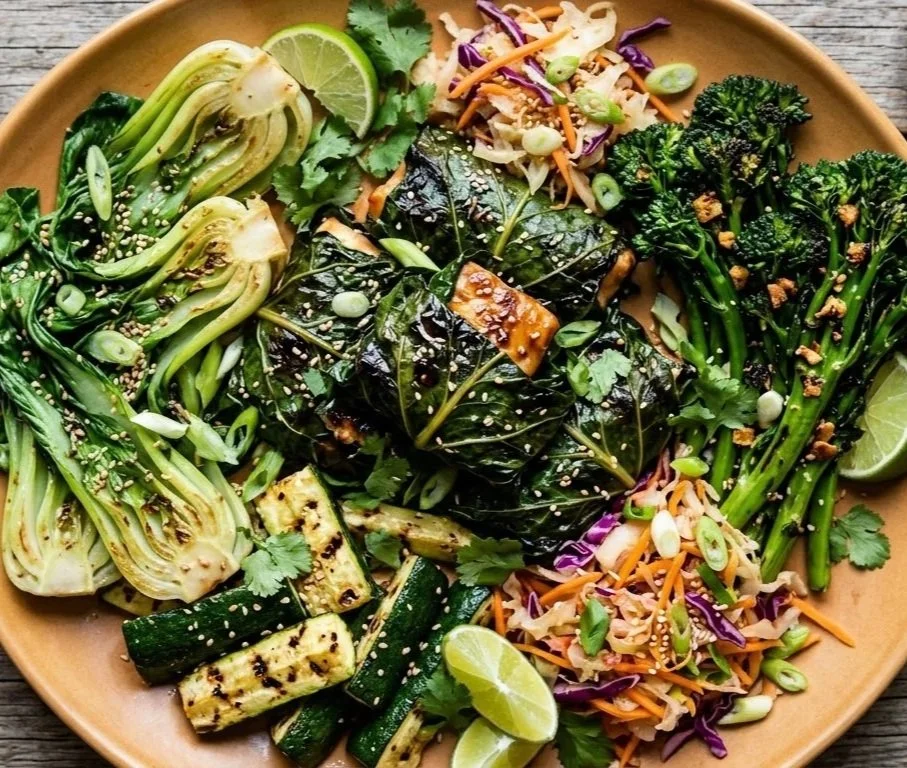
Complete Menu
Miso-Marinated Cod in Blanched Collard Wraps
Ginger Baby Bok Choy
Char-Grilled Summer Zucchini
Blistered Broccolini with Garlic and Lemon
Cabbage-Carrot Kraut (store-bought Wildbrine or Farmhouse Culture)
Optional accompaniments: toasted sesame seeds, sliced scallions, fresh cilantro, nori strips, additional coconut aminos, fresh lime wedges.
Fish Choice: Black Cod vs. Regular Cod
Two fish options that deliver different experiences:
Wild-Caught Black Cod (Sablefish) — The Traditional Choice
Pros:
Traditional saikyo yaki fish (Nobu-style, classical Japanese preparation)
Exceptionally high fat content — one of the highest omega-3 profiles of any fish
Uniquely suited to sweet-savory miso marinade — the fatty flesh caramelizes beautifully
Meaningfully more silky, buttery texture than regular cod
Deep pink-orange flesh delivers restaurant-elegant presentation
Cons:
Meaningfully more expensive ($25-35/lb typical retail)
Less widely available (specialty fishmongers, wild seafood shippers)
Sometimes only available frozen (which is honestly fine — frozen-at-sea black cod is exceptional)
Wild-Caught Regular Cod (Atlantic or Pacific) — The Accessible Choice
Pros:
Widely accessible at natural grocers, seafood counters, and shippers
Meaningfully more affordable ($10-18/lb typical retail)
Mild, flaky, takes on the character of the miso marinade beautifully
Leaner (higher protein density per calorie)
Fresh availability more consistent
Cons:
Less silky texture than black cod
Lower fat content means less caramelization during broiling
Cooks faster (easy to overcook if not watched carefully)
Slightly less traditional to the saikyo yaki technique
My honest recommendation: If you can source and afford black cod, honestly go with black cod — the traditional technique was developed for a specific fatty fish. If not, regular cod delivers a beautiful home-cooked version with honest ingredients. Both work.
Recipe 1 — Miso-Marinated Cod in Blanched Collard Wraps
Yield: 4 servings · Active: 15 min (plus 24-48 hr marinade) · Total: 25 min cooking + 5 min wrapping
Ingredients
Fish (choose one):
4 wild-caught black cod (sablefish) fillets (about 6 oz each, skin on) — traditional choice
OR 4 wild-caught cod fillets (about 6-8 oz each, Atlantic or Pacific, skin on or off) — accessible choice
Miso marinade (works for both fish)
½ cup white miso paste (organic, unpasteurized)
3 tbsp raw honey
2 tbsp raw apple cider vinegar
2 tbsp toasted sesame oil
1 tbsp fresh ginger, finely grated
2 garlic cloves, finely grated
Zest of ½ lemon
Collard wraps
8 large collard leaves (2 per wrap, or 1 per wrap for larger leaves)
Large pot of salted boiling water
Large bowl of ice water
To finish
2 tbsp toasted white or black sesame seeds
3 scallions, thinly sliced
Fresh cilantro
Lime or lemon wedges
Optional: 2 tbsp coconut aminos (traditional drizzle)
Method
Marinate the fish (24-48 hours ahead):
Make the marinade. In a small bowl, whisk together white miso, raw honey, apple cider vinegar, toasted sesame oil, grated ginger, grated garlic, and lemon zest until smooth.
Marinate. Pat fish fillets completely dry. Place in a glass container. Spread miso marinade generously over all sides (about 2 tbsp per fillet). Cover tightly. Refrigerate:
Black cod: 24-48 hours (48 delivers meaningfully deeper caramelization)
Regular cod: 12-24 hours (regular cod is more delicate and doesn't need as long)
Prep the collard leaves:
Trim and blanch. Trim the thickest part of the collard stem with a sharp knife (don't cut into the leaf) to make it more pliable. Bring a large pot of salted water to a boil. Prepare a large bowl of ice water.
Blanch. Working with 2-3 leaves at a time, submerge in boiling water for 30-45 seconds — just until the leaves turn a vibrant green and are pliable but still firm. Immediately transfer to ice water to stop the cooking.
Dry. Pat leaves dry on a clean kitchen towel. Set aside.
Cook the fish:
Bring fish to room temperature. Remove from refrigerator 30 minutes before cooking.
Preheat broiler. Position rack about 6 inches from the broiler element. Preheat broiler on high.
Prep for broiling. Line a heavy sheet pan with parchment paper. Scrape most of the marinade off the fish fillets (leave a thin coating — too much marinade will burn). Reserve scraped marinade for basting.
Broil.
Black cod: Place skin-side down on parchment. Broil 6-8 minutes without moving. The top will caramelize into a mahogany-brown crust with charred spots. Internal temperature 130-135°F
Regular cod: Broil 4-6 minutes — watch carefully as regular cod cooks faster. Internal temperature 130°F. If you have thicker fillets, you may need to move the pan slightly further from the broiler element
Test for doneness. The fish is ready when the flesh flakes easily with a fork. Don't exceed 140°F internal — the delicate flesh is easily overcooked.
Rest. Transfer to a warm plate. Rest 2-3 minutes.
Wrap the cod in collard leaves:
Assemble. Lay a blanched collard leaf flat on a plate. Place a portion of miso cod in the center (about 4-5 oz). Top with a few sesame seeds, sliced scallions, and fresh cilantro.
Wrap. Fold the sides of the collard leaf over the fish, then roll from the bottom up (like a burrito). Alternatively, for a more open presentation, simply fold the leaf over the top and leave the fish partially exposed.
Slice (optional). For elegant plating, cut each wrap diagonally in half. For hand-eating, leave whole.
Serve. Arrange on a serving platter. Drizzle with coconut aminos if desired. Garnish with additional sesame seeds, scallions, cilantro, and lime wedges.
Recipe 2 — Ginger Baby Bok Choy
Yield: 4 servings · Active: 12 min · Total: 15 min
Ingredients
1½ lb baby bok choy (6-8 heads, depending on size), halved lengthwise
3 tbsp avocado oil or extra virgin olive oil
2 tbsp fresh ginger, finely grated or julienned
4 garlic cloves, thinly sliced
2 tbsp coconut aminos
1 tbsp toasted sesame oil
1 tbsp raw apple cider vinegar
1 tsp raw honey (optional)
½ tsp Baja Gold sea salt
¼ tsp freshly cracked black pepper
Optional: pinch of red pepper flakes
To finish: toasted sesame seeds, additional scallions
Method
Prep the bok choy. Rinse baby bok choy thoroughly (the leaves collect grit). Pat dry. Halve each head lengthwise.
Heat the pan. Heat 2 tbsp avocado oil in a large skillet or wok over medium-high heat until shimmering.
Sear. Place bok choy cut-side down in the pan in a single layer (work in batches if needed — don't crowd). Sear 2-3 minutes without moving, until the cut sides are deeply golden-brown.
Flip and add aromatics. Flip the bok choy. Add remaining 1 tbsp oil, grated ginger, sliced garlic, and optional chili flakes. Cook 30-45 seconds until fragrant.
Add sauce. Add coconut aminos, toasted sesame oil, apple cider vinegar, optional honey, salt, and pepper. Toss to coat.
Cook until just tender. Continue cooking 1-2 more minutes, tossing gently, until the bok choy is tender-crisp (the leaves should be wilted and the stems should still have a slight bite).
Plate. Transfer to a warm serving platter. Sprinkle with toasted sesame seeds and sliced scallions.
Recipe 3 — Char-Grilled Summer Zucchini
Yield: 4 servings · Active: 15 min · Total: 20 min
Ingredients
3 medium summer zucchini (or 2 zucchini + 1 yellow squash for color), cut lengthwise into ½-inch thick planks
3 tbsp extra virgin olive oil
3 garlic cloves, thinly sliced
1 tsp Baja Gold sea salt
½ tsp freshly cracked black pepper
Zest of ½ lemon
Juice of ½ lemon
1 tbsp fresh flat-leaf parsley or basil, chopped
Flaky sea salt
Optional: red pepper flakes
Optional: 1 tbsp grated Parmigiano-Reggiano or crumbled sheep's milk feta
Method
Prep the zucchini. Wash and pat dry. Cut lengthwise into ½-inch thick planks. Pat dry again — moisture prevents charring.
Toss. In a large bowl, toss zucchini planks with 2 tbsp olive oil, sliced garlic, salt, pepper, and lemon zest.
Grilling method (best flavor):
Preheat grill. Heat grill to high (450-500°F). Oil the grates lightly.
Grill. Place zucchini planks directly on the grates. Grill 2-3 minutes per side without moving, until deeply charred grill marks form and the zucchini is tender but still holding shape.
Stovetop method (cast iron):
Heat cast iron. Heat a large cast iron skillet or grill pan over high heat until smoking. Add 1 tbsp olive oil (or use avocado oil in this case, since it has a better high smoke point).
Sear. Place zucchini planks in a single layer (work in batches if needed). Sear 2-3 minutes per side, until deeply charred and tender.
Finish (both methods):
Transfer to a serving platter. Squeeze fresh lemon juice over. Scatter fresh parsley or basil, flaky sea salt, and optional chili flakes.
Optional cheese finish. Sprinkle with grated Parmigiano-Reggiano or crumbled feta while still warm — the cheese melts slightly.
Recipe 4 — Blistered Broccolini with Garlic and Lemon
Yield: 4 servings · Active: 15 min · Total: 20 min
Ingredients
1½ lb broccolini (2 bunches), tough stem ends trimmed
3 tbsp extra virgin olive oil
4 garlic cloves, thinly sliced
1 tsp Baja Gold sea salt
½ tsp freshly cracked black pepper
Pinch of red pepper flakes (optional)
Zest of 1 lemon
Juice of ½ lemon
2 tbsp fresh flat-leaf parsley, chopped
Flaky sea salt
Method
Preheat a cast iron skillet. Heat a large heavy cast iron skillet over medium-high heat until very hot (3-4 minutes).
Toss the broccolini. In a large bowl, toss broccolini with 3 tbsp olive oil, salt, pepper, and optional chili flakes.
Blister. Add broccolini to the hot skillet in a single layer (work in 2 batches if needed — don't crowd). Cook 3-4 minutes without moving, letting the underside blister and char. Toss and cook another 2-3 minutes until charred in spots and tender through the stems but still bright green.
Add garlic. Add sliced garlic and cook 30 seconds until fragrant but not browned.
Finish. Remove from heat. Squeeze fresh lemon juice over. Add lemon zest.
Plate. Transfer to a warm platter. Scatter fresh parsley and flaky sea salt.
Recipe 5 — Cabbage-Carrot Kraut (Store-Bought, recommended Brands)
Yield: about 1 cup, serves 4 as a condiment · Active: 2 min · Total: 2 min
For this meal, we're honestly reaching for a quality store-bought fermented cabbage-carrot kraut. Making sauerkraut at home is a beautiful project (24-48 hour ferment, minimal equipment), but for a weeknight-accessible plate, you can buy store-bought brands that provide real live-culture probiotic support without the DIY commitment. Look for kraut in the refrigerated section (never shelf-stable — shelf-stable kraut is pasteurized, meaning the beneficial live cultures have been destroyed). Ingredients should be simply cabbage + salt + optional carrots/spices. Avoid brands with vinegar — real sauerkraut is fermented, not pickled.
Method
Serve directly from the jar. Spoon 2-3 tablespoons per person onto the plate alongside the miso cod wraps and vegetable sides.
Cross-reference and pairing note. The tangy live cultures cut through the richness of the miso cod beautifully and provide probiotic support that complements the entire plate.
Plating the Complete Meal
Build family-style on a large warm platter or individual plates: place the miso cod collard wraps in the center; arrange the ginger bok choy on one side; the grilled zucchini alongside; the blistered broccolini in another section; and pile the cabbage-carrot kraut in a small bowl or scattered directly on the plate.
Garnish everything with toasted sesame seeds, sliced scallions, fresh cilantro, and lime wedges. Add small bowls of coconut aminos and additional lime wedges at the table.
Sourcing
Wild-caught black cod (sablefish) — from Sea to Table, Vital Choice, or Wild Alaskan Company shipped, or from a fishmonger with wild Alaskan sourcing. Frozen-at-sea black cod is often more accessible than fresh and equally nutritious
Wild-caught cod (regular) — Atlantic or Pacific cod, wild-caught. From natural grocers, fishmongers, or shipped from Sea to Table or Vital Choice
White miso paste (shiro miso) — organic, unpasteurized (contains live cultures), single-ingredient. Look for miso with just soybeans (or chickpeas for soy-free), rice koji, salt, and water. Avoid brands with MSG, artificial additives, or added sugars. South River Miso and Miso Master are quality accessible options. Chickpea miso is available for those avoiding soy
Toasted sesame oil — cold-pressed, single-ingredient, in a dark glass bottle
Fresh collard greens — large, unblemished leaves. From a farmers' market or organic produce section. Look for deep green color, sturdy stems, and no yellowing
Baby bok choy — small heads (about 4-6 inches tall), vibrant white stems and dark green leaves. From an Asian grocer, farmers' market, or specialty produce section
Fresh summer zucchini — firm, unblemished, medium-sized (about 6-8 inches). From a farmers' market at peak summer for the sweetest flavor
Fresh broccolini — bright green stems, tightly closed florets. Farmers' market or organic produce section. Substitute broccoli rabe (rapini) or gai lan if broccolini isn't available
Fresh ginger and garlic — organic hardneck garlic for more complex flavor; firm, plump ginger root from an Asian grocer or farmers' market
Coconut aminos — single-ingredient (fermented coconut sap and sea salt), no soy. Coconut Secret or Big Tree Farms are widely accessible
Raw apple cider vinegar — with the mother
Raw honey — local, unfiltered, single-origin
Fresh cilantro, scallions, parsley, basil — vibrant green, from a farmers' market or windowsill pot
Fresh limes and lemons — organic when using zest
Toasted sesame seeds — organic, single-ingredient
Optional Parmigiano-Reggiano DOP or sheep's milk feta — 24+ month aged Parm; traditional Bulgarian or Greek feta
Fermented cabbage-carrot kraut (refrigerated section) — Wildbrine, Farmhouse Culture, Bubbies, Cleveland Kitchen, or Sonoma Brinery
Avocado oil or extra virgin olive oil — cold-pressed, single-ingredient
Single-estate extra virgin olive oil — Portuguese, Italian, Spanish, or Greek, harvest-dated
Baja Gold sea salt for cooking; fleur de sel or Maldon for finishing
Whole and ground spices (organic, non-irradiated, single-origin) — chili flakes. Ground fresh from whole seeds when possible
Storage
Miso marinade (before use): Refrigerated up to 2 weeks in a sealed jar. Excellent for future miso-marinated fish or chicken
Marinated fish (before cooking): In the marinade up to 48 hours for black cod, 24 hours for regular cod. Do not exceed these times — the fish becomes overly cured
Cooked miso cod: Refrigerated up to 2 days. Best fresh — the delicate flesh loses texture on reheating
Blanched collard leaves (uncooked): Refrigerated up to 3 days in a sealed container between paper towels
Ginger bok choy: Refrigerated up to 3 days. Best fresh; texture softens on reheating
Grilled zucchini: Refrigerated up to 4 days. Excellent cold in salads or reheated at 400°F for 3-4 minutes
Blistered broccolini: Refrigerated up to 3 days. Reheat in a hot skillet or serve at room temperature
Cabbage-carrot kraut: Refrigerated up to 6 months in the original jar — the live cultures continue slowly fermenting
Nourishment Notes
Wild-caught black cod (sablefish) — omega-3 fatty acids, vitamin D, B12, and complete protein. Black cod is one of the highest omega-3 fish available, delivering EPA and DHA at concentrations that rival wild salmon. Also vitamin D (particularly meaningful for winter cycle support), B12, selenium, and complete protein. The high fat content makes it uniquely satisfying and nutrient-dense — meaningful for luteal-phase satiety and blood-sugar stability.
Wild-caught cod (regular) — lean complete protein, iodine, B12, selenium. Cod delivers exceptional iodine (essential for thyroid function), complete protein, B12, and selenium. Meaningfully leaner than black cod but still delivering complete amino acid profile.
White miso — probiotic cultures, isoflavones, umami depth. Unpasteurized miso delivers live Aspergillus oryzae cultures, Lactobacillus, and other beneficial bacteria supporting gut microbiome and estrobolome. Traditional soybean-based miso also delivers isoflavones in balanced fermented form.
Collard greens — sulforaphane, vitamin K, folate, calcium. Cruciferous greens deliver exceptional sulforaphane (supporting estrogen metabolism through Phase 2 liver detoxification), vitamin K (one of the highest food sources), folate, calcium, and fiber. Traditional across Southern American, Portuguese, and African cooking as a foundational green.
Baby bok choy — sulforaphane, indole-3-carbinol, vitamin K, folate, potassium. Cruciferous vegetable delivering indole-3-carbinol (which converts to DIM — diindolylmethane — supporting estrogen metabolism), sulforaphane, vitamin K, potassium, and hydration. Traditional across East Asian cooking for centuries.
Summer zucchini — potassium, vitamin C, hydration, gentle fiber. Peak-season zucchini delivers potassium, vitamin C, and gentle cooling hydration — meaningful during warmer months and PMS water retention.
Broccolini — sulforaphane, vitamin K, folate. Delivers sulforaphane (with documented anti-inflammatory and estrogen-metabolism-supporting effects), vitamin K, folate, vitamin C, and fiber. Blistering concentrates natural sugars while preserving the cruciferous compounds.
Fresh ginger — gingerols, shogaols, anti-inflammatory support. Traditional across Japanese, Chinese, and Indian cooking for centuries. Ginger has been well-studied for menstrual pain relief, digestive support, and anti-inflammatory effects.
Fresh garlic — allicin and organosulfur compounds. Cardiovascular and antimicrobial support.
Fermented cabbage-carrot kraut — live probiotic strains, sulforaphane, vitamin C. Traditional lacto-fermented kraut delivers live Lactobacillus strains supporting gut microbiome, cruciferous sulforaphane, vitamin C, and vitamin K. Traditional Eastern European longevity food.
Toasted sesame oil and seeds — lignans, calcium, magnesium, monounsaturated fats. Sesame delivers lignans (sesamin and sesamolin) that support hormone balance and estrogen metabolism, particularly for female cycle support. Sesame is also one of the highest plant sources of calcium and magnesium.
Coconut aminos — subtle umami without soy inflammation. Traditional fermented Filipino ingredient delivering gentle sweetness with fermentation depth.
Raw apple cider vinegar — acetic acid and live cultures. Blood-sugar regulation and gentle probiotic support.
Fresh lemon — d-limonene, vitamin C. Liver detoxification support.
Raw honey — trace minerals and antimicrobial enzymes with gentle sweetness.
Fresh cilantro — chlorophyll, aromatic oils, heavy metal binding. Traditional across East Asian and Latin American cooking as both flavor and gentle detoxification support.
Extra virgin olive oil and avocado oil — oleic acid, polyphenols, monounsaturated fats. Amplifies absorption of fat-soluble compounds throughout the meal.
Optional Parmigiano-Reggiano or sheep's milk feta — concentrated calcium, K2, A2 casein (feta from sheep milk).
Baja Gold sea salt — over 90 trace minerals. Meaningful mineral supplementation with every meal.
— Anna aka Food Marshall