Whole Herb-Roasted Chicken with Golden Beet-Arugula-Hazelnut Salad
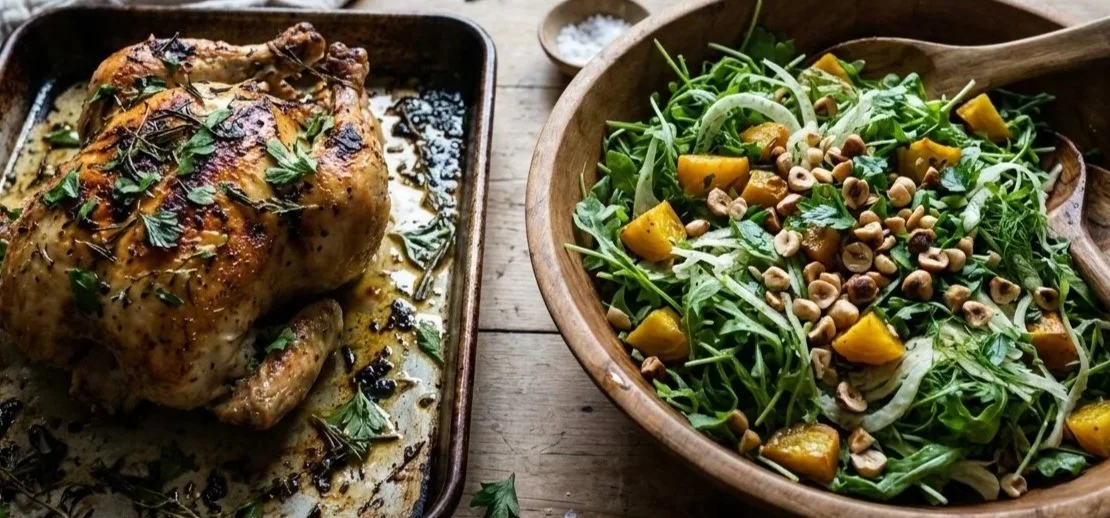
Recipe 1 — Whole Herb-Roasted Chicken with Lemon and Garlic
Yield: 6 servings (from one 4-5 lb chicken) · Active: 20 min · Total: 1½ hr
Ingredients
Chicken
1 whole pasture-raised chicken (4-5 lb)
2 tbsp Baja Gold sea salt (for dry brine, day before)
4 tbsp grass-fed butter, softened
2 tbsp extra virgin olive oil
8 garlic cloves, smashed
1 whole lemon, halved
4 sprigs fresh rosemary
6 sprigs fresh thyme
8 fresh sage leaves
1 tsp freshly cracked black pepper
Bed of aromatics (in the roasting pan)
1 large yellow onion, thickly sliced
2 medium carrots, cut into thick chunks
2 celery stalks, cut into thick chunks
1 whole lemon, halved
6 additional garlic cloves, smashed
3 sprigs fresh rosemary
4 sprigs fresh thyme
1 cup bone broth or filtered water
Method
Day before serving:
Dry brine. Pat chicken completely dry with paper towels (inside the cavity too). Rub 2 tbsp of sea salt evenly over all surfaces (breast, legs, back, and inside the cavity). Place on a wire rack over a sheet pan, uncovered, in the refrigerator for 12-24 hours. Dry-brining meaningfully improves the skin crispness and depth of flavor.
Roasting day:
Bring to room temperature. Remove chicken from refrigerator 45 minutes before roasting. Preheat oven to 425°F.
Build the roasting bed. In a large heavy roasting pan or oven-safe skillet, arrange the sliced onion, carrot chunks, celery chunks, halved lemon, smashed garlic, rosemary, and thyme. Drizzle with 2 tbsp olive oil. Pour 1 cup of bone broth or water into the pan.
Prep the chicken. Pat the chicken dry again (moisture from the fridge accumulates on the skin). Rub the softened butter all over the skin and under the skin of the breast if you can lift it gently. Sprinkle with black pepper.
Stuff the cavity. Place the halved lemon, smashed garlic, rosemary sprigs, thyme sprigs, and sage leaves inside the chicken cavity.
Truss (optional). Tie the legs together with kitchen twine. Not required, but helps the chicken roast evenly.
Place on the roasting bed. Position the chicken breast-side up on the bed of vegetables. Tuck the wings under the body (this prevents burning).
Roast at high heat. Roast at 425°F for 20 minutes to set the skin.
Reduce heat and continue. Reduce temperature to 375°F. Roast an additional 60-70 minutes, basting once at the 30-minute mark with the pan juices. The chicken is done when internal temperature reaches 165°F at the thickest part of the thigh (not touching bone).
Rest. Transfer chicken to a cutting board. Tent loosely with parchment paper. Rest 15 minutes — critical for juicy meat.
Skim and reduce the pan juices. While the chicken rests, place the roasting pan over medium heat on the stovetop. Skim excess fat off the top. Simmer 5-8 minutes to reduce and concentrate. Strain into a small pitcher.
Carve. Remove the legs and thighs from the body. Slice the breast against the grain. Arrange on a warm platter.
Serve. Drizzle with the pan juices. Garnish with fresh parsley and lemon wedges.
Recipe 2 — Golden Beet-Arugula-Hazelnut Salad with Sherry Vinaigrette
Yield: 6 servings · Active: 20 min · Total: 1 hr (including beet roasting)
Ingredients
4 medium golden (yellow) beets, scrubbed
5-6 cups baby arugula (about 5 oz)
1 medium fennel bulb, thinly shaved (fronds reserved)
½ small red onion, thinly sliced
½ cup raw hazelnuts
⅓ cup crumbled sheep's milk feta (Bulgarian or Greek)
¼ cup fresh flat-leaf parsley, roughly chopped
2 tbsp fresh mint leaves (optional), torn
Sherry vinaigrette
¼ cup extra virgin olive oil
2 tbsp aged sherry vinegar
1 tbsp fresh lemon juice
1 tsp Dijon mustard
1 tsp raw honey
1 small garlic clove, finely grated
½ tsp sea salt
¼ tsp freshly cracked black pepper
To finish
Flaky sea salt
A drizzle of high-quality olive oil
Zest of ½ orange (optional, for winter brightness)
Method
Roast the golden beets first (can be done 24 hours ahead):
Preheat oven to 400°F.
Roast. Wrap scrubbed beets in parchment paper. Place on a sheet pan. Roast 45-60 minutes, until a knife slides in with no resistance.
Cool and peel. Let cool 10-15 minutes. Rub off the skins with paper towels (they slip off easily when warm).
Slice. Cut peeled beets into thin wedges or ½-inch dice. Set aside.
Toast the hazelnuts:
Toast. Spread hazelnuts on a small sheet pan. Toast at 350°F for 10-12 minutes until the skins darken and split. Transfer to a clean kitchen towel and rub together to remove most of the skins. Roughly chop.
Prep the vegetables:
Shave the fennel. Trim the fennel bulb (reserve fronds). Shave into paper-thin slices.
Combine. In a large salad bowl, combine arugula, shaved fennel, sliced red onion, sliced golden beets, and chopped parsley.
Make the vinaigrette:
Whisk. In a small bowl or jar, combine olive oil, sherry vinegar, lemon juice, Dijon, honey, grated garlic, salt, and pepper. Shake or whisk to emulsify.
Dress and finish:
Dress. Pour vinaigrette over the salad. Toss gently to coat.
Assemble. Transfer to a serving platter. Scatter reserved fennel fronds, chopped toasted hazelnuts, crumbled sheep's milk feta, and optional mint leaves. Finish with flaky sea salt, a drizzle of high-quality olive oil, and optional orange zest.
Serve immediately while the arugula is fresh and lively.
Sourcing
Whole pasture-raised chicken (4-5 lb) — from a farmers' market, local producer, or shipped source clearly labeled pasture-raised. Yolk-orange skin indicates true pasture access
Fresh golden beets — organic, firm bulbs with fresh green tops attached
Fresh arugula — baby arugula for tenderness, or wild arugula for peppery bite. Farmers' market or organic produce section
Fresh fennel — firm bulb, no browning at the base, fresh green fronds
Raw hazelnuts — single-ingredient, organic. From a specialty nut supplier or Turkish/Italian grocer
Sheep's milk feta — traditional Bulgarian or Greek 100% sheep's milk feta with A2 casein
Aged sherry vinegar — from Jerez, Spain. Look for aged 12+ years for the DOP designation
Grass-fed butter — from cows on pasture year-round. European-style cultured butter is exceptional
Fresh lemon, orange (optional) — organic
Fresh herbs (rosemary, thyme, sage, parsley, mint) — windowsill pot or farmers' market
Fresh onion, celery, carrots, garlic — organic, hardneck garlic
Bone broth — homemade or shipped, clearly labeled 100% grass-fed
Dijon mustard — single-ingredient
Raw honey — local, unfiltered, single-origin
Single-estate extra virgin olive oil — for cooking and finishing
Baja Gold sea salt for cooking; fleur de sel or Maldon for finishing
Storage
Cooked chicken: Refrigerated up to 4 days, sealed. Excellent shredded onto salads, into wraps, or into a next-day soup
Pan juices: Refrigerated up to 5 days. Use as a soup base or for reheating leftover chicken
Golden beet salad (dressed): Refrigerated up to 2 days. Actually improves after several hours
Undressed salad components: Refrigerated up to 3 days
Roasted beets alone: Refrigerated up to 5 days
Toasted hazelnuts: Room temperature up to 1 week in a sealed jar
Nourishment Notes
Whole pasture-raised chicken — B12, choline, glycine, and complete protein. Bone-in whole chicken delivers substantial complete protein, B vitamins (especially niacin, B6, B12), zinc, selenium, and glycine (from the bone-in cut, particularly concentrated in the pan juices from the slow roast). Pasture-raised chicken delivers meaningfully more omega-3s, vitamin D, and beta-carotene than commodity confinement chicken. The whole bird also provides skin (rich in collagen when eaten) and dark meat (higher iron, zinc, and B vitamins than white meat).
Pan juices (from slow roasting) — collagen, glycine, minerals. As the whole chicken slow-roasts, collagen breaks down into gelatin, glycine, and proline — supporting joint health, skin, and gut lining. The pan juices concentrate all this nourishment plus the fat-soluble vitamins from the herbs and vegetables.
Fresh herbs (rosemary, thyme, sage, parsley) — rosmarinic acid, thymol, carnosic acid, and vitamin K. Traditional across Mediterranean cooking for both flavor and medicinal effect. Rosemary and sage in particular have documented neuroprotective and hormonal-supportive effects.
Grass-fed butter (skin baste) — CLA, K2, butyrate. Butter from grass-fed cows delivers CLA, butyrate (a short-chain fatty acid supporting gut health), beta-carotene, and vitamin K2.
Golden beets — betalains and nitrates. Golden beets deliver betaxanthins (the yellow pigment in the betalain family, with documented antioxidant effects), dietary nitrates (supporting nitric oxide production and healthy blood flow), folate, potassium, and manganese. Beets have been prized across ancestral cultures for blood-supportive properties.
Arugula — sulforaphane, folate, and vitamin K. Peppery cruciferous compound supports estrogen metabolism. Arugula delivers folate (essential for follicular phase cellular growth), vitamin K, and calcium.
Fennel — anethole, vitamin C, and digestive support. Anethole delivers estrogen-modulating and digestive-soothing effects.
Toasted hazelnuts — vitamin E, magnesium, and copper. Hazelnuts deliver alpha-tocopherol (vitamin E), magnesium (essential for luteal-phase mood and cramp prevention), copper, folate, and monounsaturated fats.
Sheep's milk feta — calcium, K2, A2 casein. Concentrated calcium and vitamin K2. A2 casein makes it accessible for many who don't tolerate cow dairy.
Aged sherry vinegar — polyphenols, organic acids. Long fermentation develops polyphenols and organic acids supporting blood-sugar regulation. Distinctive nutty-oxidized character adds depth.
For complete nourishment details on Roasted Rainbow Carrots — see Meal 1.
Extra virgin olive oil — oleic acid and polyphenols. Amplifies fat-soluble compound absorption throughout the meal.
Raw honey — trace minerals and antimicrobial enzymes.
Dijon mustard — glucosinolates and pungent aromatics stimulating digestion.
Optional orange zest — flavonoids, d-limonene. Adds brightness and detoxification support.
— Anna aka Food Marshall