Little Pots: Vanilla Gelatin Pots, Chocolate Custard Pots, and Dulce de Leche
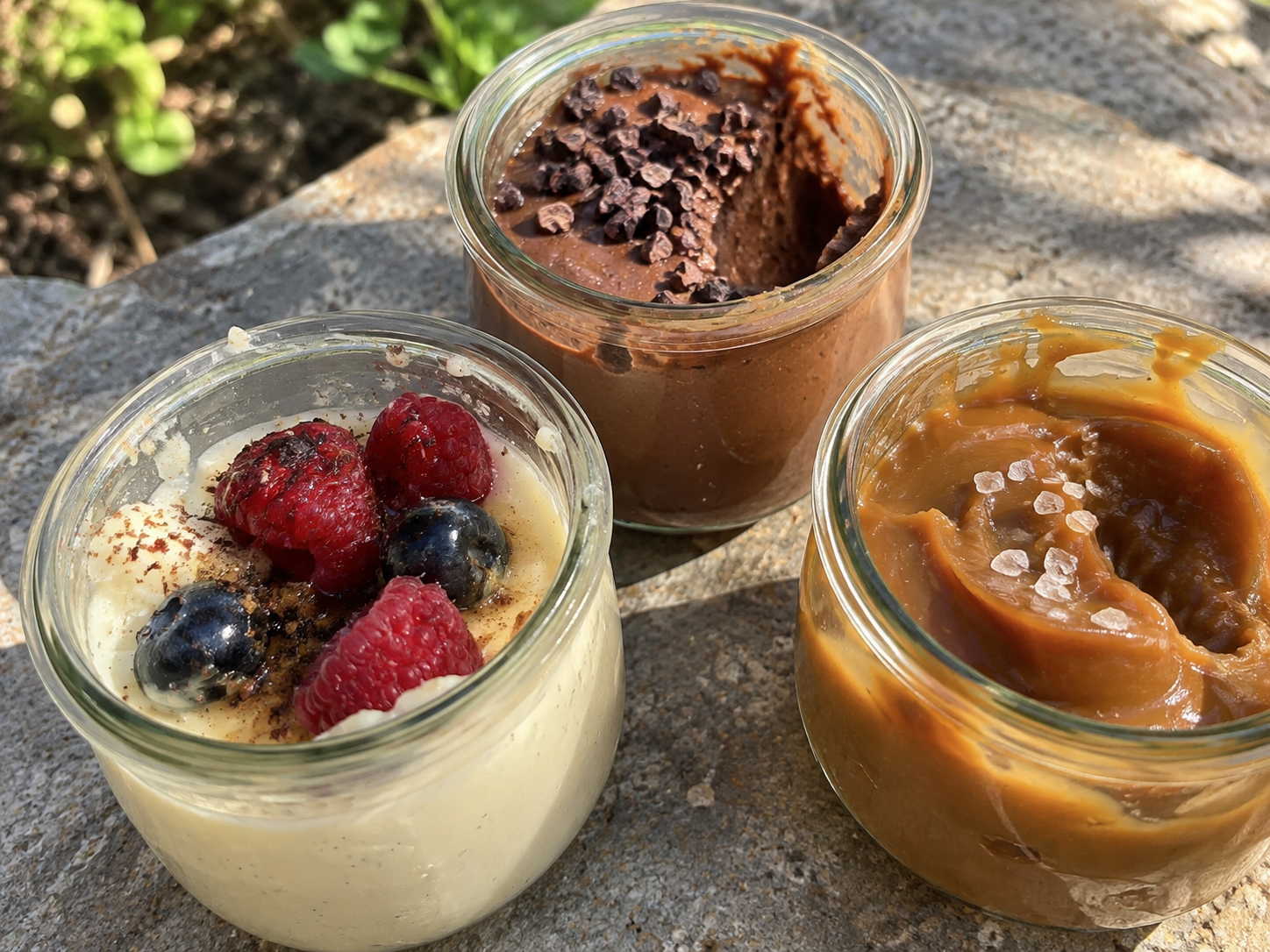
Three simple, nourishing desserts made with real milk, pasture-raised egg yolks, grass-fed gelatin, and unrefined sweeteners: wobbly vanilla bean gelatin pots, silky chocolate custard pots, and a slow-simmered, caramel-sweet dulce de leche to spoon over everything. Each one takes about 15 minutes of hands-on work, and they're lovely on their own or served together.
Yield: 6 small pots per recipe, plus about 1 cup dulce de leche · Active: 15 min each · Total: 4 hours, mostly chilling (2½ hours for the dulce de leche) · Year-round · Best eaten: afternoon
1. Vanilla Bean Gelatin Pots
Makes 6 small pots (about ½ cup each)
Soft, wobbly, and gently sweet, like a cross between a pudding and a panna cotta, with the warm flavor of real vanilla.
Ingredients
3 cups raw or grass-fed whole milk (or 2 cups milk plus 1 cup cream, for a richer pot)
2½ tsp grass-fed gelatin (use 1 tbsp for a firmer set, or if you'd like to unmold them)
¼ cup maple syrup, honey, or coconut sugar (coconut sugar gives them a golden, caramel color)
1 vanilla bean, split and scraped, or 1 tbsp pure vanilla extract
Pinch of Baja Gold sea salt
Method
Bloom the gelatin. Pour ½ cup of the cold milk into a small bowl, sprinkle the gelatin over it, and let it sit 5 minutes, until wobbly.
Warm the milk. Warm the remaining 2½ cups milk with the sweetener, salt, and vanilla bean and seeds (if using) over medium-low heat, stirring, until steaming, but not simmering (about 160°F).
Dissolve the gelatin. Take the pot off the heat, and whisk in the bloomed gelatin until completely dissolved. Stir in the vanilla extract (if using). Remove the vanilla pod.
Pour and chill. Strain the mixture into a pitcher, pour it into 6 small jars or ramekins, and refrigerate at least 4 hours, until set.
2. Chocolate Custard Pots
Makes 6 small pots (about ⅓ cup each)
Deep, dark, and silky, made the old-fashioned way: egg yolks gently cooked with milk, cream, and cacao on the stovetop.
Ingredients
1 cup raw or grass-fed whole milk
1 cup raw or grass-fed cream
3 tbsp raw cacao powder
4 pasture-raised egg yolks
¼–⅓ cup honey or maple syrup, to taste
Pinch of Baja Gold sea salt
2 oz cacao paste (100% cacao) or 100% cacao chocolate, finely chopped
1 tsp pure vanilla extract
Method
Warm the dairy. Whisk the milk, cream, and cacao powder in a saucepan over medium-low heat until smooth and steaming.
Whisk the yolks. In a bowl, whisk the yolks with the honey and salt until smooth.
Temper. Slowly pour about half the hot milk into the yolks, whisking constantly, then pour everything back into the saucepan.
Cook gently. Stir constantly over low heat with a spatula, scraping the bottom, for 5–8 minutes, until the custard thickens enough to coat the spoon and reaches 170–175°F. Don't let it boil, or the yolks will scramble.
Add the chocolate. Take it off the heat, and stir in the chopped cacao paste until melted and glossy, then the vanilla.
Pour and chill. Strain the custard into a pitcher, pour it into 6 small jars or ramekins, and refrigerate at least 4 hours, until set.
Softer or firmer? The cacao paste is what gives these their set. For a looser, pourable pudding, use 1 oz; for a firmer pot, use 3 oz.
3. Dulce de Leche
Makes about 1 cup
Milk and sweetener simmered slowly until thick, golden, and caramel-sweet. It takes time, but it's almost entirely hands-off.
Ingredients
4 cups raw or grass-fed whole milk
¾ cup coconut sugar (or ½ cup maple syrup or honey)
¼ tsp Baja Gold sea salt
¼ tsp baking soda
1 tsp pure vanilla extract
Method
Heat. Combine the milk, sweetener, and salt in a wide, heavy pot that's at least twice as big as the milk needs, since it foams. Bring it to a simmer over medium heat, stirring to dissolve the sweetener.
Add the baking soda. Take the pot off the heat and stir in the baking soda. It will foam up, which is normal. The baking soda keeps the milk from curdling and helps it turn a deep caramel color.
Simmer low and slow. Return the pot to low heat and simmer gently, uncovered, for 1½–2½ hours, stirring every 10 minutes (and more often toward the end, as it thickens). It's ready when it's thick, golden-brown, and reduced to about 1 cup.
Finish. Stir in the vanilla, and let it cool. It thickens a lot as it cools. If it's grainy, a quick blend will smooth it out.
About sweeteners: Coconut sugar gives the deepest caramel color and flavor. Maple syrup and honey make a lighter, golden dulce de leche, and they tend to foam more, so keep the heat low and the pot large.
Ways to Serve Them Together
Vanilla pot with dulce de leche: a thin layer of dulce de leche over each set vanilla pot, finished with flaky salt
Chocolate pot with whipped cream: a dollop of whipped raw cream and a sprinkle of cacao nibs
Chocolate and caramel: a spoonful of dulce de leche on a chocolate pot, with flaky salt
Layered: pour the vanilla mixture into jars, let it set, then add a layer of the chocolate custard on top and chill again
Toppings for Every Season
Spring: sliced strawberries, rose petals, or lemon zest
Summer: fresh raspberries, blueberries, or sliced peaches
Fall: stewed cinnamon pears or apples, or toasted pecans
Winter: orange zest, pomegranate arils, or a pinch of cinnamon and cardamom
Storage
Vanilla and chocolate pots: refrigerated, covered, up to 4 days.
Dulce de leche: refrigerated in a glass jar up to 2 weeks. Warm it gently to make it pourable.
A note on raw milk and honey: Heating raw milk and raw honey means they're no longer raw, but they still make wonderful, nourishing desserts. Honey shouldn't be given to babies under 12 months.
Nourishment Notes
Whole milk and cream — protein, calcium, vitamins A and K2, and CLA, especially from grass-fed cows.
Grass-fed gelatin — glycine and proline, the building blocks of collagen, which support the gut lining, skin, and joints. Glycine has also been studied for calming the nervous system and supporting sleep.
Pasture-raised egg yolks — choline, lutein, and vitamins A, D, E, and K2.
Raw cacao and cacao paste — magnesium, iron, flavanols, and theobromine.
Coconut sugar, maple syrup, and honey — unrefined sweeteners with trace minerals.
Vanilla — vanillin and a warm, comforting aroma.
As a circadian treat, these pots land best in the afternoon. The chocolate pots contain theobromine and a little caffeine, so they're better earlier in the day, while the vanilla pots are gentle enough for an early evening dessert.
For your cycle: The chocolate pots' magnesium makes them a comforting luteal-phase treat, when many women crave chocolate, and the gelatin's glycine is soothing in every phase.
Sourcing
Milk and cream — raw from a farmer you know and trust, or organic, grass-fed, low-temperature pasteurized milk and cream
Grass-fed gelatin — from pasture-raised, grass-fed cattle, unflavored, like Perfect Supplements or Great Lakes Wellness (make sure it's gelatin, not collagen peptides, which won't set)
Eggs — organic and pasture-raised, with deep orange yolks, ideally from a local farm
Raw cacao powder and cacao paste — organic, single-origin, and ideally tested for heavy metals
Coconut sugar — organic, like Madhava
Maple syrup and honey — organic Grade A dark maple syrup; organic, local, unfiltered honey
Vanilla — organic whole vanilla beans or pure vanilla extract
Baking soda — aluminum-free
Toppings — organic, seasonal fruit; organic nuts; raw or grass-fed cream
Salt — Baja Gold sea salt; Maldon for finishing
— Anna aka Food Marshall