Caesar Salad Library: One Dressing, Three Salads
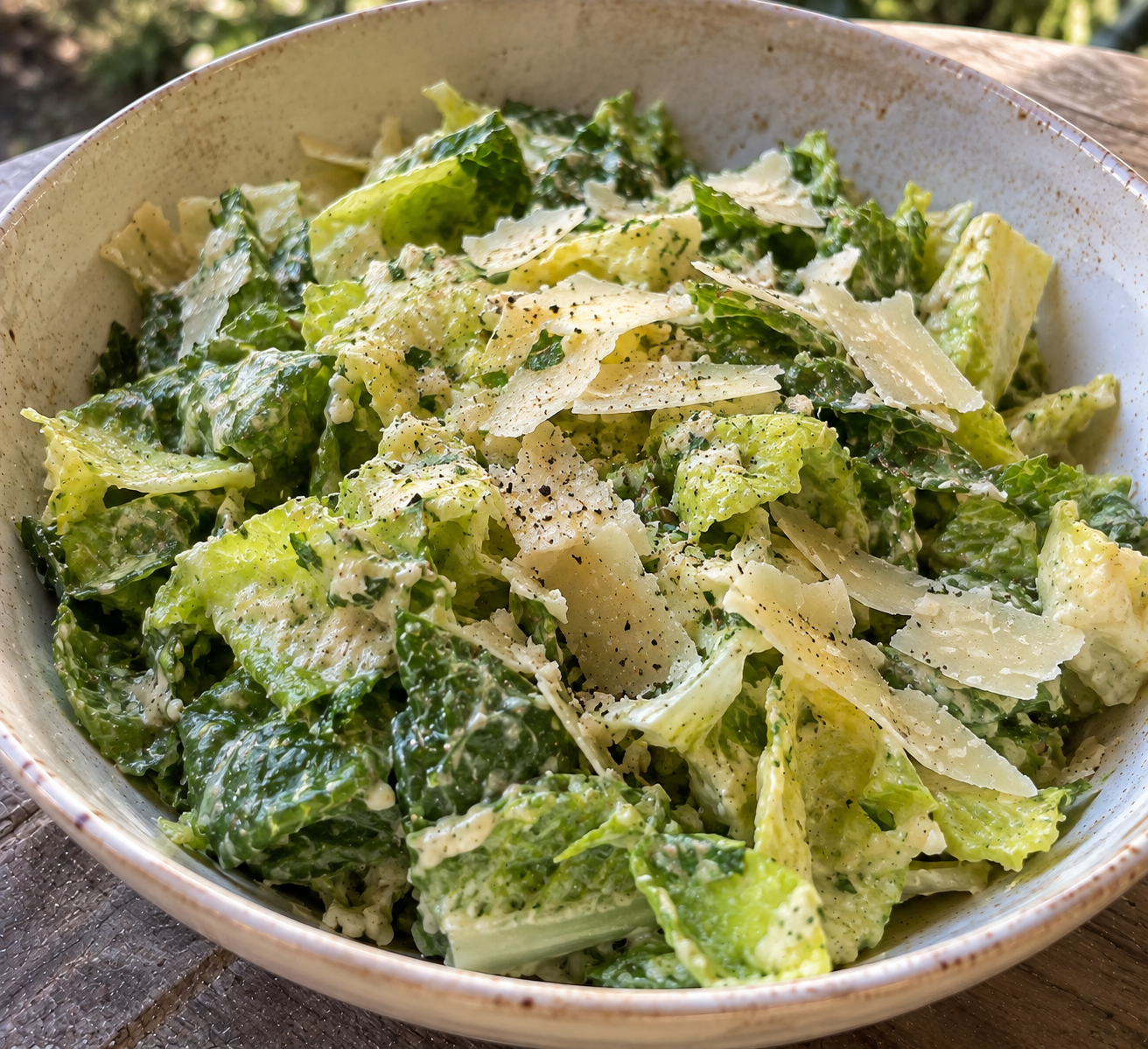
A creamy, garlicky Caesar dressing you’ll make again and again, and three ways to use it: a classic chicken Caesar, a shaved Brussels sprouts Caesar for fall and winter, and a golden turmeric cauliflower Caesar with a dairy-free cashew dressing.
Yield: Serves 4 (each salad) · Active: 20–30 min · Total: 30–45 min · Year-round: the classic in summer, the Brussels sprouts version from October through March, and the golden cauliflower version anytime · Cuisine: Mexican-Italian · Best eaten: midday
It all starts with the dressing. Make a batch on Sunday, and you have Caesar for the week.
Looking for a dairy-free, tahini-based Caesar? See my Butternut Squash and Brussels Sprouts Salad with Tahini Caesar.
The Foundational Caesar Dressing
Inspired by homeopath and chef Heathar Shephard. Makes about 1¾ cups.
1 pasture-raised egg yolk
1 garlic clove
1½ tbsp Dijon mustard
4–5 anchovy fillets
1 tbsp raw apple cider vinegar
2 tsp fresh lemon juice, plus more to taste
½ cup finely grated Pecorino Romano (or Parmigiano-Reggiano)
Pinch of Baja Gold sea salt and black pepper
1¼ cups extra virgin olive oil (or half olive oil and half avocado oil, for a milder flavor)
Optional: 1 tsp coconut aminos and a dash of hot sauce
Blend the base. Blend everything except the oil in a blender or food processor until smooth.
Add the oil. With the motor running, pour in the oil in a slow, steady stream, until thick, creamy, and emulsified.
Taste. Add more lemon, salt, or an extra anchovy, to taste. If it’s too thick, blend in a spoonful of water.
Storage: in a glass jar in the fridge, up to 1 week.
A note on raw egg: The yolk in this dressing is raw. If you’re pregnant or serving young children or anyone with a weakened immune system, use a pasteurized egg.
About Worcestershire: Many classic Caesar dressings use Worcestershire sauce, but most brands contain malt vinegar, made from barley. Coconut aminos plus the anchovies give the same savory depth, grain-free.
Salad 1: Classic Chicken Caesar
Serves 4 · Active: 20 min · Total: 40 min
1½ lbs pasture-raised boneless chicken breasts or thighs
2 tbsp extra virgin olive oil
1 tbsp each fresh parsley and thyme, chopped
Baja Gold sea salt and black pepper
2 large heads romaine, chopped
¾ cup shaved Parmigiano-Reggiano
About ¾ cup The Foundational Caesar Dressing
Optional: hard-boiled pasture-raised eggs, capers, extra anchovies, and Parmesan crisps (below)
Roast the chicken. Heat the oven to 425°F. Rub the chicken with the olive oil, herbs, salt, and pepper, and roast on a sheet pan until breasts reach 165°F (15–20 minutes) or thighs reach 175°F (25–30 minutes). Rest 5 minutes, then slice.
Dress the romaine. Toss the romaine with about half the dressing, adding more as needed, until lightly coated.
Top and serve. Top with the chicken, shaved Parmigiano, and any extras, with more dressing on the side.
Parmesan crisps (grain-free croutons): Heat the oven to 375°F. Spoon ½ cup grated Parmigiano into small mounds on a parchment-lined sheet pan, 2 inches apart. Bake 5–7 minutes, until lacy and golden, then let them cool to crisp, and break them over the salad.
Salad 2: Shaved Brussels Sprouts Caesar
Serves 4 · Active: 20 min · Total: 30 min
1½ lbs Brussels sprouts, very thinly shaved (a mandoline is easiest)
½ cup shaved Parmigiano-Reggiano, plus more to finish
About ¾ cup The Foundational Caesar Dressing
¼ cup pine nuts or pumpkin seeds, lightly toasted
Optional: 2 extra anchovy fillets, chopped, or crispy bacon
Shave the sprouts. If you can, let them sit for 30 minutes after shaving (see the Nourishment Notes).
Dress and massage. Toss the sprouts and Parmigiano with about two-thirds of the dressing, then massage it in with clean hands for 1 minute, until the leaves soften.
Top and serve. Scatter with the toasted pine nuts and more Parmigiano, and serve with extra dressing on the side.
Make ahead: Unlike romaine, shaved sprouts hold up beautifully after dressing; they’re even better after an hour.
Salad 3: Golden Cauliflower Caesar (Dairy-Free)
Inspired by Dr. Mark Hyman. Serves 4 · Active: 25 min · Total: 45 min
Roasted turmeric cauliflower
1 head cauliflower, cut into small florets
2 tbsp extra virgin olive oil or melted ghee
1 tsp ground turmeric
½ tsp Baja Gold sea salt and ¼ tsp black pepper
Salad
1 head romaine, chopped
4 cups mixed baby greens
1 small shallot, thinly sliced
2 tbsp capers, drained
3 tbsp hemp seeds
¼ cup sprouted sunflower or pumpkin seeds
1 ripe avocado, sliced
Optional protein: wild salmon, pasture-raised chicken, or hard-boiled eggs
Golden cashew Caesar dressing
¾ cup cashews, soaked 2 hours and drained
¼ cup fresh lemon juice
2 tbsp coconut aminos
2 tbsp unfortified nutritional yeast
1 tsp Dijon mustard
1 tsp ground turmeric
1 garlic clove
½ tsp onion powder
2 anchovy fillets (optional, for a classic Caesar flavor)
½ cup water, plus more as needed
Baja Gold sea salt and black pepper
Roast the cauliflower. Heat the oven to 425°F. Toss the cauliflower with the oil, turmeric, salt, and pepper, and roast 25–30 minutes, turning once, until golden and crisp at the edges.
Make the dressing. Blend all the dressing ingredients until completely smooth and pourable, adding water as needed. Taste for salt, lemon, and pepper.
Toss. Toss the romaine, greens, shallot, capers, hemp seeds, and sprouted seeds with enough dressing to lightly coat.
Top and serve. Top with the warm cauliflower, avocado, and your protein of choice. Finish with more hemp seeds, capers, and black pepper.
Storage
Foundational dressing: up to 1 week in the fridge.
Golden cashew dressing: up to 5 days in the fridge (it thickens as it sits; thin with water).
Salads: best eaten the day they’re dressed, except the Brussels sprouts Caesar, which holds for a few hours.
For a crowd: For 8 or more, double the dressing, and set out the components so guests can build their own.
Nourishment Notes
Pasture-raised egg yolk — choline, vitamins A, D, E, and K2, and lecithin, the natural emulsifier that makes Caesar dressing so silky. Choline supports the liver and brain, and many people don’t get enough.
Anchovies — EPA and DHA omega-3s, selenium, and vitamin D, with very little mercury, since they’re small fish low on the food chain. Their deep, savory flavor has been prized in Mediterranean cooking since Roman times, when cooks used garum, a fermented fish sauce much like the fish sauces of Southeast Asia, which developed separately.
Parmigiano-Reggiano and Pecorino Romano — calcium, protein, and vitamin K2. Their long aging breaks down nearly all the lactose, so many people who are sensitive to fresh dairy enjoy them. Pecorino Romano, made from sheep’s milk, is sharper and saltier.
Romaine — folate, vitamin K, and vitamin A, with the crunch to stand up to a rich dressing.
Brussels sprouts — vitamins C and K, folate, fiber, and glucosinolates, which your body turns into sulforaphane, supporting estrogen metabolism. Eaten raw, the sprouts keep all their vitamin C and their myrosinase, the enzyme that makes sulforaphane, and shaving them and letting them sit gives it time to work.
Cauliflower and turmeric — glucosinolates from the cauliflower, and curcumin from the turmeric, one of the most studied anti-inflammatory plant compounds. Curcumin is best absorbed with fat and black pepper, which this salad has plenty of.
Hemp seeds — complete plant protein, magnesium, and omega-3 and omega-6 fats.
Sprouted seeds — zinc, magnesium, and vitamin E. Sprouting reduces phytic acid, which makes their minerals easier to absorb.
Cashews — zinc, copper, and magnesium, plus a creamy, dairy-free body.
Pasture-raised chicken — complete protein, B vitamins, and selenium.
Lemon, Dijon, and extra virgin olive oil — vitamin C, glucosinolates from the mustard seed, and oleocanthal, an olive oil polyphenol with well-documented anti-inflammatory effects.
As a circadian food, these protein-rich salads are best at midday, when your body digests rich food most easily. Rotate them with the seasons: the classic chicken Caesar in summer, the Brussels sprouts Caesar through fall and winter, and the golden cauliflower Caesar anytime.
For your cycle: The Brussels sprouts and cauliflower Caesars support estrogen metabolism in the follicular and luteal phases, and the chicken Caesar’s protein keeps energy steady in any phase.
Sourcing
Eggs — organic and pasture-raised, from a local farm (or pasteurized eggs, if needed)
Chicken — pasture-raised, from a local farm or White Oak Pastures
Anchovies — packed in olive oil, from Spain or Italy, like Ortiz or Don Bocarte
Parmigiano-Reggiano and Pecorino Romano — DOP; Parmigiano aged 24 months or more
Romaine, Brussels sprouts, cauliflower, greens, shallots, garlic, and lemons — organic, from a farmers’ market
Dijon mustard — organic, like Delouis Fils or Maison Orphée
Raw apple cider vinegar — organic, with the mother (Bragg)
Coconut aminos — organic and soy-free, like Coconut Secret
Cashews, hemp seeds, pine nuts, and sprouted seeds — organic; sprouted seeds from a source like Living Intentions or Go Raw
Nutritional yeast — unfortified
Turmeric — organic and non-irradiated
Extra virgin olive oil — organic, single-estate, harvest-dated, in dark glass
Salt — Baja Gold sea salt
— Anna aka Food Marshall