Alentejo Purslane Soup (Sopa de Beldroegas) with Crispy Cured Pork and Poached Eggs
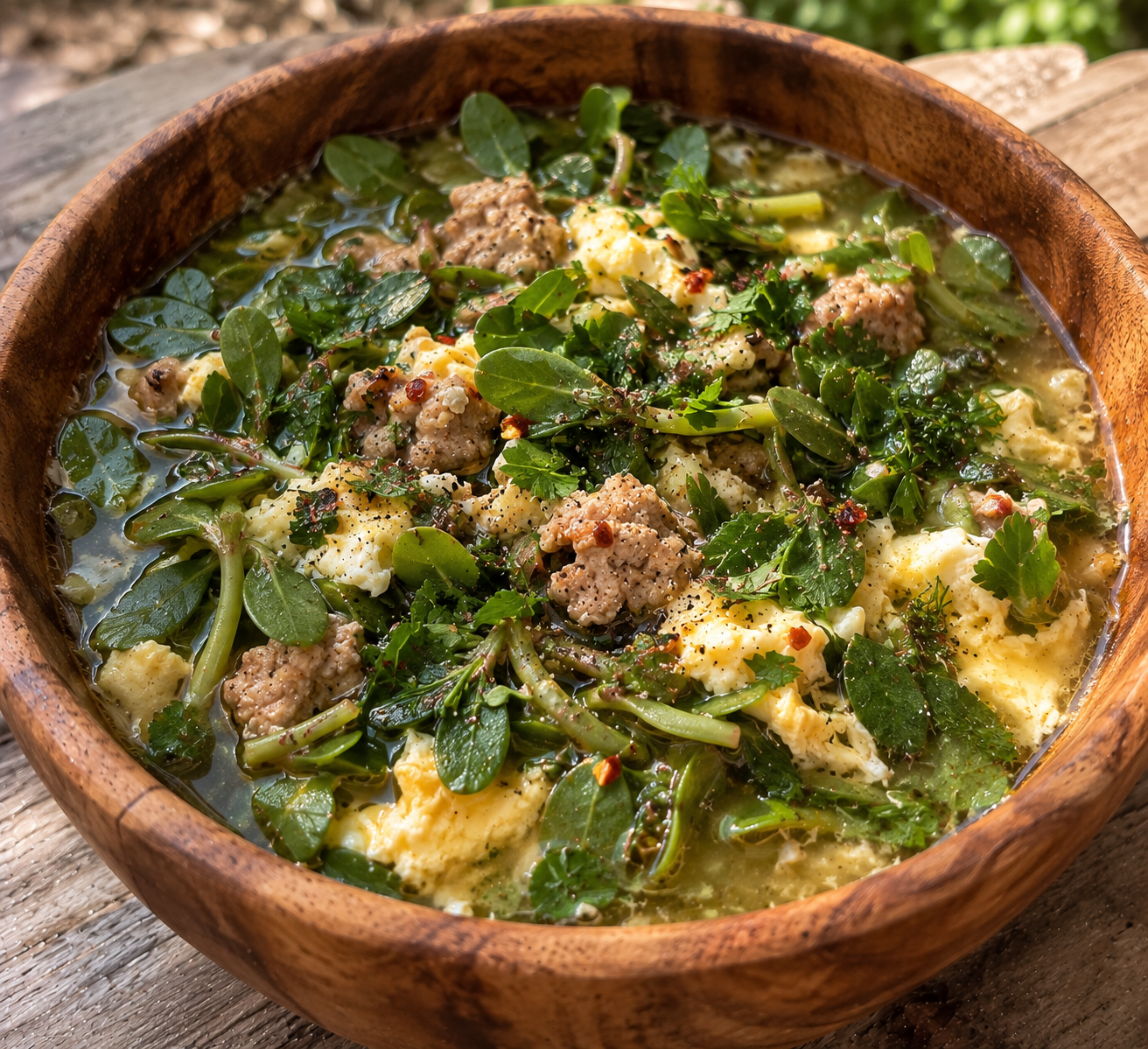
A traditional peasant soup from Portugal’s Alentejo: wild purslane, whole golden-fried garlic heads, and potatoes in a brothy olive oil base, with eggs poached right in the soup, a wedge of sheep’s cheese, and crispy cured pork. Grain-free, deeply restorative, and built on foraged greens.
Yield: Serves 4 · Active: 30 min · Total: 1 hour · July through September, when wild purslane grows thick in Alentejo gardens and North American farmers’ markets · Cuisine: Portuguese, Alentejo · Best eaten: midday, or as a light early dinner
Inspired from my travels through the Alentejo — the vast, sun-baked heart of southern Portugal, with its cork oaks, olive groves, and whitewashed villages. Sopa de beldroegas is one of the region’s great peasant soups, built around wild purslane (beldroegas), the little succulent green that grows in Mediterranean gardens, along pathways, and in the cracks of old stone walls. It’s a perfect lesson in Portuguese country cooking: cheap, humble ingredients (wild greens, garlic, potatoes, olive oil, eggs from the hens, and cheese from the family flock) turned into something deeply nourishing.
Traditionally, the soup is ladled over slices of day-old bread. To keep it grain-free and still satisfying, I’ve added a little more potato and a scattering of crispy cured pork, also traditional in the Alentejo, home of the famous porco preto, the Iberian black pig.
Can’t find purslane? Look for it at farmers’ markets or Mexican grocers, where it’s called verdolaga. Or substitute watercress, baby spinach, or a mix of tender greens and fresh herbs (parsley, cilantro, and mint). The soup loses a little of its character, but stays delicious.
More soups from my Portugal travels: my Sopa da Panela: Alentejo Pot of Mixed Meats and Cozido das Furnas.
Ingredients
Soup
1 large bunch fresh purslane (about 4 cups packed leaves and tender stems)
½ cup Portuguese or Spanish extra virgin olive oil
2 whole heads garlic, loose outer skins removed (leave the inner purple skins on)
1 large yellow onion, thinly sliced
4 medium waxy potatoes (Yukon Gold or red), peeled and cut into 1-inch chunks
6 cups light chicken bone broth or filtered water
Baja Gold sea salt and black pepper
Crispy cured pork (choose one)
6 oz Portuguese chouriço or linguiça, thinly sliced (gluten-free)
6 oz toucinho or pasture-raised bacon, cut into ¼-inch pieces
6 oz presunto, jamón ibérico, or jamón serrano, torn into strips
1 tbsp olive oil or pasture-raised lard, for crisping
To finish
4 pasture-raised eggs
4 small wedges of sheep’s milk cheese, like queijo da Serra, Azeitão, Idiazábal, or aged Manchego (about 2 oz each)
Chopped fresh parsley or extra purslane leaves
A drizzle of good olive oil
Black pepper
Lemon wedges
Method
Prep the purslane. Pick the tender leaves and small stems off the thicker main stalks. Wash them well in cool water (purslane can hold a lot of grit), and drain.
Crisp the pork. Heat the olive oil or lard in a small skillet over medium heat. Add the pork, and cook 4–6 minutes (a little longer for bacon pieces, a little less for thin ham), stirring now and then, until golden and crisp. Drain on a paper towel-lined plate.
Fry the garlic. Heat the ½ cup olive oil in a large, heavy soup pot over medium heat. Add the whole garlic heads, and fry them, turning now and then, for 5–7 minutes, until deep golden but not blackened. Lift them out, and set them aside.
Soften the onion. Add the onion to the garlic-scented oil, and cook 6–8 minutes, stirring now and then, until soft and golden.
Add the potatoes. Stir in the potatoes, and season with salt and pepper. Cover, and cook over low heat for 8–10 minutes, until they just start to soften.
Simmer the soup. Add the purslane, broth, and the fried garlic heads. Bring to a gentle simmer, cover, and cook 15–20 minutes, until the potatoes are tender and the garlic is soft. Taste, and adjust the salt and pepper.
Poach the eggs in the soup. Lower the heat so the soup barely simmers. Crack each egg into a small cup, and gently slide it into the soup, spacing them apart. Cover, and poach 3–4 minutes, until the whites are set and the yolks are still runny. (Prefer them separate? Poach them in a small pot of simmering water with 1 tbsp vinegar.)
Serve. Ladle the broth, potatoes, purslane, and an egg into each bowl. Add a wedge of sheep’s cheese, which softens into the hot broth. Set a garlic head in each bowl (or on a small plate alongside), so everyone can squeeze the soft, sweet cloves into their soup. Scatter with the crispy pork, parsley, a drizzle of olive oil, and black pepper. Serve with lemon wedges. And as the original recipe wisely notes: don’t forget the wine.
If you eat grains: Lay a slice of day-old sourdough in each bowl, and ladle the soup over it, the traditional Alentejo way.
Variations
Heartier: Stir in ½–1 cup cooked white beans (a traditional Iberian addition) for the last 10 minutes, or add shredded slow-cooked pork shoulder or poached chicken for the last 5 minutes, to make it a main course.
Without pork: Skip the cured pork, use a slightly larger wedge of cheese, and top with toasted Marcona almonds.
A little heat: Add a few drops of piri-piri sauce or fresh chili to each bowl.
Easier eggs: Soft-boil them for 6½ minutes, peel, halve, and set them in each bowl.
Serve It With
A glass of crisp Portuguese white wine, like an Alvarinho or Vinho Verde, and a small plate of olives and Marcona almonds to start. For a full Alentejo meal, follow it with grilled wild fish or slow-roasted lamb with garlicky greens.
Storage
Make ahead: The soup base (without the eggs, pork, or cheese) keeps 3 days in the fridge. Reheat it gently, without boiling, so the purslane stays green, then poach the eggs and add the garnishes.
Crispy pork: best the day it’s made; refrigerate leftovers up to 2 days.
Assembled soup: best eaten right away. Leftovers keep 1 day, though the eggs and cheese lose their texture.
Nourishment Notes
Purslane — one of the richest leafy greens in omega-3 ALA, plus vitamin C, vitamin E, beta-carotene, magnesium, potassium, and calcium. Cooks across the Mediterranean (Portuguese, Greek, Turkish, and Lebanese) and in Mexico have long gathered it in summer as a cooling, hydrating green. Like spinach, it’s high in oxalates, so it’s best enjoyed cooked and in rotation with other greens.
Whole garlic heads — frying them gives the cloves a toasty sweetness, and simmering them in the soup turns them soft and mellow. Cooking tames garlic’s sharp allicin into gentler sulfur compounds, studied for supporting heart health.
Olive oil — oleic acid and polyphenols like hydroxytyrosol, oleuropein, and oleocanthal, with well-documented anti-inflammatory effects. The generous pour is traditional in Portuguese country cooking, and it helps you absorb the purslane’s carotenoids.
Potatoes — potassium, vitamin C, B6, and grounding carbohydrates that balance the rich olive oil. (Potatoes that have been cooked and cooled also develop resistant starch, which feeds healthy gut bacteria, so leftovers are a bonus.)
Cured Iberian pork — thiamine (B1, which pork is one of the richest sources of), zinc, selenium, and iron. The Iberian black pig is raised in the montado, the oak savannas of the Alentejo (called the dehesa in Spain), where it forages on acorns and wild herbs. Its fat is rich in oleic acid, the same fat in olive oil.
Sheep’s milk cheese — calcium, protein, and vitamins A, D, and K2. Sheep’s milk naturally contains A2 casein, which many people find easier to digest than conventional cow’s milk. Queijo da Serra, made from raw sheep’s milk in the Serra da Estrela mountains, is Portugal’s most famous cheese.
Pasture-raised eggs — choline, lutein, zeaxanthin, and vitamins A, D, E, and K2. As the runny yolk breaks into the broth, it turns it silky.
As a seasonal food, this is a summer soup, made when purslane grows wild and abundant; the bright greens and lemon keep it light, even in the heat. A soup like this shows what peasant cooking can be when the ingredients are good: wild greens from the hillside, garlic and potatoes from the garden, eggs from the hens, cheese from the flock, oil from the olive grove, and a little cured pork from the family pig. Nothing is fancy, and nothing is wasted.
For your cycle: With iron and zinc from the pork, omega-3s and magnesium from the purslane, and choline from the eggs, this soup is restorative during your period, and lovely in any phase.
Sourcing
Purslane — from a farmers’ market in summer, a Mexican grocer (verdolaga), a Middle Eastern grocer, or your own garden, where it often grows on its own; look for plump, bright green leaves
Garlic — organic whole heads, firm, with no green sprouts
Olive oil — single-estate, harvest-dated Portuguese or Spanish extra virgin olive oil in dark glass, like Esporão from the Alentejo
Cured pork — Portuguese chouriço, linguiça, toucinho, or presunto, or Spanish jamón ibérico or serrano, from La Tienda, Despaña, Fermín, or an Iberian specialty shop (check sausages are gluten-free)
Sheep’s milk cheese — queijo da Serra, Azeitão, Idiazábal, or aged Manchego, from a good cheese shop
Eggs — organic and pasture-raised, from a local farm
Potatoes and onions — organic waxy potatoes and onions, from a farmers’ market
Bone broth — homemade, or Bonafide Provisions
Salt — Baja Gold sea salt; fleur de sel for finishing
— Anna aka Food Marshall