Cozido das furnas — Slow-Cooked Azorean Stew
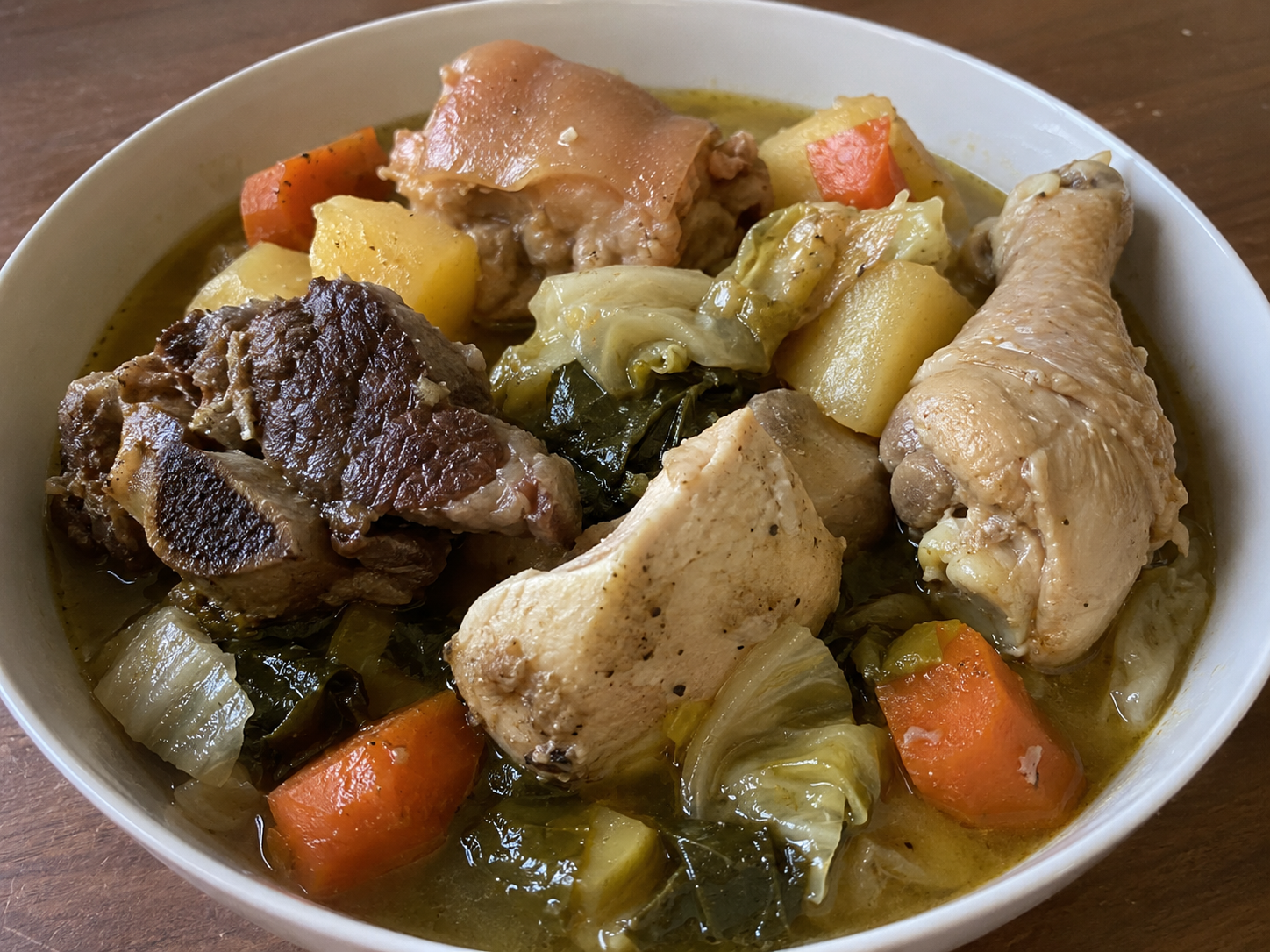
The legendary slow-cooked Azorean stew — traditionally buried underground in the geothermal fumaroles of Furnas on São Miguel island, here adapted for a slow cooker. Layers of pasture-raised beef, pork, chicken, and quality sausage with root vegetables and hearty greens, slow-cooked in bone broth for 8 hours until the meat shreds with the touch of a fork.
Yield: 8-10 generous servings
Active: 30 min · Total: 8 hr 30 min (slow cooker)
Year-round (peak autumn-winter)
A note from the kitchen
Cozido das Furnas is one of the great dishes of the world — a multi-meat, multi-vegetable slow-cooked stew that originated in the village of Furnas on São Miguel island in the Azores. The traditional preparation is genuinely extraordinary: layered pots of raw meat and vegetables are buried for 6-7 hours in the ground where natural volcanic fumaroles vent steam from the earth's interior. The geothermal heat slow-cooks everything to perfect tenderness — meat falls apart with the touch of a fork, vegetables absorb the meat juices, and the whole alchemy of fire-and-earth transforms simple ingredients into something deeply nourishing and culturally meaningful.
Eating Cozido das Furnas at Furnas Lake, watching the steam rise from the ground where the pots are being unearthed at midday, is one of the great food experiences possible on Earth. The Azorean restaurants surrounding the lake all serve their own versions — but the technique remains: layers of meats, vegetables, and broth, slow-cooked underground for hours, served with the extra broth poured over at the table.
For those who can't access volcanic fumaroles (which is most of us), a slow cooker is the most honest approximation. The 8-hour low-and-slow cooking produces the same fall-apart-tender meat and intermingled flavors. The slow cooker is doing what the earth did — gentle, sustained heat over many hours.
This recipe captures the essence of Cozido das Furnas with pasture-raised meats, quality sausages, root vegetables, and a rich bone broth base. Served with the extra cooking broth ladled separately at the table, alongside a small bowl of flaky sea salt. It's a deeply restorative meal that connects to Portuguese rural cooking and Azorean island tradition.
Best made in autumn through winter, when root vegetables and hearty greens are at their peak. The leftover broth is gold — use it as the base for soup throughout the week.
On the best meat cuts
This recipe rewards careful selection of cuts. Here's what works best:
Grass-fed beef
Beef shank (best choice) — the cross-cut bone with marrow and meat, ideal for long slow cooking. The connective tissue breaks down into gelatin; the marrow bone enriches the broth. Look for 2-inch-thick cross-cut sections.
Beef leg / round (alternative) — the tougher cuts that benefit most from slow cooking. Eye of round or bottom round work well, sliced into 2-3 inch chunks.
Beef chuck (also excellent) — boneless chuck roast cut into large chunks. More marbling than round; produces meltingly tender results.
Grass-fed pork
Pork shoulder (best choice) — boneless or bone-in, cut into large 3-inch chunks. The marbled fat and connective tissue break down over 8 hours into the silkiest texture.
Pork ribs (great addition) — country-style pork ribs (cut from the shoulder) or baby back ribs cut into individual rib pieces. Add bone-rich gelatin to the broth.
Pork leg / ham hocks (smoky variation) — smoked or cured ham hocks add deep flavor; fresh pork leg works too, cut into chunks. One ham hock is plenty for the whole pot — it permeates everything.
Pasture-raised chicken
Bone-in chicken legs and thighs (best choice) — the dark meat stays moist over long cooking, and the bones add to the broth.
Chicken drumsticks — work beautifully alongside the legs.
Chicken breast — works for those who prefer white meat, but add it in the last 2-3 hours of cooking to prevent drying out. Bone-in skin-on breast is preferred.
Quality sausage
Portuguese chouriço — the smoked, paprika-cured Portuguese sausage that's traditional. Look for gluten-free versions.
Linguiça — milder Portuguese cured sausage, also gluten-free options available.
Spanish chorizo — Spanish version of the same family of paprika-cured pork sausages; chorizo ibérico from acorn-fed Iberian pigs is exceptional. Available from La Tienda or Despaña.
Fresh Italian sausage (mild or sweet) — if Portuguese/Spanish aren't available; choose sausage with simple ingredients (just pork, salt, spices, no fillers or seed oils).
Morcela (Portuguese blood sausage) — traditional in Cozido but harder to find in the US. Skip if not available, or substitute additional chouriço.
Ingredients
Meats
1 lb grass-fed beef shank (2-inch cross-cut sections, with bone and marrow)
1 lb grass-fed pork shoulder, cut into 3-inch chunks
4-6 country-style pork ribs (about 1 lb)
4 bone-in skin-on chicken legs (drumsticks + thighs attached, or 2 lb total of mixed dark meat)
1 large bone-in skin-on chicken breast (optional, added in the last 2-3 hours)
8 oz quality chouriço or Portuguese-style cured sausage, sliced into 2-inch chunks (gluten-free)
8 oz quality linguiça or fresh Italian sausage, sliced into 2-inch chunks (gluten-free)
Optional: 1 smoked ham hock (about 1 lb) for additional depth
Root vegetables (peeled and cut into 2-inch chunks)
1 lb purple potatoes, sweet potatoes (Hannah or regular), or Yukon Gold potatoes
1 lb taro root (or substitute with additional sweet potato or rutabaga if taro isn't accessible)
4 large carrots, cut into 2-inch pieces
2 large turnips, quartered
Optional: 1 large parsnip, cut into 2-inch pieces (sweeter, deeper flavor)
Hearty greens (added in the last 1-2 hours)
1 large bunch collard greens, stems removed, leaves chopped into 3-inch pieces
½ head green cabbage, cut into 2-inch wedges (or substitute Savoy or Portuguese couve-tronchuda)
Aromatics and seasoning
1 large yellow onion, peeled and quartered (left in large pieces to flavor the broth)
6-8 cloves garlic, peeled and lightly smashed
4-6 bay leaves
2 tsp whole black peppercorns
1 tsp Baja Gold sea salt (plus more to taste)
Optional: 1 tsp pimentón de la Vera (smoked Spanish paprika) for additional depth
Broth
6-8 cups quality bone broth (beef, chicken, or a mix — homemade if possible)
Additional 2-3 cups bone broth or filtered water (to reserve and serve at the table)
To serve
Fresh flat-leaf parsley, finely chopped
Lemon wedges
Flaky sea salt
Optional: small bowl of homemade piri-piri sauce or fresh chopped chili for those who want heat
Method
Prep all the ingredients first
Prep the meats. Remove all meats from the refrigerator about 30 minutes before cooking to take the chill off. Pat the beef shank, pork shoulder, pork ribs, and chicken pieces dry with paper towels. Season everything generously with sea salt and freshly cracked black pepper.
Prep the vegetables. Peel and cut all root vegetables into uniform 2-inch chunks. Prep the greens (collards stems removed, leaves chopped; cabbage wedged) and set aside separately — they go in later.
Prep the aromatics. Quarter the onion (keep large pieces — they'll flavor the broth and be removed at the end if desired). Lightly smash the garlic cloves. Have the bay leaves and peppercorns ready.
Layer the slow cooker (the architecture matters)
Bottom layer: aromatics and root vegetables. Place the quartered onion at the bottom of a 7-8 quart slow cooker. Add the smashed garlic cloves, bay leaves, and peppercorns. Layer the root vegetables (potatoes, taro, carrots, turnips, optional parsnip) across the bottom — they'll cook in the meat juices and absorb the deepest flavor.
Middle layer: heartier meats and bones. Add the beef shank, pork shoulder chunks, and pork ribs on top of the vegetables. If using a smoked ham hock, place it in the center where the heat is most consistent.
Top layer: chicken legs. Place the bone-in chicken legs (drumsticks and thighs) on top of the beef and pork. The chicken will finish cooking from above while the beef and pork render from below.
Pour in the broth. Pour in 6-8 cups of bone broth — enough to come about ⅔ of the way up the contents (everything doesn't need to be fully submerged; the slow cooker's lid traps the steam). Add 1 tsp salt and the optional pimentón de la Vera.
Slow cook (8 hours on low)
Cover and cook on LOW for 6 hours. Don't lift the lid during this period — each time you do, you add 20-30 minutes to the cooking time. The slow cooker is doing what the volcanic fumaroles do: gentle, sustained heat over many hours.
Add the sausages (hour 6). After 6 hours, add the chouriço and linguiça chunks. If using a whole chicken breast, add it now (so it cooks for the final 2 hours without drying out). Cover and continue cooking.
Add the greens (hour 7). After 7 hours total, add the cabbage wedges and chopped collard greens on top. Push them gently into the broth — they'll wilt and tenderize in the last hour. Cover and continue cooking.
Final hour. Let everything cook 1 more hour. At the end of 8 hours total, the meat should fall apart with the touch of a fork, the vegetables should be deeply tender, and the broth should be rich and concentrated.
Plate the dish
Lift the meats and vegetables. Use a slotted spoon to gently lift the meats and vegetables onto a large platter or individual deep plates. Try to keep each meat type relatively intact (the beef shank should release its marrow; the chicken legs should fall off the bone; the pork should shred easily).
Strain and reserve the broth. Ladle the cooking broth through a fine-mesh strainer into a large pitcher or gravy boat. Discard the bay leaves and peppercorns. Taste and adjust salt. This broth is liquid gold — meant to be poured over each serving at the table.
Heat additional broth. Warm the reserved 2-3 cups of additional bone broth (or water mixed with a bit of the cooking liquid) and bring to the table separately. This is the "extra broth provided separately" of the traditional Furnas service.
Serve
Build the bowls. Place a generous serving of each meat, several root vegetables, and a portion of greens in each bowl or wide plate.
Pour the broth. Pour the cooking broth generously over each serving — the meat absorbs it, the vegetables soak it up, and the whole dish comes together in the bowl.
Garnish and serve. Finish each plate with a sprinkle of fresh chopped parsley, a wedge of lemon, and a pinch of flaky sea salt. Serve the extra warm broth and optional piri-piri sauce on the table for guests to add to their own taste.
Variations
With salt cod (bacalhau) added: Add 1 lb soaked, desalted salt cod (bacalhau) in the last 2 hours of cooking. Traditional in some Azorean variations. Soak the salt cod in cold water 24-48 hours, changing the water every 6-8 hours, before adding.
With lamb instead of beef: Substitute the beef shank with bone-in lamb shanks or lamb shoulder. Slightly different flavor profile — gamier, deeper.
With cured meat additions: Add 4 oz quality cured ham (presunto, jamón serrano, or jamón ibérico) in the last 30 minutes — it warms through and adds salt-cured depth without breaking down.
Stovetop or Dutch oven version: If you don't have a slow cooker, use a heavy 8-quart Dutch oven. Cover and cook in a 275°F oven for 6-7 hours, checking once in the middle to ensure the broth hasn't reduced too much.
Pressure cooker version (faster): Layer ingredients the same way in an Instant Pot or pressure cooker. Cook on high pressure for 60-75 minutes. Quick-release pressure, then add greens and cook on sauté mode for 5 minutes until wilted. Less traditional flavor depth but works for weeknight emergencies.
Make-ahead: The entire stew benefits from being made 1 day ahead — the flavors deepen overnight and the meats become even more tender on reheating. Refrigerate the whole pot, then warm slowly on the stovetop or in a low oven before serving.
Leftovers as soup: The leftover broth + shredded leftover meats + vegetables make an exceptional soup the next day. Add a handful of fresh greens and serve as a complete meal in a bowl.
Sourcing
Grass-fed beef shank. From a local farmers' market, pasture-raised meat CSA, or specialty butcher. Reliable shipped sources: White Oak Pastures, Crowd Cow, US Wellness Meats, Heritage Foods USA. Heritage breeds (Highland, Devon, Hereford) are exceptional when accessible.
Grass-fed pork shoulder, ribs, and ham hocks. Look for heritage-breed pasture-raised pork. Mangalitsa is the gold standard for Cozido — the Hungarian woolly pig prized for its concentrated fat. Sources: Mosefund Farm (specifically Mangalitsa), Heritage Foods USA, US Wellness Meats, Niman Ranch, local farms via Eatwild.com.
Pasture-raised chicken legs and breasts. Bone-in skin-on dark meat is essential — boneless skinless cuts dry out over long cooking. Sources: White Oak Pastures, Wild Pastures, Crowd Cow, local farms.
Portuguese chouriço and linguiça. Look for traditional cured Portuguese sausages with gluten-free certification.
Root vegetables (carrots, turnips, potatoes, taro, parsnips). From a farmers' market or CSA share at peak autumn-winter season. Heirloom varieties (purple carrots, watermelon radishes, heirloom turnips, purple potatoes) add visual contrast and meaningfully more flavor.
Taro root. Look for fresh taro at Asian grocers, Caribbean markets, or specialty produce sections. Should be firm with no soft spots. If not accessible, substitute with additional sweet potato or rutabaga.
Hearty greens (collard greens, cabbage, couve-tronchuda). From a farmers' market or CSA share at peak season (autumn through early spring).
Bone broth. Homemade is best — beef bones roasted, then simmered with vegetables 12-24 hours produce the deepest flavor. For shipped options: Kettle & Fire (sells beef, chicken, and chicken-beef blends), Bonafide Provisions, or local artisan bone broth producers. Look for 100% grass-fed and bone-in.
Sea salt. Baja Gold mineral sea salt for cooking, fleur de sel for finishing.
Storage
Whole stew (refrigerated): Up to 4-5 days, sealed. The flavor deepens overnight and continues to improve over the first 2 days.
Whole stew (frozen): Up to 3 months, in sealed glass containers or freezer bags. Thaw overnight in the refrigerator before reheating.
Reheating: Reheat gently on the stovetop or in a 300°F oven. Don't boil — gentle warming preserves the texture of the meat and vegetables.
Broth alone (separated): Refrigerated up to 5 days, frozen up to 3 months. The leftover broth is exceptional as a soup base — add fresh greens, leftover shredded meats, and a small handful of fresh herbs for a complete meal.
Shredded meats alone: Refrigerated up to 4 days, sealed. Excellent as:
Salad topper over greens with vinaigrette
Filling for lettuce wraps with the piri-piri sauce
Folded into scrambled eggs for breakfast
Layered into sweet potato tacos with avocado and salsa
Heated in additional broth for a quick lunch
Nourishment Notes
Multi-meat protein and amino acid completeness. The combination of beef, pork, chicken, and sausage delivers a fuller amino acid profile than any single protein. Beef shank delivers heme iron, zinc, B12, and the connective tissue compounds (collagen, glycine, proline) that break down into bone-broth gelatin during the long cook. Pork shoulder and ribs deliver B1 thiamine (pork is one of the richest dietary sources), zinc, selenium, and the medium-chain fatty acids characteristic of pasture-raised pork. Chicken legs deliver complete protein with substantial niacin and vitamin B6. Heritage and pasture-raised meats specifically deliver meaningfully more omega-3, more vitamin D, more conjugated linoleic acid (CLA), and a fundamentally different fat profile than commodity confinement-raised meats.
Bone broth as the foundation. The 6-8 hours of slow cooking with bone-in cuts (beef shank, chicken legs, optional ham hock) extracts gelatin, collagen, glucosamine, chondroitin, glycine, proline, and the bioavailable minerals from the bones (calcium, magnesium, phosphorus, potassium). This is genuine medicinal cooking — traditional cultures across Europe, Asia, Africa, and the Americas have used bone broth as a restorative food for thousands of years. The broth alone (served as the "extra broth" at the table in the traditional Furnas service) delivers concentrated nourishment that's particularly supportive of gut lining integrity, joint health, and skin elasticity.
Quality Portuguese sausages — concentrated B vitamins, iron, and ancestral cured fats. Quality chouriço and linguiça from gluten-free producers deliver concentrated B vitamins (especially B1 thiamine), zinc, selenium, iron, and the traditional cured-fat compounds. Used in moderation (about 2 oz per serving), they add deep flavor and umami without dominating the dish.
Root vegetables — diverse carotenoids, fiber, and slow-burning carbohydrates. The combination of root vegetables (carrots, turnips, potatoes/sweet potatoes, taro, parsnips, optional ones) delivers exceptional vitamin A precursors (beta-carotene in orange carrots, sweet potato), vitamin C, potassium, fiber, and the broader carotenoid family (alpha-carotene, lutein, zeaxanthin). Each color delivers different pigments — purple potatoes carry anthocyanins, orange carrots carry beta-carotene, white turnips carry sulfur compounds from the cruciferous family. Taro root specifically delivers fiber and the resistant starch that feeds beneficial gut bacteria when cooled-and-reheated foods are eaten.
Hearty greens — vitamin K, magnesium, and chlorophyll. Collard greens and cabbage deliver exceptional vitamin K (essential for blood clotting and calcium metabolism), vitamin A, vitamin C, magnesium, potassium, calcium, and the cruciferous family compounds with documented anti-inflammatory effects. Added in the last 1-2 hours, they retain their bright color and substantial nutrition without overcooking.
Garlic and onion — sulfur compounds and prebiotic fiber. Garlic and onion deliver allicin, organosulfur compounds, and prebiotic inulin fiber. The slow-cooked preparation softens the harsh raw compounds while preserving the bioactive effects.
Bay leaves, black peppercorns, and pimentón — anti-inflammatory polyphenols. The dried spices deliver concentrated polyphenols (eugenol in bay, piperine in black pepper, capsaicin compounds in paprika) with documented anti-inflammatory and digestive-supporting effects. Traditional Mediterranean cooking has used these spices as both flavor and medicine for thousands of years.
Why this kind of cooking matters. Cozido das Furnas is what restorative ancestral cooking looks like. Nothing is fast; nothing is processed; nothing is wasted. The whole animal contributes (bones, marrow, connective tissue, lean meat, fat); the root vegetables absorb the meat juices and contribute their own minerals; the greens go in last to preserve their vitality; the broth becomes liquid gold to be served separately. Eight hours of slow cooking does what no other cooking method can do — it breaks down tough cuts into the silkiest texture, melds flavors into something deeper than any individual ingredient, and produces a meal that satisfies in the way ancestral cooking was meant to. The volcanic fumaroles of Furnas in the Azores have been cooking this stew underground for generations — the slow cooker is doing what the earth does, just inside the kitchen instead of beneath it.
— Anna aka Food Marshall