Key Lime Two Ways — Raw Avocado-Cashew Tart and Baked Custard Pie
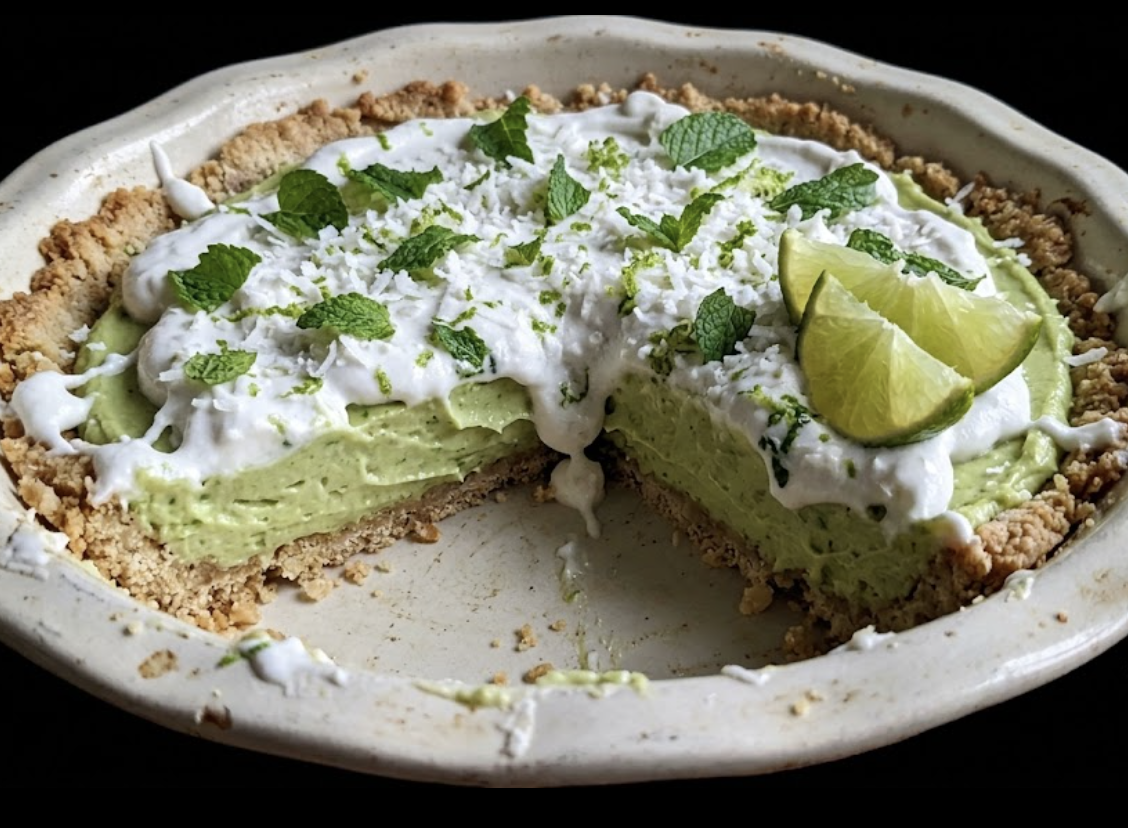
Two Grain-Free Key Lime Desserts: Raw Avocado-Cashew Tart and Baked Coconut-Custard Pie
Two grain-free Key Lime treatments — the Raw Macadamia-Crust Avocado-Cashew Mousse Tart, and the Baked Almond-Crust Key Lime Custard Pie. Both built around real fats, raw honey, and traditional thickeners — no refined flour, no sweetened condensed milk, no graham crackers, no industrial seed oils, no agave.
Cuisine: American · Floridian · Modern Grain-Free · Raw and Paleo
Yield: Tart serves 8-10 · Pie serves 8-10
Best eaten: Spring through summer (peak Key lime season), slightly chilled
A note from the kitchen
This pairing presents two grain-free Key Lime treatments built on opposite ends of the technique spectrum. The Raw Macadamia-Crust Avocado-Cashew Mousse Tart is the no-bake, raw-foods version — macadamia-and-coconut crust, avocado-and-cashew mousse filling enriched with coconut butter for silky body, made entirely in a food processor and set in the freezer. The Baked Almond-Crust Key Lime Custard Pie is the more traditional baked version — almond-and-coconut-flour crust, egg-thickened coconut-milk custard.
Both deliver the signature key lime brightness in a grain-free format, but the textures and flavor architectures are meaningfully different — the tart is silky and mousse-like with the depth of cashews and coconut butter; the pie is custard-firm, classically Floridian. Pick whichever fits the occasion: the tart for a weeknight raw-foods treat, the pie for a celebration centerpiece.
A note on Key limes vs. regular limes. Key limes (Citrus aurantiifolia) are the smaller, more tart, more aromatic variety native to Southeast Asia and brought to the Florida Keys by Spanish colonists. The original "key lime pie" was made with these specific limes, which carry a distinctly more floral, more concentrated lime character than the more common Persian limes (Citrus latifolia) sold in most American supermarkets. Real Key limes are seasonal (peak summer), small (ping-pong-ball-sized), and somewhat hard to find outside Florida, the Keys, and specialty produce markets. Regular Persian lime juice works as a substitute and the dish is called "key lime" by tradition rather than strict botanical accuracy in most modern recipes — but if you can find real Key limes, the difference is meaningful and worth seeking out.
Both desserts benefit beautifully from toasted coconut flakes and fresh lime zest on top — a small finishing step that elevates the visual reward and ties the coconut flavor through every bite.
RECIPE 1 · Raw Macadamia-Crust Avocado-Cashew Mousse Tart
The no-bake raw version — macadamia-coconut crust, avocado-cashew mousse filling enriched with coconut butter for silky body.
Yield: One 9-inch tart (8-10 slices) · Active: 30 min · Total: 4 hr (including soaking and freezing)
Ingredients
Macadamia-coconut crust
1½ cups raw macadamia nuts
½ cup unsweetened shredded coconut
¾ cup soft medjool dates, pitted (soaked 10 min in warm water if firm, then drained)
Zest of 1 organic lime
¼ tsp sea salt
Coconut oil, for greasing the tart pan
Avocado-cashew mousse filling
1½ cups raw cashews, soaked 4-6 hours and drained
3 large ripe avocados, peeled and pitted
½ cup fresh Key lime juice (or regular Persian lime juice — about 8-10 Key limes or 3-4 Persian limes)
2 tbsp grated organic lime zest (about 4-6 organic limes)
½ cup raw honey (or pure maple syrup)
3 tbsp coconut butter, melted
2 tbsp full-fat coconut milk (no gums — Native Forest Simple preferred)
1 tsp pure vanilla extract (or ½ vanilla bean, seeds only)
½ tsp sea salt
Topping (added just before serving)
¼ cup unsweetened coconut flakes, lightly toasted
Zest of 1 organic lime
6-8 thin lime slices or wedges, for garnish
Optional: fresh mint sprigs, edible flowers (calendula, viola, pansy)
Method
Make the macadamia-coconut crust
Pulse the nuts and coconut. In a food processor, pulse the macadamia nuts, shredded coconut, lime zest, and salt until coarse and sandy. Don't over-process — the nuts should retain some texture and not turn to butter.
Add the dates. Add the soaked-and-drained medjool dates and pulse just until the mixture sticks together when pressed between your fingers. Keep it slightly chunky rather than blending into a smooth paste.
Press into the pan. Lightly grease a 9-inch tart pan or springform pan with coconut oil. Press the crust mixture firmly across the base and slightly up the sides, smoothing with the back of a measuring cup.
Chill the crust. Place in the freezer to set while you make the filling, at least 30 minutes.
Make the avocado-cashew mousse
Blend the cashews first. In a high-speed blender or food processor, blend the soaked-and-drained cashews with 2 tbsp coconut milk and the vanilla until completely smooth and silky, about 2-3 minutes. Stop and scrape down sides as needed. The cashew base should be lump-free before adding other ingredients.
Add avocados and lime. Add the avocados, lime juice, lime zest, honey (or maple syrup), and salt. Blend until completely smooth and uniform, about 1-2 minutes.
Add coconut butter last. Add the melted coconut butter and blend briefly until incorporated. Work in short bursts so the mixture doesn't overheat.
Taste and adjust. The mousse should taste bright, tart, creamy, and distinctly lime-forward. Add another squeeze of lime juice for more tartness, or another tablespoon of honey for more sweetness, as preferred.
Fill and chill
Fill the crust. Pour the mousse into the chilled crust. Smooth the top with an offset spatula.
Set in the freezer. Freeze 3-4 hours, until firm enough to slice. For a softer mousse-like texture, move to the refrigerator about 20-30 minutes before serving.
Toast the coconut flakes
Toast. Spread unsweetened coconut flakes on a sheet pan. Toast in a 325°F oven for 4-5 minutes, stirring once, until golden and fragrant. Cool completely. Can be done 1 week ahead and stored in a sealed jar.
Garnish and serve
Final touches. Just before serving, scatter toasted coconut flakes across the top of the tart. Sprinkle with fresh lime zest. Arrange thin lime slices decoratively around the edge. Add fresh mint sprigs or edible flowers if using.
Slice and serve. Slice with a sharp knife (run under hot water and dry between cuts for clean edges). Best served slightly chilled — the mousse should be silky but not rock-hard.
RECIPE 2 · Baked Almond-Crust Key Lime Custard Pie
The classic Floridian pie, grain-free — almond-and-coconut-flour crust, egg-thickened coconut-milk custard (no gelatin needed). Finished with optional coconut whipped cream.
Yield: One 9-inch pie (8-10 slices) · Active: 30 min · Total: 5 hr (including baking, cooling, and overnight chill)
Ingredients
Grain-free almond crust
2 cups fine blanched almond flour
2 tbsp coconut flour
¼ tsp sea salt
Zest of 1 organic lime
4 tbsp grass-fed butter, melted (or ghee or coconut oil)
2 tbsp pure maple syrup or raw honey
1 large pasture-raised egg
Key lime custard filling
4 pasture-raised egg yolks
2 whole pasture-raised eggs
½ cup pure maple syrup or raw honey
1 cup full-fat canned coconut milk (no gums — Native Forest Simple preferred)
½ cup fresh Key lime juice (or regular Persian lime juice — about 10-12 Key limes or 4-5 Persian limes)
Zest of 2 organic limes
1 tsp pure vanilla extract
Pinch of sea salt
Optional coconut whipped topping
Solid cream from one can of chilled full-fat coconut milk (chilled overnight)
⅛ tsp pure vanilla extract
1 tsp pure maple syrup or raw honey
Topping (added just before serving)
¼ cup unsweetened coconut flakes, lightly toasted
Zest of 1 organic lime
6-8 thin lime slices or wedges, for garnish
Optional: edible flowers (calendula, viola, lavender), fresh mint sprigs
Method
Make the almond crust
Preheat the oven. Heat the oven to 350°F (175°C). Grease a 9-inch pie dish or tart pan with coconut oil or butter.
Mix the dry ingredients. In a large bowl, whisk together the almond flour, coconut flour, salt, and lime zest.
Add the wet ingredients. Stir in the melted butter, maple syrup (or honey), and egg until a soft dough forms.
Press into the pan. Press the dough evenly across the base and up the sides of the pie pan. Prick the bottom several times with a fork to prevent puffing.
Pre-bake the crust. Bake 10-12 minutes, until lightly golden at the edges. Remove from the oven and let cool 10 minutes. Reduce the oven temperature to 325°F (165°C).
Make the custard filling
Whisk the eggs. In a large bowl, gently whisk the egg yolks and whole eggs until just combined. Avoid whipping in lots of air — you want a silky custard, not a foamy one.
Add the remaining ingredients. Whisk in the maple syrup (or honey), coconut milk, lime juice, lime zest, vanilla, and salt until smooth and uniform.
Strain the custard (optional but recommended). Pour the custard through a fine-mesh strainer into the warm crust — this catches any egg chalazae or lime zest pieces for a silkier final texture.
Bake the pie
Bake the custard. Bake at 325°F for 18-24 minutes, until the outer edges are set but the center still has a gentle wobble when you nudge the pan. The custard will firm as it cools — don't overbake.
Cool at room temperature. Let the pie cool completely at room temperature, about 1-2 hours.
Chill to set. Refrigerate at least 4 hours, ideally overnight. The custard will firm to a sliceable consistency as it chills.
Make the optional coconut whipped topping (right before serving)
Chill in advance. The night before, place a can of coconut milk in the refrigerator to chill (along with a small mixing bowl).
Scoop the cream. Open the chilled can of coconut milk and remove just the solid cream from the top, being careful not to transfer the liquid below. Reserve the liquid for smoothies or other use.
Whip briefly. Place the cream in the chilled mixing bowl with the vanilla and maple syrup (or honey). Whip with an electric mixer for just 10-15 seconds — over-whipping loosens the cream. Stop as soon as soft peaks form.
Pipe or spoon onto the pie. Place in a piping bag with a star tip, or spoon dollops onto each serving.
Toast the coconut flakes
Toast. Spread unsweetened coconut flakes on a sheet pan. Toast in a 325°F oven for 4-5 minutes, stirring once, until golden and fragrant. Cool completely.
Garnish and serve
Final touches. Just before serving, scatter toasted coconut flakes across the top (over the whipped cream if using). Sprinkle with fresh lime zest. Arrange thin lime slices decoratively around the edge. Add fresh mint sprigs or edible flowers if using.
Slice and serve. Slice with a sharp knife (run under hot water and dry between cuts for clean edges). Serve slightly chilled.
Variations
Raw tart with pistachios instead of macadamias: Substitute the macadamia nuts in the crust with raw pistachios. Slightly less rich, more green-floral character. The crust takes on a vivid green hue that pairs beautifully with the green avocado mousse.
Raw tart with pecans instead of macadamias: Substitute the macadamia nuts with raw pecans for a more autumnal flavor profile.
Raw tart with cacao butter: Add 2 tbsp melted raw cacao butter alongside the coconut butter for a faintly white-chocolate-like richness.
Baked pie with lemon instead of lime: Substitute the lime with lemon for a lemon-custard-style pie. Adjust honey or maple syrup slightly upward to balance the additional tartness.
Baked pie with added ginger: Add 1 tsp fresh grated ginger to either the tart mousse or the pie custard for a brighter, spicier note.
Baked pie with added basil: Add 2 tbsp finely chopped fresh basil to the raw tart mousse for a more herbal, Mediterranean-inflected version.
Mini pie format: Press the almond crust into a 12-cup muffin tin lined with parchment cupcake liners. Bake the crusts 8-10 minutes. Divide the custard among the cups. Bake 12-15 minutes at 325°F. Beautiful for entertaining.
Mini tart format: Press the raw macadamia crust into four 4½-inch removable-bottom tart shells. Divide the avocado-cashew mousse among them. Excellent for individual portions or dinner-party plating.
With Key lime curd layer (more intense lime): Make a thin layer of homemade Key lime curd (½ cup lime juice + 4 egg yolks + ¼ cup honey + 3 tbsp butter, cooked over a double boiler until thick) and layer it between the custard and whipped topping for added intensity.
Make ahead: The tart crust can be made 3 days ahead and kept frozen. The pie crust can be made 2 days ahead. The fillings should be made the day of or up to 24 hours ahead. For 16+ guests, double the pie recipe and use a 9×13 pan or two 9-inch pies.
Pairs Well With
Sparkling water with cucumber, fresh mint, and lime, or chilled coconut water with a squeeze of lime. A small espresso or strong black coffee for an afternoon finish. Fresh tropical fruit (mango, pineapple, papaya) alongside the dessert for a complete tropical fruit course. Fresh berries (raspberries, blackberries) for visual color contrast. A small bowl of toasted coconut flakes and chopped macadamia nuts as additional textural toppings at the table. For a complete spring or summer celebration spread, serve as the dessert centerpiece at a brunch or dinner alongside grilled wild fish, slow-roasted pork shoulder, or a Mediterranean composed plate.
Sourcing
Raw macadamia nuts. Hawaiian-grown (Mauna Loa, Hamakua) or Australian (Buderim, MacFarms). Single-ingredient, raw, unsalted. Store in the refrigerator or freezer — macadamias oxidize quickly due to their high oil content.
Raw cashews. Single-ingredient raw cashews — never roasted or salted. Anthony's Goods, Big Tree Farms, or One Degree Organic Foods. Avoid bulk-bin "raw" cashews from supermarkets — most are steamed (which technically isn't raw). Store in the refrigerator after opening.
Medjool dates. Bautista Family Organic Date Ranch or Joolies (small Coachella Valley producer). Avoid commercial bulk dates — they're often dry, fibrous, and lack the caramel depth of fresh medjools.
Avocados. Look for Hass or Reed varieties, ripe but firm (yielding slightly to gentle pressure at the stem end). Organic when possible.
Unsweetened shredded coconut and large flake coconut. Let's Do Organic, Bob's Red Mill, Big Tree Farms, or Anthony's Goods. Single-ingredient, no preservatives.
Coconut oil and coconut butter. Cold-pressed, unrefined, organic. Nutiva, Garden of Life, Dr. Bronner's (for coconut oil), or Artisana, Nutiva (for coconut butter). Should smell distinctly of fresh coconut.
Pure vanilla bean and vanilla extract. Heilala, Singing Dog Vanilla (single-origin Madagascar), or Frontier Co-op. Real vanilla bean pods can be split and seeds scraped; extract should be single-ingredient (just vanilla + alcohol or vegetable glycerin).
Pasture-raised eggs. Yolks should be deep orange. Vital Farms, Pete & Gerry's, or a local farmers' market.
Blanched almond flour. Finely ground blanched almond flour (skins removed). Bob's Red Mill Super-Fine, Anthony's Goods, or King Arthur Baking.
Coconut flour. Single-ingredient organic coconut flour. Bob's Red Mill or Nutiva.
Grass-fed butter. From cows on pasture year-round. Vital Farms, Organic Valley Pasture Butter, Kerrygold Reserve, or Beurre d'Isigny.
Full-fat coconut milk. Single-ingredient — just coconut, no gums (guar gum, xanthan gum). Native Forest Simple (BPA-free cans, no gums) is the cleanest option. Aroy-D (cardboard packaging, no gums) is also excellent. Trader Joe's Organic is widely accessible.
Raw honey. Local, unfiltered, single-origin from a beekeeper or farmers' market. For these recipes, a lighter honey (orange blossom, wildflower, acacia) works beautifully and doesn't overwhelm the lime.
Pure maple syrup. Grade A dark or amber. Crown Maple, Hidden Springs Maple, Coombs Family Farms, or Anderson's. Both honey and maple syrup work in either recipe; pick based on flavor preference.
Key limes (Citrus aurantiifolia). Florida Keys producers, specialty produce markets, or seasonal at Whole Foods (peak summer). Persian limes substitute well if Key limes aren't available.
Organic limes. The zest is the most pesticide-exposed part of the lime, so organic really matters when using zest. From an organic produce section or farmers' market.
Edible flowers (optional garnish). From a farmers' market vendor that specifically sells edible flowers, specialty grocers, or a backyard garden. Important: Never use florist flowers — they're sprayed with pesticides not safe for food. Reliable edible varieties: rose petals (organic only), pansies, violas, calendula, lavender, nasturtium.
Sea salt. Baja Gold mineral sea salt for cooking, fleur de sel for finishing.
Storage
Raw Macadamia-Crust Avocado-Cashew Tart
Refrigerated: Up to 4 days (the avocado mousse will brown slightly over time — best within the first 2 days for visual freshness)
Frozen: Up to 1-2 months, well-wrapped
Best within 24 hours of finishing
Baked Almond-Crust Coconut-Custard Pie
Refrigerated: Up to 3-4 days, sealed
Frozen: Up to 1-2 months, well-wrapped (texture is best fresh, but freezing works)
Best within 24 hours of slicing
Make-ahead components
Tart crust: Can be made 3 days ahead and kept frozen
Pie crust: Can be made 2 days ahead, kept at room temperature
Tart filling (avocado-cashew mousse): Best made the day of, or up to 24 hours ahead (avocado will brown slightly)
Pie custard filling: Bake the day before serving for the freshest texture
Coconut whipped topping: Best made within 2 hours of serving
Toasted coconut flakes: Up to 1 week at room temperature in a sealed jar
Nourishment Notes
These two Key Lime treatments deliver the bright signature character of the Florida Keys' most-loved dessert in two grain-free formats — both substantially more nutrient-dense than conventional key lime pie made with sweetened condensed milk and graham crackers.
The Raw Macadamia-Crust Avocado-Cashew Mousse Tart is the no-bake version. Macadamia nuts — the highest-monounsaturated-fat-content nut, with a buttery-sweet flavor that pairs specifically with coconut and citrus — form the crust alongside unsweetened coconut, medjool dates, and lime zest. Macadamia contributes additional palmitoleic acid (omega-7) and the rare fatty-acid profile that distinguishes macadamia from other nuts. The crust is no-bake — processed briefly so the nuts don't turn to butter, then chilled until firm.
The avocado-cashew mousse is the silky centerpiece. Avocados are remarkably nutrient-dense — potassium, monounsaturated fats, folate, vitamin K, vitamin E, and substantial fiber — and their naturally creamy texture, blended with cashews and lime juice, produces a mousse that's silky-smooth and naturally rich. The three avocados in the recipe deliver about 30g of monounsaturated fat across the 8-10 slices, alongside the carotenoid lutein (which gives ripe avocados their golden flesh) and β-sitosterol (a phytosterol with documented effects on cholesterol metabolism).
Cashews build the creamy body and contribute zinc, copper, magnesium, and tryptophan. Soaking the cashews is non-negotiable for silky texture — it neutralizes phytic acid and softens the seed for proper blending. Coconut butter adds medium-chain triglycerides (lauric acid) and the fats that give the mousse its substantial body and clean set. Lime juice and zest provide vitamin C, citrate, and d-limonene — the essential oil that supports liver detoxification. Raw honey or pure maple syrup contributes trace minerals and the slow sugar release that fiber-bound natural sweeteners deliver compared to refined sugar.
The Baked Almond-Crust Key Lime Custard Pie is the more traditional Floridian pie reconstructed grain-free. The almond-and-coconut-flour crust delivers vitamin E, magnesium, and high-fiber bulk; grass-fed butter contributes butyrate, K2, and the full fat-soluble vitamin complex; pasture-raised egg provides choline, lecithin, and the binding that gives the crust its character.
The custard is the satisfying centerpiece — and it's egg-thickened, not gelatin-thickened. The four egg yolks plus two whole eggs do all the structural work, using the traditional French custard technique that pre-modern desserts always relied on. Pasture-raised egg yolks provide choline, lecithin, complete protein, and the fat-soluble vitamin complex (A, D, E, K2). Full-fat coconut milk delivers medium-chain triglycerides (lauric acid) and the substantial fat that carries the fat-soluble vitamins. Raw honey or pure maple syrup contributes manganese, antimicrobial enzymes (in honey), and slow-burning sweetness that's fiber-bound and metabolically gentler than refined sugar.
Toasted coconut flakes on top add a final layer of textural and visual reward — crunchy, golden, slightly sweet from the toasting process, and reinforcing the coconut flavor that runs through both desserts.
Both treatments deliver bright, refreshing, deeply satisfying desserts that capture the floral-tart character of Key limes with the substantial fat-and-protein anchoring that makes them deeply nourishing rather than just sweet. Both are best eaten cold, ideally outdoors in spring or summer — the sweet-tart-cold combination is honestly refreshing on warm afternoons. Pair with a chilled cup of coconut water with lime or sparkling water with cucumber and mint.
— Anna aka Food Marshall