RAW FLORAL CASHEW Cheesecake with EDIBLE FLOWERS AND SPRING BERRIES
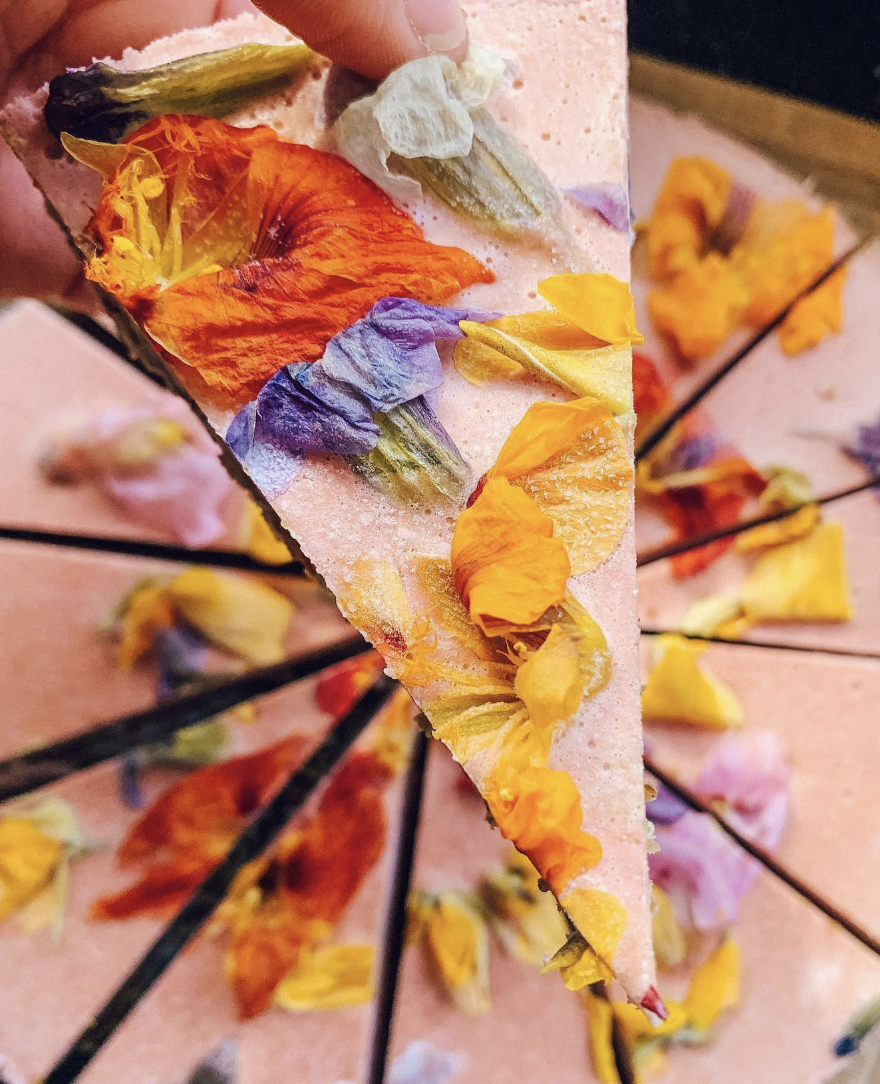
A no-bake spring celebration cake — sprouted nuts, soaked cashews, edible flowers.
Season: Spring through Summer (peak edible flower season)
Cuisine: Raw · Grain-free · Dairy-free · Refined-sugar-free
Yield: One 9-inch springform cake (10-12 slices)
Active: 30 min · Total: 6 hr+ (overnight set ideal)
Ingredients
Crust
2½ cups sprouted pecans, walnuts, or almonds (or a mix)
5-6 medjool dates, pitted
5–6 dried apricots
¼ tsp ground Ceylon cinnamon
1–2 tbsp coconut oil, melted
Pinch sea salt
Optional: ½ cup fresh raspberries (scattered over the pressed crust as a bottom layer)
Filling
2½ cups raw cashews, soaked 4+ hours and drained
Juice of 1 fresh lemon
½ cup full-fat coconut milk (no guar gum — Native Forest preferred)
½ cup coconut oil, melted
½ cup pure maple syrup or raw unfiltered honey
1 tsp pure vanilla extract
Optional pink swirl: ½ tsp pink beetroot powder + a few drops of food-grade rose water, blended into half the filling
Garnish
Edible flowers (rose petals, pansies, violas, lavender, calendula)*
Fresh berries
Sliced apricots (optional)
Notes on substitutions:
Sub: any sprouted nut mix works — pecans for richness, walnuts for omega-3s, almonds for body.
Cashews are non-negotiable for the filling: their neutral flavor and natural creaminess can't be replicated.
*Important: Use only edible flowers from organic growers, farmers' markets, or your own pesticide-free garden. Never use florist flowers — they're sprayed with pesticides that aren't food-safe
Method
Line a 9-inch springform pan with parchment rounds. Lightly coat the sides with coconut oil.
Crust: pulse all crust ingredients in a food processor until they form a sticky dough that holds together when pinched. Press firmly into the prepared pan in an even layer.
Scatter the raspberries over the crust.
Filling: blend all filling ingredients in a high-speed blender until completely smooth and creamy — 2–3 minutes of active blending. Stop and scrape down the sides as needed.
For the two-tone swirl: divide the filling in half. Leave one half plain. To the second half, add the beetroot powder and rose water; blend until smooth and pink.
Assemble (single-color): pour the filling over the crust and smooth with an offset spatula.
Assemble (two-tone swirl): pour the white filling over the crust. Drop spoonfuls of pink filling on top in a pattern, then use a knife or chopstick to swirl through both layers like a zebra cake.
Freeze overnight, or at least 6 hours, to set fully.
Transfer to the refrigerator 30 minutes before serving to soften slightly.
Arrange edible flowers, fresh berries, and sliced apricots on top in a beautiful pattern just before serving.
Slice with a sharp knife — run under hot water and dry between cuts for clean edges.
Nourishment Notes
This is a celebration cake built without any of the inputs that make conventional cheesecake metabolically heavy — no refined flour, no industrial dairy, no white sugar, no inflammatory seed oils, no synthetic emulsifiers. What's left is a dessert built almost entirely on whole foods that happen to set into a silky, sliceable cake when handled correctly. Sprouted nuts have been pre-soaked and dried to activate the enzyme phytase and reduce phytic acid, which increases the bioavailability of the zinc, iron, magnesium, and other minerals locked in the nut's seed structure. Pecans, walnuts, and almonds together deliver vitamin E in its full tocopherol complex, manganese, copper, omega-3 ALA, and monounsaturated fats. Cashews build the silky body of the filling and contribute zinc, copper, magnesium, and tryptophan. Coconut milk and coconut oil layer in medium-chain triglycerides and lauric acid — the saturated fats that give the cake its set without the dairy.
The sweeteners and flavoring agents earn their place — doing more than flavor work. Medjool dates contribute potassium, copper, and manganese-rich slow sugars softened by the fiber that comes with them — a profile entirely different from refined sugar. Dried apricots add beta-carotene and potassium; raw maple or honey carry trace minerals and (for honey) enzymes the body reads as food rather than as pure glucose. Raspberries deliver ellagic acid, anthocyanins, and vitamin C — the same antioxidant compounds that give them their deep red color. Beetroot powder, used optionally for the pink swirl, is more than coloring: betalains are pigments that support nitric oxide production, vascular function, and phase-two liver detoxification, and they survive the no-cook preparation intact. Food-grade rose water contributes the floral compound that has been used in Persian, Indian, and Middle Eastern desserts for centuries; rose has been understood across these traditions as both digestive support and a gentle nervine.
As a seasonal food, this cake belongs to spring and early summer, when fresh edible flowers are most abundant and the body welcomes lighter, brighter, fruit-forward sweets. The lengthening days of spring shift the body's metabolic curve toward easier carbohydrate handling at midday — but a celebration dessert like this is best served as part of a midday or early-afternoon meal rather than as a late-evening dessert, when the substantial fat and slow sugars sit cleanest in daylight digestion. Slightly chilled (not frozen-hard) is the ideal serving temperature — the texture reaches its silkiest, the flavors are most expressive, and the floral notes lift properly.
Storage
Whole assembled cake (refrigerated): Up to 5 days, covered. The pink swirl colors deepen slightly over time.
Whole cake (frozen): Up to 2-3 months, sealed in an airtight container. Thaw in the refrigerator overnight or on the counter for 30 minutes before serving.
Crust alone (refrigerated): Up to 4 days, sealed.
Filling alone (refrigerated): Up to 3 days, sealed. Re-blend briefly if it separates.
Edible flowers: Always add just before serving — they wilt within hours and lose their visual character. Store flowers in a sealed container with a damp paper towel in the refrigerator until use.
Sliced cake (individual portions): Wrap each slice in parchment and store in a sealed container. Excellent as packed lunch dessert or daytime snack
Variations
Single-color version (no pink swirl): Skip the beetroot powder and rose water. Pour the plain filling over the crust and smooth. Garnish with edible flowers and berries as the visual focal point.
All-pink version: Add the beetroot powder and rose water to the entire filling (not just half). A uniform pale pink cake.
Lemon-vanilla version: Skip the beetroot powder and rose water. Increase the lemon juice to 3 tbsp and add the zest of 1 lemon to the filling. A brighter, more citrus-forward variation.
Lavender-honey version: Add 1 tbsp dried culinary lavender to the soaking water for the cashews (it infuses while they soak). Strain before blending. Substitute the maple syrup with raw honey. A floral-honey alternative.
With chocolate ganache top: After the cake has set, pour a thin layer of melted dark chocolate (½ cup raw cacao chocolate + 2 tbsp coconut oil + 2 tbsp maple syrup) over the top. Set in the refrigerator before garnishing with flowers. More dramatic, less floral.
Strawberry version: Substitute the raspberries with 1 cup hulled fresh strawberries (blended into the pink layer instead of beetroot powder for a more natural pink color).
Make ahead: The whole cake can be made up to 5 days ahead and refrigerated. The crust and filling can be made up to 2 days ahead and assembled the morning of serving. Frozen, the cake keeps 2-3 months — thaw in the refrigerator overnight before garnishing and serving.
Sourcing
Sprouted nuts (pecans, walnuts, almonds). Living Tree Community, Go Raw, or Wildly Organic for sprouted nuts (pre-soaked and dehydrated to neutralize phytic acid). Alternatively, sprout your own — soak raw nuts in filtered water with 1 tsp sea salt overnight, drain, rinse, then dehydrate in a 150°F oven for 8-12 hours.
Raw cashews. Single-ingredient raw cashews. Anthony's Goods, Big Tree Farms, or One Degree Organic Foods. Avoid bulk-bin cashews from supermarkets — most are steamed (which technically isn't raw). Store in the refrigerator after opening.
Medjool dates. Bautista Family Organic Date Ranch or Joolies (small Coachella Valley producer). Avoid commercial bulk dates.
Dried apricots. Single-ingredient unsulfured Turkish or California apricots. Made in Nature, Sun-Maid Natural Apricots (look for no added sulfites), or Anthony's Goods. Avoid bright-orange sulfite-treated apricots — they have added preservatives.
Full-fat coconut milk. Single-ingredient — just coconut, no gums. Native Forest Simple (BPA-free cans, no gums) is the cleanest option. Aroy-D (cardboard packaging, no gums) is also excellent.
Coconut oil. Cold-pressed, unrefined, organic. Nutiva, Garden of Life, or Dr. Bronner's.
Pure maple syrup or raw honey. For maple syrup: Crown Maple, Hidden Springs Maple, Coombs Family Farms. For raw honey: local, unfiltered, single-origin from a beekeeper or farmers' market.
Pure vanilla extract. Single-ingredient (just vanilla and alcohol). Singing Dog Vanilla (single-origin Madagascar) is the benchmark.
Ground Ceylon cinnamon. True Ceylon cinnamon (not Cassia). Burlap & Barrel or Diaspora Co.
Beetroot powder. Single-ingredient organic beetroot powder. The Spice Lab, Burlap & Barrel, or Anthony's Goods. Look for vibrant deep red color — pale powders have lost their pigment potency.
Food-grade rose water. Single-ingredient rose water from a Middle Eastern grocer (Cortas, Mymouné, Sadaf) or Indian grocer. Avoid rose-scented products with artificial flavoring.
Edible flowers. From a farmers' market vendor that specifically sells edible flowers (look for "unsprayed" or "pesticide-free"), specialty grocers (Whole Foods sometimes carries them in spring), or a backyard garden. IMPORTANT: Never use flowers from a florist — they're heavily sprayed with pesticides. Reliable edible varieties: rose petals (organic only), pansies, violas, calendula, lavender, nasturtium, borage, chamomile.
Fresh raspberries and other berries. From a farmers' market or organic produce section in peak spring/summer season.
Sliced fresh apricots. From a farmers' market or organic produce section at peak season (May-August).
Sea salt. Baja Gold mineral sea salt
— Anna aka Food Marshall