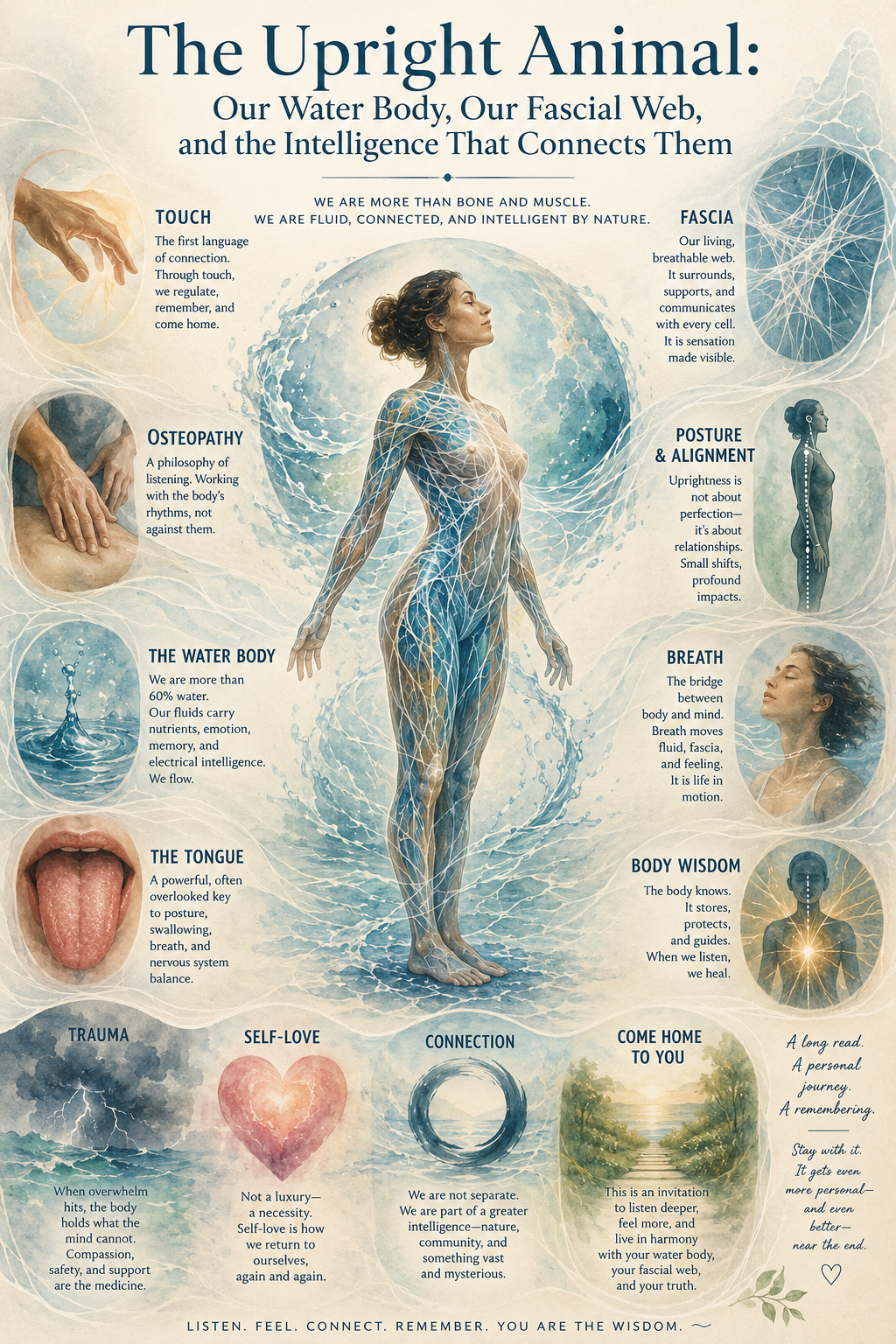
The Upright Animal: Our Water Body, Our Fascial Web, and the Intelligence That Connects Them
Why we rose, what we risked, and the wisdom held in living tissue —
You are balancing a column of bone, organ, and breath against gravity, holding the most irreplaceable and vulnerable parts of yourself — your heart, your lungs, the soft architecture of your belly — turned outward toward the world. This is so ordinary it disappears beneath notice. Yet, from an evolutionary standpoint, it is one of the most unordinary postures any large animal has ever adopted, and understanding why we adopted it opens a door into nearly everything about how the human body is built, how it moves, how it suffers, and how a skilled body-worker’s pair of hands can read it like a text.
The Exposed Heart
Consider first the audacity of the arrangement. A four-legged animal carries its vital organs slung beneath a horizontal spine, the soft underbelly oriented toward the protected ground and shielded above by the vertebral column and on the sides by the legs. The heart and lungs sit in a kind of bony cradle, low and hidden. When such an animal is threatened, its instinct is to keep that underside away from teeth and claws. The viscera are, quite literally, the body’s best-kept secret.
To stand upright is to give that secret away. Rising onto two legs rotated the entire front of the body toward the horizon — throat, chest, and abdomen now arrayed in a vertical line, facing whatever approaches. The carotid arteries in the neck, the heart behind the thin shield of the sternum, the undefended belly: all of it presented forward. No other large mammal exposes its core so completely as a matter of ordinary posture. From a purely defensive perspective, it looks like a catastrophic decision.
This vulnerability is written into how we behave under threat. When we are frightened, grieving, or struck, the body folds forward — the shoulders round, the chest caves, the head drops, the limbs draw in toward the centerline. This is the protective crouch, an ancient motor reflex that re-hides what uprightness exposed, returning the body for an instant to the safer geometry of the four-legged ancestor. The flinch toward the floor is a memory in the flesh. By the same logic, the open chest — shoulders back, sternum lifted, throat bare — is the posture of confidence, courage, and trust. We expose the heart, anatomically and emotionally, when we feel safe. The grammar of human emotional expression is built directly on top of this evolutionary gamble, and much of it appears to read across culture: the collapsed chest of defeat and shame, the lifted chest of pride and welcome (de Waal, 2019).
So Why Rise? The Tensegrity Answer
If standing upright exposed our most precious cargo, the obvious question is what we received in return that made the trade worthwhile. Part of the answer requires letting go of a stubborn mental picture: the body as a tower of bones stacked like bricks, each pressing down on the one below, the whole precarious column liable to topple. That image is wrong, and the corrected version reframes the entire problem of standing.
The connective-tissue theorist and author of Anatomy Trains, Thomas Myers, building on the architectural insights of Buckminster Fuller and the biomechanical work of Stephen Levin, describes the body as a tensegrity structure — a blend of the words “tensional” and “integrity” (Myers, 2021; Levin, 2002). In a tensegrity system, rigid compression elements (here, the bones) do not touch one another directly. Instead they float, suspended within a continuous network of tension elements (here, the fascia, ligaments, and muscles). The bones are the struts; the soft tissue is the web of guy-wires holding them in dynamic, balanced suspension. Push on one part of such a structure and the load distributes through the entire network rather than crushing down through a single column. This is why a body can fall, twist, and absorb impact in ways no stack of bricks could survive, and why the upright human is far more resilient than its precarious appearance suggests. We did not build a fragile tower. We strung a living tent.
Within that reframing, the benefits of rising come into focus. The single most consequential gain was the liberation of the hands. Freeing the forelimbs from the work of locomotion is the revolution at the root of human distinctiveness and productivity. Hands no longer needed for walking became hands free to carry food across distances, to fashion and wield tools, to gesture and so to communicate, and to hold an infant against the chest while the body moved. The upright spine and human culture arrive together.
The throwing arm deserves special mention here, because it turns vulnerability into dominance. The human shoulder evolved into an elastic energy-storage system: as the arm cocks back, tendons and fascia at the shoulder stretch and load like a slingshot, then release that stored energy to hurl a projectile at speeds no other primate can approach (Roach, Venkadesan, Rainbow, & Lieberman, 2013). We are the only animal that can reliably kill at a distance with a thrown object. The same exposed, open-fronted posture that bared the heart is what permitted the shoulder to wind up and the arm to swing free. The risk and the weapon are two faces of one anatomy. The feat is on vivid display in our own species’ extremes: a Major League pitcher hurling a baseball past a hundred miles an hour, or a javelin thrower launching a spear the length of most of a football field. No chimpanzee, for all its raw strength, can throw with anything close to that speed or accuracy — the difference lies not in muscle but in the elastic, fascia-loaded architecture of the human shoulder, cocked and released like a drawn bow.
Born to Run: Vulnerability as Strategy
There is a second great payoff to the upright form, and it transforms our apparent physical weakness into one of the most formidable hunting strategies in the animal kingdom. On the face of it, humans are unimpressive athletes. Almost any prey animal — antelope, deer, hare — can outsprint us in a burst, and many predators can too. But sprint speed is not the contest our ancestors entered. Over long distances, in heat, the human body is very nearly unbeatable, a fact popularized by Christopher McDougall in Born to Run (2009) and grounded in the scientific work of Dennis Bramble and Daniel Lieberman on endurance running as a defining human adaptation (Bramble & Lieberman, 2004).
The mechanism is thermal, and it is worth pausing on the physics, in plain terms. Every working muscle is, in effect, a small furnace: it burns fuel to produce movement, and like any furnace it throws off heat as a byproduct. Run hard for long enough and that heat builds toward a dangerous internal temperature — this is the real limit on sustained effort for most animals, not tired legs but an overheating engine. The body that can shed heat fastest is the body that can keep going. Most fast quadrupeds shed heat by panting, and an animal cannot pant effectively while galloping — it must stop, rest, and cool. Humans took the opposite route. We lost most of our body hair and developed several million eccrine sweat glands distributed across nearly the entire skin surface, allowing us to dump heat continuously while still in motion (Lieberman, 2013). A galloping antelope banks its heat like a debt and must stop to pay it off by panting; the human pays continuously, in sweat, as it goes — never accumulating the thermal debt that forces the four-legged animal to halt. We do not run faster. We run cooler. That same naked, sweating, electrically conductive skin, pressed against the ground at rest, is also our living interface with the earth’s own supply of free electrons — the very basis of grounding, which we will return to — so that the skin that cools us is also the skin that connects us electrically to the planet. That same naked, sweating skin — our living electrical interface with the earth, as we will see — is also the skin that cools us. Upright posture compounds the cooling advantage: standing tall presents less body surface to the punishing overhead sun of midday and lifts the head into cooler moving air. The human is, in effect, a heat-management machine on two legs.
From these facts emerges the persistence hunt, one of the oldest hunting methods known and still practiced into recent times by some San hunters of the Kalahari and other peoples (Liebenberg, 2006). The hunter does not try to outrun the prey — an impossible task. Instead, the hunter tracks a single animal and keeps it moving through the hottest part of the day, never allowing it the pause it needs to shed its accumulating heat. The animal sprints away, then must stop; the patient hunter jogs up and starts it running again, and again, and again, until the creature collapses in hyperthermic exhaustion and the hunter simply walks up to it. We do not outpace our prey. We outlast it. We exhaust it into the ground. Vulnerability — our slowness, our nakedness — is precisely what made the strategy work.
The body built for this work bears the evidence everywhere. Lieberman and his colleagues documented an entire suite of anatomical features that make sense only as adaptations for endurance running rather than walking, and they make a vivid catalogue of evolutionary engineering (Bramble & Lieberman, 2004). The nuchal ligament stabilizes the head against the pitching of a run and is present in dedicated runners such as dogs and horses but absent in our non-running ape relatives. The Achilles tendon and the arched, springy foot store and return elastic energy with each stride, recycling roughly half the energy of the footfall.
The gluteus maximus — our defining oversized buttock — fires powerfully during running but is largely quiet during a walk, betraying what it was truly built for.
Wide shoulders decoupled from the head allow the torso to counter-rotate against the swinging hips while the gaze stays level. And crucially, our breathing is no longer locked to our stride the way a galloping quadruped’s is, freeing the runner to breathe in whatever rhythm the effort demands. The same vertical openness that exposed the heart let the lungs and limbs swing free in the long, loping cadence of the chase.
But endurance alone does not capture what made us so formidable. We also out-think our prey. The persistence hunt is not merely a feat of stamina; it is a feat of cognition — the ability to track an animal that has vanished over a rise, to read a bent blade of grass or a scuffed stone, to imagine where a frightened creature will run and to hold that prediction in mind across hours of pursuit. This is the work of an expanded frontal cortex and the executive functions it supports: planning, foresight, sustained attention, the suppression of the urge to give up.
Underneath this capacity runs a particular chemistry. Dopamine, the neuromodulator we often reduce to a synonym for pleasure, is better understood as the molecule of pursuit — it drives wanting, seeking, and the willingness to keep moving toward a reward that has not yet arrived. Compared with our archaic relatives, anatomically modern humans appear to have evolved a different balance of this system. Genetic work comparing our lineage with Neanderthals has identified variants affecting dopamine signaling that became common in Homo sapiens, and some researchers have proposed that a more dopamine-rich brain favored exactly the traits the persistence hunt demands: cooperation, abstraction, long-horizon planning, the patient chase whose payoff lies hours or days ahead. The same brain that could plan a hunt could plan a planting, a migration, a tool not yet made.
The story does not end in the deep past. Dopamine remains central to how we move and think today, which is why its disruption shows up across so much of modern suffering — the motor decline of Parkinson’s, differences in motivation and attention, the restless dissatisfaction of a brain bathed in cheap, constant reward. We evolved a chemistry built to chase distant goals across open country. We now ask it to fire for a notification. Endurance gave us the body to outlast our prey; the prefrontal cortex gave us the mind to outwit it; and dopamine, properly understood, gave us the drive to begin the chase at all.
If our minds were shaped to chase, our bodies were shaped to carry the chase out. That body, used as designed, was a body almost always in motion. Among traditional peoples who still live close to the ancestral pattern — the running cultures of East Africa, the hunter-gatherers who cover great distances daily on foot — movement is not an event scheduled into the day but the texture of the day itself, frequently totaling well over ten thousand steps. Most of us in the modern West, by contrast, struggle to reach even four or five thousand. The gap between those two numbers is, in a real sense, the gap between the body’s design specification and the conditions we now ask it to endure.
The Unpaid Bill: What Uprightness Still Costs
It would be a mistake to imagine that the trade-off of standing on two legs was settled long ago and the account closed. We are still, in a sense, paying installments on a loan our ancestors took out when they first rose onto two feet — and many of the most common human afflictions are the recurring charges on that debt. The lower back, asked to bear and transmit loads it was only recently redesigned for, is a chronic site of pain across human populations. Hernias exploit the weak points where the upright abdomen must contain pressure that a horizontal one never faced. Varicose veins and venous pooling in the legs follow from asking blood to return uphill against gravity through a tall column. The pelvic floor must hold the weight of the viscera from below in a way no quadruped’s does, with consequences ranging from incontinence to prolapse.
Most dramatic of all is what anthropologists call the obstetrical dilemma. Reshaping the pelvis for efficient upright walking narrowed the birth canal at the very moment human evolution was enlarging the infant brain and skull, leaving human childbirth more difficult and demanding than that of most mammals and helping to explain why human infants are born so strikingly helpless and early relative to other apes (Rosenberg & Trevathan, 2002). And yet “difficult” need not mean the agony our culture treats as inevitable. The body is also, in its way, exquisitely designed for birth, and there is a long tradition — supported by the experience of many women and by approaches such as hypnobirthing and undisturbed physiological birth — of childbirth that is calmer, more empowered, and for some women dramatically less painful. Much of the pain we assume to be intrinsic is amplified by fear, by the bright, exposed, supine hospital setting, by interventions that work against the body’s own rhythm, and by a culture that primes women to expect agony. When a laboring woman feels safe, unobserved, free to move, and deeply relaxed — the very parasympathetic, vagal state this whole chapter is concerned with — the body’s own design can express itself far more gently than the cultural script suggests. The upright form gave us the free hands that built civilization and the running body that fed it, and it raised the stakes of birth, but the body is a living compromise and a remarkable design, not simply a flawed one.
And the modern world has taken this ancient compromise and made its costs far worse — not through anything written in our anatomy but through how we now live inside it. The upright animal was built to move, and to move constantly, squatting and kneeling and reaching and climbing, resting on the earth and rising from it again throughout the day. We touched earlier on the gulf between the many thousands of daily steps that defined ancestral life and the few thousand most of us now manage; the deeper problem is not just the step count but the loss of variety — the hundreds of different positions a body once flowed through and now almost never visits. We have confined children in containers — strollers, bouncers, seats, screens — and confined adults in chairs, and in doing so we have starved the upright body of the very loading it requires to stay supple, strong, and pain-free. We do not, in truth, need most of our furniture. We can sit on the ground and rise from it, eat outdoors on the earth, read lying on a towel in the grass or on the floor, and let the body move through the full range of postures it was designed to flow between. Much of the unpaid bill of uprightness comes due only because we stopped moving the way the upright form demands.
Fascia Speaks the Language of Its Function
Underneath all of this — the standing, the throwing, the running — lies the connective tissue that holds the whole tensile structure together, and it is worth understanding that fascia is not one uniform material but a continuum of densities and characters, each tuned to the job it must do. Think of it the way a single material can be spun into very different forms for very different purposes: the same basic fiber can be woven into a heavy ship’s hawser meant to hold a vessel against the tide, or into a sheer, weightless veil meant only to drift on the breath of air. The fascia is not the same around a powerful locomotor muscle as it is around the delicate tissue of the lung, for exactly the same reason the rope and the veil are not the same — each is built to its task.
Where the body must generate and transmit great mechanical force, the fascia densifies into tough, fibrous, highly organized sheets aligned along the lines of pull. The iliotibial band down the outer thigh, the thoracolumbar fascia spanning the low back, and the plantar fascia along the sole of the foot are nearly tendon-like in their toughness — load-bearing cables designed to withstand and channel strain, to store and return elastic energy, to keep the running body from tearing itself apart (Schleip, Findley, Chaitow, & Huijing, 2012). These are the guy-wires under the heaviest tension.
Deep in the chest, by contrast, the connective tissue surrounding the alveoli and the fine branching architecture of the lungs is gossamer — cobweb-fine, loose, areolar, richly elastic, built not to resist force but to permit the gentle, ceaseless expansion and recoil of breath. The pulmonary interstitium must be supple enough to let lung tissue balloon and deflate roughly twenty thousand times a day for an entire lifetime, and it accomplishes this through a delicate elastic mesh that would be useless as a load-bearing structure and is never asked to be one (West & Luks, 2021). The same body that requires cable-strength fascia at the iliotibial band requires whisper-thin elastic webbing around the air sacs.
The principle, stated simply, is that fascia speaks the language of the function it serves. Where we generate force, it thickens and organizes. Where we exchange the breath of life, it softens and yields. The body is not uniformly armored; it is selectively armored. And there is a poignancy in noticing that our most life-essential exchanges — the breath at the alveoli, the heartbeat within its thin pericardial sleeve — take place in the most delicate tissue we possess, situated behind the most exposed surface of the upright form. Vulnerability runs all the way down, past the bared chest, past the undefended belly, to the microscopic scale of the tissue itself.
The Water Body and the Water We Make
That fascia is supple at all depends on something we rarely think of as part of connective tissue: water. It is easy to picture the body as a structure of bone and muscle that merely contains water, the way a vessel holds a liquid. The truth is closer to the reverse. The human body is roughly two-thirds water by weight — but by molecule count, closer to 99%. Water is such a small, light molecule that it dominates the count: about ninety-nine of every hundred molecules in you are water. The fascial web we have been describing is among the most water-rich tissues we possess. Indeed, when fascia is examined honestly by its composition, it is overwhelmingly water — far more water than fiber by volume— a living sponge whose collagen fibers are sheathed in bound water that gives the network its glide, its springiness, and its capacity to transmit force smoothly across the whole tensegrity structure (Schleip et al., 2012; Pollack, 2013). To call fascia a tissue of collagen is therefore almost to mislabel it; it is far more accurate to call it water, given shape and tension by a sparse scaffold of fiber. When fascia loses its water, it does not simply dry out; it stiffens, snags, and loses the frictionless slide between layers that healthy movement depends on. Hydration, properly understood, is not a side issue for the fascial body. It is the fascial body.
But here the everyday notion of hydration — drink more water — turns out to be only a fraction of the story, and not the most important fraction. What matters to a cell is not how much water passes through the gut but how much structured, usable water sits inside the cell itself and how well that water is organized around the proteins and membranes that do the work of life.
EZ Water: The Fourth Phase
The biophysicist Gerald Pollack has spent decades studying a form of water that behaves unlike the bulk liquid we drink. In his account, water adjacent to certain surfaces — including the proteins and membranes of our cells — organizes itself into a distinct, more ordered layer he calls the exclusion zone, or EZ water, sometimes described as a fourth phase of water between liquid and solid (Pollack, 2013). This structured water carries a slight negative charge, excludes dissolved particles, and forms a gel-like, energetically favorable medium. Crucially, in Pollack’s experiments, the energy that builds this structured layer comes substantially from light, particularly the infrared wavelengths that bathe us constantly from the sun and from warm surfaces. Water, in this view, is a battery, and light is part of what charges it.
Even more intriguing, the water inside our cells can be structured and energized in part by the light environment we live in, which makes intracellular hydration not merely a matter of fluid intake but of light exposure, warmth, and the molecular surfaces — the fascia, the membranes, the proteins — against which water organizes itself. This is where it helps to think of the body itself as a kind of living solar panel. Scattered through our tissues are molecules called chromophores — light-absorbing pigments — and they do for us something analogous to what chlorophyll does for a plant. The hemoglobin in our blood, the melanin in our skin, and, most importantly, a pigment called cytochrome c oxidase deep inside the mitochondria all absorb particular wavelengths of light. Red and near-infrared light, in particular, penetrate the skin and are taken up by that mitochondrial pigment, where the captured light energy boosts the cell’s energy production. And as the mitochondria hum along, they help build and organize the structured EZ water around themselves.
Light also speaks to the body in a second language. Beyond fueling the cell, it carries information: specialized receptors in the eye read the light around us — its brightness, its color, its timing — and report to the brain’s master clock, which sets the rhythm of nearly every tissue we have. So light both powers us and times us. This article is concerned with the first of those roles — light as energy — but the two are always working in concert.
So the chain runs like this: light enters through the skin and eyes, is absorbed by the body’s chromophores, energizes the mitochondria, and that energy in turn structures the cellular water. The body is not just plumbing; it is an arrangement of surfaces that captures light and uses it to build ordered water.
The Water You Make: Mitochondria as Springs
Even more overlooked than the water we drink is the water we manufacture. Deep inside nearly every cell, the mitochondria run the final step of energy production through the electron transport chain, and at the very end of that chain sits an enzyme called cytochrome c oxidase (CCO), or Complex IV — the very same light-absorbing pigment just described. Its job is to take the electrons stripped from our food, combine them with oxygen and protons, and produce — water (Nelson & Cox, 2017). This is metabolic water, water synthesized fresh inside the cell as a direct byproduct of burning fuel with oxygen. A healthy, well-functioning mitochondrion is, among its other roles, a small spring producing pure, structured water exactly where the cell needs it most.
This is a profound idea. It means that the quality of your hydration is partly the quality of your metabolism. When mitochondria are functioning well — fed properly, exposed to natural light, not poisoned by an inflammatory or sedentary lifestyle — they generate a continuous supply of intracellular water at the source. When mitochondrial function is impaired, that internal spring runs dry, and no amount of water sipped from a glass fully replaces water made on-site at the membrane. Drinking water hydrates the spaces between and around cells; metabolic water hydrates from within. Both matter, but the second is the one almost no one talks about.
There may be a deeper reason we dry out as we age. It is a well-known fact that the body grows less watery over a lifetime — an infant is roughly three-quarters water, an older adult closer to half — and this is usually explained by changes in tissue and thirst. But if the mitochondria are among our internal springs, then their decline offers another explanation. The pioneering mitochondrial geneticist Douglas Wallace has shown that mitochondria accumulate damage and mutations across the years, and that each cell carries a mixture of healthy and faltering ones — a state called heteroplasmy. Only when the proportion of dysfunctional mitochondria crosses a certain threshold does the cell tip into dysfunction (Wallace, 2005). As that threshold approaches, the cell's capacity to run the electron transport chain — and with it the CCO that produces metabolic water — begins to falter. Part of becoming “dried out” with age may be the slow failing of the springs themselves: fewer working mitochondria, less metabolic water made on-site, the inner springs no longer flowing as they once did. If that is so, it may be all the more reason, with age, to give the mitochondria what still sustains them — the red and infrared light that helps the working ones keep producing.
Lowering Deuterium
There is a further dimension to cellular water — one concerning not how much we have, but what kind. Ordinary water contains a tiny fraction of heavy hydrogen, called deuterium — a hydrogen atom carrying an extra neutron. Deuterium is naturally present in all water and all food, but a growing body of frontier research proposes that the delicate molecular machinery of the mitochondria, in particular the tiny rotary motor that produces cellular energy, works more efficiently in an environment depleted of deuterium, and that excess deuterium may gum up these nanoscale machines (Boros et al., 2016). In this view, the mitochondria themselves preferentially produce deuterium-depleted water as a byproduct of healthy metabolism — another reason the water you make may be metabolically superior to the water you drink.
The practical takeaways here are gentler than the biochemistry sounds, and they overlap heavily with ancestral eating patterns this series returns to again and again: diets richer in natural fats (which are naturally lower in deuterium than carbohydrates), an abundance of fresh, seasonal produce grown in sunlight, and robust mitochondrial function through movement and light exposure all tilt the body toward a lower-deuterium internal environment. The most important water in your body is the water your own cells build and maintain, not merely the water you pour down your throat.
What Dries the Web Out
If healthy hydration is built from light, metabolism, and movement, it is worth naming what works in the opposite direction — what stiffens and desiccates the watery web. The most obvious culprits are the familiar ones: chronic dehydration, a sedentary life, a diet of processed food and industrial seed oils that impairs the very mitochondria meant to make our water. But there are subtler drains as well. The body’s burden of environmental toxins and heavy metals settles into the connective tissue and interferes with the delicate chemistry by which water is structured and held. And there is growing concern that the artificial electromagnetic fields of modern life — the non-native electromagnetic fields (nnEMFs) radiating from wireless devices, routers, and power infrastructure — may disturb the ordered, charged water inside our cells, since structured water is an electrical medium and these fields are an electrical disturbance the body never evolved alongside. Even our inner weather plays a part: chronic stress and a steady diet of fearful, contracted thoughts keep the body braced and the breath shallow, and a braced, shallow-breathing body does not move its fluids or tend its fascia well. The water body, in other words, is dried out not only by what we fail to give it but by what we surround it with — and some of the most important hydration practices are really practices of removal: less processed food, less toxic load, less screen-bound stillness, less chronic alarm.
Hydrating the Cell, Not Just the Glass
If intracellular hydration is the goal, then a handful of practical strategies follow, most of which have nothing to do with drinking more. Get morning and midday sunlight on the skin and eyes, since infrared light helps structure cellular water and natural light drives the mitochondrial function that makes water (Pollack, 2013). The infrared-rich light of sunrise and sunset is especially valuable here: these low-angle, red-and-infrared-heavy parts of the day flood the body with exactly the wavelengths that build structured water, and they do so gently, without the intensity of the midday sun — which is part of why bookending the day with skin and eyes turned toward the rising and setting sun is among the most restorative light practices available.
Eat a diet rich in water-dense, structured-water-containing whole foods — the water inside a vine-ripened tomato, or in raw dairy, comes already organized within living tissue, unlike the dead, disordered water most of us drink. The contrast is worth drawing sharply: water that has sat in straight, angular plastic pipes is structurally degraded compared with water taken from a natural, moving spring, where the tumbling, spiraling, vortexing motion over stone and through living systems keeps it ordered and alive. The body recognizes the difference. Add a pinch of unrefined mineral salt to drinking water so that the minerals needed to move water into cells are present, since water without electrolytes (such as in reverse osmosis water) can pass straight through without ever entering the cellular compartment. Support the mitochondria through movement, warmth (sauna, sweating), cold exposure (cold showers, cold-water immersion, fewer layers outdoors), and the avoidance of seed oils and processed foods, which impair them.. And tend the fascia itself through movement and the practices that follow, because the structured water of the body is held in and on the fascial web, and a stagnant, dehydrated web cannot hold it well.
Keeping the River Moving: The Lymphatic System
All of this water, all of this fluid moving through and around the fascial network, must eventually be cleared, filtered, and renewed — and that is the work of the lymphatic system, the body’s drainage and immune-surveillance network and one of the most neglected systems in conventional health advice. The lymphatic vessels collect fluid, cellular waste, pathogens, and debris from the tissue spaces and route them through the lymph nodes for filtering before returning the cleaned fluid to the bloodstream. It is, in effect, the body’s wastewater treatment and security system combined.
The lymphatic system has one defining vulnerability: unlike the blood, it has no central pump. And here it is worth dispelling a related misconception, because even the blood’s “pump” is not quite what we were taught. The heart is conventionally described as a mechanical pump pushing blood through the pipes of the circulatory system by pressure alone — but the math has never fully added up, since the sheer resistance of the body’s billions of tiny capillaries should bring such a system to a near standstill. A more complete picture treats the heart less as a brute pump and more as a regulator within a system where the blood itself is partly self-propelled. Structured EZ water forming against the vessel walls helps the blood flow more freely, and the negative charge it carries keeps red blood cells from clumping, spacing them apart so they flow smoothly in single file rather than stacking into sticky rolls (a phenomenon called rouleaux formation). This is also one of the proposed benefits of grounding, which raises the blood’s “zeta potential” — the electrical charge that keeps cells repelling one another — lowering viscosity so the whole river runs thinner and smoother. The heart, in this view, presides over a flow that the charged, structured water is helping to drive.
The lymph, however, has no such central organ at all. It moves only when we move it — propelled by the contraction of skeletal muscles, the pressure changes of deep breathing, and the gentle pulsing of nearby arteries (Moore & Bertram, 2018). A sedentary body is a body whose lymph stagnates, allowing waste and inflammation to pool in the very tissue spaces the fascia depends on keeping clear. The watery fascial body and the lymphatic system are intimately linked: stagnant lymph means a congested, inflamed fascial environment, while flowing lymph keeps the whole network clean and supple. The aim, in the memorable spirit of Kelly Starrett’s Becoming a Supple Leopard, is exactly that suppleness — a body that moves freely through its full range because its tissues stay mobile, hydrated, and uncongested, rather than stiffening into the braced, restricted shape that pain and stagnation carve over time.
The Lymph Big 6
The chiropractor and movement specialist Perry Nickelston has popularized a practical approach to lymphatic flow he calls the Lymph Big 6 — six major junctions in the body where lymphatic vessels converge and where flow most easily becomes congested, and which can be gently stimulated by hand to encourage drainage (Nickelston, 2018). Working these areas in sequence, with light circular pressure, opens the major drainage gates so that the system can clear downstream. The six regions are the area just above the collarbones at the base of the neck; the sides and front of the neck; the shoulders and armpits; the abdomen and the deep cisterna chyli behind it; the crease of the groin where the legs meet the torso; and the backs of the knees. The guiding principle is to clear the central, upstream gates first — beginning at the collarbones, where lymph ultimately drains back into the bloodstream — so the fluid has somewhere to go before mobilizing it from the limbs. Light, slow, and rhythmic is the rule; lymphatic vessels sit just beneath the skin and respond to feather-light pressure, not deep force.
Rebounding
Because lymph moves through muscular contraction and pressure change, few activities mobilize it as efficiently as rebounding — gentle bouncing on a mini-trampoline. The repeated, rhythmic shift between weightlessness at the top of each bounce and increased load at the bottom creates a pumping pressure gradient throughout the body that opens and closes the one-way lymphatic valves in sequence, driving fluid through the system. It engages the whole musculature lightly and simultaneously, it requires no impact-heavy pounding of the joints, and even a few minutes of soft bouncing meaningfully stirs a stagnant system. For a desk-bound modern body whose lymph rarely gets the muscular pumping it evolved to expect, rebounding is among the most time-efficient interventions available.
It would be a mistake, though, to conclude that impact is always the enemy and that gentleness is always best. From Thomas Myers’s view of the body as an elastic, load-adapting fascial network, we can draw a counterintuitive conclusion: the springy, elastic tissues of the foot, leg, and spine are built to absorb and return load, and they stay strong and resilient largely by being loaded. A life of nothing but low-impact, cushioned movement can leave the fascia under-stimulated and, paradoxically, weaker — the way a bone deprived of weight-bearing loses density. Rhythmic, repeated impact — the kind running provides — sends exactly the type of load through the system that trains the fascia to store and return energy, at least within sensible limits. This is not to contradict the case for gentle rebounding, but to complete it. The lesson is not to pound the joints recklessly but to recognize that some impact strengthens rather than damages — the tissue wants to be challenged, not perpetually coddled.
Earthing and Grounding
Finally — as touched on earlier in connection with our conductive skin — there is the practice of earthing, or grounding: direct skin contact with the surface of the earth, whether by walking barefoot on soil, grass, sand, or stone, or by other direct contact with the ground. The proposed mechanism is electrical: the surface of the earth carries a subtle negative charge, a reservoir of free electrons, and direct contact may allow these electrons to flow into the body, where they are thought to act as antioxidants, neutralizing the positively charged free radicals that drive inflammation (Chevalier et al., 2012; Oschman, Chevalier, & Brown, 2015). The published research has reported reductions in inflammation, improvements in sleep, and changes in the electrical properties and flow characteristics of the blood after grounding, including reduced blood viscosity — exactly the smoother, less-clumped flow described above, which would have direct relevance to the easy movement of every fluid in the water body, lymph included.
Beyond the contested electron-transfer mechanism, grounding has an unimpeachable simplicity to recommend it: it returns the body to direct contact with the natural world, almost always involves being outdoors in natural light, and typically accompanies the unhurried movement that itself drives lymphatic flow. Whether the deepest benefits prove to be electrical or simply the compound effect of sun, movement, and contact with the living earth, the practice aligns the body with the conditions under which it evolved. The watery, fascial, light-charged body is, after all, an organism that spent nearly all of its history in direct contact with the ground beneath it and the sun above it. Much of what ails the modern body is the severance of exactly those two contacts — and much of the remedy is their gentle restoration.
The Diaphragm: Bridge Between Worlds
If the front of the body is where we are most exposed, it is also where two domains of the nervous system meet and negotiate, and the muscle that mediates that meeting is the diaphragm. The diaphragm is unique among the muscles of survival: it works tirelessly and automatically, governed by the brainstem so that we breathe through sleep and distraction without a thought, yet it is also one of the very few visceral functions we can seize voluntarily — we can hold the breath, slow it, deepen it, shape it. It is the bridge between the autonomic and the voluntary, the one place where conscious will reaches directly into the otherwise hidden machinery of the body (Bordoni & Zanier, 2013).
This bridging role has anatomical depth as well. The diaphragm is fascially continuous with the pericardium above it — the sleeve around the heart — and with the psoas muscle below, which runs down to attach at the inner thigh. Through these connections the rhythm of the breath is mechanically linked upward to the heart and downward into the locomotor core of the body. Every inhalation gently massages the heart and stirs the deep muscles of the hip. This is part of why breath practices can quiet the heart and release the low back, and why bodyworkers attend so closely to the diaphragm: it is a literal crossroads of the exposed front body, the place where the breath we can command meets the heartbeat we cannot. It is also, as we will see, the muscle that ties together the water body, the lymphatic river, and the regulating nervous system in a single act.
The Vagus Nerve: Where Breath Becomes Regulation
Threading through the very throat and chest we bared by standing runs the vagus nerve, and following it reveals why the exposed front of the body is not only our most defenseless surface but our most relational and regulatory one. The vagus is the precise point where breath, water, fascia, and the felt sense of being alive all converge into a single regulatory system — and where we have more conscious influence than almost anywhere else in the body. If you could see it traced on the body, it would look like a great river system: a central channel descending from the brainstem and branching into ever-finer tributaries that reach the throat, the heart, the lungs, the stomach, and the long winding course of the gut. Like a river, it touches and feeds nearly every territory it passes through, and the health of the whole watershed depends on its flow.
The vagus is the longest cranial nerve, wandering — its Latin name means wandering — from the brainstem down through the throat and into the heart, lungs, and digestive organs. It is the principal pathway of the parasympathetic nervous system, the branch responsible for rest, repair, digestion, and the slowing of the heart, and in Stephen Porges’s polyvagal account it also carries the circuitry of social safety and connection (Porges, 2011). The face, the voice, the heart, and the gut are linked through this circuitry, so that feeling safe, making eye contact, softening the voice, and calming the heartbeat are all of a piece. We turned the heart outward, and in doing so we made ourselves vulnerable not merely to predators but to one another — available for the face-to-face encounter, the embrace, the calming presence of another nervous system. The front of the body is the body of intimacy and trust. Its exposure is the price and the precondition of human connection.
We are also among the very rare animals that mate face to face, and this is no trivial detail of anatomy. To turn the exposed front of the body — the bared throat, the open chest, the soft belly, the beating heart — toward another in the most vulnerable act of all is to make of physical intimacy something simultaneously emotional and, for many, spiritual. Eye meets eye, breath synchronizes with breath, two hearts and their overlapping fields draw close. The same uprightness that bared the heart to danger is what allows two people to meet heart to heart, to read each other’s faces in the act of love, to merge not only bodies but nervous systems and, many traditions would say, spirits. Our vulnerability and our capacity for the deepest connection are, once again, two faces of the same anatomy.
The physics beneath this is truly awe-inspiring. The heart generates the strongest electromagnetic field in the body, a field whose magnetism extends several feet beyond the skin, and when two people stand close their fields overlap and sample one another — each reading the other’s photons, each plasma body brushing against the next. This connects to a frontier understanding, explored at length in Robert Temple’s A New Science of Heaven, of the body as a being not merely of solid, liquid, and gas but of plasma — the fourth state of matter, the luminous, charged state that makes up most of the visible universe. In this view we carry plasma bodies that engage, interact, and read one another’s biophotons, the faint stream of light our cells continuously emit (Temple, 2022). Our gut microbes participate in this exchange as well: they carry their own light signature and interact with the external environment, a reminder that we are not sealed, self-contained units but open systems, perpetually broadcasting and receiving, our boundaries far more porous than the skin suggests.
That porousness is startlingly concrete when it comes to the gut. The community of microbes we carry is sensing the outside world constantly, often ahead of our conscious awareness — you can walk past a bakery and your gut microbes register the scent of warm bread before you have consciously noticed the shop at all, and in that instant they are already lobbying, nudging, shaping what will feel like your craving a moment later. This casts the old idea of “trusting your gut” in a sharper light. A microbiome fed on sugar and processed food will manufacture cravings for more of the same, so a sudden, urgent desire for a donut is less a message from your deep wisdom than a signal that the inner ecology needs correcting. But a balanced, well-fed microbiome produces intuitions worth heeding: a craving for a wide variety of amino acids, for the glycine and collagen of a slow-cooked bone broth, for the specific nutrients the body is actually short on. The goal is not to override the gut but to tend it until its cravings can be trusted again — to make the inner ecology healthy enough that intuition becomes reliable.
Roughly four-fifths of the vagus nerve’s fibers are afferent, meaning they carry information up from the body to the brain rather than commands down from brain to body (Berthoud & Neuhuber, 2000). This is worth pausing on. The vagus is largely a listening nerve. It is constantly reporting the state of the heart, the lungs, the gut, and the tissues back to the brain, which means that the body is perpetually informing the mind of how safe or threatened it is — and that we can change the mind’s verdict by changing the body’s signal. This is the physiological basis for the ancient intuition, embedded in every contemplative tradition, that the way into a calm mind runs through the body.
The single most direct lever we have on the vagus nerve is the breath. The heart does not beat at a perfectly even pace; it speeds slightly on each inhale and slows on each exhale, a phenomenon called respiratory sinus arrhythmia, and the size of that rhythmic variation is governed largely by vagal tone (Shaffer & Ginsberg, 2017). A well-toned vagus produces a heart that is adaptable and responsive, speeding and slowing in a wide, healthy swing with the breath — measured clinically as heart rate variability (HRV), one of the best available markers of resilience, recovery, and autonomic balance. A poorly toned vagus produces a rigid, metronomic heart and a body stuck in low-grade fight-or-flight. And because the exhale is the moment the vagus applies its braking influence on the heart, the breath gives us a direct dial: lengthen the exhale and you deliberately strengthen the vagal brake, shifting the whole nervous system toward calm.
There is a deeper layer to breath training than calming alone, explored in the work of natural-movement teacher Erwan Le Corre and the broader breath-science revival. Much of what limits us in breathing is not a lack of oxygen but an intolerance to carbon dioxide. When CO₂ rises in the blood, we feel the urgent, anxious need to breathe — but that signal fires long before we are actually low on oxygen. By practicing gentle, comfortable breath-holds, we can gradually raise our tolerance to CO₂, and as that tolerance grows, breathing tends to become slower, calmer, and more efficient; the body learns to make better use of each breath and to stay composed in situations that once triggered the urge to gasp. Few of us will reach Erwan’s level of multi-minute breath-holds, but extending a comfortable hold from around 30 seconds toward a minute or more is well within reach for most people with consistent practice.Counterintuitively, the molecule we are trained to fear turns out to be the key that unlocks oxygen delivery to the tissues, since a certain level of CO₂ is what allows hemoglobin to release its oxygen where the body needs it. Cultivating a calm, unhurried relationship with the breath-hold — never straining, never gasping — builds resilience at the cellular level and has been linked to better stress tolerance and, plausibly, to longevity, since a body that breathes slowly and tolerates CO₂ well is a body that lives more of its life in the parasympathetic, repairing state.
The neurosurgeon Jack Kruse takes this water-and-vagus connection furthest with what he calls becoming a “water muse.” His starting premise is bracing: you cannot heal in the same environment that made you sick. Modern illness, in his view, grows out of a chronic disconnection from the two ancestral signals the body was built around — natural light and water — and recovering health means deliberately rebuilding our relationship to both. The light piece he treats as non-negotiable. Be outside at sunrise every morning, before reaching for a phone or screen, and again at sunset every night; let the low, red-rich light of the day’s edges reach your eyes and skin. Lose the sunglasses outdoors, since the vagus nerve surfaces around the eye and the very light entering the pupil helps set its tone — even the small act of rubbing the eyes can stir the nerve. And block artificial blue light after dark, because the same wavelengths that wake us at noon scramble the body’s signaling when they pour from screens at midnight.
The water piece is the namesake, and it works on several levels at once. At the simplest, moving water calms us: fifteen minutes of waves, a waterfall, or a running river can measurably drop stress hormones, and falling water charges the surrounding air in a way the nervous system reads as safety. Build water into daily life — quite literally: a small home waterfall, time near rivers or the sea, even gazing at images of the ocean, all of which research links to improved mood. But the water that matters most lies deeper still: the structured EZ water inside our cells, the ordered, charged layer introduced earlier. This internal water as a kind of Faraday cage — a protective electrical shield — that, when well-built, helps buffer the cell against the artificial electromagnetic fields of modern life. And here light and water meet: red and infrared light, absorbed deep in the tissues, help build that structured cellular water and help spin the mitochondria’s tiny energy engine, the ATPase, faster and more efficiently. This is also where deuterium comes in — that heavy form of hydrogen described earlier weighs roughly twice as much as ordinary hydrogen, and a heavy rotor cannot spin as fast, so keeping the cellular environment light, cool, and well-structured lets the engine run cleaner. One needn’t accept every link in this chain to take the practical point: light and water, together, are tending the cell’s energy and its electrical resilience.
Layered on top are the direct, do-it-yourself vagal stimulants, all of them free and most of them ancient. Cold water on the face after exercise — or, more intensely, holding crushed ice and cold water in the mouth and submerging the tongue — triggers the mammalian dive reflex, an ancient circuit that slows the heart and floods the system with parasympathetic calm. Slow belly breathing with a long exhale tones the nerve through the lungs. So does sound: humming, chanting a sustained “OM,” or playing a quartz singing bowl, each of which Kruse describes as a kind of self-administered, at-home antidote to stress. For those who progress further, free-diving-style breath training is an advanced form of the same vagal work. Cold exposure, breath-holding, and immersion all converge on the same target: a stronger vagal brake, a calmer baseline, a nervous system that recovers quickly because it has been trained, again and again, to find its way back to safety. The thread running through all of it is that the most powerful nervous-system regulation is not bought or prescribed — it is reclaimed through forces freely available in nature: light, water, breath, sound, and cold. And we should not overlook one of the most profound, deep parasympathetic, vagal resets of all — the heart-opening release of a loving orgasm!
There is also a gut-level layer to the vagus worth naming here, because so much of the nerve’s work happens in the belly. The vagus oversees nearly the entire digestive tract, sensing food the moment it enters the mouth and signaling the gut to ready its hormones for digestion long before anything is swallowed. It is the great communication line between the gut, its vast community of microbes, the gut’s own immune tissue, and the brain — which is part of why the state of the gut and the state of the mind are so tightly bound. When that lining is inflamed or leaky, the signaling degrades and the whole system suffers; when the gut is well-fed — with fermented and fiber-rich foods that nourish beneficial flora and feed the cells of the colon — the conversation runs clean. Tending the vagus, in other words, is not only a matter of breath and cold and water at the surface; it is also a matter of what we feed the living ecosystem the nerve is constantly listening to.
Whether or not one follows Kruse all the way into the biophysics, the practical core is sound, gentle, and ancestral: light at the edges of the day, water for the senses and the cells, cold for the nerve, a slow breath to signal safety, and a well-fed gut to keep the body’s longest nerve well-informed. A well-toned vagus, on this account, quiets the body’s central stress switch, lowers inflammation, sharpens memory, steadies blood pressure and blood sugar, improves sleep and mood, supports the body’s own repair and renewal, and — in his more speculative reach — may even shape how efficiently we make energy and therefore how long and how well we live.
Breathing as Self-Regulation
This is why breathing technique is a genuine intervention into the autonomic nervous system, and why a handful of simple patterns can reliably move the body from agitation toward regulation. The common principle beneath all of them is slow, rhythmic, nasal breathing with attention to the exhale.
Box breathing, used by everyone from contemplatives to military operators, divides the breath into four equal parts: inhale for a count of four, hold for four, exhale for four, hold for four, and repeat. The equal, deliberate structure imposes order on a scattered nervous system and slows the respiratory rate into the range where vagal tone rises. It is especially useful for acute stress, because the counting itself occupies the agitated mind while the slowed breath does the physiological work. Once the basic four-count pattern feels easy, the same structure can be lengthened — an eight-count box, for instance, with longer holds — for a deeper effect. And there is a subtler practice that can be layered onto the held breath: during the retention, gently draw up and engage the pelvic floor (the same muscles one would use to stop the flow of urine), lifting that energy upward through the core. This is a foundational technique in kundalini and other yogic traditions, where it is understood as raising and circulating sexual and vital energy, and it activates and tones the pelvic region, links the breath to the deep core, and adds a dimension of inward focus to the hold. A complementary daily practice is the simple extended exhale — inhaling for a count and exhaling for double that count — which weights the whole nervous system toward calm.
Resonance or coherence breathing — most commonly a steady six-count inhale and six-count exhale, producing about five breaths per minute — has been studied extensively and appears to bring the rhythms of breath, heart, and blood pressure into a single synchronized oscillation, maximizing heart rate variability and vagal engagement (Lehrer & Gevirtz, 2014). For many people this slow, even, balanced pace is the most sustainable daily practice, a kind of metronome that retunes the whole system over weeks of repetition the way regular exercise gradually strengthens a muscle.
Extended-exhale breathing makes the principle explicit by deliberately lengthening the out-breath relative to the in-breath — inhaling for four and exhaling for six or eight, for instance. Because the exhale is when the vagal brake engages, weighting the breath toward exhalation tilts the autonomic balance most strongly toward the parasympathetic. This is the pattern to reach for when the goal is to come down quickly: before sleep, after a fright, in the aftermath of conflict. It is also, not coincidentally, the breath pattern embedded in the sigh, the body’s own built-in reset.
A more advanced practice worth knowing belongs to the yogic tradition: the vacuum breath, or nauli, built on a foundation called uddiyana bandha. After a full exhale, with the breath held out, one draws the belly up and back under the ribs — creating a powerful internal vacuum that lifts the diaphragm high into the chest and hollows the abdomen. From this lifted hold, nauli isolates and churns the abdominal muscles, rolling them side to side. The practice does several things at once: it gives the diaphragm a full upward excursion it rarely gets in ordinary breathing, mobilizes and “massages” the abdominal organs, and stirs the deep lymphatic and circulatory flow of the belly — the same congested abdominal junction the Lymph Big 6 targets. Traditionally it is regarded as a cleansing practice, said to tone digestion and awaken the core. Nauli is best performed on an empty stomach. Like the breath-holds above, it is also a vagal practice — performed slowly and without strain, it trains both breath retention and a deep, conscious relationship with the core.
Why the Nose Matters
Across all of these, how we breathe matters as much as the rhythm, and the central rule is to breathe through the nose. Nasal breathing is how the body is built to function; chronic mouth breathing is a quiet dysfunction whose consequences ripple through the whole system (Nestor, 2020). The nose filters, warms, and humidifies incoming air, protecting the delicate, water-rich tissues of the lungs we considered earlier. It slows the breath naturally through its own resistance, nudging us toward the calm, parasympathetic range. And it releases nitric oxide produced in the sinuses, a molecule that dilates the airways and blood vessels and improves the uptake of oxygen into the blood (Lundberg & Weitzberg, 1999). Mouth breathing bypasses all of this, tending toward fast, shallow, upper-chest breathing — precisely the pattern that signals threat to the nervous system and keeps the body braced. To breathe through the nose, low into the belly and the back, is to tell the vagus, with every breath, that all is well.
If nasal breathing has lapsed, it can be relearned and rebuilt — and the keystone of that rebuilding is the tongue. The tongue is meant to rest fully against the roof of the mouth, its tip just behind the front teeth and its whole body suctioned up to the palate. In this position it holds the mouth closed, encourages nasal breathing automatically, and even helps shape the developing face; the practice of holding it there with intention has come to be called “mewing,” after the orthodontist Dr. Mew who popularized it. The face, far from being a fixed inheritance, is remarkably malleable over time, and the tongue is its principal sculptor: where the tongue rests, the bones and sutures slowly follow. Much of what we read as beauty is, at root, the signature of health and good oral posture — a wide palate, a forward jaw, open airways — and much of that can be cultivated through patient daily practice rather than surgery or braces.
A useful daily approach begins by loosening the fascia before trying to hold new positions, since stuck tissue resists change. Heat helps a great deal here: a hot bath, hot shower, or sauna warms and softens the fascia, so that any release work afterward goes deeper and the tongue-to-palate work is felt more fully. Three gentle movements open the major lines before any fine work: a cobra pose held for thirty to sixty seconds to open the front line of the body; a forward fold to release the superficial back line; and a slow neck retraction — drawing the head back over the shoulders and tucking the chin to undo forward-head posture — to realign the upper body. With the fascia warmed and these lines opened, the more specific tongue and palate work becomes far more effective.
The tongue itself often needs to be freed before it can rest properly. To loosen a tight tongue, say the letter “T” to find the spot where the tip naturally rises, then gently push the tongue backward against resistance, stretching the underside; hold for about thirty seconds and repeat a couple of times a day, which allows the cranial fascia to soften. Chewing mastic gum through the day (more on this below) keeps the jaw and surrounding tissue worked and pliable. Then, repeatedly pressing the tip of the tongue up to the roof of the mouth for several minutes at a time trains the suction that makes true mewing possible, after which proper head posture falls into place more easily.
For those drawn to the more advanced palate work sometimes called “thumb pulling,” the principle is to use the fact that the bones of the skull and face are joined by sutures that, contrary to the textbook assumption of a fixed adult skull, retain a small but real capacity to shift and adapt under sustained, gentle pressure. The body is, after all, made of fascia and sutures that can loosen, and bone and muscle that can be coaxed to adapt. The aim is to gently widen the midline of the palate, since a wider palate means more room for the tongue, a more open airway, and better facial symmetry. The setup matters as much as the technique: stand with the back against a wall, step the feet a few inches forward, roll the shoulders back and down, and tuck the chin firmly toward the neck — deliberately giving oneself a “double chin” — so that the whole structure is aligned and stable against the wall, which on its own tends to draw the palate toward symmetry. From this aligned position, place the thumbs at the middle of the palate, keep the chin tucked, and push upward and outward with steady, controlled, considerable pressure, holding for around thirty seconds while feeling the tension spread through the face; then stop resisting with the neck, allow the head to ease back, and feel the sutures release and the fascia realign before returning to the start. Loosening the cheek (zygomatic) area first makes the palate more willing to expand. A reasonable practice is three to four minutes, two or three times a day, always controlled and consistent, combined with mewing throughout the day and, for those who choose it, gentle taping of the lips at night to maintain a proper seal and keep the tongue on the palate while sleeping. Sleeping on the side, with a pillow supporting the head and another between the knees, helps the tongue stay suctioned to the roof of the mouth through the night.
A short morning or evening “base routine,” then, might run: warm the tissue with heat; open the three fascial lines (cobra, forward fold, neck retraction); loosen the tongue and the cheeks; do a few minutes of thumb pulling from the wall-aligned posture; and carry the work into the day through mewing, mastic-gum chewing, and a conscious closed-mouth, nasal-breathing posture. None of this is about vanity for its own sake. The tongue, it turns out, is close to everything: master its posture and breathing improves, sleep improves, facial development improves, and the whole upright carriage of the body organizes itself around an open, well-supported airway. We are built of adaptable tissue, and with patient, daily, do-it-yourself practice — alongside diet, lifestyle, and a life lived in rhythm with the sun — we can meaningfully shape both our health and our form.
Breath, Fascia, and Water
Here the threads we have followed begin to draw together. The diaphragm, as we saw, is the great fascial bridge of the body, continuous with the heart’s pericardium above and the psoas below, the one muscle that is both automatic and consciously commanded. Every slow, deep nasal breath does several things at once: it engages the diaphragm fully, gently mobilizing the heart and the deep core through their fascial connections; it drives the lymphatic flow that has no pump of its own, since the pressure swings of deep breathing are among the primary forces that move lymph through the thoracic duct; and it recruits the vagus nerve toward calm. Breath is the place where the fascial body, the water body, and the regulatory nervous system are operated by a single act. When you breathe well, you are simultaneously pumping the lymph, mobilizing the fascia, structuring the conditions for cellular water to do its work, and signaling safety to the brain. No other voluntary act touches so many systems at once.
Chewing, Saliva, and the Jaw
There is one further, often overlooked, vagal lever worth mentioning: the simple act of chewing. The muscles of mastication and the act of producing saliva are richly tied to the cranial nerves and the parasympathetic system; vigorous chewing stimulates saliva flow, exercises the jaw, and engages reflexes that support digestion and a sense of calm (Smith, 2010). Some practitioners recommend mastic gum — a firm, natural resin from the mastic tree traditionally chewed around the Mediterranean — specifically because its toughness gives the jaw a genuine workout, strengthening the muscles, supporting nasal breathing by encouraging a closed mouth and proper tongue posture, and stimulating the abundant saliva that protects the mouth and aids digestion. These are real and worthwhile benefits, grounded in the connection between the jaw, the cranial nerves, and the parasympathetic state.
The deeper point is that the jaw, like the face it anchors, is built by use — and ideally that building begins in infancy. The pioneering dentist Weston A. Price, traveling the world in the early twentieth century to study peoples still eating their traditional diets, documented again and again that those raised on nutrient-dense ancestral foods developed broad, well-formed dental arches, straight teeth, and wide airways, while the first generation raised on soft, processed, industrial foods showed narrowed jaws, crowded teeth, and the pinched faces that follow (Price, 1939). The mechanism is partly nutritional and partly mechanical: a jaw that is never asked to work never grows to its full breadth. This is why the way we feed infants matters so much. Breastfeeding itself is the first and most important jaw exercise, demanding effort that shapes the palate and trains the tongue; and as solid food is introduced, real, firm, textured food — crunchy vegetables, the meat off a bone, foods that demand genuine chewing — develops the jaw far better than the mushy purées and soft commercial baby foods that ask nothing of it. The same theme is taken up in book Jaws: The Story of a Hidden Epidemic, which argues that the modern epidemic of crooked teeth, narrow faces, and disordered breathing is largely a consequence of soft diets and lost oral posture — and, encouragingly, that much of it is preventable and even reversible through the kind of jaw work, chewing, and tongue posture described throughout this section (Kahn & Ehrlich, 2018). A child started right — breastfed, given real food to chew, never handed a pacifier to distort the developing palate — may never need the braces and expanders so many of us grew up with. And for those of us who did grow up with them, the same principles, applied patiently in adulthood, can still recover a great deal.
Training the Fascial Fabric
If hydration is something the body builds from within, it is also something we can actively work into the fascial web through how we move — and here the practical wisdom of those who train fascia directly becomes invaluable. Thomas Myers, whose tensegrity model opened this chapter, has spent years translating the emerging fascial research into concrete training principles, and several of them reframe ordinary movement advice in a useful way.
The first concerns water, and it overturns the familiar instruction to simply drink more. Myers points out that fascia is astonishingly water-rich — your Achilles tendon, he notes, is roughly sixty-three percent water — and that this water is not inert filler but, in his words, the medium of exchange inside your fascia. Yet getting water into a particular patch of dry, restricted tissue has little to do with how many glasses you drink. As Myers puts it, it matters where the water goes. Tissue must be squeezed like a sponge so that the old fluid is pressed out and fresh, protein-carrying fluid can flow back in. Large muscular effort does this, but so does direct attention to the stuck places — self-myofascial release with a roller or ball, or simply working into a dry, sticky area with the fingers, which floods the tissue and brings healing proteins with the returning water. This is the hands-on, local counterpart to the metabolic hydration described above: the body makes its purest water at the mitochondria, but movement and touch are what deliver water to the places that have gone dry.
The mechanism is not only mechanical — it is also bioelectrical, and this is where the work of the orthopedic researcher Robert O. Becker becomes essential. Becker, author of The Body Electric, spent decades demonstrating that the body runs on subtle electrical currents, that these currents are intimately involved in healing and regeneration, and that the connective tissue and its water are a primary medium through which they travel (Becker & Selden, 1985). Fascia, in this light, is not merely a mechanical web but an electrical one — a body-wide conductor whose function depends on its charged, structured water. This has a sobering corollary for the modern world: the same nnEMFs raised earlier as a threat to cellular water are, by the same logic, a disturbance to the fascia’s electrical life, since you cannot perturb the water without perturbing the conductive matrix it lives in. To care for the fascia, then, is partly to protect its electrical environment — to hydrate it, move it, and shield it from the artificial fields it never evolved alongside.
The second principle concerns how fascia changes shape, and it explains why the slow, sustained holds of yoga feel so different from athletic stretching. Fascia lengthens slowly, and a gentle sustained stretch coaxes the tissue open the way one might ease open a plastic shopping bag — gradually, without tearing it. Speed is the danger: if you take the fascia too fast, that’s when it tears, and because fascia is poorly supplied with blood, those tears heal slowly and stubbornly. This is no minor point. Fascial tearing or straining, rather than dramatic damage to muscle or bone, is among the most common injuries the body sustains. The practical rule follows: to build length into the body, move at yoga or tai chi speeds; to build something else entirely — springiness — move faster.
That something else is elasticity, the third principle, and it is the quality of youthful tissue. A toddler who tumbles down the stairs bounces; grandmother, sadly, does not. For a long time elasticity was assumed to be simply a gift of youth that inevitably faded, but the fascial research suggests it can be cultivated at any age — not through slow stretching but through rhythmic, bouncy, springing movement loaded and released within roughly a second, the kind of stretch-shortening rhythm found in a running gait or in paddling a kayak. Where slow holds lengthen the web, rhythmic bounce trains it to store and return energy like a spring, restoring some of the resilience we associate with younger bodies.
There is a fourth principle that completes the picture, and it concerns the direction of load. Muscles can be trained effectively by working them repeatedly along the same line, which is what gym machines are built to do; fascia is different, and trains best when we vary the vectors of loading — rope work, throwing and catching, movement that arrives from changing angles — because tissue trained on a single fixed path leaves the fascia right beside it untrained and prone to injury. Life doesn’t load the body along a single fixed track — and neither should your training.
This insight has been built into entire movement systems. The Functional Patterns methodology developed by Naudi Aguilar, for example, organizes all training around the body’s true biomechanical patterns — standing, walking, running, throwing — and treats the fascial lines, rather than isolated muscles, as the real unit of training. Aguilar is pointed about the prerequisite work: before piling on strength or new movement, he argues, many people would benefit from setting aside their usual exercise for a stretch of time and doing nothing but dedicated myofascial release to undo the knots and adhesions first, because loading a tangled, restricted web only reinforces the dysfunction. The image is worth holding onto. A chronic fascial knot is like a stubborn snag in the tissue, and the myofascial release that undoes it is best done with a firm ball — a lacrosse ball, not a soft tennis ball that simply deforms without reaching the restriction. The work is frankly uncomfortable: you find the spot, you sink into it, and you stay there, breathing, often for a surprisingly long time, until you feel the tissue finally give and release. Crucially, stretching a knotted area without first releasing it tends to make things worse, pulling the surrounding tissue tighter around the snag like cinching a knot from both ends; release undoes the knot, where stretching alone can tighten it. A skilled practitioner — a Rolfer, a structural integration specialist — can find and facilitate these releases far more precisely than we can reach on our own, but much can be done with a firm ball, patience, and breath.
A chronically braced, compressed body is like a crushed soda can — flattened, its structure collapsed inward. Part of the aim of breath-led fascial work is to restore its volume, letting the tissue expand and decompress. This is the territory of approaches like the Postural Restoration Institute (PRI), which use the breath — and specific positions, often including the deceptively simple act of exhaling fully into a balloon to engage the deep core and reposition the ribcage and pelvis — to restore balanced, three-dimensional expansion to a body that has collapsed into habitual asymmetry. Breathing fully into a balloon sounds trivial; in practice it teaches the diaphragm and the deep abdominal wall to work together in a way that decompresses the whole system from the inside. The upshot of all of it is that the fascial body wants several distinct kinds of movement, and most of us neglect all of them: long, slow, sustained stretch to keep it supple and open; quick, rhythmic, springing load to keep it elastic and alive; targeted release to undo the knots before loading them; breath-led decompression to let the compacted structure unravel; and varied, multidirectional loading to prepare the whole web, not just its most-used lines, for the unpredictable demands of real life.
The Body’s Gardeners
There is a temptation, having called fascia a fabric and a web, to imagine it as something woven once and then fixed — a static scaffold. It is the opposite. The fascial system is being continuously torn down and rebuilt by a population of cells called fibroblasts. We are all familiar, with the army of white blood cells that patrols the bloodstream fighting off invaders; we are far less aware that the body carries a roughly equal number of what Myers calls “gardeners” running around the body gardening the body (Myers, 2024). These are the fibroblasts of the fascial system. Like gardeners, they work at both ends: their enzymes clip away old, worn fascia on one side while, on the other, they secrete the fresh materials that build new tissue. This remodeling goes on everywhere, all the time, quietly replacing the fabric that holds us together.
This challenges the familiar urban myth that every cell or molecule in the body is replaced every seven years. The truth is more interesting and more specific: some tissues turn over briskly while others barely change at all. One may likely have molecules in his own Achilles tendon that have been there since the age of 12, an extraordinarily stable structure, while bone, by contrast, swaps out its material constantly. The body is not uniformly renewed; it is selectively renewed, tended patch by patch by its gardeners according to the demands placed on each region.
The practical hope embedded in this picture is large. If we can learn to support these gardeners — through nutrition, through the right kinds of movement, through light and hydration and rest — we can actively enhance the body’s capacity to repair and remodel its own architecture. And the implications run far beyond posture, because the fascia is not an isolated system. Think of it as the body’s internal internet: a single, body-spanning network of communication that links every region to every other. This extracellular matrix — the fascia and the structured water and signaling molecules within it — is increasingly understood to be in constant conversation with the immune system, with the gut, with every organ it wraps and threads. And much of that conversation is not chemical but electrical: where a hormone or a chemical messenger must be manufactured, released, and carried slowly through the blood to its target, an electrical signal travels through the charged, watery matrix almost instantly. The fascia, in other words, may be the body’s fastest communication highway — faster than chemistry, woven into everything, carrying information about tension, injury, inflammation, and repair across the whole organism at the speed of charge. To tend the fascia is to tend a system that touches immunity, digestion, and overall health all at once.
How the Web Holds a Pattern
If fascia is constantly remodeling, then the long-standing shapes our bodies settle into are not accidents; they are patterns the gardeners have been instructed, by years of habit and posture, to build and maintain. Look at many people from the side and you will see an arc running from shoulder to ankle — and where there is an arc, there is a bow, and where there is a bow, there is a bowstring. The bowstring, the tissue along the back of the body that has shortened to hold the curve, is doing the work, while the front of the body has been pulled tight and compressed by it.
Not all curve is collapse, however, and here it is worth introducing a different and complementary view of posture. The movement teacher Desi Springer, in her Bowspring method, reframes the ideal body not as a rigid, flattened, “stacked” column — the posture much conventional advice and even some yoga drives us toward — but as a buoyant, curvaceous, springy form that works like a hydraulic system, its natural curves accentuated rather than ironed out. In the Bowspring view, the gentle counter-curves of a healthy spine and limbs are what give the body its resilience and lift, like a drawn bow ready to release energy, and the goal is to inhabit those curves dynamically rather than to force the body into a flat, military straightness. This is a useful corrective to the assumption that “good posture” means standing as straight and stacked as possible, and a reminder that some popular movement practices, pursued mechanically, can actually flatten the body’s natural springs and make health and posture worse rather than better. The art is to distinguish the shortened, collapsed bowstring that needs releasing from the buoyant, energized curve that gives the body its life.
The crucial clinical insight follows: people will complain about the strained, tight, painful side, but it is often the short side, elsewhere, that actually needs to lengthen. The pain announces itself in one place; its cause lives in another. This is the wisdom compressed into the title of Dr. Perry Nickelston’s work — stop chasing pain. Chase the symptom and you will be forever a step behind; read the pattern, find where the tension truly originates, and the pain often resolves from a place you were not even touching.
The same logic plays out in the legs. Someone with bowed legs will complain of everything on the outside of the leg — friction and irritation along the outer thigh and hip — yet the fascia that has genuinely shortened runs along the inside, from the base of the pelvis to the inner ankle, and it is that short inner line that is pushing the whole structure outward. Reading the body this way, as a tensioned network where the site of strain and the site of cause are frequently different places, is precisely what distinguishes structural thinking from chasing symptoms. It is the architectural counterpart to the palpating hand: the skilled practitioner is not treating where it hurts but reading where the tension originates.
Fascia as a Sensing Organ
For a long time fascia was dismissed as mere packing material — the inert wrapping you cut through to reach the interesting structures beneath. That view has collapsed under recent research, and its collapse dignifies the entire practice of skilled touch. The work of Robert Schleip and others has shown that fascia is densely populated with sensory nerve endings, very possibly making it one of our richest organs of proprioception — the sense of where the body is in space — and of interoception, the sense of the body’s internal state (Schleip et al., 2012; Schleip & Bäker, 2015). The fascia, in other words, is not just what holds us together. It may be a substantial part of how we feel ourselves from the inside.
This reframing matters enormously for understanding why hands-on work can be so powerful. If fascia is a sensing tissue richly wired into the nervous system, then to touch it skillfully is to communicate directly with a sensory organ — not to manipulate dead webbing, but to enter a conversation with living, responsive flesh that is itself listening. And keep in mind: you don’t need a practitioner for the work to be transformative. A good therapist is a gift — someone who simply listens and offers neutral, nonjudgmental feedback, with none of the reciprocity a friendship asks of you. So is a bodyworker’s table, where you can lay down, let go, and feel cared for. But the deepest version of this you can give to yourself. In the safety and privacy of your own home — through myofascial release with a lacrosse ball, through self-massage, even through self-pleasure — you can meet your own blocks, move through what no longer serves you, and come home to your body. The journey is yours, and it comes from within.
Reading the Body: What the Osteopaths Found
I want to make all of this less abstract by describing some recent osteopathy sessions. Over the past year while traveling, I have sat with a string of remarkable osteopaths — every one of them happened to be French — each skillfully reading a pattern in my body that I could feel was true the moment it was named. What follows is not offered as proof of anything; it is offered as testimony to what the trained hand perceives when it treats the body as one continuous, listening fabric rather than a collection of separate parts. I find deep value in receiving this kind of bodywork from a man I trust: the opposite polarity makes me feel held, protected, and secure, and a good practitioner mirrors back a great deal of insight I could not have reached alone.
The most startling of these readings concerned my tongue positioning. An osteopath noticed, simply from the way I spoke, that my tongue rested low in my mouth rather than lifted to the roof, where the body’s design intends it to live — the palate is, in a sense, the tongue’s home. What he drew from that one observation was rather profound. The tongue carried low, he suggested, is a posture of reaching, of wanting, of needing something from outside oneself (as it naturally pushes the head to a forward head position). The tongue resting up against the palate is a posture of contentment, of wholeness, of a self that requires nothing external to feel complete. I suspect part of it is simply the English language, which lets the tongue ride lower than some others do (as well as my history of mouth breathing as a young child, which I am working on improving with wearing mouth tape at night and being cognizant of mewing— keeping my tongue pressed against the roof of my palate in a sort of suction mechanism). And the low tongue, he proposed, was of a piece with a pattern I already knew in myself — a body arranged to take in everyone else’s energy, soaking up whatever was around me until I had to pull away and spend long stretches in solitude before I felt restored. To lift the tongue, to hold the posture more upright and self-contained, was not merely a mechanical correction; it was a way of telling the whole system that I was complete as I was, and no longer needed to carry what belonged to others. There is even a linguistic layer to this: some languages hold the tongue habitually high against the palate, while others — English among them — let it ride lower, so that the very language we speak all day subtly trains the resting architecture of the mouth, the breath, and the posture of the self toward the world.
The best sessions are when the practitioner does not arrive with a protocol and impose it. The body shows the hand where to go, and the work is to follow. One osteopath observed that my left and right sides seemed to be working against each other rather than together — the integrated whole had split into two halves at odds — and much of the session became an exploration of what disconnected them and how to let the two sides of the body, and of the brain that governs them, find each other again. One could read that split however one likes: the feminine and the masculine at odds, the inner self pulling against societal expectation, whatever metaphysical frame feels true. Perhaps cross-lateral movements that ask the opposite hand and foot to coordinate, slow alternating patterns that knit the hemispheres back into cooperation, can be a way of reintegrating the parts to fuse together. In addition, I would continue to practice Internal Family Systems (IFS) — a therapy that treats the psyche as a family of ‘parts’ — using it after my sessions to integrate more deeply. Often I would internally engage in dialogue with my parts, letting the Self act as mediator between two that stood opposed, so they could come to understand one another and recognize that they belong to the same whole — that each holds value, and neither needs to fight or stay at odds with the other. Such was the case with the two I’ve come to call Miss Radiant, the worthy queen, and Miss Unworthy, the shameful, hiding one. It was a full-blown deliberation, like a courtroom — but with no need for lawyers or opposing sides, and no winner or loser, because the two were one and the same: parts of the whole me. Each felt seen, heard, and valued, and that softness and lightness settled into my being, easing the burdens the body so faithfully keeps.
What moved me most, though, was discovering how much emotion the tissue itself was holding — something I already knew from my own myofascial-release practices, where working into stuck, rigid tension areas has more than once brought an unexpected wave of tears, a genuine cathartic release, or the surfacing of old grief I thought long resolved. The body keeps the score, as van der Kolk put it; or, as the somatic saying goes, the issues are in the tissues. As one osteopath’s hands rested on different regions — the head, the base of the spine, the low belly — distinct feelings and even vivid images would rise, each seemingly stored in a particular place, as though the body kept its histories filed by location rather than by date. And from an emotional, psychosomatic standpoint, the ‘Parts’ of us stay stuck in that moment — so we have to update them and invite them into the present.
The strangest and most beautiful of these came when his hand cradled my head in a form of cranial sacral work, gently turning it to the left. Under that contact something in me began, unmistakably, to rewind — time itself seemed to run counter-clockwise, spooling backward, until I was suddenly looking at myself as a little girl of about eight, dressed up on an Easter morning, staring at herself in the mirror in her cute blue flowered dress, smiling at herself and certain of her own beauty. The point of the image was a wonderful reminder that I am still her, no matter the self-deprecating or intrusive thoughts and beliefs that have muddied my conviction. The body had filed her away, and the hand, turning my head against the clock, had opened the key to reconvening with her.
Other images surfaced at other sites, each with its own emotional weather. Pressure at the tailbone brought a flat, exhausted voice from my years as a competitive figure skater — I don't want to be here anymore — an old refusal the body had carried at the very base of the spine. That spot held a physical record too: I fell hard on my tailbone more times than I can count, and the ache settled into the bone and the tissue around it, never fully leaving. When I could not say I wanted to leave, my body said it for me — a blinding migraine would come on, the room tilting toward black, and I would vomit, my body purging to keep me from fainting outright, until at last I was allowed to leave practice. It was protecting me, finding the only exit it had.
Pressure on the womb surfaced a wave of frustration tied to intimacy I had longed for and not received — though that was only what rose to the surface first, being the most recent. Tissue can hold far more than we consciously know: old experiences we don't remember, even griefs and patterns inherited across generations, lodged in the body long before we had words for them. The work does not require knowing or figuring out what is there. It asks only that we acknowledge it, work gently with the tissue, send it love, and stay open — letting whatever wants to come simply come. Simply reconnecting with ourselves opens the space. And pressure at the crown opened the most luminous vision of all: a goddess with long hair and a flowing dress walking slowly through a room full of small twin beds, each holding a sleeping little girl, peaceful and content, every one of them cared for at last — no longer needing to lash out, no longer needing anything, simply safe. I understood, without words, that the room was full of all my younger selves, and that they were finally being adorned, cherished, and held.
I am sharing these specifics because they are the whole point: the tissue holds patterns laid down by everything we have lived, filed by place rather than by date, and skilled, attuned touch can invite those patterns to surface and, sometimes, to release. The body, it turns out, is where the unprocessed waits. And there is a sentience to every part of the body. The sexual organs especially seem to act as oracles — gateways to something larger than ourselves — and the more we turn inward and listen to the body, the more clearly we hear our own intuition and higher knowing, and the more direction we find in our lives.
When you are not in your body, someone or something else moves in to occupy the space — presence is not optional. You cannot reason your way through an emotion; logic is the wrong tool entirely, because an emotion is energy in motion, a chemical and physical event that must be felt and moved rather than analyzed. The simplest way back is the body scan: when you notice you have drifted up into your head, drop your attention down and find where the tightness or discomfort lives in the body, sit with it, let it be recognized and felt, and let awareness itself begin to loosen it. And — a lesson I am still learning — there is a particular discomfort, for those of us habituated to giving, in the experience of only receiving. The body registers that imbalance too. And simply by allowing yourself to receive — through surrendering, letting go, accepting — you find the grace and humility to keep moving forward.
There were small, practical gifts in these sessions as well. For an ankle that had stiffened and lost some of its range of motion: sit on a high surface with the legs dangling free and write the entire alphabet in the air with the foot, twice through, twice a day — a way of restoring the full range of motion the joint had quietly surrendered. For congestion in the chest and the lymphatic crowding of the armpit: gentle massage of the tissue beneath the breast and up into the armpit, loosening exactly the kind of stagnation the lymphatic section described earlier — which ties directly back to the Lymph Big 6 routine. These are simple, do-it-yourself counterparts to the work of the hand, and they sit alongside the myofunctional and orthodontic exercises covered earlier — the mewing, the palate work — that can expand the palate without the braces and expanders so many of us endured as children. Much of that, in turn, could have been prevented at the very start with breastfeeding and a childhood free of pacifiers; but that is no parent’s fault, and the encouraging truth is that we really can change the shape and structure of the face, improve our gait, our breathing patterns, and our tongue alignment, all through simple practices done at home. This is the whole spirit of good care: the practitioner finds the restriction and then hands you the means to keep tending it yourself, which is, as we will see, the entire aim of good care.
What Hands Actually Do
This brings us to an honest and clarifying account of what hands-on work can and cannot accomplish — one that punctures some of the wellness industry’s looser claims while preserving the real power of touch. Myers has been candid, even at the cost of being misquoted, on this point. When a reporter’s story once rendered his nuanced view as the blunt headline that fascia cannot change, what he had actually said was more precise and more useful: you are unlikely to meaningfully lengthen a dense structure like the iliotibial band or the plantar fascia by rolling on it. It may feel good, it may bring relief, but, in his words, don’t tell me you’re lengthening it (Myers, 2024). The toughest, most cable-like fascia — what he calls the body’s exo-symbiotic skeleton — does not stretch like taffy under a foam roller. (This is the same caution raised earlier about myofascial release: the firm-ball work undoes knots and adhesions, but it does not literally lengthen the densest cables; what it changes is the clutter around them and the nervous system’s hold on them.)
So what does the work do? First, it addresses the accumulated clutter — the extra strands and adhesions that build up over years and that anatomy textbooks never show because they have all been cleaned away in dissection to reveal the tidy idealized structure beneath. Myers gives the example of the psoas: in the textbook its tendon runs cleanly to its attachment, but in a living person whose psoas is actively engaged, the tissue reveals a tent of extra fascial strands that have accumulated over the years, distributing force sideways. The aim is not to scrape or lengthen the tendon but to reduce the buildup — to clear that raised ridge of extra tissue — so the area sits flatter and moves more freely. Second — and inseparable from the first — the work reawakens the nervous system in regions that have gone so quiet and forgotten that a person can no longer feel them at all. Skilled hands do both at once: they clear the accumulated “goo and glue” and they restore sensation and signal to neglected tissue. For example, when you touch the side of someone’s neck, they may report a sensation shooting into the nerves of the arm, not because the hand is in the wrong place but because the surrounding fascia is so tight it transmits every contact straight through. The job there is gentle and calming — to comb the extra binding tissue away so the nerve can glide freely again, letting the crowded structures differentiate before any talk of strengthening or integrating function.
This is also why lasting change is never only mechanical. Loosening tissue without re-educating the nervous system invites the old pattern to reassert itself; the body will rebuild the bowstring it has always known. A change in posture requires persuading the nervous system to organize the body differently — to stand, to move, to get in and out of a car along new lines — so that the structural change has a reason to endure. The hand opens the door; the nervous system must be taught to walk through it.
The Wisdom of the Hand
All of these threads — the tensegrity web, the continuity of fascia throughout the body, its differing densities, its watery suppleness, its newly recognized role as a sensing organ — converge to explain something that can otherwise seem almost mystical: why a gifted osteopath or bodyworker can place their hands on a body and seem to know what is happening inside it. The explanation is the direct consequence of the architecture we have been describing.
Because fascia forms one continuous web throughout the body, a restriction in one location radiates as altered tension elsewhere, the way pulling on one corner of a stretched net changes the geometry of the whole. The skilled palpating hand is reading that web — feeling the guy-wires of the living tensegrity structure and sensing where the tension has gone wrong. What the trained hand perceives is remarkably rich: temperature, which speaks of inflammation, congestion, or the activity of the sympathetic nervous system; tissue tone and texture, distinguishing a muscle that is hypertonic and gripping from one that is boggy and waterlogged or fibrotic and scarred; and the quality of glide, the subtle drag felt as tissue layers either slide cleanly over one another or fail to, betraying adhesion and restriction (Chaitow, 2017).
A skilled osteopath feels first and listens after. The practitioner does not arrive with a plan and impose it; the body itself shows the hand where to go. The tension announces itself, and the osteopath follows it the way one would follow a kink in a bunched, twisted sheet — tracing the pull to its first knot, unwinding that knot, and then discovering that releasing it reveals another knot further along the line, and another after that. The body is read as a single twisted fabric: smooth out one fold and the next becomes legible. The work is not a sequence of separate fixes but the patient unwinding of one continuous tensioned cloth, each release making the next restriction visible. The hand can feel the difference between a muscle that will not let go and one that cannot, between recent guarding and the deposited residue of an old injury.
The same principle is yours to practice: feel first, and listen after. When you turn to your own body, let it show you where to go rather than arriving with a plan — follow the pull to its knot, breathe, and take conscious part in the release rather than forcing it.
Andrew Taylor Still, the nineteenth-century founder of osteopathy, distilled the diagnostic faith of the hand into a famous instruction: find it, fix it, and leave it alone (Still, 1899). Underlying that confidence is a deeper truth, namely that the body holds the record of its habits. Posture, breath patterns, old injuries, and the chronic bracing laid down by emotional stress are all written into the tissue as patterns of tension and density, and the palpating hand reads this text. This is not the claim that memories are literally stored in tissue — an idea one might rightly be skeptical of, since it is far from clear what the physical substrate of a memory would even be. It is the more defensible, observable claim that patterns of habitual tension are real, that they accumulate, and that they can be felt. Whether that holding lives in the tissue itself, or in the subtler energetic body, the pattern is there — and it can be worked with. This is why touch can be diagnostic in ways an image is not: a scan captures structure frozen in a single instant, whereas the hand meets living, responsive, dynamic tissue — and, behind it, the nervous system that is setting the tension in the first place.
Finally, touch is never one-directional. Because the tissue under the hand is a sensing organ wired for safety and threat, skilled contact also speaks back to the nervous system. Slow, attuned, confident touch can signal safety, invite the parasympathetic system to come forward, and give the tissue permission to release what it has been holding. The hand both reads and writes. This is the subtle profundity of good bodywork: a meeting between two nervous systems through the medium of a tissue that evolution built to keep us upright, to let us run, to guard the exposed heart — and, it turns out, to feel.
The Aim Is to Graduate
There is a principle that follows from all of this, and it reaches well beyond bodywork into every practice meant to help a person heal or change. The goal is not to acquire a client for life but to graduate one. Somewhere around the second-to-last session, the conversation should already be turning toward the door — how are we doing with this process, we’re coming toward the end, what might be next for you? What Myers warns against is the slow drift into the 30th and 50th session, week after week, until the relationship has quietly become a dependency — the practitioner reduced to a person’s weekly fix of nurturing feelings and nice touch (Myers, 2024), no longer making a real difference but no longer expected to. By that point, he argues, less and less value comes out of each session, and a good practitioner can feel it.
This is a definition of what it means to be good at helping. The bodyworker, the coach, the therapist, the teacher, the healer of any stripe — the measure of their skill is not how indispensable they make themselves but how reliably they work their way out of a job. A client who still needs you after years is not always a sign of devotion; often it is a sign that the deeper work of equipping them to stand on their own was never finished. The aim is to hand the person back to themselves — to their own movement, their own awareness, their own capacity to maintain the change — and, when useful, to send them onward to a different practitioner or practice for the next stage of growth rather than holding them in orbit around oneself. This does not foreclose an ongoing relationship; a practitioner may have clients of many years, seen occasionally, for a focused session or two, rather than in perpetual weekly maintenance. The broader philosophy at play here is this: the entire point of skilled, attuned care is to restore a person’s own self-regulation, not to substitute for it. Still’s instruction to “find it, fix it, and leave it alone,” and Myers’s insistence on graduating the client, are the same ethic expressed at two scales — the single session and the whole arc of care. The best practitioner, like the best teacher, succeeds precisely by becoming unnecessary.
Remember: you are your own greatest healer, the CEO of your health. And I would be remiss not to say it once more — the touch of your own hands on your own body is powerful and healing too. Only you know what you truly need, and how it feels. The more you connect with yourself, the more your sentient organs and tissues speak back to you, until that conversation integrates into the whole — no longer disparate parts calling out to one another, but a unified you that simply knows, feels, and senses. A built-in radar tuned to filter the noise and seek only coherence and love. And that love, you can give back to yourself — meeting yourself now with all the tenderness you once longed for.
Breath, Water, and Consciousness: The Form We Are
To stand is to live inside an ancient bargain. We turned the heart toward the world and accepted the risk of exposure, and in exchange we received the free hands that make and the running body that endures. We are held together not by a brittle stack of bones but by a living web of tension, a watery, light-charged tissue that thickens where we must be strong and softens where we must breathe, that holds the record of our histories and senses our presence from within. Threaded throughout is a nervous system that is constantly listening to its own internal state and reporting that state to the mind, and the breath sits at the exact center of the whole arrangement. It is the one bodily rhythm that is both automatic and consciously controllable — the doorway, as nearly every contemplative tradition independently discovered, between the involuntary body and the willing mind.
Because the vagus is mostly a sensory nerve carrying the body’s state upward, and because the breath directly sets that state, the breath is the lever by which consciousness reaches down into the autonomic body and the autonomic body reaches up into consciousness. Slow the breath and lengthen the exhale, and you do not merely feel calmer; you measurably shift heart rhythm, vagal tone, lymphatic flow, fascial mobility, and the chemistry of the blood. The felt sense of peace and the physiological state of safety are two faces of one event. The traditions that placed breath at the heart of meditation, prayer, and embodied practice were, in their own language, describing this exact bridge — the place where water, fascia, nerve, and breath resolve into the single experience of being a settled, present, conscious animal at home in its own body.
The upright form turned the heart toward the world and made us vulnerable. The watery fascial web suspends and feeds us. The lymph and the breath keep the rivers moving. The vagus, listening always, lets the breath we can command speak to the heart we cannot. To understand the upright body is to understand a creature that became powerful by becoming vulnerable, and whose deepest wisdom — the wisdom the healing hand reads — is held not in the bones but in the supple, listening, water-filled fabric that suspends them. And the deepest act of self-regulation available to a human being turns out to be the simplest one we own: to breathe, slowly, through the nose, with a long and easy exhale, and to feel the whole watery, living architecture settle into safety. Meet yourself there, in that settling, with the steady attention and care you would offer anyone you love.
— Anna, aka Health Marshall
Your Rx
Practice the open chest. Several times a day, especially after long sitting, draw the shoulders gently back and down, lift the sternum, and soften the throat. The collapsed forward posture is a protective reflex; consciously reversing it counters the all-day micro-flinch of modern life and restores the upright animal’s birthright of an open front.
Move the way you were built to move. The human body was shaped for sustained, rhythmic, weight-bearing movement — long walks, easy jogs, the loping endurance gait of the persistence hunter — and for far more daily movement, in far more varied positions, than modern life asks. Aim for the ancestral baseline of frequent, varied motion rather than only brief intense bouts: long unhurried walks, time spent on the ground, rising and lowering, reaching and squatting, and a sensible amount of impact to keep the fascia strong. The fascia, the springy foot, and the cooling skin are all waiting to be used as designed.
Move to rhythm, not just for function. Beyond walking and lifting, the body longs to move expressively — to be danced rather than merely exercised. Free, unchoreographed movement to music, as in 5Rhythms or ecstatic dance, lets the fascia move in every direction at once, discharges held emotion, and floods the system with the same safety and connection that all embodied joy brings. Let the body lead and the mind follow; there is no wrong way to move, only the honest one.
Hydrate from within, not just the glass. Get morning and midday sunlight on skin and eyes — and bookend the day with the infrared-rich light of sunrise and sunset — eat water-dense whole foods, prefer living spring water over water that has sat in plastic, add a pinch of unrefined mineral salt to your water so it actually enters the cells, and support the mitochondria that make your purest water through movement, warmth, and an ancestral, seed-oil-free diet. Reduce what dries the web out: processed food, toxic load, chronic screen-bound stillness, and constant low-grade stress. Fascial layers depend on this hydration to slide cleanly over one another; prolonged stillness and a dehydrated web encourage adhesion.
Move the lymph. Because lymph has no pump of its own, mobilize it deliberately: a few minutes of gentle rebounding, dry brushing the skin toward the heart to stimulate the lymphatic vessels just beneath the surface, light self-massage of the Lymph Big 6 junctions in sequence (collarbones first, then neck, armpits, abdomen, groin, and behind the knees), and the deep diaphragmatic breathing that drives the thoracic duct.
Tend the diaphragm and the vagus. A few minutes daily of slow, deep, nasal diaphragmatic breathing — longer on the exhale than the inhale, or a steady six-in and six-out — engages the one bridge you have between conscious will and the autonomic body, mobilizes the heart and psoas through their fascial links, pumps the lymph, and recruits the vagus toward calm. Add gentle breath-holds to build CO₂ tolerance, cold-water exposure to tone the vagus directly, and humming or audible sighing on the exhale — the vibration in the throat reaches the vagus, and the lengthened breath does the rest. Breathe through the nose by default, day and night.
Let sound move through you. The nervous system listens constantly, and certain sounds settle it directly — the running of water, birdsong and wind, the low tones of the human voice, the rhythm of a heartbeat or breath against the ear. Seek these out as medicine: sit beside a river or the sea, hum or tone aloud, rest in silence broken only by natural sound. The vagus, ever a water muse, answers the body’s oldest frequencies — the ones it knew long before words.
Master the tongue and the airway. Rest the tongue fully against the roof of the mouth, keep the lips sealed, and breathe through the nose. Loosen the fascia with heat and the three opening movements (cobra, forward fold, neck retraction), free the tongue, and practice mewing and, if you choose, thumb pulling to widen the palate over time. Support jaw development with firm, real food and mastic-gum chewing. The tongue is the keystone of breathing, sleep, facial form, and upright carriage.
Touch the earth. Spend unhurried time in direct contact with the ground — barefoot on soil, grass, sand, or stone — ideally outdoors in natural light. Whether the benefit proves electrical or simply the compound effect of sun, movement, and contact with the living world, it returns the body to the two contacts modern life severs: the earth below and the sun above.
Release before you load. When tissue is stuck, undo the knots first — firm-ball myofascial release, held with patience and breath — before piling on stretching or strength, since loading a knotted web only reinforces it. Then re-educate the nervous system into the new pattern through varied, multidirectional movement.
Come back into the body. When you notice you have drifted up into your head, drop your attention downward and find where tightness or discomfort lives in the body. Sit with it, let it be felt rather than analyzed, and let awareness itself begin to loosen it — remembering that emotion is energy in motion, meant to be moved through the body, not reasoned away. Sometimes the body simply needs to discharge what it is holding — shake the limbs loose, bounce gently on the heels, let the tissue tremble the way an animal shakes off a fright. When you need a way in, let the eyes slowly orient to the room around you — naming what you see and hear — or rest a warm hand on your chest or belly and simply feel the breath move beneath it; contact and orientation both tell the nervous system it is safe. Self-pleasure, too, belongs here when it is met as devotion rather than escape — slow, present, and loving, a sacred turning-toward your own body rather than a hurried, screen-driven release. Touched this way, the body answers with the same settling, the same flood of oxytocin and safety, that all loving contact brings. Two simple restorations from the osteopath table are worth keeping in rotation: for a stiff ankle, sit with the legs dangling and “write” the alphabet in the air with the foot, twice through, twice a day; and for chest and armpit congestion, gently massage the tissue beneath the breast and up into the armpit to free the lymphatic crowding there.
Seek skilled hands when the web is stuck. Persistent restriction, guarding, or pain that will not yield to movement alone is a reasonable occasion to consult an osteopath or trained manual therapist. The attuned hand can read and address fascial restrictions in ways self-care cannot reach — and the touch itself signals safety to a guarded nervous system. The best practitioner will aim to graduate you, not to keep you.
References
Becker, R. O., & Selden, G. (1985). The body electric: Electromagnetism and the foundation of life. William Morrow.
Berthoud, H.-R., & Neuhuber, W. L. (2000). Functional and chemical anatomy of the afferent vagal system. Autonomic Neuroscience, 85(1–3), 1–17.
Bordoni, B., & Zanier, E. (2013). Anatomic connections of the diaphragm: Influence of respiration on the body system. Journal of Multidisciplinary Healthcare, 6, 281–291.
Boros, L. G., D’Agostino, D. P., Katz, H. E., Roth, J. P., Meuillet, E. J., & Somlyai, G. (2016). Submolecular regulation of cell transformation by deuterium depleting water exchange reactions in the tricarboxylic acid substrate cycle. Medical Hypotheses, 87, 69–74.
Bramble, D. M., & Lieberman, D. E. (2004). Endurance running and the evolution of Homo. Nature, 432(7015), 345–352.
Chaitow, L. (2017). Palpation and assessment in manual therapy (4th ed.). Handspring Publishing.
Chevalier, G., Sinatra, S. T., Oschman, J. L., Sokal, K., & Sokal, P. (2012). Earthing: Health implications of reconnecting the human body to the Earth’s surface electrons. Journal of Environmental and Public Health, 2012, 291541.
de Waal, F. (2019). Mama’s last hug: Animal emotions and what they tell us about ourselves. W. W. Norton.
Kahn, S., & Ehrlich, P. R. (2018). Jaws: The story of a hidden epidemic. Stanford University Press.
Lehrer, P. M., & Gevirtz, R. (2014). Heart rate variability biofeedback: How and why does it work? Frontiers in Psychology, 5, 756.
Levin, S. M. (2002). The tensegrity-truss as a model for spine mechanics: Biotensegrity. Journal of Mechanics in Medicine and Biology, 2(3–4), 375–388.
Liebenberg, L. (2006). Persistence hunting by modern hunter-gatherers. Current Anthropology, 47(6), 1017–1026.
Lieberman, D. E. (2013). The story of the human body: Evolution, health, and disease. Pantheon Books.
Lundberg, J. O., & Weitzberg, E. (1999). Nasal nitric oxide in man. Thorax, 54(10), 947–952.
McDougall, C. (2009). Born to run: A hidden tribe, superathletes, and the greatest race the world has never seen. Alfred A. Knopf.
Moore, J. E., & Bertram, C. D. (2018). Lymphatic system flows. Annual Review of Fluid Mechanics, 50, 459–482.
Myers, T. W. (2021). Anatomy trains: Myofascial meridians for manual and movement therapists (4th ed.). Elsevier.
Myers, T. (2024). [Interview on fascia, structural integration, and the body’s “third system”]
Nelson, D. L., & Cox, M. M. (2017). Lehninger principles of biochemistry (7th ed.). W. H. Freeman.
Nestor, J. (2020). Breath: The new science of a lost art. Riverhead Books.
Nickelston, P. (2018). Stop chasing pain: A vital guide for healing your body, moving well, and regaining control of your life. Victory Belt Publishing.
Oschman, J. L., Chevalier, G., & Brown, R. (2015). The effects of grounding (earthing) on inflammation, the immune response, wound healing, and prevention and treatment of chronic inflammatory and autoimmune diseases. Journal of Inflammation Research, 8, 83–96.
Pollack, G. H. (2013). The fourth phase of water: Beyond solid, liquid, and vapor. Ebner & Sons.
Porges, S. W. (2011). The polyvagal theory: Neurophysiological foundations of emotions, attachment, communication, and self-regulation. W. W. Norton.
Price, W. A. (1939). Nutrition and physical degeneration. Paul B. Hoeber.
Roach, N. T., Venkadesan, M., Rainbow, M. J., & Lieberman, D. E. (2013). Elastic energy storage in the shoulder and the evolution of high-speed throwing in Homo. Nature, 498(7455), 483–486.
Rosenberg, K., & Trevathan, W. (2002). Birth, obstetrics and human evolution. BJOG: An International Journal of Obstetrics & Gynaecology, 109(11), 1199–1206.
Schleip, R., & Bäker, A. (2015). Fascia in sport and movement. Handspring Publishing.
Schleip, R., Findley, T. W., Chaitow, L., & Huijing, P. A. (Eds.). (2012). Fascia: The tensional network of the human body. Churchill Livingstone Elsevier.
Shaffer, F., & Ginsberg, J. P. (2017). An overview of heart rate variability metrics and norms. Frontiers in Public Health, 5, 258.
Smith, A. (2010). Effects of chewing gum on cognitive function, mood and physiology. Nutritional Neuroscience, 13(1), 7–16.
Starrett, K. (2015). Becoming a supple leopard: The ultimate guide to resolving pain, preventing injury, and optimizing athletic performance (2nd ed.). Victory Belt Publishing.
Still, A. T. (1899). Philosophy of osteopathy. A. T. Still.
Temple, R. (2022). A new science of heaven: How the new science of plasma physics is shedding light on spiritual experience. Coronet.
West, J. B., & Luks, A. M. (2021). West’s respiratory physiology: The essentials (11th ed.). Wolters Kluwer.
Glossary
Afferent. Carrying signals toward the brain or spinal cord; most vagus nerve fibers are afferent, reporting the body’s state upward to the brain.
Alveoli. The tiny air sacs at the ends of the lung’s branching airways where oxygen and carbon dioxide are exchanged with the blood; surrounded by delicate, elastic connective tissue.
Areolar (loose) connective tissue. A soft, gel-like, lightly fibrous form of connective tissue that permits movement and cushioning, found around organs such as the lungs.
Biophotons. The faint, ultraweak stream of light emitted by living cells, proposed to play a role in cellular communication.
Bipedalism. Habitual walking on two legs; the defining locomotor adaptation of humans.
Bowspring. A movement method (Desi Springer) that cultivates a buoyant, curvaceous, spring-loaded posture working hydraulically, rather than a flat, stacked, rigid alignment.
Box breathing. A breathing pattern of equal four-count phases — inhale, hold, exhale, hold — used to calm the nervous system under acute stress.
Chromophore. A light-absorbing molecule in the body (such as hemoglobin, melanin, or cytochrome c oxidase) that captures specific wavelengths of light, allowing the body to function in part like a solar panel.
CO₂ tolerance. The body’s ability to comfortably withstand rising carbon dioxide; raised through gentle breath-holding, it underlies slower, calmer, more efficient breathing and better oxygen delivery to tissues.
Cytochrome c oxidase (Complex IV). The final enzyme of the mitochondrial electron transport chain, which combines electrons, oxygen, and protons to produce metabolic water; also a light-absorbing chromophore sensitive to red and near-infrared light.
Deuterium. A heavy isotope of hydrogen carrying an extra neutron; present in all water and food, and proposed to burden mitochondrial energy machinery when in excess.
Diaphragm. The dome-shaped muscle separating chest from abdomen that drives breathing; uniquely both automatic and consciously controllable.
Eccrine glands. The body’s primary sweat glands, distributed across nearly the entire skin surface, enabling continuous evaporative cooling during movement.
Extracellular matrix. The body-wide network of fascia, structured water, and signaling molecules surrounding cells; increasingly understood as a fast, largely electrical communication system linking the immune system, gut, and every organ.
EZ water (exclusion-zone water). A proposed fourth, gel-like phase of water that forms an ordered, negatively charged layer against surfaces such as cell membranes, built partly by infrared light.
Earthing (grounding). The practice of direct skin contact with the earth’s surface, proposed to transfer free electrons into the body, reduce inflammation, and lower blood viscosity.
Fascia. The continuous network of connective tissue that surrounds and connects muscles, bones, and organs throughout the body; varies in density according to function and is overwhelmingly composed of water.
Fibroblasts. The cells that continuously build, maintain, and remodel fascial tissue, clearing old fibers and secreting new ones.
Functional Patterns. A training methodology (Naudi Aguilar) organized around the body’s true biomechanical patterns and fascial lines, emphasizing myofascial release before loading.
Heart rate variability. The beat-to-beat variation in heart rate, governed largely by vagal tone and used as a marker of resilience and autonomic balance.
Interoception. The sense of the body’s internal physiological state, such as heartbeat, breath, hunger, and tension.
Interstitium. The fluid-filled connective-tissue space between cells and structures; in the lung, the delicate scaffolding around the alveoli.
Lymphatic system. The body’s drainage and immune-surveillance network, which clears fluid and waste from the tissues; it has no central pump and moves through muscular contraction, breathing, and movement.
Mastic gum. A firm natural tree resin traditionally chewed in the Mediterranean; valued for jaw exercise, saliva stimulation, and support of nasal breathing.
Metabolic water. Water synthesized inside the cell as a byproduct of mitochondrial energy production.
Mewing. The practice of resting the whole tongue against the roof of the mouth to support nasal breathing, oral posture, and facial development.
Myofascial release (MFR). Sustained, firm pressure (often with a ball or roller, or by a practitioner) applied to restricted fascia to undo knots and adhesions; best done before stretching or loading the area.
Nitric oxide. A signaling molecule released in the sinuses during nasal breathing that dilates airways and blood vessels and improves oxygen uptake.
Non-native EMFs. Artificial electromagnetic fields from wireless and electrical technology, proposed to disturb the body’s structured water and bioelectrical fascial environment.
Nuchal ligament. An elastic ligament at the back of the neck that stabilizes the head during running; present in running animals and absent in non-running apes.
Obstetrical dilemma. The evolutionary tension between a pelvis narrowed for upright walking and the need to deliver a large-brained infant, making human birth more demanding.
Palpation. The diagnostic use of skilled touch to assess the texture, tension, temperature, and motion of the body’s tissues.
Parasympathetic nervous system. The “rest and digest” branch of the autonomic nervous system that slows the heart and supports recovery and social engagement; carried largely by the vagus nerve.
Persistence hunting. A hunting strategy in which humans pursue prey at a steady pace through the heat of the day until the animal collapses from overheating.
Proprioception. The sense of the position and movement of one’s own body in space.
Rebounding. Gentle bouncing on a mini-trampoline; a low-impact way to drive lymphatic flow through rhythmic pressure changes.
Resonance (coherence) breathing. Slow breathing at roughly five breaths per minute (commonly six counts in, six out) that synchronizes the rhythms of breath, heart, and blood pressure to maximize heart rate variability.
Respiratory sinus arrhythmia. The natural speeding of the heart on inhalation and slowing on exhalation, an index of vagal tone.
Rouleaux formation. The clumping of red blood cells into stacked rolls, which thickens blood; reduced when cells carry sufficient negative charge (zeta potential) to repel one another.
Tensegrity (tensional integrity). A structural principle in which rigid elements float within a continuous tension network rather than stacking in direct compression; applied to the body as biotensegrity.
Thumb pulling. A palate-expansion practice using sustained thumb pressure against the roof of the mouth, paired with aligned posture, to gently widen the midline of the palate over time.
Vagal tone. The strength of the vagus nerve’s calming influence on the heart and body; higher tone reflects better self-regulation.
Vagus nerve. The long, wandering nerve of the parasympathetic system linking brainstem, throat, heart, and gut, central to calming and social connection.
Zeta potential. The electrical charge that keeps suspended particles (such as red blood cells) repelling one another; higher zeta potential means smoother, less viscous blood flow.