Butternut Squash Lasagna with Mushrooms, Sage, Kale, Bacon, cauliflower, and Ricotta (+ deconstructed pasta version with pork meatballs)
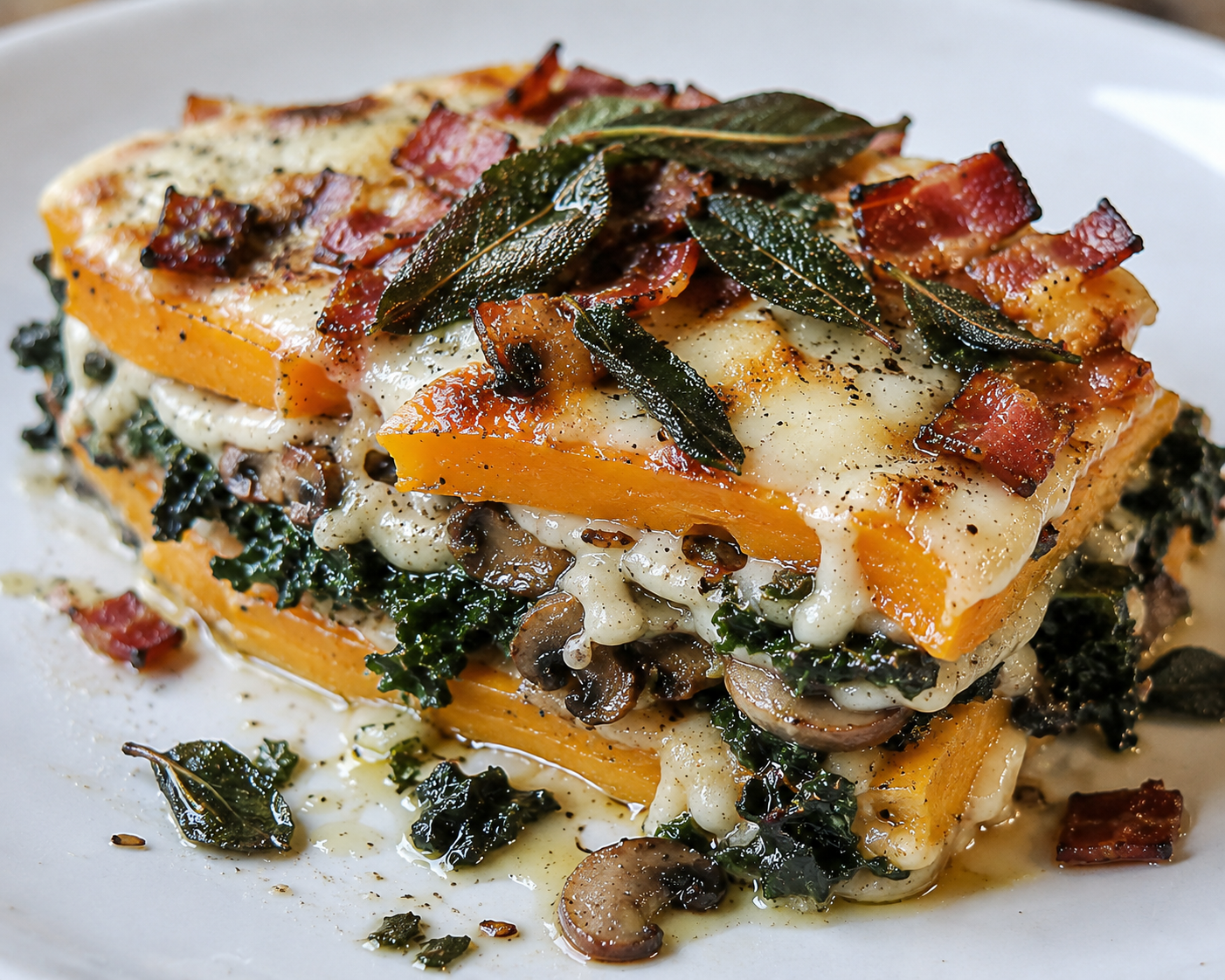
A grain-free autumn lasagna using thin butternut squash rounds as the noodle layer, layered with a silky cauliflower cream, raw ricotta, sautéed mushroom-kale-sage, and finished with fried sage. Naturally grain-free, gluten-free, and built around peak-season autumn vegetables.
Yield: 8 servings
Active: 45 min · Total: 2 hr
Autumn-winter (peak butternut squash season)
A note from the kitchen
This is one of those recipes that captures autumn cooking in a single dish — peak butternut squash sliced into thin rounds standing in for pasta sheets, layered with a silky cauliflower cream, raw ricotta, and a deep mushroom-kale-sage filling.
The butternut squash rounds are sliced ⅛-inch thin (a mandoline is the right tool), which allows the lasagna to hold its shape beautifully through the long bake — unlike other grain-free vegetable alternatives like zucchini, which often collapses to mush. The natural sweetness of the squash pairs against the savory mushroom-kale layer the same way pasta pairs against tomato sauce. Using only the cylindrical “neck” of the squash produces the cleanest, most uniform rounds.
The cauliflower cream serves as the silky white element that ties everything together — neither a true béchamel (no roux) nor a dairy cream sauce (no thickening agent), but a steamed-and-blended cauliflower with butter and nutmeg that delivers the creamy mouthfeel of a traditional bechamel with a fraction of the dairy. Combined with the layer of raw ricotta, the dish lands satisfyingly rich without being heavy.
Best made in autumn through early winter, when butternut squash is freshly harvested, sweet, and dense. Out-of-season squash can be hollow, watery, and bland — worth waiting for the right moment.
Ingredients
Cauliflower cream
1 large head cauliflower, chopped into florets
3 tbsp grass-fed butter
½ tsp ground nutmeg
Sea salt and freshly cracked black pepper, to taste
Butternut squash "noodles"
1 large butternut squash (about 3 lb), peeled, sliced into 36 thin ⅛-inch rounds (use the cylindrical "neck" of the squash for the cleanest rounds)
Sautéed vegetables (the dark layer)
1 yellow onion, finely chopped
8 oz mushrooms (cremini, shiitake, maitake, or a wild mix), thinly sliced
6 fresh sage leaves, finely chopped (plus more for garnish)
1 bunch dinosaur (lacinato) kale, stems removed, leaves chopped
2 tbsp grass-fed ghee, butter, tallow, or pastured lard
Sea salt and freshly cracked black pepper, to taste
Ricotta layer
2 cups grass-fed sheep, cow, or goat ricotta (raw if available)
Optional cheese topping
½ cup freshly grated Parmigiano-Reggiano
½ cup shredded fontina or aged Manchego
Optional pork addition
8 oz pastured bacon or pancetta, diced
(Save the rendered fat for sautéing the vegetables)
Fried sage garnish (optional but recommended)
¼ cup fresh sage leaves
2 tbsp extra virgin olive oil
Method
Make the cauliflower cream
Steam the cauliflower. Bring a large pot of water to a simmer. Add the cauliflower florets and steam (or boil) 15-20 minutes, until very tender and easily pierced with a fork. Drain in a colander and let cool 5 minutes. Press gently to release excess water.
Blend the cream. Transfer the cauliflower to a food processor with the butter, nutmeg, ½ tsp sea salt, and a generous grind of black pepper. Process until completely smooth and silky. Taste and adjust seasoning. Set aside.
Cook the bacon (if using)
Render the bacon. In a large skillet over medium heat, cook the diced bacon or pancetta 6-8 minutes until crispy and the fat is rendered. Transfer to a paper towel-lined plate. Reserve 2 tbsp of the rendered fat in the skillet for sautéing the vegetables (the rest can be saved in a glass jar for future cooking).
Sauté the vegetables
Sauté the onion. Heat 2 tbsp ghee, butter, or the reserved bacon fat in a large skillet over medium heat. Add the chopped onion and sauté 5-7 minutes, until tender and translucent.
Add mushrooms and sage. Add the sliced mushrooms and chopped sage leaves. Sauté 4-5 minutes, until the mushrooms release their moisture and become tender.
Add kale. Add the chopped kale, season with salt and pepper. Sauté 5-7 minutes, until the kale is tender and any moisture has cooked off. Remove from heat.
Slice the squash
Prepare the rounds. Using a mandoline (or a very sharp knife), slice the butternut squash neck into ⅛-inch thin rounds. You should have about 36 rounds. Reserve the bulb end for soup or another use (the seedy bulb doesn't produce clean rounds).
Assemble the lasagna
Grease the dish. Lightly oil a 9×13 baking dish with olive oil or butter.
First squash layer. Layer about 12 butternut squash rounds on the bottom of the dish, overlapping slightly to cover the surface completely.
Ricotta layer. Spread half the ricotta evenly over the squash, dotting with a spoon if needed.
Cauliflower cream layer. Spread half the cauliflower cream evenly over the ricotta.
Vegetable layer. Distribute half the sautéed mushroom-kale mixture evenly across.
Bacon layer (if using). Sprinkle half the crispy bacon evenly across.
Second squash layer. Layer 12 more butternut squash rounds.
Repeat middle layers. Spread the remaining ricotta, then the remaining cauliflower cream, then the remaining sautéed vegetables, then the remaining bacon if using.
Top squash layer. Cover with the remaining 12 butternut squash rounds.
Optional cheese topping. If using, sprinkle the grated Parmigiano and shredded fontina across the top.
Bake
Cover and bake. Cover with parchment paper or a matching glass / ceramic lid that fits your baking dish. Bake at 375°F for 35-40 minutes.
Uncover and finish. Remove the lid and bake uncovered another 25-30 minutes, until the squash is fork-tender, the top is golden, and the edges are bubbling. If you've added the cheese topping, watch the last 5-10 minutes for golden browning.
Rest. Let the lasagna cool 10-15 minutes before slicing — the layers need this time to set.
Fry the sage garnish
Crisp the sage. While the lasagna rests, warm 2 tbsp olive oil in a small skillet over medium heat. Add the whole sage leaves and reduce heat to medium-low. Stir gently 2-3 minutes until fragrant and the leaves darken slightly. Remove with a slotted spoon to a paper towel-lined plate. They crisp as they cool.
Serve
Plate. Slice the lasagna into 8 generous portions. Garnish each slice with 2-3 fried sage leaves. Serve warm.
Variations
With pork meatballs (the heartier version): Add 1 lb of pastured pork meatballs alongside the lasagna. Combine 1 lb ground pasture-raised pork with 3 tbsp minced fresh parsley, 1 tsp dried Italian herb blend (oregano + basil), 1 pastured egg yolk, 1-2 minced garlic cloves, a pinch of sea salt and pepper. Form into 12 golf-ball-sized meatballs. Bake at 400°F for 12-15 minutes on a parchment-lined sheet pan. Serve 2 meatballs alongside each slice of lasagna.
With spiralized butternut squash "noodles" instead of rounds: Use a spiralizer to create butternut squash noodles. Sauté in 2 tbsp grass-fed butter or olive oil 3-4 minutes until just tender. Plate the noodles, top with cauliflower cream, sautéed mushroom-kale-sage mixture, and the optional pork meatballs. A “deconstructed” version that skips the layering and bake — quicker, lighter, but with different texture.
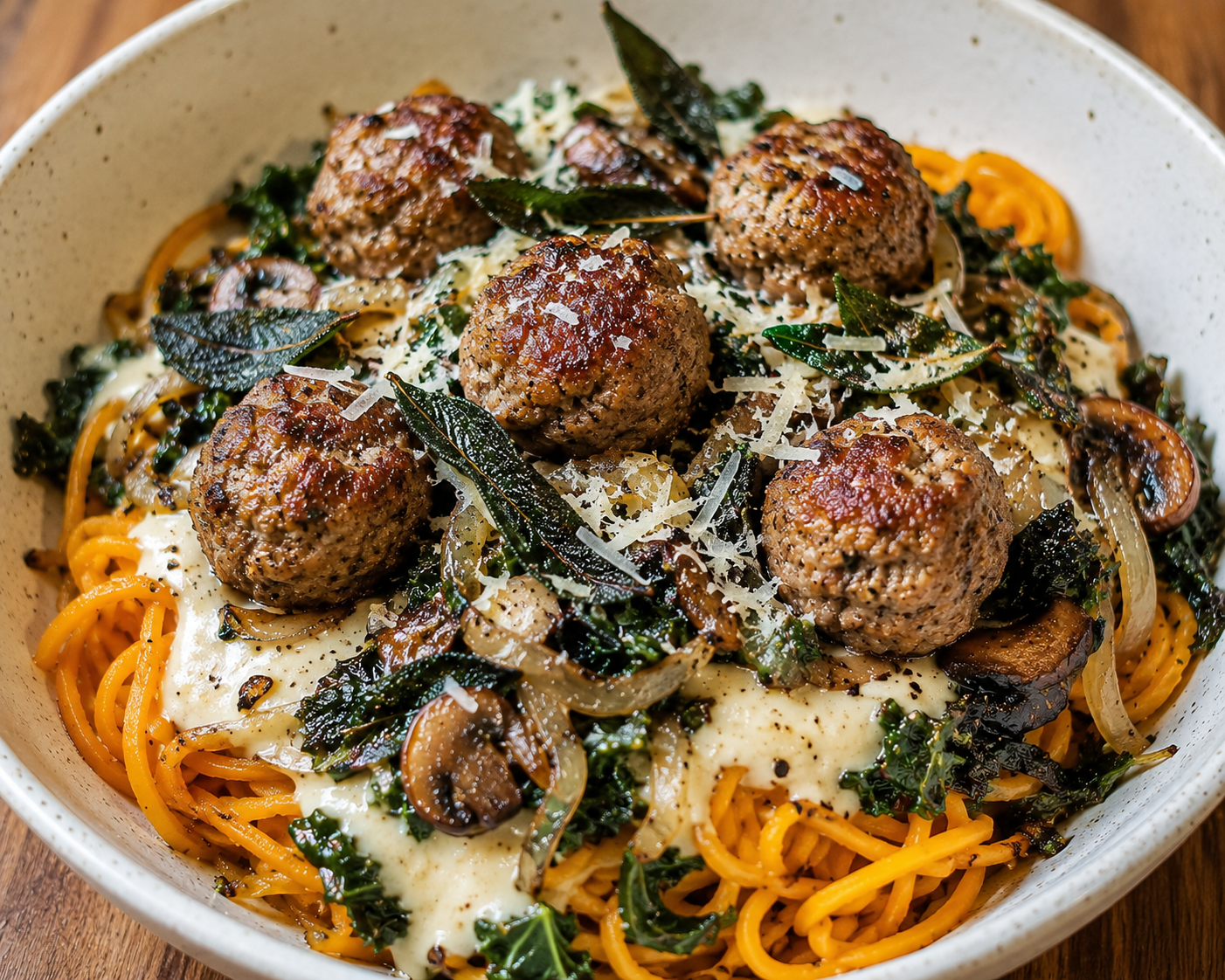
With wild mushrooms (autumn-foraged): Substitute the standard cremini mushrooms with a wild mushroom mix — chanterelles, maitake, hen-of-the-woods, or king trumpet — for a deeper, woodsier flavor.
With Italian sausage: Substitute the bacon with 1 lb crumbled, browned Italian sausage (sweet or hot). Cook the sausage in step 3 instead of (or in addition to) the bacon.
With slow-roasted chicken: Shred 2 cups of leftover slow-roasted chicken thighs into the sautéed vegetable layer for added protein.
Vegetarian version: Skip the bacon and meat. The cauliflower cream + ricotta + mushroom-kale-sage combination is satisfying on its own without added animal protein.
With added greens variety: Substitute half the kale with Swiss chard, escarole, or mustard greens for more complex bitter notes.
With sweet potato instead of butternut squash: Use Hannah or regular sweet potato sliced into ⅛-inch rounds. Sweeter and softer in texture— works but produces a different dish.
Make ahead: The entire lasagna can be assembled (unbaked) up to 24 hours ahead and refrigerated. Bring to room temperature 30 minutes before baking, then add 10-15 minutes to the bake time. The cauliflower cream can be made up to 3 days ahead. The sautéed vegetables can be made up to 2 days ahead.
Sourcing
Butternut squash. From a farmers' market or CSA share at peak season (September-December). Look for heavy, dense squash with matte (not shiny) skin and a firm stem. The cylindrical "neck" is the part you want for clean lasagna rounds — the bulb end has seeds and uneven curves. Heirloom varieties (Long Island Cheese, Galeux d'Eysines, Honeynut) are exceptional when accessible.
Cauliflower. Look for firm, white, dense heads with no brown spots or soft areas. Heirloom varieties (Romanesco, purple, orange cheddar) work beautifully and add visual interest.
Mushrooms. Wild-foraged when in season — chanterelles in early autumn, maitake (hen-of-the-woods) in autumn, king trumpets year-round — both worth the splurge. For farmed, look for small specialty cultivators: Far West Fungi, Smallhold, your regional producer. Pre-packaged supermarket cremini are fine as a base; blend with something more interesting if you can.
Lacinato kale. Also called dinosaur kale or cavolo nero. From a farmers' market or CSA share. The dark blue-green leaves hold their color through long cooking better than curly kale.
Raw grass-fed ricotta. From a local raw-dairy producer, Amish creamery, or quality cheese shop. Bellwether Farms (small-scale California sheep dairy) is the rare commercial-scale producer that meets the standard and ships nationally. realmilk.com is the directory for raw dairy. For pasteurized alternatives: Calabro, Vermont Creamery, or homemade from raw milk using the whey-ricotta technique.
Grass-fed butter. From cows on pasture year-round. Vital Farms, Organic Valley Pasture Butter, Beurre d'Isigny, Kerrygold Reserve, or local artisan brands.
Pastured bacon or pancetta (optional). Look for nitrate-free, pasture-raised pork. US Wellness Meats, Niman Ranch, North Country Smokehouse, or local farms via Eatwild.com. For Italian-style: Despaña Brand Foods or La Tienda for pancetta arrotolata (rolled Italian-cured pancetta).
Parmigiano-Reggiano DOP, 24+ months aged. Look for the stamped rind. Specialty Italian importers or local cheese counters carry traceable-origin Parmigiano. Grate fresh — pre-grated is lifeless.
Fontina or aged Manchego. Italian Fontina Val d'Aosta DOP or Spanish aged Manchego from a quality cheese shop. Avoid grocery-store "fontina-style" which is usually a mild, unfermented imitation.
Fresh sage. From a farmers' market or windowsill pot. Fresh sage is essential — dried sage doesn't deliver the same camphor-pine character.
Single-estate extra virgin olive oil. Harvest-dated within the last 12 months, in a dark glass bottle. Italian or Spanish single-origin works beautifully.
Sea salt. Baja Gold mineral sea salt for cooking, fleur de sel for finishing.
Storage
Whole assembled lasagna (refrigerated): Up to 4 days, sealed. Reheat individual portions at 350°F for 15 minutes, or until heated through and bubbling.
Whole lasagna (frozen): Up to 2 months, well-wrapped. Thaw overnight in the refrigerator, then reheat at 350°F for 25-30 minutes.
Cauliflower cream (made ahead): Refrigerated up to 3 days, sealed. Warm gently before using.
Sautéed vegetables (made ahead): Refrigerated up to 2 days, sealed.
Pork meatballs (if using): Refrigerated up to 4 days, sealed. Freezer up to 2 months. Reheat in a 350°F oven for 10 minutes.
Why This Dish
This is autumn comfort cooking with traditional techniques, real fats, and nourishing ingredients.
Butternut squash — beta-carotene, vitamin A, and slow-burning carbohydrate. Butternut squash delivers exceptional beta-carotene (converted in the body to vitamin A), vitamin C, potassium, magnesium, and fiber. The natural sugars are slow-burning and balanced by substantial fiber, making butternut squash a low-glycemic food despite its sweet flavor. Peak autumn-winter squash is denser and more nutrient-rich than out-of-season storage squash.
Cauliflower — sulforaphane and cruciferous compounds. Cauliflower delivers sulforaphane (the cruciferous compound with documented anti-inflammatory and cellular protection effects), vitamin C, fiber, and the broader cruciferous family of plant compounds. Steaming and blending preserves the sulforaphane more effectively than long roasting.
Wild mushrooms — beta-glucans and ergothioneine. Wild or small-farm mushrooms deliver beta-glucans (immunomodulatory polysaccharides), ergothioneine (a mitochondrial antioxidant), B vitamins, copper, and selenium. Mushrooms grown outdoors synthesize vitamin D when exposed to sunlight (the same way human skin does).
Lacinato kale — vitamin K, lutein, and chlorophyll. Kale delivers exceptional vitamin K (essential for blood clotting and calcium metabolism), lutein and zeaxanthin (eye-supporting carotenoids), vitamin C, and chlorophyll. The dark blue-green color signals the dense pigment content.
Fresh sage — anti-inflammatory terpenes. Sage delivers terpenes (thujone, camphor, eucalyptol) with documented anti-inflammatory, antimicrobial, and digestive-supporting effects. Traditional Mediterranean cooking has used sage as both flavor and medicine for thousands of years.
Raw grass-fed ricotta — A2 casein and live cultures. Raw ricotta from grass-fed cows, sheep, or goats delivers easily digestible protein, live cultures, calcium, phosphorus, and the fat-soluble vitamins A, D, K2. Sheep and goat ricottas have only A2 beta-casein, which doesn't trigger the same inflammatory response that A1 cow casein can in sensitive individuals.
Grass-fed butter — CLA, butyrate, and vitamin K2. Real butter from grass-fed cows delivers conjugated linoleic acid (CLA), butyrate (a short-chain fatty acid that supports intestinal health), beta-carotene, and vitamin K2 (essential for calcium metabolism and arterial health). The butter in both the cauliflower cream and the vegetable sauté is doing real nourishment work.
Pastured bacon (optional) — concentrated B vitamins and ancestral fats. Quality cured pork delivers concentrated B vitamins (especially B1 thiamine), zinc, selenium, and traditional cured-fat compounds. Used as a small flavor element here — about 1 oz per serving — rather than as the main protein.
Why this kind of cooking matters. This recipe inverts what most American “comfort food” has become — refined wheat pasta, industrial seed oils, ultra-processed cheese, factory-farmed meat. Instead, every component is meaningfully nourishing: peak-season vegetables, traditional fats, raw dairy, optional pastured pork.
— Anna aka Food Marshall