Farm-to-Table Roasted Root Vegetables with Labneh, Dukkah, and Mint Gremolata
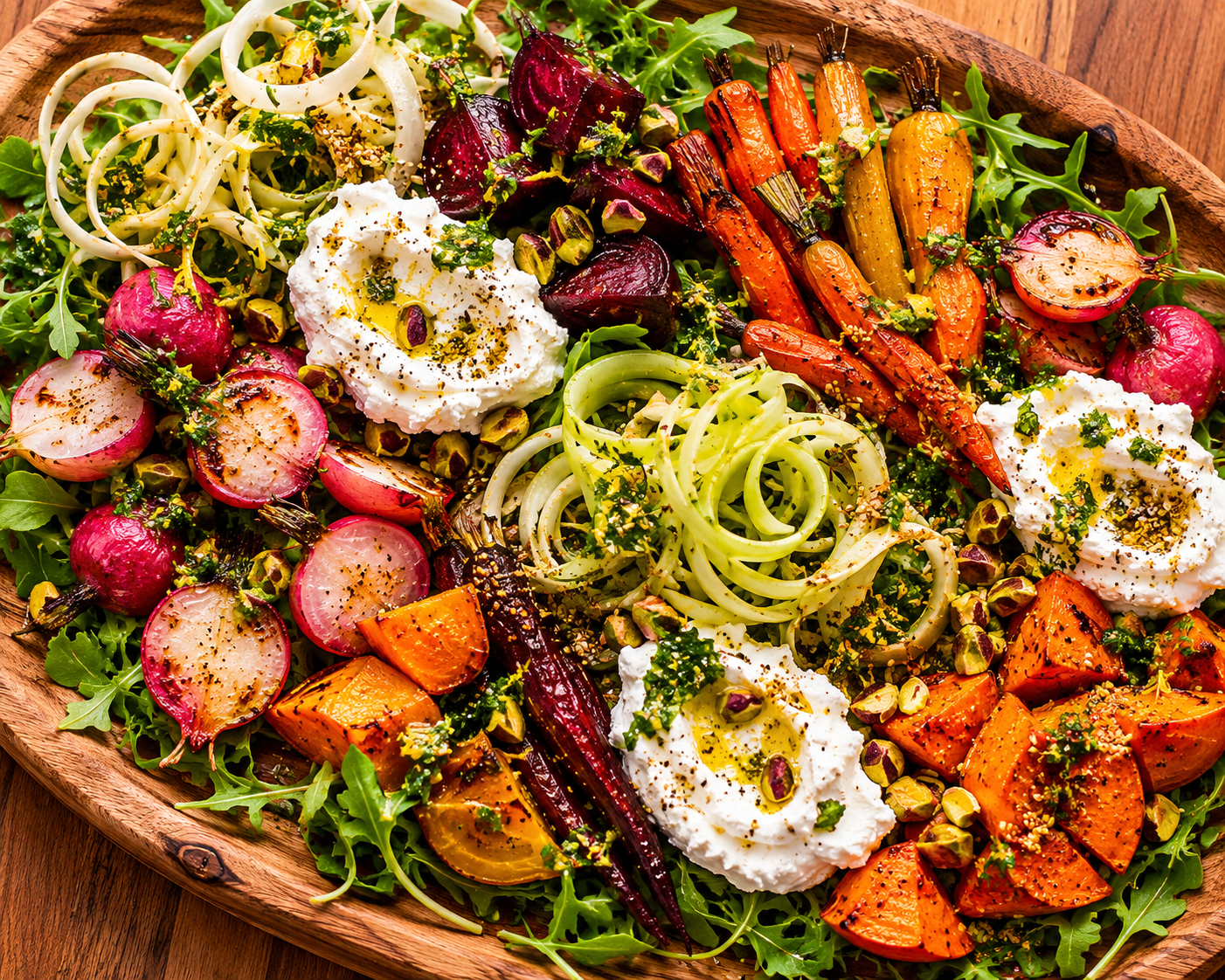
A composed plate of za'atar-roasted root vegetables, spiraled raw celeriac and kohlrabi, all served over greens with creamy labneh and herb gremolata
Yield: 4 servings
Active: 30 min · Total: 1 hr
Autumn-winter (peak root vegetable season) ·
A note from the kitchen
Best made at peak autumn-winter root vegetable season, when beets, carrots, celeriac, kohlrabi, and sweet potatoes are at their sweetest and most abundant. Out of season, the recipe still works with whatever is fresh — but the autumn-winter combination is the magic moment.
Ingredients
Roasted root vegetables
12 small radishes (French breakfast, watermelon, or daikon), halved or quartered
3 medium beets (red and yellow if available), peeled and cut into 1-inch chunks
8-12 rainbow carrots, cut into 2-inch pieces on a bias
2 small sweet potato, peeled and cut into 1-inch chunks
5-6 tbsp extra virgin olive oil
Juice of 1 lemon
2 tbsp apple cider vinegar
2 tbsp za'atar
sea salt and freshly ground black pepper, to taste
Spiraled raw vegetables
1 small celeriac (celery root), peeled and spiralized (or thinly julienned)
1 small kohlrabi, peeled and spiralized
Juice of half a lemon
Pinch sea salt
Drizzle of extra virgin olive oil
Greens base
4 cups arugula, baby kale, or mixed wild greens
Labneh
2 cups labneh (Greek yogurt strained 24 hours, or quality store-bought labneh)
2-3 tbsp extra virgin olive oil
Pinch sea salt
Pinch sumac (optional)
Mint gremolata
½ cup fresh mint leaves, packed
½ cup fresh cilantro, packed
½ cup fresh parsley, packed
Zest of 1 lemon
1 small garlic clove
3 tbsp extra virgin olive oil
1 tbsp fresh lemon juice
Pinch sea salt and freshly cracked black pepper
Garnish
½ cup pistachio-hazelnut dukkah (or any quality dukkah, see sourcing for DIY)
¼ cup chopped raw pistachios
Pomegranate arils (autumn-winter, optional)
Additional fresh herb sprigs
Method
Roast the root vegetables
Preheat the oven to 425°F.
Toss the non-beet vegetables. In a large bowl, toss the radishes, carrots, and sweet potato with olive oil, lemon juice, apple cider vinegar, za'atar, salt, and pepper. Spread on a parchment-lined baking sheet in a single layer.
Toss the beets separately. In a separate small bowl, toss the beets with olive oil, salt, pepper, and a pinch of za'atar. Place on a separate sheet pan (or a clearly separate area of the same pan) to prevent the beets from staining the other vegetables.
Roast 25-30 minutes, turning halfway, until tender and caramelized at the edges.
Prep the spiraled raw vegetables
Spiralize or julienne the celeriac and kohlrabi into thin ribbons. If you don't have a spiralizer, use a mandoline to create thin matchsticks or a vegetable peeler to make wide ribbons. Toss with lemon juice, salt, and a small drizzle of olive oil. Set aside — the lemon prevents browning.
Make the gremolata
Combine all gremolata ingredients in a food processor. Pulse until the herbs are finely chopped but still vibrant green (about 6-8 pulses). Don't over-process. Adjust seasoning.
Prepare the labneh
Whisk the labneh with olive oil, salt, and sumac in a small bowl until smooth.
Assemble
Build the platter. Spread the arugula in a single layer on a large platter.
Add the spiraled raw vegetables in a few small mounds across the greens.
Top with the warm roasted root vegetables — don't dump them all in one place. Distribute in clusters.
Spoon the labneh in 5-6 generous dollops around the platter.
Drizzle the mint gremolata across everything.
Scatter the dukkah (see recipe below), chopped pistachios, pomegranate arils (if using), and additional fresh herbs.
Serve immediately.
Homemade Pistachio-Hazelnut Dukkah
Quick to make and dramatically better than store-bought. Keeps refrigerated up to 1 month in a sealed jar.
- ½ cup raw pistachios
- ¼ cup raw hazelnuts
- 2 tbsp sesame seeds
- 1 tbsp cumin seeds
- 1 tbsp coriander seeds
- 1 tsp sea salt
- ½ tsp freshly cracked black pepper
Toast the nuts and seeds separately in a dry skillet over medium-low heat — pistachios and hazelnuts 5-7 minutes, sesame seeds 2-3 minutes, cumin and coriander seeds 1-2 minutes (just until fragrant). Cool completely. Pulse together in a food processor or mortar and pestle until coarsely ground — texture should be chunky, not powdered. Stir in salt and pepper. Store in a sealed glass jar at room temperature up to 2 weeks, or refrigerated up to 1 month
Variations
Spring version: Substitute the roasted root vegetables with roasted asparagus, peas, and radishes. Substitute the raw spiraled vegetables with shaved fennel and cucumber. Add fresh dill to the gremolata.
Summer version: Substitute the roasted root vegetables with roasted eggplant, zucchini, and bell peppers. Add fresh basil to the gremolata. Top with fresh halved cherry tomatoes.
With added protein: Add grilled wild salmon, pan-seared scallops, slow-roasted lamb shoulder, or shredded leftover chicken to make a complete dinner. The plate scales beautifully.
With grilled halloumi or feta: Substitute the labneh with grilled halloumi cubes or large crumbles of grass-fed feta. More substantial, more salty.
Make ahead: Roasted vegetables can be made up to 2 days ahead and refrigerated. Gremolata can be made up to 3 days ahead. Labneh can be made up to 1 week ahead. Assemble fresh just before serving.
Pairs Well With
Sparkling water with cucumber, lemon, and fresh mint, or chilled hibiscus tea. For a fuller Middle Eastern-inspired dinner spread, serve alongside grilled wild fish, slow-roasted lamb shoulder, or pan-seared duck breast. Beautiful as the centerpiece of a meze spread with grilled halloumi, marinated artichokes, and additional dips (hummus, baba ghanoush, muhammara).
Sourcing
Root vegetables (beets, carrots, radishes, sweet potato, celeriac, kohlrabi). From a farmers' market or CSA share in autumn-winter when these vegetables are at peak. Rainbow varieties (purple carrots, yellow beets, watermelon radishes) add visual contrast. Look for firm vegetables with their leafy tops still attached (when applicable) — fresh tops signal recent harvest.
Labneh. Look for traditional Middle Eastern labneh. For homemade: strain 32 oz whole-milk Greek yogurt through a cheesecloth-lined strainer in the refrigerator for 24 hours. Bellwether Farms or Redwood Hill Farm sheep's or goat's milk labneh are exceptional dairy-alternative options.
Za'atar. Traditional Middle Eastern blend of dried thyme, sumac, sesame seeds, and salt. Look for artisanal blends from Burlap & Barrel (Wild Mountain Za'atar from Palestine), Curio Spice Co., or Lebanese grocers. Avoid pre-made grocery store za'atar with added soybean oil or preservatives.
Pistachio-hazelnut dukkah. Egyptian-Middle Eastern blend of nuts, seeds, and spices. Quality brands: Burlap & Barrel, NY Shuk, or homemade (toast and grind together: ½ cup pistachios, ¼ cup hazelnuts, 2 tbsp sesame seeds, 1 tbsp cumin seeds, 1 tbsp coriander seeds, 1 tsp salt, ½ tsp black pepper).
Raw pistachios. Single-ingredient raw pistachios. Sicilian Bronte pistachios are the benchmark when accessible; otherwise California-grown raw from Anthony's Goods, Big Tree Farms, or Terrasoul. Store in the refrigerator.
Fresh herbs (mint, cilantro, parsley). From a farmers' market or windowsill pot for the freshest aromatic oils. The gremolata depends on truly fresh herbs.
Sumac. Tart, deep-red ground berry from the sumac bush. Look for single-ingredient sumac from Burlap & Barrel, Curio Spice Co., or Middle Eastern grocers.
Pomegranate arils. Fresh pomegranates from a farmers' market or organic produce section in autumn-winter (October-January peak). Pre-packed POM Wonderful arils work as a convenience substitute.
Arugula or baby kale. From a farmers' market or CSA share. Wild rocket (the smaller, peppier arugula) has more flavor than commodity baby arugula.
Extra virgin olive oil. Single-estate, harvest-dated within the last 12 months, in a dark glass bottle. Greek, Lebanese, or Spanish olive oil works beautifully with this dish. Use your best bottle for the finishing drizzle.
Raw apple cider vinegar. With the mother — Bragg's is the benchmark.
Sea salt. Baja Gold mineral sea salt for cooking, fleur de sel for finishing.
Storage
Assembled plate: Best the moment it's made.
Roasted root vegetables: Refrigerated up to 4 days, sealed.
Mint gremolata: Refrigerated up to 3 days in a sealed glass jar with a thin layer of olive oil on top to prevent oxidation.
Labneh: Refrigerated up to 1 week in a sealed container.
Spiraled raw vegetables: Best the day they're cut. Refrigerated up to 1 day before browning.
Why This Dish
Labneh — Middle Eastern strained yogurt — is one of the most nutritionally dense fermented foods available. The 24-hour straining process removes most of the whey while concentrating the protein, fat, and live cultures into a thick, spreadable preparation. Used as the cream base on this plate, labneh provides both probiotic activity and the silky mouthfeel that ties the warm-roasted and raw-spiraled vegetables together. Traditional Lebanese labneh is widely available, and making it at home is fairly simple—requiring only Greek yogurt and a cheesecloth-lined strainer.
Roasted vegetables provide the deep, caramelized warmth and concentrated sweetness, while raw spiraled vegetables provide bright, crisp counterpoint.
Celeriac has a flavor profile that combines celery and parsley with a hint of nuttiness; kohlrabi (literally "cabbage turnip" in German) tastes like a cross between a turnip and a broccoli stem with substantial crunch. Both are at peak in autumn-winter and store remarkably well — they were European peasant staples specifically because they kept through long cold months without losing nutritional value.
The gremolata-on-everything approach is a classic Italian technique — gremolata is the parsley-lemon-garlic condiment traditionally served with osso buco, but the same architecture works as a finishing element on any roasted vegetable plate.
— Anna aka Food Marshall