Fig and Goat Cheese Pastries — Two Ways (Pinwheels or Hand Pies)
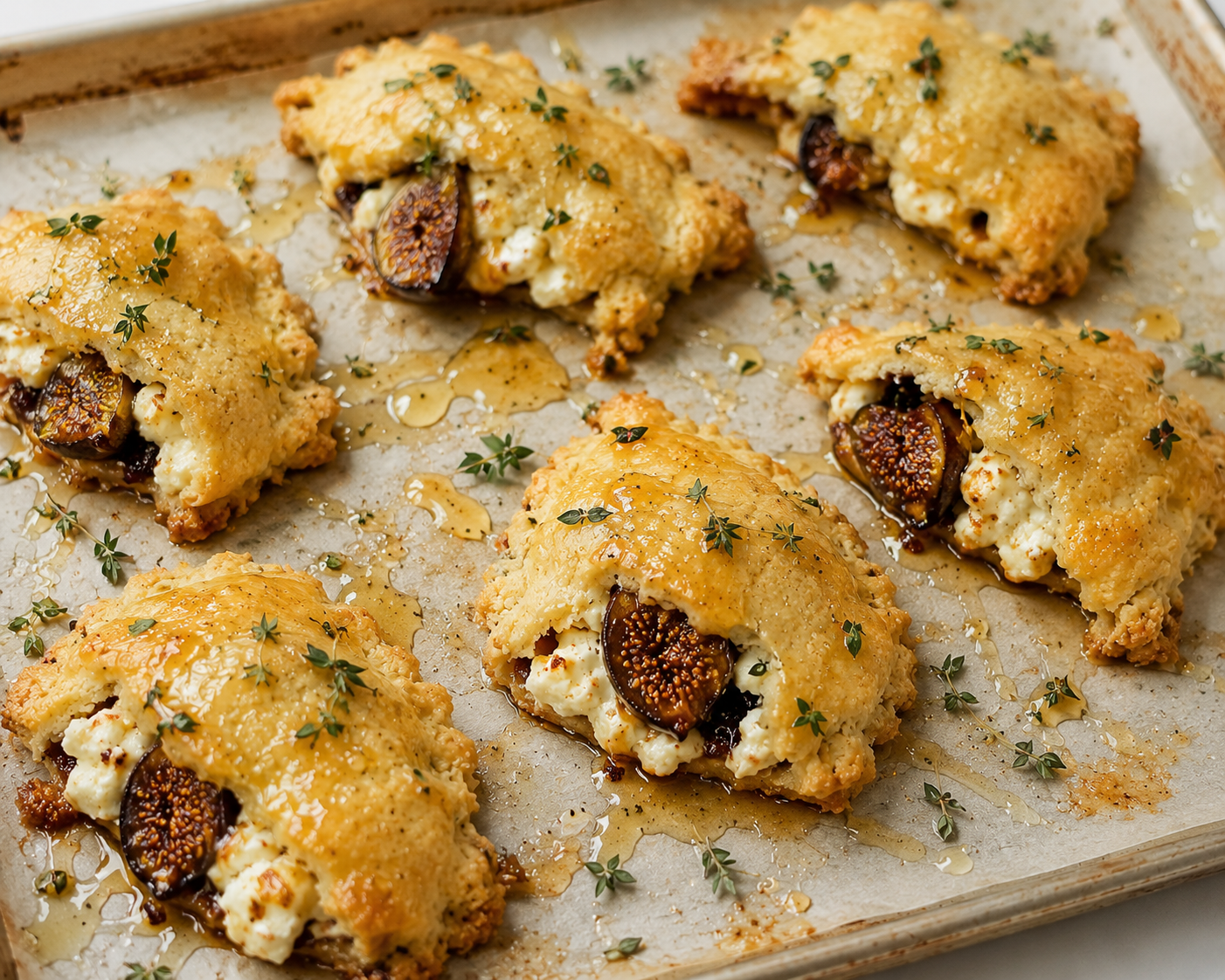
Flaky cassava-almond pastry filled with whipped honeyed goat cheese and stewed figs, shaped two ways — as sliced pinwheels with photogenic spiral cross-sections, or as half-moon hand pies. Naturally grain-free, gluten-free, refined-sugar-free, and built around real fats, raw chèvre, and fresh figs.
Yield: 12 hand pies OR about 18 pinwheels
Active: 45 min · Total: 1 hr 30 min
Late summer-autumn (peak fig season, August-October)
A note from the kitchen
This is one of those pastries that earns its place at autumn gatherings — fresh figs and whipped goat cheese rolled into a flaky grain-free pastry, finished with a brush of egg wash, a sprinkle of coconut sugar, and a drizzle of raw honey. The combination is a classic Mediterranean pairing — chèvre's tangy fat cuts through the figs' concentrated sweetness, and the honey amplifies both. The same principle behind the classic French fromage de chèvre frais au miel served across country bistros, here translated into a pastry format that travels beautifully to brunches and dinner parties.
The recipe gives you two formats from the same base components:
Pinwheels — the pastry is rolled into a thin rectangle, spread with whipped goat cheese and fig spread, rolled into a tight log, sliced, and baked. The spiral cross-sections are photogenic and elegant — beautiful for serving on a platter.
Hand pies — the pastry is rolled and cut into rounds, filled with whipped goat cheese and fig pieces, folded into half-moons, crimped, and baked. More traditional, sturdier, slightly easier to make.
Both formats use the same pastry, the same fig filling, and the same whipped goat cheese. The shaping is the only meaningful difference. Pick whichever fits your gathering.
Best made when fresh figs are at their peak — late August through October in California and the Mediterranean. Out of season, this pastry isn't worth making with the small, hard, underripe figs that show up in commodity supermarket produce sections.
Ingredients
Pastry dough
1 cup cassava flour
½ cup blanched almond flour
¼ cup arrowroot powder (or tapioca flour)
½ tsp sea salt
8 tbsp grass-fed butter, cold and cubed
1 pasture-raised egg
2-3 tbsp ice water
Fig filling
8 ripe fresh figs (Black Mission, Brown Turkey, Adriatic, or Calimyrna), stems removed and quartered
2 tbsp pure maple syrup or raw honey
Pinch of sea salt
Optional: 1 tsp aged balsamic vinegar (deepens the fig flavor)
Whipped goat cheese
6 oz fresh chèvre, room temperature
2 tbsp pure maple syrup or raw honey
1 tsp lemon zest (optional)
Pinch of sea salt
Egg wash and finishing
1 pasture-raised egg yolk, beaten with 1 tsp water
Coconut sugar, for sprinkling (or skip for a less-sweet finish)
Raw honey, for drizzling
Fresh thyme leaves, for garnish
Method
Make the pastry dough
Pulse the dry ingredients. In a food processor, pulse the cassava flour, almond flour, arrowroot, and salt to combine.
Cut in the butter. Add the cold cubed butter and pulse until pea-sized pieces form throughout. Don't over-process — visible butter pieces produce a flakier pastry.
Add the egg and water. Add the egg and 2 tbsp ice water. Pulse until the dough begins to clump. Add the third tbsp of water if needed — the dough should hold together when pinched but not be sticky.
Shape and chill. Turn the dough out onto a clean surface. For pinwheels: Knead briefly into a flat rectangle for easier rolling. For hand pies: Knead briefly into a flat disk. Wrap in parchment and refrigerate at least 1 hour (or up to overnight).
Make the fig filling
Cook the figs. In a small saucepan, combine the quartered figs, maple syrup, salt, and optional balsamic vinegar. Cook over medium-low heat 5-7 minutes, stirring occasionally, until the figs have broken down and the mixture is jam-like.
Mash and cool. Mash gently with a fork until spreadable but not entirely smooth — small fig pieces add visual texture in both formats. Cool completely.
Make the whipped goat cheese
Whip the cheese. In a food processor, combine the chèvre, maple syrup or honey, lemon zest, and salt. Process until light and fluffy, about 1 minute. Transfer to a bowl and refrigerate until ready to use.
Shape, fill, and bake
For Pinwheels:
Preheat the oven. Heat the oven to 375°F. Line a sheet pan with parchment.
Roll the dough. Place the chilled dough between two sheets of parchment. Roll into a 12 × 8-inch rectangle, about ⅛-inch thick. Remove the top parchment.
Spread the fillings. Spread the whipped goat cheese evenly across the surface of the dough, leaving a 1-inch border on the top long edge. Spread the cooled fig filling evenly across the goat cheese.
Roll into a log. Starting from the long edge closest to you (not the bordered edge), roll the dough tightly into a log, using the parchment to help guide it. The 1-inch border at the top creates the seal.
Chill the log. Wrap the log in fresh parchment. Refrigerate at least 30 minutes (or freeze 15 minutes) to firm up — easier slicing.
Slice and arrange. Using a sharp knife, slice the log into ½-inch rounds. Place cut-side up on the prepared sheet pan, leaving 1 inch between each.
Wash and sugar. Brush each pinwheel with the egg yolk wash. Sprinkle with coconut sugar if using.
Bake. Bake 22-25 minutes, until deeply golden and the pastry is crisp at the edges.
Finish. Cool 10 minutes. Drizzle with raw honey and scatter fresh thyme leaves before serving.
For Hand Pies:
Preheat the oven. Heat the oven to 375°F. Line a sheet pan with parchment.
Roll and cut. On a parchment-lined surface, roll the chilled dough to about ⅛-inch thick. Cut into 12 rounds (about 4 inches wide). Re-roll scraps once if needed.
Fill. Place a small dollop of whipped goat cheese on one half of each round. Top with 2-3 fig pieces and a small drizzle of any reserved fig juice.
Fold and seal. Brush the edges of each round with the egg wash. Fold over to form a half-moon. Press the edges firmly to seal. Crimp with a fork.
Wash and sugar. Transfer to the prepared sheet pan. Brush each pie with egg wash. Sprinkle with coconut sugar if using.
Bake. Bake 22-25 minutes, until deeply golden.
Finish. Cool 10 minutes. Drizzle with raw honey and scatter fresh thyme leaves before serving.
Variations
Spring version with strawberries: Substitute the figs with 1 cup fresh strawberries (quartered) cooked the same way with maple syrup. A bright spring pastry.
With caramelized onion + thyme (savory variation): Substitute the fig filling with ½ cup slow-caramelized onions (cooked 40 minutes in butter until jammy) and 1 tsp fresh thyme leaves. Add a tiny pinch of fresh black pepper to the goat cheese. Skip the coconut sugar topping. Drizzle with a thread of olive oil instead of honey before serving.
With prosciutto or jamón ibérico: Add a small folded piece of prosciutto, jamón ibérico, or jamón serrano alongside the goat cheese before rolling/folding. The salty cured pork pairs beautifully with the sweet figs.
With balsamic reduction drizzle: Drizzle the finished pastries with aged balsamic vinegar (reduce 2 tbsp aged balsamic with 1 tsp honey in a small pan until syrupy, cool, drizzle) instead of (or in addition to) the raw honey.
With pistachio or walnut topping: Sprinkle finely chopped raw pistachios or walnuts over the egg-washed pastries before baking. Adds crunch and visual contrast.
Mini pinwheels for parties: Roll the dough thinner and slice the log into ¼-inch rounds. Bake 18-20 minutes. Makes about 28-30 mini pinwheels — bite-sized for pintxo-style passing.
Larger hand pies as a brunch course: Cut the dough into 6 larger rounds (about 6 inches wide). Use more filling per pie. Bake 25-28 minutes. Plate as individual brunch portions with fresh fruit alongside.
Sheep's milk cheese instead of goat: Substitute the chèvre with fresh sheep's milk ricotta or whipped raw sheep's milk cheese (Bellwether Farms, Vermont Shepherd). Slightly milder and creamier.
Make ahead: The pastry dough can be made up to 3 days ahead and refrigerated, or frozen up to 2 months. The fig filling and whipped goat cheese can be made up to 2 days ahead and refrigerated. The assembled but unbaked log (for pinwheels) or assembled hand pies can be frozen up to 2 months — bake from frozen, adding 5-7 minutes to the bake time.
As a gift: Wrap baked pinwheels or hand pies in parchment paper, tie with kitchen twine, add a sprig of fresh thyme or rosemary, and a small jar of raw honey. Beautiful for holiday or hostess gifting.
Pairs Well With
Sparkling water with a slice of lemon and fresh thyme, or chilled hibiscus tea. A small board of aged Manchego, Marcona almonds, and fresh autumn pears as a complete brunch or aperitif spread. For a fuller autumn dinner spread, serve as a starter before roasted lamb chops, slow-braised short ribs, or pan-seared duck breast. The pastries also work beautifully as a dessert — alongside cardamom-spiced or chai-spiced vanilla ice cream, or a dollop of whipped vanilla raw cream
Sourcing
Fresh figs. Look for fragrant, slightly yielding figs with intact skin and visible "tear drop" at the bottom (a sign of ripeness). Black Mission, Brown Turkey, Adriatic, Calimyrna, and Kadota are all varieties worth seeking out — each has a distinct flavor profile. Farmers' markets, CSA shares, and specialty grocers carry heritage varieties. Out-of-season grocery figs are usually under-ripe and not worth using. Backyard fig trees produce abundantly in late summer through autumn in zones 7-10.
Cassava flour. Single-ingredient cassava flour (not tapioca flour — they're different products). Otto's Naturals is the benchmark for baking; Bob's Red Mill is also reliable. Should be finely milled and free of clumps. Store in a sealed container.
Blanched almond flour. Finely ground blanched almond flour (skins removed) — not almond meal. Bob's Red Mill Super-Fine, Anthony's Goods, or King Arthur Baking. Store in the refrigerator after opening — almond flour oxidizes faster than expected.
Arrowroot powder. Single-ingredient arrowroot. Bob's Red Mill or Anthony's Goods. Tapioca flour works as a substitute but produces a slightly chewier texture.
Grass-fed butter. From cows on pasture year-round. Vital Farms, Organic Valley Pasture Butter, Beurre d'Isigny, or local artisan brands. Cold butter is essential for the flaky pastry.
Fresh chèvre. Look for fresh goat cheese from a small dairy. Vermont Creamery, Cypress Grove, Laura Chenel, Humboldt Fog, or local farmers' market goat dairies. Avoid shelf-stable supermarket goat cheese logs — the flavor has been processed out. For ancestral sourcing, find a local goat dairy through Eatwild.com or realmilk.com.
Pasture-raised eggs. Yolks should be deep orange. From a farmers' market or local farm. Vital Farms is a reliable shipped option.
Pure maple syrup. Grade A dark or amber for richer flavor. Crown Maple, Coombs Family Farms, Anderson's, or a local maple producer.
Raw honey. Local, unfiltered, single-origin when possible. For drizzling on the finished pastries, a lighter honey (orange blossom, wildflower, acacia) works beautifully. Avoid heated/pasteurized honey.
Coconut sugar. Single-ingredient organic coconut sugar (not "coconut palm sugar" with additives). Use sparingly — this is a concentrated sweetener. Wholesome Sweeteners, Big Tree Farms, or skip the sugar topping entirely if you want a less-sweet pastry.
Fresh thyme. From a farmers' market or windowsill pot. Lemon thyme works beautifully as an alternative.
Sea salt. Baja Gold mineral sea salt for cooking, fleur de sel for finishing.
Storage
Baked pastries (room temperature): Up to 1 day, well-covered. The pastry is crispest the day it's made.
Baked pastries (refrigerated): Up to 3-4 days, sealed. Reheat at 325°F for 5-8 minutes to recrisp.
Unbaked pastries (refrigerated): Up to 24 hours, well-wrapped. Bring to room temperature briefly before baking.
Unbaked pinwheel log (frozen): Up to 2 months, wrapped tightly in parchment then sealed in a glass container. Slice and bake from frozen, adding 5-7 minutes to the bake time.
Unbaked hand pies (frozen): Up to 2 months, wrapped individually. Bake from frozen, adding 5-7 minutes to the bake time.
Pastry dough alone (refrigerated): Up to 3 days, wrapped.
Pastry dough alone (frozen): Up to 2 months, well-wrapped.
Fig filling and whipped goat cheese: Refrigerated up to 3 days, sealed.
Why These Pastries: Nourishment Notes
A fresh fig and goat cheese pastry is a meditation on autumn Mediterranean cooking — peak figs, raw chèvre, traditional fats, and a thoughtfully sweetened pastry. Every component is doing meaningful nourishment work.
Fresh figs — fiber, potassium, and polyphenols. Fresh figs deliver fiber (about 3g per fig), potassium, magnesium, vitamin K, and a range of polyphenols (rutin, chlorogenic acid, ferulic acid) with documented antioxidant effects. Unlike dried figs (which are concentrated sugar), fresh figs have meaningful water content and a balanced sugar-fiber ratio. Mediterranean cultures have valued figs as a restorative fruit for thousands of years.
Fresh chèvre — A2 casein and easy digestibility. Goat's milk produces only A2 beta-casein, which doesn't trigger the inflammatory response that A1 cow casein can in sensitive individuals. Goat cheese also delivers calcium, phosphorus, vitamin A, and the medium-chain fatty acids characteristic of goat dairy. Many people who don't tolerate cow dairy can eat goat cheese comfortably.
Cassava flour — resistant starch and grain-free baking. Cassava flour (made from the whole cassava root) delivers fiber, resistant starch (which feeds beneficial gut bacteria), vitamin C, and copper. The resistant starch content increases when cooled-and-reheated foods are eaten — these pastries refrigerated overnight and reheated land more gently on blood sugar.
Blanched almond flour — vitamin E and magnesium. Almond flour delivers vitamin E (alpha-tocopherol form), magnesium, copper, riboflavin, and monounsaturated fats. The fat content also slows the carbohydrate release from the pastry.
Grass-fed butter — CLA, butyrate precursors, and vitamin K2. Real butter from grass-fed cows delivers conjugated linoleic acid (CLA), short-chain fatty acid precursors that support gut health, beta-carotene, and vitamin K2 (essential for calcium metabolism and arterial health). The pea-sized butter pieces in the pastry are what create the flaky layers.
Raw honey and pure maple syrup — natural cofactors. Raw honey delivers glucose oxidase, polyphenols, pollen-bound compounds, and trace minerals. Maple syrup delivers manganese, zinc, calcium, potassium, and over 65 documented polyphenol compounds. Used moderately (about 1 tbsp per pastry across the filling and finishing), the sweetness lands gently with cofactors that conventional refined sugar lacks entirely.
Pasture-raised eggs — choline and fat-soluble vitamins. The egg yolk in the pastry and the egg wash deliver choline (essential for brain and liver function), lutein and zeaxanthin (eye-supporting carotenoids), and vitamins A, D, E, and K2 in the deep orange yolks. The egg also helps bind the grain-free pastry.
Why this kind of pastry matters. Most American baked goods deliver refined wheat flour, refined cane sugar, hydrogenated industrial fats (canola, soybean oil, palm shortening), and emulsifiers and preservatives. These pastries invert all of that. The flour is whole-food (cassava + almond + arrowroot). The fat is real (grass-fed butter). The sweetness is gentle and fiber-bound (figs + small amounts of honey/maple). The cheese is raw chèvre from small dairies. The whole pastry is meant to honor a brief seasonal moment — peak fig season in late summer through autumn — when fresh figs, autumn herbs, and the slowing season come together on the table.
— Anna aka Food Marshall