Braised Pasture Pork Shoulder with Wilted Broccoli, Collard, and Cabbage Greens
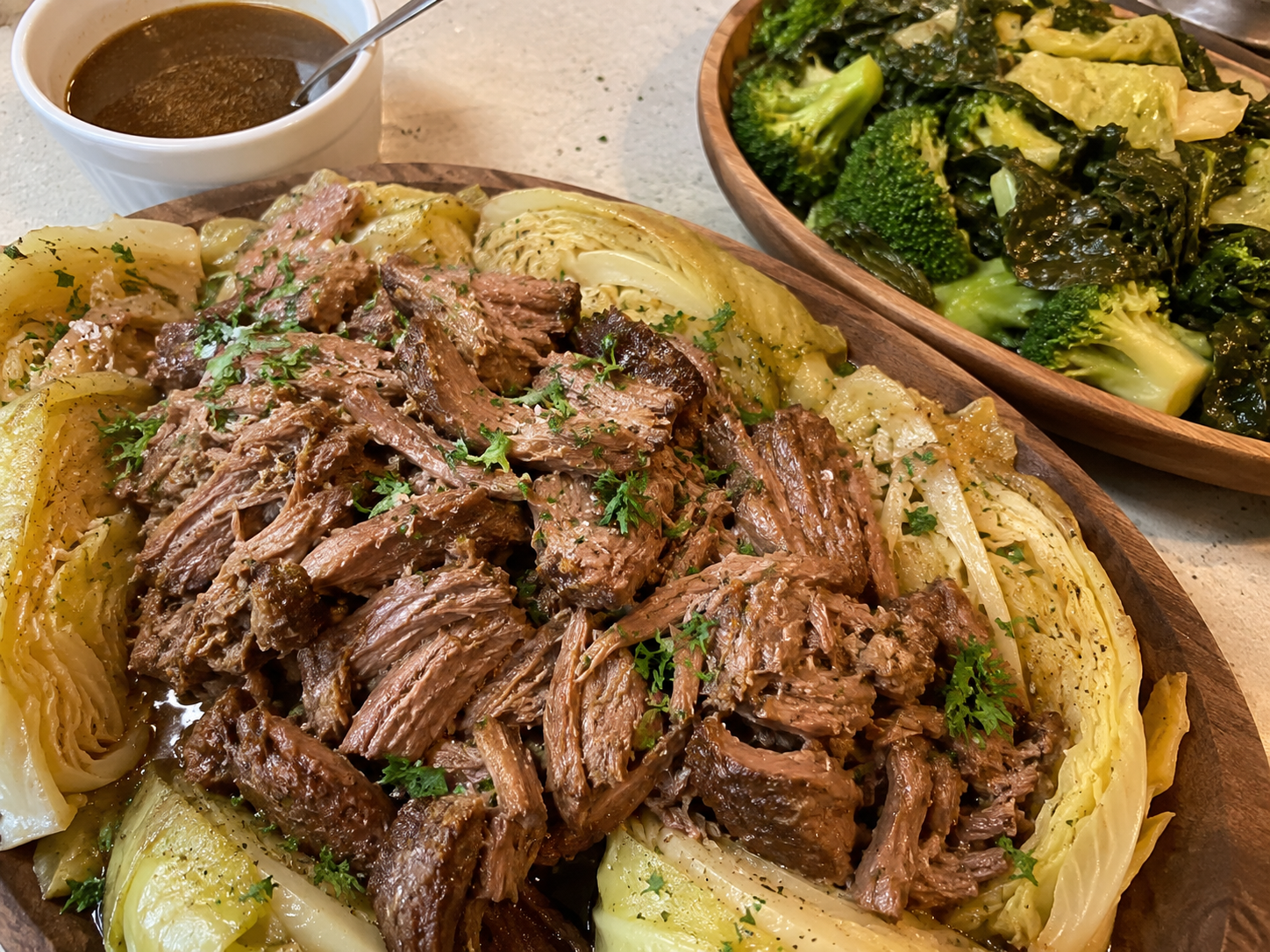
Yield: 6-8 servings · Active: 40 min · Total: 5-6 hr · Autumn through winter · Best eaten: early evening
Recipe 1 — Braised Pasture Pork Shoulder with Wilted Cabbage
Yield: 6-8 servings · Active: 25 min · Total: 4-5 hr (plus optional overnight dry brine)
Ingredients
The pork
1 bone-in pasture-raised pork shoulder (also called Boston butt or picnic shoulder), 4-5 lb
2 tbsp Baja Gold sea salt (for dry brine, day before)
2 tbsp extra virgin olive oil (for searing)
Spicy braising liquid
1 large yellow onion, thickly sliced
2 medium carrots, cut into thick chunks
6 garlic cloves, smashed
3 sprigs fresh rosemary
4 sprigs fresh thyme
3 bay leaves
2 tbsp tomato paste (single-ingredient)
1 tbsp Dijon mustard (single-ingredient, no additives)
1 tbsp raw honey
⅓ cup raw apple cider vinegar
3 cups bone broth (chicken, pork, or beef)
1 medium green cabbage, cored and cut into 8 thick wedges
Spice rub
1 tbsp ground cumin
1 tbsp sweet paprika
1 tsp smoked paprika (pimentón de la Vera)
1 tsp ground coriander
1 tsp red pepper flakes (or more for heat)
1 tsp ground black pepper
1 tsp ground ginger
½ tsp ground cinnamon
½ tsp ground cloves
Method
Day before serving:
Dry brine. Pat pork shoulder completely dry. Rub 2 tbsp of sea salt evenly over the surface. Place on a wire rack over a sheet pan, uncovered, in the refrigerator for 12-24 hours. This meaningfully improves the crust and flavor.
Braising day:
Bring to room temperature. Remove pork from refrigerator 60 minutes before cooking.
Preheat the oven. Heat to 300°F.
Make the spice rub. In a small bowl, combine cumin, sweet paprika, smoked paprika, coriander, chili flakes, black pepper, ginger, cinnamon, and cloves.
Rub the pork. Pat pork dry again. Rub the spice mixture generously all over the shoulder, pressing into any creases and folds.
Sear. Heat 2 tbsp olive oil in a large heavy Dutch oven over medium-high heat. Sear the pork on all sides until deeply browned, about 3-4 minutes per side. Transfer to a plate.
Build the braising liquid. In the same Dutch oven with the pork drippings, add sliced onion, carrot chunks, and smashed garlic. Sauté 5-6 minutes until softened and lightly browned. Add tomato paste, Dijon mustard, and raw honey. Stir to combine and cook 1 minute.
Deglaze. Pour in the raw apple cider vinegar and let it bubble 30 seconds. Add the bone broth, rosemary, thyme, and bay leaves.
Return the pork. Nestle the seared pork shoulder back into the Dutch oven. The liquid should come about halfway up the sides. Bring to a gentle simmer.
Braise covered. Cover tightly (parchment paper crumpled under the lid helps seal). Transfer to the 300°F oven. Braise 3½-4 hours, until the meat pulls away from the bone with almost no resistance.
Add the cabbage. In the last 45 minutes of braising, tuck the cabbage wedges around the pork in the Dutch oven. They'll soak up the braising liquid and become deeply flavored.
Uncover and brown. Remove the lid. Increase oven temperature to 425°F. Roast uncovered 20-25 minutes to caramelize the top of the pork and reduce the braising liquid slightly.
Rest. Transfer pork and cabbage to a warm serving platter. Let rest 15-20 minutes.
Reduce the braising liquid. Strain the braising liquid into a saucepan (discard the herbs). Simmer over medium heat 10-15 minutes to reduce and concentrate. Taste — adjust with additional salt, pepper, or a splash of raw ACV for brightness.
Shred and plate. Use two forks to shred the pork into large chunks, discarding excess fat. Return the shredded meat to the reduced braising liquid and toss to coat. Season with additional flaky sea salt.
Serve. Transfer to a large warm platter with the braised cabbage wedges alongside. Spoon extra reduced braising liquid over the top.
Recipe 2 — Wilted Broccoli, Collard, and Cabbage Greens
Yield: 6-8 servings · Active: 20 min · Total: 25 min
Ingredients
1 small head broccoli, cut into small florets and stems chopped (about 4 cups)
1 large bunch collard greens (about 1 lb), stems removed, leaves chopped into 2-inch pieces (about 5 cups)
½ small green cabbage, cored and thinly shredded (about 4 cups)
3 tbsp pastured lard
6 garlic cloves, thinly sliced
1 tsp fresh ginger, finely grated
1 tsp red pepper flakes (optional)
1 tsp sea salt
½ tsp freshly cracked black pepper
Juice of ½ lemon
3 tbsp raw hulled hemp seeds
2 tbsp fresh flat-leaf parsley, chopped
Flaky sea salt for finishing
Method
Blanch the collards first. Bring a large pot of salted water to a boil. Add chopped collard greens and blanch 3-4 minutes to soften slightly. Drain and press out excess water. This step tenderizes the collards, which are tougher than cabbage or broccoli.
Heat the lard. In a large cast iron skillet or wok, heat the lard over medium-high heat.
Sauté aromatics. Add sliced garlic, grated ginger, and optional chili flakes. Cook 30 seconds until fragrant.
Add broccoli first. Add the broccoli florets and stems. Sauté 3-4 minutes, stirring occasionally, until the broccoli is bright green and starting to soften.
Add cabbage. Add the shredded cabbage. Sauté 3-4 more minutes, tossing frequently, until the cabbage is wilted but retains some crunch.
Add collards. Add the blanched collard greens, salt, and pepper. Toss to combine and warm through, about 2 minutes.
Finish. Squeeze fresh lemon juice over the greens. Toss to coat.
Serve. Transfer to a warm serving platter. Sprinkle generously with hemp seeds, chopped parsley, and flaky sea salt.
Plating the Complete Meal
Present family-style on a large warm platter or serving board: pile the shredded braised pork in the center, moistened with the reduced braising liquid; arrange the braised cabbage wedges around the pork; serve the wilted greens on a separate warm platter alongside. Spoon extra braising liquid into a small dish for drizzling. Garnish with fresh parsley and flaky sea salt. Everyone builds their own plate — this is meant to be shared, cold-weather comfort food.
Sourcing
Pasture-raised bone-in pork shoulder — from a farmers' market, local butcher, or shipped source clearly labeled pasture-raised and heritage-breed when possible (Berkshire, Mangalitsa, Tamworth carry meaningfully more flavor than commodity confinement pork)
Fresh broccoli, green cabbage, collard greens — firm, dense, from a farmers' market or organic produce section
Fresh onion, carrots, garlic — organic, hardneck garlic
Fresh ginger — plump, firm rhizomes
Fresh rosemary and thyme — windowsill pot or farmers' market
Bone broth — homemade is best (rich, gelatinous when cold). Shipped options clearly labeled 100% grass-fed
Tomato paste — single-ingredient, in a glass jar or tube
Dijon mustard — single-ingredient (mustard seeds, vinegar, salt, no sugar or additives)
Raw apple cider vinegar — with the mother
Raw honey — local, unfiltered, single-origin from a beekeeper or farmers' market
Grass-fed ghee — clarified grass-fed butter with the milk solids removed. Traditional across Indian cooking and increasingly available. 4th & Heart and Pure Indian Foods are quality accessible options
Raw hulled hemp seeds — single-ingredient (just hemp seeds), no additives. Organic when possible
Whole and ground spices (organic, non-irradiated, single-origin) — cumin, coriander, paprika, ginger, cinnamon, cloves. Ground fresh from whole seeds for meaningfully brighter flavor and bioactive compound retention. Pimentón de la Vera (Spanish smoked paprika) adds authentic smoky depth
Fresh lemons — organic
Single-estate extra virgin olive oil — Portuguese, Spanish, or Italian for cooking
Baja Gold sea salt for cooking; fleur de sel or Maldon for finishing
Storage
Cooked braised pork: Refrigerated up to 5 days, sealed in the braising liquid. Reheat gently on the stovetop or in a covered skillet. Freezes up to 3 months
Wilted greens: Refrigerated up to 3 days, sealed. Reheat gently — best fresh
Reduced braising liquid alone: Refrigerated up to 5 days. Frozen up to 3 months. Excellent base for future soups or braises
Braising liquid before cooking: Not stored — it's built while braising
Leftover pork transformations: Warm over cauliflower rice with the braising liquid for a next-day bowl; shred into butter lettuce cups with fresh cilantro and lime for grain-free tacos; scramble with pastured eggs and greens for a hearty breakfast; add to bone broth with additional root vegetables for a rich soup.
Support for the Female Infradian Rhythm
This meal is deeply restorative for the menstrual and luteal phases of the female cycle (Days 18-5) when warming, grounding, iron-rich foods are most nourishing. Pasture-raised pork delivers exceptional B1 thiamine (pork is one of the richest dietary sources), zinc, selenium, iron, and complete protein — meaningful iron replenishment during menstruation. Warming braising spices (cumin, coriander, cinnamon, ginger, paprika) support circulation and digestion during a phase when many women feel colder and slower. Turmeric-adjacent ginger delivers documented anti-inflammatory effects for menstrual cramping. Broccoli, cabbage, and collard greens together deliver sulforaphane, DIM precursors, and glucosinolates — supporting Phase 2 liver detoxification of estrogen through follicular and luteal phases. Hemp seeds deliver complete plant protein plus omega-3s, magnesium, and zinc (essential for luteal-phase mood and PMS support). Grass-fed ghee delivers butyrate and vitamin K2. The whole meal is warm, deeply satisfying, and grounding — exactly what ancestral cold-weather cooking has always offered.
Nourishment Notes
Pasture-raised pork shoulder — B1 thiamine, zinc, selenium, and traditional cured pork compounds. Pork is one of the highest dietary sources of B1 thiamine (essential for energy metabolism), along with zinc, selenium, iron, and complete protein. Heritage-breed pasture-raised pork delivers a fundamentally different fatty acid profile than commodity confinement pork — meaningfully more monounsaturated fats and lower inflammatory omega-6. The bone-in cut also contributes glycine, proline, and gelatin from the collagen breakdown during slow braising.
Warming braising spices — anti-inflammatory aromatic oils and antimicrobial compounds. Cumin's cuminaldehyde, coriander's linalool, cinnamon's cinnamaldehyde (blood-sugar supportive), cloves' eugenol (antimicrobial), ginger's gingerols (anti-inflammatory), paprika's capsanthin and beta-carotene. Together delivering an exceptional load of bioactive compounds through the long slow braise.
Broccoli, cabbage, and collard greens — sulforaphane, vitamin K, and folate. All three cruciferous vegetables deliver sulforaphane (supporting Phase 2 liver detoxification of estrogen), vitamin K, folate, and vitamin C. Collard greens specifically deliver exceptional calcium in a plant format (one of the highest calcium content vegetables), plus vitamin A and lutein. The three-vegetable combination captures a fuller cruciferous compound spectrum than any single vegetable alone.
Hemp seeds — complete plant protein, omega-3s, and magnesium. Raw hulled hemp seeds deliver complete plant protein (all essential amino acids in a 3:1 omega-6 to omega-3 ratio that matches human needs), magnesium, zinc, iron, and gamma-linolenic acid (GLA — a rare anti-inflammatory omega-6 that supports hormone balance and skin health). One of the most nutritionally dense seeds available.
Grass-fed ghee — butyrate, K2, and CLA. Clarified grass-fed butter with the milk solids removed delivers butyrate (a short-chain fatty acid supporting gut health), vitamin K2, CLA, and beta-carotene. Traditional across Indian and Middle Eastern cooking; ghee has the same nutritional density as grass-fed butter but with a higher smoke point and no lactose or casein (making it accessible for many with dairy sensitivities).
Bone broth (braising liquid) — collagen, glycine, and mineral extraction. The bone broth in the braising liquid enriches with concentrated collagen, glycine, proline, glucosamine, and bioavailable minerals. As the pork slow-braises for 4-5 hours, this liquid concentrates and becomes deeply nourishing — the shredded meat tossed in it captures all that concentrated support.
Raw apple cider vinegar — acetic acid and live cultures. Small amount adds brightness and supports blood-sugar regulation.
Fresh garlic — allicin, organosulfur compounds, and prebiotic inulin fiber.
Fresh ginger — gingerols and anti-inflammatory support. Particularly meaningful for menstrual cramping and digestive support.
Fresh herbs (rosemary, thyme, parsley) — rosmarinic acid, carnosic acid, thymol, and vitamin K. Traditional across Mediterranean cooking for both flavor and medicinal effect.
Extra virgin olive oil — oleic acid and polyphenols.
Raw honey (small amount) — trace minerals and antimicrobial enzymes.
— Anna aka Food Marshall