Miso Cod with Broccoli Mash and Roasted Carrot-Cauliflower-Mushroom Medley
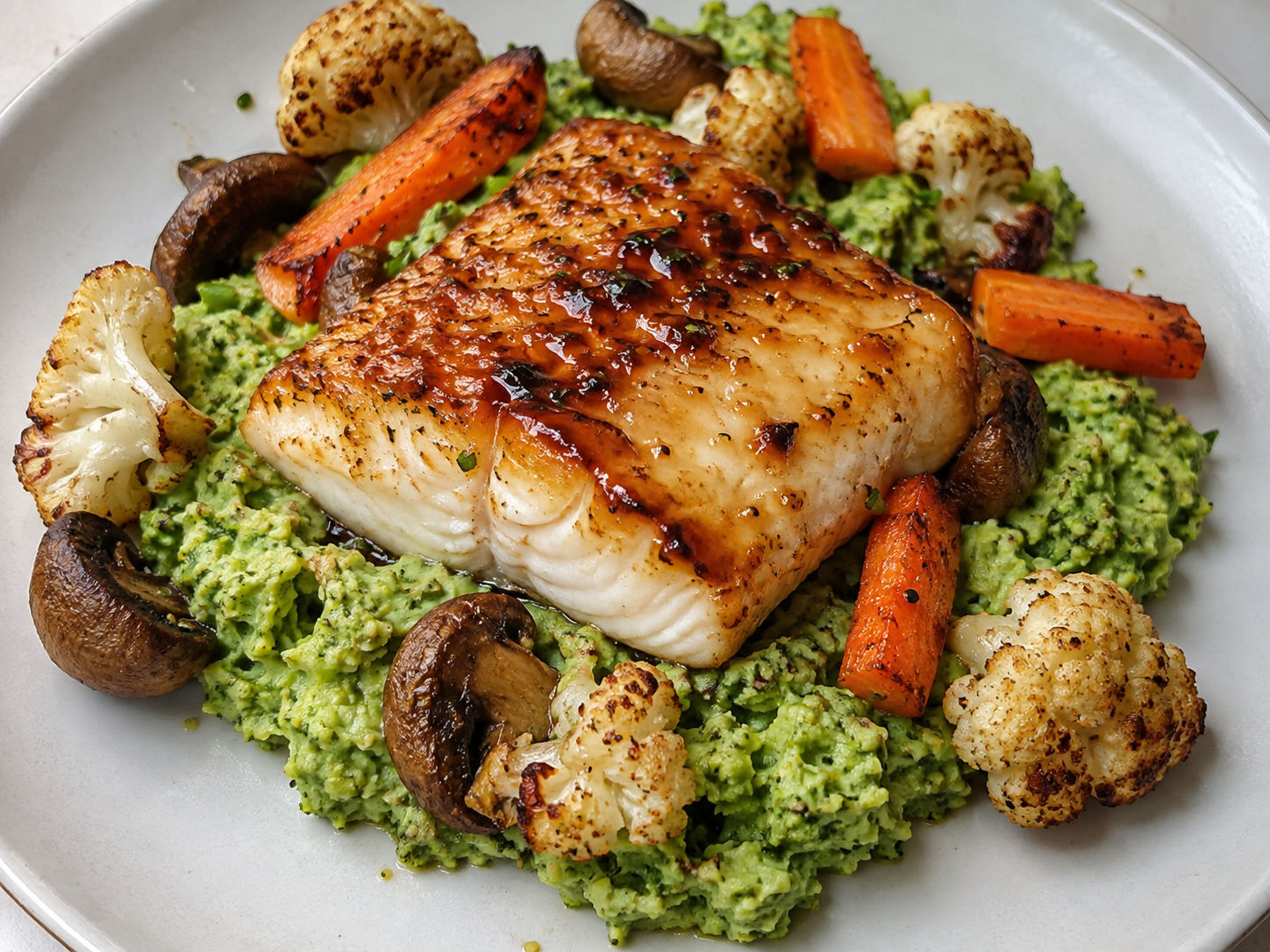
Yield: 4 servings · Active: 40 min · Total: 1 hr (plus 24 hr fish marinade, ideal 48 hr) · Autumn through spring · Best eaten: early evening
Complete Menu
Miso Cod — start marinating 24-48 hours ahead
Broccoli Mash with Garlic and Chili Flakes
Roasted Rainbow Carrot, Cauliflower, and Sautéed Mushroom Medley
Optional accompaniments: fresh cilantro, toasted sesame seeds, sliced scallions, lime wedges, nori strips.
A note on miso black cod
Miso-marinated black cod. Black cod (sablefish) is a cold-water Alaskan fish with exceptionally high fat content — one of the highest omega-3 profiles of any fish. This makes it uniquely suited to the sweet-savory miso marinade, which forms a beautiful caramelized crust on the fatty flesh during broiling.
Traditional saikyo yaki uses white miso, mirin (Japanese sweet rice wine), sake, and sugar. This version reimagines it without sake (an alcohol you've kept out of your library) or refined sugar — using raw honey plus a splash of raw apple cider vinegar to replicate mirin's sweet-tangy character.
Recipe 1 — Miso Cod
Yield: 4 servings · Active: 15 min (plus 24-48 hr marinade) · Total: 25 min cooking
Ingredients
Fish
4 wild-caught black cod (sablefish) fillets (about 6 oz each, skin on)
Miso marinade
½ cup white miso paste (organic, unpasteurized)
3 tbsp raw honey
2 tbsp raw apple cider vinegar
2 tbsp toasted sesame oil
1 tbsp fresh ginger, finely grated
2 garlic cloves, finely grated
Zest of ½ lemon
To finish
2 tbsp toasted white or black sesame seeds
2 scallions, thinly sliced
Fresh cilantro
Lime or lemon wedges
Method
Marinate 24-48 hours ahead:
Make the marinade. In a small bowl, whisk together white miso, raw honey, apple cider vinegar, toasted sesame oil, grated ginger, grated garlic, and lemon zest until smooth.
Marinate the cod. Pat cod fillets completely dry. Place in a glass container. Spread the miso marinade generously over all sides of each fillet (about 2 tbsp per fillet). Cover tightly with parchment or a lid. Refrigerate 24-48 hours. The 48-hour marinade delivers deeper caramelization and flavor penetration.
Cook the cod:
Bring to room temperature. Remove cod from refrigerator 30 minutes before cooking.
Preheat broiler. Position rack about 6 inches from the broiler element. Preheat broiler on high.
Prep for broiling. Line a heavy sheet pan with parchment paper. Scrape most of the marinade off the cod fillets (leave a thin coating — too much marinade will burn). Reserve scraped marinade for basting.
Broil. Place cod skin-side down on the parchment-lined sheet pan. Broil 6-8 minutes without moving. The top will caramelize deeply into a mahogany-brown crust with charred spots — that's the classic saikyo yaki finish. Don't let it burn to black — pull it out when the crust is deep amber.
Test for doneness. The cod is ready when the flesh flakes easily with a fork and reads 130-135°F at the thickest part. Internal temperature should not exceed 140°F — the fatty flesh is easily overcooked.
Rest. Transfer to a warm plate. Rest 2-3 minutes.
Serve. Garnish with toasted sesame seeds, sliced scallions, and fresh cilantro. Serve with lime or lemon wedges.
Recipe 2 — Broccoli Mash with Garlic and Chili Flakes
Yield: 4 servings · Active: 15 min · Total: 20 min
Ingredients
2 large heads broccoli, cut into florets and stems chopped (about 6 cups)
3 tbsp extra virgin olive oil, coconut oil, or grass-fed butter
4 garlic cloves, finely minced
½ tsp red pepper flakes
2 tbsp grass-fed butter or ghee
1 tsp sea salt
½ tsp freshly cracked black pepper
2 tbsp fresh lemon juice
¼ cup fresh flat-leaf parsley, chopped
Flaky sea salt
Method
Steam or blanch the broccoli. Bring a large pot of salted water to a boil. Add broccoli florets and stems. Cook 4-5 minutes until very tender when pierced with a fork (softer than usual — you want it to mash easily). Drain thoroughly.
Sauté aromatics. In a large skillet, heat fat of choice over medium heat. Add minced garlic and chili flakes. Cook 30 seconds until fragrant.
Mash. Add the drained broccoli to the skillet. Using a potato masher or the back of a wooden spoon, mash directly in the pan. Aim for a chunky-mashed texture, not a purée — visible bits of broccoli make it interesting.
Finish. Add butter or ghee, salt, pepper, and lemon juice. Stir to combine. Cook 2-3 more minutes to warm through and let flavors meld.
Plate. Transfer to a serving bowl. Scatter fresh parsley and flaky sea salt over the top.
Recipe 3 — Roasted Rainbow Carrot, Cauliflower, and Sautéed Mushroom Medley
Yield: 4-6 servings · Active: 15 min · Total: 40 min
Ingredients
Roasted portion
1 lb rainbow carrots (mixed varieties), cut into 1½-inch chunks on the bias
1 medium head cauliflower (about 1½ lb), cut into 1½-inch florets
4 tbsp extra virgin olive oil, divided
1 tsp ground cumin
½ tsp ground coriander
1 tsp sea salt
½ tsp freshly cracked black pepper
4 garlic cloves, thinly sliced
Sautéed mushrooms
12 oz mixed mushrooms (shiitake, cremini, oyster, maitake — mixed for depth), sliced or torn
2 tbsp grass-fed butter or ghee
2 tbsp extra virgin olive oil
3 garlic cloves, finely minced
1 tbsp fresh thyme leaves
1 tbsp coconut aminos
1 tsp fresh lemon juice
½ tsp sea salt
To finish
2 tbsp fresh flat-leaf parsley, chopped
Flaky sea salt
Method
Roast the vegetables:
Preheat oven to 425°F. Line a large sheet pan with parchment paper. (Or coat a cast iron pan with olive oil or tallow)
Toss. In a large bowl, toss carrots and cauliflower with 3 tbsp olive oil, cumin, coriander, salt, pepper, and sliced garlic.
Roast. Spread on the sheet pan in a single layer. Roast 25-30 minutes, tossing once, until deeply caramelized and tender. (Or simply spread on cast iron pan and place in oven)
Sauté the mushrooms (in the last 10 minutes of roasting):
Heat the pan. In a large cast iron skillet, heat butter/ghee and olive oil over medium-high heat until foaming.
Cook the mushrooms. Add mushrooms in a single layer. Don't crowd — work in 2 batches if needed. Cook without moving for 3-4 minutes to develop a golden crust on one side. Toss and cook another 3-4 minutes.
Add aromatics. Add minced garlic, thyme leaves, coconut aminos, lemon juice, and salt. Toss to coat. Cook 1 minute more.
Combine:
Plate. On a warm serving platter, arrange the roasted carrots and cauliflower. Pile the sautéed mushrooms on top or alongside. Scatter fresh parsley and flaky sea salt.
Plating the Complete Meal
Present family-style: place the miso black cod fillets on one warm platter; pile the broccoli mash in a warm serving bowl; arrange the roasted carrot-cauliflower-mushroom medley on a third platter. Garnish everything with fresh cilantro, sesame seeds, and lime wedges. This is a restaurant-elegant Japanese-influenced plate — meant to be shared, savored slowly, and paired with quiet conversation.
Sourcing
Wild-caught black cod (sablefish) — from a fishmonger, specialty seafood counter, or shipped from wild Alaskan producers. Look for wild-caught with deep pink-orange flesh (not pale). Frozen-at-sea black cod is often more accessible than fresh and equally nutritious
White miso paste (shiro miso) — organic, unpasteurized (contains live cultures), single-ingredient. Look for miso with just soybeans (or chickpeas for soy-free), rice koji, salt, and water. Avoid brands with MSG, artificial additives, or added sugars
Toasted sesame oil — cold-pressed, single-ingredient, in a dark glass bottle
Broccoli, cauliflower, rainbow carrots — firm, from a farmers' market or organic produce section
Mixed mushrooms (shiitake, cremini, oyster, maitake) — from a specialty mushroom farm, farmers' market, or high-quality grocer. Fresh, dense, no slime
Raw apple cider vinegar — with the mother
Raw honey — local, unfiltered, single-origin
Coconut aminos — single-ingredient (fermented coconut sap and sea salt), no soy
Fresh ginger and garlic — organic, hardneck garlic
Fresh cilantro, parsley, scallions — vibrant green, from a farmers' market or windowsill pot
Grass-fed butter or ghee — European-style cultured butter is exceptional
Avocado oil — cold-pressed, single-ingredient
Single-estate extra virgin olive oil — Portuguese, Italian, Spanish, or Greek, harvest-dated
Toasted sesame seeds and nori — single-ingredient, no additives
Baja Gold sea salt for cooking; fleur de sel or Maldon for finishing
Whole and ground spices (organic, non-irradiated, single-origin) — cumin, coriander, chili flakes. Ground fresh from whole seeds for meaningfully brighter flavor
Storage
Miso marinade (before use): Refrigerated up to 2 weeks in a sealed jar. Excellent for future miso-marinated fish or chicken
Cooked miso cod: Refrigerated up to 2 days. Best fresh — the delicate flesh loses texture on reheating
Broccoli mash: Refrigerated up to 4 days. Excellent reheated gently or served at room temperature
Roasted vegetable and mushroom medley: Refrigerated up to 4 days. Reheat at 400°F for 5-6 minutes
Leftover transformations: Flake cold miso cod over rice bowls or salads; blend leftover broccoli mash into a soup with bone broth; scramble the vegetable medley with pastured eggs for a hearty breakfast.
Support for the Female Infradian Rhythm
This meal is deeply supportive across all cycle phases, with particular strengths for follicular and luteal phases. Wild black cod delivers exceptional omega-3 fatty acids (one of the highest of any fish), vitamin D, and vitamin B12 — meaningful for hormonal balance and reducing menstrual inflammation. Miso delivers live probiotic cultures supporting the estrobolome. Cruciferous broccoli, cauliflower, and mushrooms deliver sulforaphane, DIM precursors, and beta-glucans — supporting Phase 2 liver detoxification of estrogen and immune modulation. Maitake specifically delivers ergothioneine, a rare amino acid with documented antioxidant effects. Rainbow carrots deliver full-spectrum carotenoids for antioxidant support. Fresh ginger delivers documented anti-inflammatory support for menstrual cramping. Toasted sesame seeds deliver lignans supporting hormone balance, plus calcium and magnesium (particularly meaningful for luteal-phase mood support and cramp prevention).
Nourishment Notes
Wild-caught black cod (sablefish) — omega-3 fatty acids, vitamin D, B12, and complete protein. Black cod is one of the highest omega-3 fish available, delivering EPA and DHA at concentrations that rival wild salmon. Also vitamin D (particularly meaningful for winter cycle support), B12, selenium, and complete protein. The high fat content makes it uniquely satisfying and nutrient-dense — meaningful for luteal-phase satiety and blood-sugar stability.
White miso — probiotic cultures, isoflavones, umami depth. Unpasteurized miso delivers live Aspergillus oryzae cultures, Lactobacillus, and other beneficial bacteria supporting gut microbiome and estrobolome. Traditional soybean-based miso also delivers isoflavones in balanced fermented form.
Broccoli — sulforaphane, vitamin K, folate. Cruciferous compound supports estrogen metabolism through Phase 2 liver detoxification. Broccoli also delivers vitamin K, vitamin C, folate, and fiber.
Cauliflower — sulforaphane and choline. Additional cruciferous support plus choline for brain and liver function.
Rainbow carrots — full-spectrum carotenoids. Purple carrots deliver anthocyanins; orange carrots deliver beta-carotene; yellow carrots deliver lutein. Full-spectrum antioxidant support.
Mixed mushrooms — beta-glucans, ergothioneine, vitamin D, B vitamins. Shiitake, maitake, and oyster mushrooms deliver beta-glucans (immune-modulating polysaccharides), ergothioneine (a rare amino acid with documented antioxidant effects), and B vitamins. Maitake specifically supports blood-sugar balance.
Fresh ginger — gingerols, shogaols, anti-inflammatory support.
Toasted sesame oil and seeds — lignans, calcium, magnesium.
Coconut aminos — subtle umami without soy inflammation.
Raw apple cider vinegar — acetic acid and live cultures.
Fresh cilantro and parsley — vitamin K, chlorophyll, heavy metal binding.
Fresh garlic — allicin and organosulfur compounds.
Extra virgin olive oil and avocado oil — oleic acid and polyphenols. Amplifies absorption of fat-soluble compounds.
Grass-fed butter or ghee — CLA, K2, butyrate.
Raw honey — trace minerals and antimicrobial enzymes.
— Anna aka Food Marshall