crispy-edged slow-Cooked Lamb Shoulder with Apricot & Roasted Vegetables
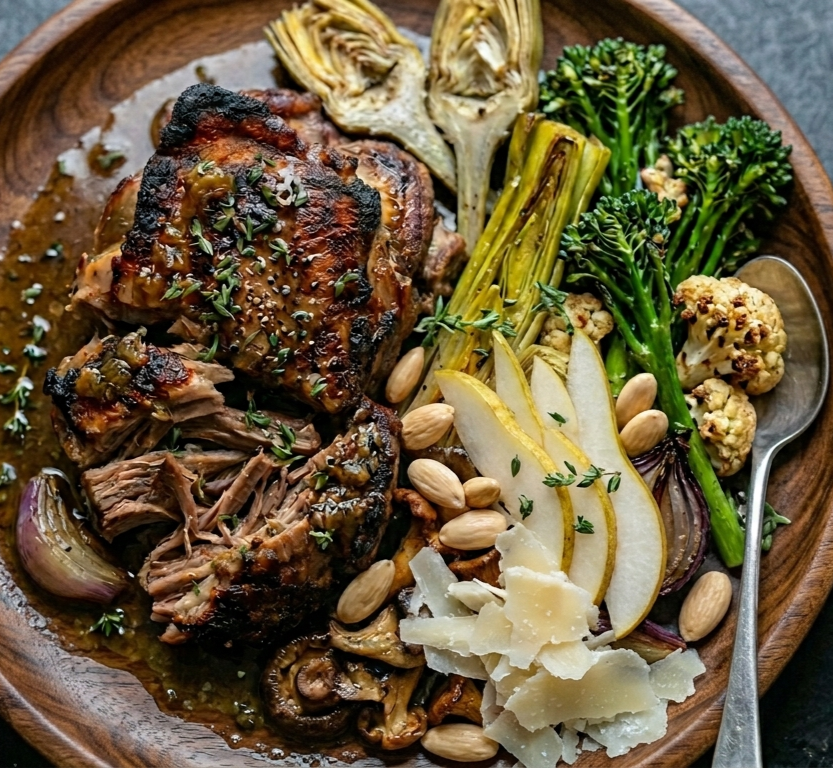
Pasture-raised lamb shoulder slow-cooked for hours until spoon-tender, then finished with crispy carnitas-style edges, served with apricot preserve, shaved smoked sheep's milk cheese (Idiazábal), charred vegetables, sautéed wild mushrooms, and toasted hazelnuts or pistachios. This is the kind of meal for autumn and winter, when the cold months are asking for deep, fat-rich, mineral-dense food.
Yield: 6 servings · Active: 1 hr · Total: 5–6 hrs (mostly hands-off) · Autumn into winter (peak: October–February)
Ingredients
For the lamb shoulder:
4–5 lb pasture-raised lamb shoulder (bone-in if possible — see sourcing)
3 tbsp extra-virgin olive oil
8 cloves garlic, crushed
2 tbsp finely chopped fresh rosemary
2 tbsp fresh thyme leaves
1 tbsp finely chopped fresh flat-leaf parsley
Zest of 1 lemon
2 tsp sea salt
1 tsp freshly cracked black pepper
Splash of dry white wine or dry Basque cider
1 tsp smoked paprika (Pimentón de la Vera DOP, sweet or hot)
For the apricot preserve serving:
⅓ cup high-quality apricot preserve (low-sugar, European-made — see sourcing)
1 tbsp aged cider vinegar
Tiny pinch smoked paprika
Pinch of flaky sea salt
For the more traditional quince paste (membrillo) variation (popular in Basque Country of Spain):
3–4 oz Spanish membrillo, cut into thin rectangles (No preparation needed — slice and serve cold on the plate beside the lamb)
For the roasted vegetables:
1 bunch broccolini (about 8 oz), trimmed
3–4 medium carrots, cut into thick batons
2 large leeks, white and pale-green parts only, halved lengthwise
3 tbsp duck fat or grass-fed butter, or 3 tbsp extra-virgin olive oil
3 sprigs fresh thyme, leaves stripped
2 sprigs fresh rosemary, leaves stripped
1 tsp sea salt
½ tsp freshly cracked black pepper
Squeeze of fresh lemon juice or splash of aged cider vinegar (to finish)
Optional add-ons: 1 small head cauliflower; 2 spring onions or scallions; 6–8 baby artichokes; 6–8 jarred piquillo peppers; 1 small head radicchio or chicories (for the wilted bitter greens variation)
For the sautéed wild mushrooms:
12 oz mixed wild mushrooms (oyster, maitake, chanterelle if available — see sourcing)
3 tbsp extra-virgin olive oil
3 cloves garlic, minced
2 sprigs fresh thyme, leaves stripped
2 tbsp fresh flat-leaf parsley, finely chopped
Pinch of sea salt Splash of aged sherry vinegar (to finish)
For the pear accent:
1 firm-ripe pear (Bosc or Comice), very thinly sliced (paper-thin if possible)
Squeeze of fresh lemon juice (to prevent browning)
For finishing:
2 oz Idiazábal cheese, very thinly shaved (use a vegetable peeler — see sourcing), or manchego
¾ cup hazelnuts OR Marcona almonds, toasted and roughly crushed
Fresh flat-leaf parsley, chopped
Flaky sea salt
Drizzle of high-quality Spanish extra-virgin olive oil
Optional: rosemary ash; grilled spring onions; freshly cracked black pepper
Method
Marinate the lamb. The night before (or at least 2 hours ahead), rub the lamb shoulder thoroughly with the olive oil, crushed garlic, rosemary, thyme, parsley, lemon zest, sea salt, black pepper, and smoked paprika. Massage the mixture into every surface and crevice. Cover and refrigerate. The longer the marinade, the deeper the flavor.
Slow-cook the lamb. Preheat the oven to 300°F. Remove the lamb from the refrigerator 30 minutes before cooking. Place the lamb in a heavy roasting pan or Dutch oven. Add a splash of dry white wine or dry Basque cider to the bottom of the pan. Cover tightly with the lid or aluminum foil. Roast 4–5 hours at 300°F, until the meat is spoon-tender and pulls apart easily with a fork. (For a smaller 3–4 lb shoulder, 3.5–4 hours is sufficient.)
Rest and shred. Remove the lamb from the oven. Let rest 15–20 minutes covered. Then shred the meat into large chunks — don't pull it to a fine shred; you want substantial pieces that will develop crispy edges in the next step.
Toast the hazelnuts. While the lamb rests, increase the oven to 350°F. Spread the hazelnuts on a small baking sheet and toast 8–10 minutes, until fragrant and the skins begin to crack. Transfer to a clean kitchen towel and rub vigorously to remove the skins. Roughly crush. (If using Marcona almonds, they're already toasted — just roughly chop.)
Make the apricot preserve serving. In a small bowl, stir together the apricot preserve, cider vinegar, smoked paprika, and a pinch of flaky sea salt. The vinegar and paprika transform the jam from "dessert preserve" to "savory fruit accent." Don't skip this step. (For the membrillo variation: simply slice the membrillo into thin rectangles. No preparation needed.)
Roast the vegetables. Increase the oven to 425°F. Toss the broccolini, carrots, and leeks (and optional cauliflower, artichokes, piquillo peppers, or chicories) with the duck fat or olive oil, thyme, rosemary, salt, and pepper. Spread on a baking sheet in a single layer. Roast 22–28 minutes, until deeply blistered, caramelized, and slightly smoky at the edges. (Note: broccolini cooks faster than cauliflower — check at the 18-minute mark and remove anything done early, or finish the cauliflower with a quick broil for golden, crispy edges.) Finish with a squeeze of lemon juice or a splash of aged cider vinegar.
Sauté the wild mushrooms. In a wide skillet over high heat, warm 2 tbsp olive oil. Add the mushrooms in a single layer (work in batches if needed — overcrowded mushrooms steam rather than brown). Cook 4–5 minutes per side, undisturbed, until deeply golden. Stir in the garlic, thyme, parsley, and salt. Cook 1 more minute, then finish with a splash of sherry vinegar.
Crisp the lamb edges. This final sear is what gives the dish its contrast — crisp caramelized edges against the slow-cooked interior. Heat a cast-iron skillet over high heat until very hot. Add 1 tbsp olive oil or rendered lamb fat. Press the shredded lamb chunks hard into the pan in a single layer. Don't move them — let them sear and caramelize for 2–3 minutes, until the edges are deeply browned and crispy. Flip and crisp the other side, 1–2 more minutes. The lamb should have deep, almost carnitas-style caramelization on the edges with tender, fatty interior. Work in batches if needed.
Slice the pear. Just before plating, slice the pear paper-thin on a mandoline. Squeeze with a tiny bit of lemon juice to prevent browning.
Plate the dish. On a large warm platter or individual dinner plates, arrange the components naturally:
Base: A bed of the roasted vegetables — carrots, broccolini, leeks (and optional cauliflower, artichokes, piquillo peppers, or wilted chicories).
Layer: The sautéed wild mushrooms scattered across the vegetables.
Center: Crispy-edged lamb shoulder pieces arranged on or beside the vegetables.
Fruit accent: A few thin pear slices tucked between the lamb pieces. Small dots or smears of the apricot preserve mixture (NOT heavily glazed — restrained accents) around the plate.
OR for the traditional variation: A few thin rectangles of quince paste arranged beside the lamb.
Finish: Scatter the toasted hazelnuts (or Marcona almonds) across the plate. Add very thin shavings of Idiazábal cheese (use a vegetable peeler — this is a finishing accent, not a topping). Sprinkle fresh parsley. Drizzle a small amount of high-quality Spanish EVOO across everything. Finish with flaky sea salt and freshly cracked black pepper.
Variations
Pork shoulder variation: Substitute slow-cooked pasture-raised pork shoulder for the lamb (same technique, same timing — 4–5 hours at 300°F). Pair with apple compote or cider reduction in place of the apricot preserve. Add roasted apples (Honeycrisp or Gala) to the vegetable plate. The result is softer, sweeter, and slightly more rustic — reminiscent of Northern Spanish cider-house cooking.
Game variation: Substitute slow-cooked wild boar shoulder (if you can source it from a local farmer or specialty butcher) or venison shoulder. Both are dramatically richer and more mineral-dense than lamb. The pairings remain the same: smoked sheep cheese, hazelnuts, dark fruit accent, deeply roasted vegetables.
Lamb leg variation: For a smaller cut, substitute a 3-lb bone-in pasture-raised lamb leg or boneless lamb leg. Roast at 325°F for 2.5–3 hours covered, then crisp the edges as in the shoulder method. Slightly leaner, slightly more tender.
Acorn-finished pork variation: For the most ancestral version of the pork variation, source acorn-finished pork (jamón ibérico de bellota or Mangalitsa pork shoulder). The depth of flavor is genuinely extraordinary — this is the same diet Iberian pigs have eaten in Spain for 2,000 years, and it produces meat with substantially higher monounsaturated fat content (similar to olive oil's fat profile).
Nourishment Notes
Pasture-raised lamb: Lamb is one of the most nutrient-dense traditional proteins. Pastured ruminants — sheep raised on grass and forage — produce meat that's structurally and nutritionally distinct from grain-finished commercial lamb. Pasture-raised lamb is naturally rich in zinc, iron, selenium, B vitamins (especially B12), and the complete amino acid profile that all wild and pastured ruminants provide. The fat is particularly notable: pasture-raised lamb contains substantially higher concentrations of CLA (conjugated linoleic acid, which has been linked to favorable metabolic effects), omega-3 fatty acids (in a more favorable ratio with omega-6s than grain-finished lamb), and fat-soluble vitamins A, D, E, and K2 — particularly K2, which is exclusively concentrated in pasture-raised animal fats and directs calcium where it belongs in bone and tooth structure rather than soft tissue.
Slow cooking and connective tissue: The slow-cooking method (300°F for 4–5 hours) is structurally what transforms a tough cut of lamb shoulder into spoon-tender meat. The collagen in the connective tissue breaks down into gelatin over hours of gentle heat — this is the same transformation that happens in bone broth, and the gelatin is what gives the meat its silky, tender texture. Gelatin is also one of the most underappreciated nutrients in modern American eating — rich in glycine (which supports liver detoxification, sleep, and connective tissue), proline (which supports collagen synthesis), and the amino acids that the body uses to rebuild gut lining, joints, and skin. Slow-cooked lamb shoulder is structurally a complete protein-and-gelatin meal.
Smoked paprika and the Maillard reaction: The crispy edges of the lamb are produced by the Maillard reaction — a non-enzymatic browning reaction between amino acids and reducing sugars at high heat that produces hundreds of new flavor compounds. The smoked paprika in the marinade amplifies this effect, adding the smoky depth that Pimentón de la Vera DOP has provided to Northern Spanish cooking for centuries. Spanish smoked paprika is compositionally different from generic American paprika because the peppers are smoked over oak wood for 10–15 days before grinding.
Idiazábal cheese: Idiazábal is one of the great traditional sheep's milk cheeses of Northern Spain. Made from raw milk of Latxa and Carranzana sheep breeds in the Basque Country and Navarra, aged for at least 2 months (often longer), and traditionally smoked over beech wood — the result is a cheese with smoky depth, sheep-fat richness, and a complex mineral-mountain flavor that's structurally unique to the region. Aged sheep cheeses are also dramatically easier to digest than cow dairy for many people — the smaller fat globules, the A2-type casein, and the natural aging process (which has broken down most of the lactose) all contribute to better digestibility. The cheese is used as a finishing accent here, not melted into the dish — restraint is essential to honor the cheese itself.
The apricot/quince fruit accent: Both apricot and quince are members of the Rosaceae family alongside plums, cherries, peaches, and almonds. Apricots are naturally rich in beta-carotene (vitamin A precursor), vitamin C, potassium, and fiber. Quince — the more traditional Spanish pairing — is particularly rich in pectin (which supports digestion and gut health), vitamin C, and dietary fiber. The combination of dark or sweet fruit acidity with rich lamb and smoky sheep cheese is structural rather than aesthetic: the acid signals the body to produce bile and digestive enzymes that allow the rich fats to be properly assimilated. This is why ancestral cuisines worldwide have always paired rich meats with fruits or fruit-based sauces — not for flavor alone, but for digestive support.
The hazelnut and pear: Hazelnuts (avellanas) are native to the forests of Northern Spain and have been a structural ingredient in Basque cooking for thousands of years — rich in vitamin E, magnesium, copper, and oleic acid. Pears (peras) add a clean, slightly sweet, subtly aromatic palate refresher that bridges the rich lamb fat and the smoky cheese. The pairing of sheep cheese + pear + hazelnut has been a foundational Spanish cheese-board combination for centuries — and it's the structural balance that makes this lamb plate complete rather than overwhelming.
Sourcing
Sourcing matters here. This dish relies on traditional ingredients with deep regional character, and the quality of each component noticeably changes the final result.
Lamb Shoulder
Look for 100% grass-fed and grass-finished lamb from regenerative or pasture-based farms. The “grass-finished” part matters — many lambs labeled grass-fed are still grain-finished toward the end of production.
Bone-in shoulder is strongly preferred. The bone enriches the cooking liquid with collagen and gelatin, creating a deeper, silkier braising base. If only boneless shoulder is available, ask your butcher for lamb bones separately and roast them alongside the meat.
Heritage breeds such as Romney, Dorset, Suffolk, or Icelandic lamb tend to have deeper flavor and better fat quality than commodity supermarket lamb. Well-raised pasture lamb should appear dark red with creamy, well-distributed fat rather than pale pink and lean.
Idiazábal Cheese
Use authentic Idiazábal DOP cheese from the Basque Country or Navarra if possible — ideally lightly smoked. Made traditionally from the raw milk of Latxa or Carranzana sheep, it brings the smoky, mountain-style flavor that defines the dish.
If unavailable, good substitutes include:
Manchego curado
Roncal
Ossau-Iraty
Use the cheese sparingly as a finishing accent rather than a heavy topping.
Apricot Preserve
Choose a low-sugar apricot preserve with a high fruit content and clean ingredient list. European-style preserves generally work best because they tend to be less aggressively sweetened.
Homemade apricot preserve made during peak apricot season (late spring through midsummer) is exceptional here.
Membrillo (Traditional Variation)
For the more traditional Basque-Spanish variation, use Spanish-made artisanal membrillo (quince paste). The pairing of sheep cheese and membrillo is one of the classic flavor combinations of Northern Spain.
Wild Mushrooms
Fresh, seasonal mushrooms make a substantial difference. Look for oyster mushrooms, maitake, chanterelles, lion’s mane, or boletus from local mushroom growers, farmers’ markets, or foragers.
If purchasing online, quality growers such as Smallhold or regional specialty mushroom farms tend to produce far better texture and flavor than standard grocery-store mushrooms.
Smoked Paprika (Pimentón de la Vera)
Use genuine DOP-certified Pimentón de la Vera from Spain. The peppers are traditionally oak-smoked before grinding, creating a much deeper flavor than standard paprika.
Both dulce (sweet) and picante (hot) versions work well here.
Piquillo Peppers (Optional)
If using the more traditional Northern Spanish variation, choose whole roasted piquillo peppers from Navarra rather than generic roasted red peppers. Their sweetness and gentle bitterness pair beautifully with lamb and sheep cheese.
Sherry Vinegar
Use Spanish Vinagre de Jerez DOP if possible, ideally aged beyond the minimum requirement. Older sherry vinegars develop remarkable depth and roundness that elevate the roasted vegetables and mushrooms.
Olive Oil
A high-quality extra-virgin olive oil is essential because it is used both in cooking and as a finishing element.
Look for first cold-pressed Spanish olive oils from small estates in Andalusia, Catalonia, Navarra, or the Basque region. Peppery, grassy oils work especially well against the richness of the lamb.
Hazelnuts & Marcona Almonds
Hazelnuts are deeply traditional to the mountain regions of Northern Spain and pair naturally with sheep cheese and roasted lamb.
For almonds, use genuine Spanish Marcona almonds if possible. Their softer texture and higher fat content make them noticeably richer than standard almonds.
Toast either nut lightly before serving to bring out aroma and sweetness.
Pears
Bosc and Comice pears both work beautifully.
Bosc pears hold their shape well and provide a firmer texture.
Comice pears are softer, juicier, and more aromatic.
The pear should be ripe but still firm enough to shave paper-thin.
Sea Salt
Use a high-quality mineral-rich sea salt such as Maldon, fleur de sel, or traditionally harvested Spanish sea salt. Finishing salt matters here — the final flakes sharpen the sweetness of the apricot and the richness of the lamb.
Vegetables & Herbs
Because this dish is otherwise deeply rich, the vegetables need freshness and brightness.
Farmers’ market carrots, broccolini, leeks, mushrooms, parsley, rosemary, and thyme will noticeably outperform standard supermarket produce, especially in colder months when root vegetables are at their peak.
Storage
Components store separately for maximum freshness:
The slow-cooked lamb shoulder refrigerates 4 days, sealed. Freezer up to 3 months. Reheats beautifully — gently warm in a 300°F oven, then crisp the edges fresh.
The apricot preserve mixture keeps refrigerated 2 weeks, sealed in a glass jar. Wonderful on cheese boards, pork, eggs, or any roasted meat.
The membrillo (if using the traditional variation) keeps refrigerated 3 months, sealed.
The roasted vegetables refrigerate 4 days. Reheat in a hot oven for 5–10 minutes to recrisp the edges.
The sautéed wild mushrooms refrigerate 3 days.
Toasted hazelnuts keep in a sealed jar at room temperature 1 week, or refrigerated 1 month.
Idiazábal cheese keeps refrigerated 2–3 weeks, wrapped tightly in parchment paper inside a sealed container. Shave fresh just before serving.
The lamb bones — don't discard. Save in the freezer for the next bone broth project. Lamb bone broth is one of the most mineral-dense traditional preparations possible, particularly excellent for cold-weather meals. . The lamb leftovers are exceptional in the days following — shredded into salads, layered into grain-free wraps, or warmed gently with a splash of olive oil for a weekday lunch.
PAIRS WEL WITH
Roasted Potatoes or Fingerlings— If serving for a larger dinner or colder-weather meal, roasted potatoes work exceptionally well.
Best options:
Crispy fingerlings
Yukon Golds roasted in duck fat or olive oil
Small waxy potatoes tossed with rosemary and garlic
The potatoes absorb the lamb juices and apricot accents without competing with the dish.
Bitter Greens or Wilted Chicories
For a more traditional mountain-style presentation, serve the lamb with:
grilled radicchio
escarole
wilted chicories
sautéed dandelion greens
The bitterness balances the richness of the lamb fat and smoked cheese.
Fermented or Pickled Components
A small acidic component wakes the entire plate up.
Excellent additions:
pickled shallots
Basque-style pickled peppers
fermented carrots
cultured cabbage
cornichons
Additional Seasonal Fruit Pairings
The fruit element is essential to the balance of the dish.
Depending on season, serve with:
thin pear slices
roasted apples
grilled figs
fresh cherries
quince paste (membrillo)
apricot preserve
Fruit provides acidity and aromatic brightness against the smoky lamb and cheese.
Dessert Pairing
sheep yogurt with honey and toasted hazelnuts
olive oil cake
dark chocolate truffles with sea salt
Classic cheesecake in small portions
The meal is already deeply satisfying — dessert should feel cleansing rather than heavy.