Crispy Duck with FIG, Brassicas, Carrot-Leek-Mushroom Sauté & Arugula-Fennel Salad
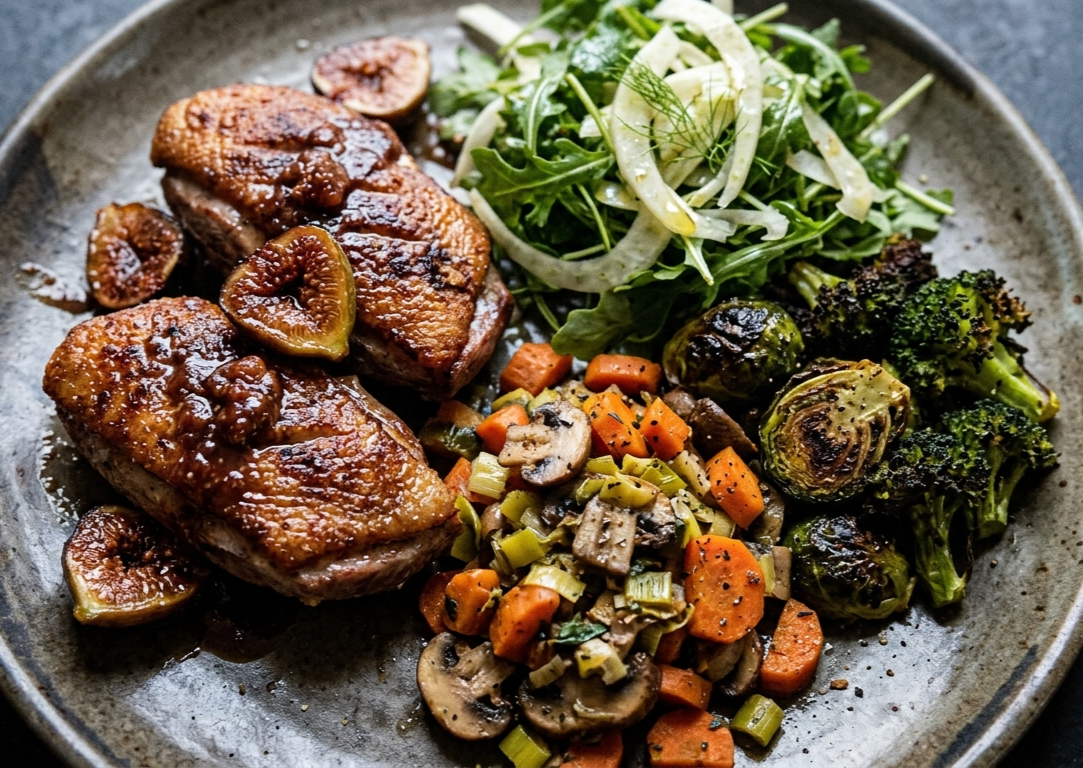
Crispy pasture-raised duck breast with a warm fig-cider reduction, roasted brassicas, a deeply caramelized carrot-leek-mushroom sauté, and a fresh arugula-fennel-pear salad with toasted hazelnuts and shaved Idiazábal (sheep cheese from the Basque country of Spain). Mineral-rich, earthy, smoky, autumnal — the way mountain coastal Spain has eaten for centuries.
Yield: 4 servings · Active: 45 min · Total: 1 hr 30 min · Autumn (peak: October–December)
A note from the kitchen
Duck or wild fowl raised on small farms, figs and pears from orchards, hazelnuts from forests, sheep cheeses from high pastures, dry cider pressed from local apples— what more could you ask for?! No industrial supply chain, no global ingredients, no shortcuts — just real food, seasonally available, prepared with the kind of patience that ancestral cooking always required.
This dish is built for autumn into early winter — when duck is naturally at its richest, when figs and pears are in full season, when the body is asking for mineral-dense, fat-anchored food to weather the cold months. The bitterness of the arugula and fennel cuts the duck's richness. The smoke of the charred leeks echoes the duck skin's crisp. The fig-cider reduction adds dark-fruit depth without being sugary. The toasted hazelnuts add the mountain crunch that defines northern Spanish home cooking. The shaved Idiazábal sheep cheese — used as a finishing accent, never melted into the dish — brings the smoky-nutty sheep-fat sharpness that ties everything together.
This may not be your typical ready-to-eat Tuesday-night dinner. This is the kind of meal you make on a Sunday afternoon when your kitchen windows are open to natural autumn light and fresh air and when the people you love are coming over to share a meal.
Ingredients
For the duck:
4 pasture-raised duck breasts (about 6–8 oz each — see sourcing for heritage-breed options)
2 tsp sea salt
1 tsp freshly cracked black pepper
4 sprigs fresh thyme, leaves stripped
2 cloves garlic, finely minced
For the fig-cider reduction:
½ cup high-quality fig jam or fig preserves (look for low-sugar; see sourcing)
½ cup Sidra (natural dry and tart apple cider from Northern Spain) or any other dry, naturally-fermented hard apple cider
½ cup bone broth (chicken or duck preferred)
1 small shallot, finely minced
2 sprigs fresh thyme
½ tsp freshly cracked black pepper
1 tsp aged sherry vinegar (optional, brightens the finish)
Pinch of flaky sea salt
For the roasted brassicas:
1 small head broccolini (or 1 large head broccoli, cut into florets)
1 small head cauliflower, cut into florets
8–10 small Brussels sprouts, halved (or 1 small cabbage, cut into wedges)
3 tbsp duck fat (rendered from the duck breasts — see method)
1 tbsp extra-virgin olive oil
3 sprigs fresh thyme, leaves stripped
1 tsp sea salt
½ tsp freshly cracked black pepper
Zest of ½ lemon (for finishing) OR 1 tsp aged cider vinegar
For the carrot-leek-mushroom sauté:
4 medium carrots (rainbow if possible), cut into thick batons
2 large leeks, white and pale-green parts only, halved lengthwise and washed thoroughly
8 oz mixed wild mushrooms (oyster, maitake, chanterelle, or cremini), sliced
2 tbsp duck fat (rendered from the duck) or grass-fed butter
1 tbsp extra-virgin olive oil
3 cloves garlic, minced
4 sprigs fresh thyme, leaves stripped
2 tbsp fresh flat-leaf parsley, finely chopped
½ tsp sea salt
½ tsp freshly cracked black pepper
Squeeze of fresh lemon juice (added at the end)
For the arugula-fennel salad:
4 cups fresh arugula (wild rocket if available, peppery and substantial)
1 small fennel bulb, very thinly shaved on a mandoline (reserve fronds for garnish)
1 firm-ripe pear (Bosc or Comice), thinly sliced
¼ cup toasted hazelnuts, roughly chopped (see method)
2 tbsp extra-virgin olive oil
1 tbsp fresh lemon juice
1 tsp aged cider vinegar
Pinch of flaky sea salt
Freshly cracked black pepper
Optional: tiny celery leaves, fresh mint, or fresh parsley
For finishing:
⅓ cup toasted hazelnuts, roughly chopped (additional, scattered across the plate)
Shaved Idiazábal sheep's milk cheese (smoked, see sourcing — about 2 oz total, very thinly shaved)
Fresh thyme leaves
Flaky sea salt
Reserved fennel fronds
Method
Bring the duck breasts to room temperature. Remove the duck from the refrigerator 30–45 minutes before cooking. This ensures even cooking. While the duck rests, prep all the vegetables.
Toast the hazelnuts. Preheat the oven to 350°F. Spread the hazelnuts on a small baking sheet. Toast 8–10 minutes, until fragrant and the skins begin to crack. Transfer to a clean kitchen towel, fold over, and rub vigorously — the skins will slip off. Roughly chop and set aside. (You'll use ¼ cup in the salad and ⅓ cup for finishing.)
Make the fig-cider reduction. In a small saucepan over medium heat, combine the fig jam, dry cider, bone broth, minced shallot, thyme, and black pepper. Bring to a gentle simmer and reduce by half, about 10–12 minutes. The sauce should be glossy and slightly thickened — savory fruit glaze, not dessert sauce. Remove from heat. Stir in the optional sherry vinegar and a pinch of flaky salt. Cover and keep warm.
Score and season the duck. Score the skin of each duck breast in a diamond pattern, cutting through the skin and fat but not into the flesh. Season generously on both sides with sea salt, black pepper, thyme leaves, and minced garlic. Pat the skin completely dry with paper towels — dry skin is the structural key to crispy duck.
Render the duck slowly. Place the duck breasts skin-side down in a cold, dry cast-iron or stainless steel skillet. Set the skillet over medium-low heat. The duck will gradually render its fat — this is the structural moment of duck cookery. Don't rush it. Render slowly for 10–14 minutes, until the skin is deeply golden-brown and crispy and most of the subcutaneous fat has rendered out.
As the duck renders, carefully pour off the accumulated fat into a heatproof container every few minutes — reserve this duck fat for roasting the vegetables (and store the rest in a sealed jar in the refrigerator for up to 3 months — duck fat is one of the most versatile cooking fats in any kitchen).
Finish the duck. Once the skin is deeply crispy, flip the breasts and cook on the flesh side for 2–4 minutes, depending on thickness — about 130°F internal temperature for medium-rare, 140°F for medium. Transfer to a cutting board and rest 5–7 minutes before slicing. (The internal temperature will rise about 5°F as it rests.)
Roast the brassicas. While the duck rests, preheat the oven to 425°F if it isn't already at temperature. On a large rimmed baking sheet, toss the broccolini, cauliflower, and Brussels sprouts with 3 tbsp of the rendered duck fat, olive oil, thyme, sea salt, and black pepper. Spread in a single layer (don't crowd the pan — use two sheets if needed). Roast 20-25 minutes, until blistered, deeply caramelized, and slightly smoky at the edges. (Note: broccolini and broccoli cook faster than cauliflower, so check at the 15-minute mark and remove anything that's done early, or do a quick broil at the end for golden, crispy cauliflower.). Finish with lemon zest or a small splash of aged cider vinegar.
Make the carrot-leek-mushroom sauté. In a wide skillet, heat 2 tbsp of duck fat (or grass-fed butter) and the olive oil over medium-high heat. Add the carrot batons and cook 6–8 minutes, undisturbed at first to develop deep caramelization, then stirring occasionally, until the carrots are tender and deeply golden.
Push the carrots to the side and add the leeks cut-side down. Sear for 4–5 minutes without moving, until the cut surfaces are deeply charred and smoky. Stir in the mushrooms and garlic. Cook 5–6 more minutes, until the mushrooms are deeply browned and the leeks are tender. Add the thyme and parsley. Season with salt and pepper. Finish with a squeeze of fresh lemon juice.
Make the arugula-fennel salad. While the duck rests and everything finishes, prepare the salad. In a small bowl, whisk the olive oil, lemon juice, cider vinegar, salt, and pepper. In a large bowl, combine the arugula, shaved fennel, sliced pear, and ¼ cup of the toasted hazelnuts. Just before plating, dress lightly and toss gently.
Slice the duck. Once rested, slice each duck breast across the grain into ¼-inch thick slices. Don't pre-slice too early — the duck will lose its juices.
Plate the dish. Warm four dinner plates. On each plate:
Base: A generous scoop of the carrot-leek-mushroom sauté + a few pieces of roasted brassicas, arranged naturally.
Center: Lay the sliced duck breast across the warm vegetables, fanned out.
Around: Spoon the warm fig-cider reduction around the plate (not pooled on top of the duck — you want to be able to see the crispy skin).
Side: A small mound of the arugula-fennel-pear salad on one side of the plate.
Finish: Scatter the remaining toasted hazelnuts across everything. Add tiny, thin shavings of Idiazábal cheese (use a vegetable peeler — restraint is essential, this is a finishing accent not a topping). Scatter fresh thyme leaves, a few fennel fronds, and a final pinch of flaky sea salt.
Serve immediately while the duck and vegetables are warm.
Variations
Add roasted chestnuts to the carrot-leek-mushroom sauté.
Substitute braised cabbage for the brassicas.
Substitute the arugula salad with grilled baby gem lettuce halves dressed in olive oil, lemon, and shaved fennel.
Summer variation: Substitute thin slices of black plum for the pear in the salad — adds darker fruit notes and brighter acidity. Use fresh figs (sliced) on the side of the plate in place of the fig reduction if figs are in peak season.
Game bird variation: Substitute pheasant, quail, or pigeon for the duck.
Lamb variation: For a heartier autumn-winter version, substitute a rack of pasture-raised lamb for the duck. Pan sear for 1-2 minutes each side and then roast at 425°F for 12–15 minutes for medium-rare. The mineral-rich lamb is exceptional with the fig-cider reduction.
Nourishment Notes
Duck and ancestral fat: Duck is one of the most nutritionally complete proteins in the autumn-winter ancestral kitchen. Pasture-raised duck is naturally rich in iron, zinc, selenium, B vitamins (especially B12 and B6), and the complete amino acid profile that all wild and pastured fowl provide. The fat is genuinely structurally distinct from poultry fats: duck fat is roughly 50% monounsaturated (similar to olive oil), 35% saturated, and only 15% polyunsaturated — a more stable ratio than chicken fat, with a higher smoke point that makes it an excellent cooking fat. Duck fat has been cherished across French, Basque, and Hungarian peasant cooking for centuries precisely because of this combination: nutrient-dense, shelf-stable, and exceptional for cooking root vegetables, eggs, potatoes, and brassicas.
The fig-cider reduction: Figs are one of the oldest cultivated fruits in human history, dating back at least 11,000 years in the Mediterranean basin. They're naturally rich in fiber, potassium, calcium, magnesium, vitamin K, and dietary fiber — a meaningful mineral profile that complements duck's iron content. The cider reduction technique is classically Basque: dry sidra natural pressed from northern Spanish heirloom apples, reduced with bone broth to concentrate the sour-fruit flavor without adding refined sugar. The combination of fig + cider creates a savory-fruit balance that supports digestion of the rich duck fat — a structural pairing that ancestral northern European cooking arrived at long before modern nutrition science.
The brassica + carrot-leek-mushroom architecture: This is the structural balance that prevents the dish from being heavy or one-note. Brassicas (broccoli, cauliflower, Brussels sprouts, cabbage) contain sulfur-rich compounds (glucosinolates, sulforaphane) that support liver detoxification and bile flow — biologically important for digesting rich duck fat. Carrots add carotenoids and complex sweet carbohydrates that balance the bitter notes. Leeks bring prebiotic fiber and the same sulfur-rich allium compounds. Wild mushrooms add ergothioneine, beta-glucans, and adaptogenic compounds. Together, these vegetables form a complete supporting cast — sweet, bitter, earthy, caramelized, slightly smoky — that anchors the duck in nutritional density without crowding the flavor.
The arugula-fennel salad as digestive bridge: This is where the dish stays alive and digestible. Arugula contains nitrates that support healthy blood pressure and circulation, plus the natural bitter compounds that signal the body to produce bile and digestive enzymes. Fennel has been used across Mediterranean cooking for thousands of years specifically for its digestive support — the anethole compounds in fennel relax the digestive tract and ease the assimilation of rich, fatty meals. Adding a fresh bitter-aromatic salad to a duck dish isn't just culinary balance; it's structural digestive support that ancestral cooks understood instinctively.
Hazelnuts as the mountain accent: Hazelnuts are native to the forests of northern Spain, France, Italy, and Turkey — and they've been a structural ingredient in northern European peasant cooking for thousands of years. Nutritionally, hazelnuts are rich in vitamin E (a potent fat-soluble antioxidant), magnesium, copper, manganese, and oleic acid (the same monounsaturated fat that makes olive oil heart-protective). Toasted hazelnuts add the crunch, mineral depth, and forest flavor that define northern Spanish home cooking — and they're the structural texture component that elevates this dish from "a duck dinner" to "a true mountain-Basque plate."
Sourcing
This is genuinely a recipe where sourcing matters enormously — the dish only works if the ingredients are real. The rule throughout: lead with what to look for, not what brand to buy. The best version of any ingredient comes from a producer you know personally — a local farmer, rancher, fishmonger, cheesemonger, or grower whose name you can speak.
Pasture-raised duck breast: This is the structural protein of the dish — sourcing matters more here than for any other ingredient. What to look for:
Pasture-raised, not "free-range" or "cage-free." "Pasture-raised" means the birds actually foraged on grass and insects. "Free-range" and "cage-free" are weaker industry terms that often mean very little.
Heritage breed (Pekin, Muscovy, Moulard, Rouen). Heritage breeds carry dramatically more flavor and a better fat profile than commercial Cherry Valley duck.
Deep red breast meat — this is the visual indicator that the bird foraged and moved. Pale pink breast meat indicates a confined bird.
A small local farm or rancher you know personally is structurally the gold standard. Ask the farmer how the birds were raised, what they ate, and whether they had outdoor access year-round.
At the farmers' market, look for vendors who can tell you the breed of duck and what the birds foraged on.
For mail-order, look for small regenerative farms with transparent sourcing pages that name the farms, breeds, and conditions — not vague "premium duck" marketing.
Avoid generic supermarket duck, anything labeled only "natural" or "all-natural," and frozen blocks with no breed identification.
Fig jam or preserves: This is the structural fruit element of the reduction. What to look for:
Refined-sugar-free. No cane sugar, white sugar, brown sugar, beet sugar, sucrose, dextrose, fructose, corn syrup, or any sugar listed under different names. Most grocery-store fig jams (including widely-marketed "European-style" brands) fail this test — they typically list sugar as the second or third ingredient.
No artificial sweeteners (sucralose, aspartame, stevia blends with additives, monk fruit blends with erythritol).
Sweetened only by the fruit itself, OR by fruit juice concentrates (grape, date, apple), OR by a small amount of raw honey.
100% fruit, ideally, with the only added ingredients being lemon juice and fruit pectin for setting.
No gums, stabilizers, or "natural flavors."
The cleanest option is homemade. Simmer 2 cups fresh ripe figs (Black Mission, Brown Turkey, or Calimyrna) with 2 tbsp raw honey, juice of 1 lemon, and a pinch of sea salt for 25–30 minutes until thickened. Optional: stir in 1 tbsp chia seeds at the end for extra structure. Refrigerates 2 weeks, freezes 3 months. Peak fresh fig season is August–October at farmers' markets.
Alternative — fresh figs (no jam at all) for autumn season: halve 6 ripe figs and sauté them with the duck during the last 5 minutes of cooking. Structurally the most ancestral version of the dish.
Dry Basque cider (sidra natural): What to look for:
"Natural cider," "sidra natural," or "dry" on the label, with no added sweeteners.
Naturally fermented — not force-carbonated and not back-sweetened.
From Asturias, the Basque Country, or Cantabria when you can find it — these are the traditional regional cider houses.
A small local craft cidery is an excellent substitute. Ask whether the cider is made from whole pressed apples (not concentrate), naturally fermented, and unsweetened.
Avoid mass-produced "hard cider" with added sugar, corn syrup, or fruit juice concentrates beyond the apple itself. Sweet ciders will ruin the reduction.
Idiazábal cheese: What to look for:
Genuine Idiazábal DOP from the Basque Country or Navarra region of Spain. The DOP designation (Denominación de Origen Protegida) is a legal protection that guarantees traditional production methods.
Raw milk from Latxa sheep (sometimes Carranzana sheep) — this is the structural ingredient that gives the cheese its character.
Cave-aged for at least 4 months, ideally longer.
Smoked over beech wood (traditional) or unsmoked — both are authentic, smoked is more common.
A natural rind — not waxed or plastic-coated.
Source from a local cheesemonger who can tell you the producer's name, age of the wheel, and milk source. A small local cheesemonger who knows your taste is structurally better than any famous national retailer.
Avoid mass-produced wedges wrapped in plastic, anything labeled "Idiazábal-style" (the legal designation matters), and pasteurized imitations.
Acceptable substitutes if real Idiazábal isn't available: real aged Manchego (also Spanish sheep), or Roncal DOP (another Basque sheep cheese from Navarra).
Wild mushrooms: What to look for:
Foraged or wild-harvested from a local mycologist or farmers' market forager during their seasons.
Chanterelles (golden, fluted, late summer–autumn), maitake/hen-of-the-woods (autumn), oyster mushrooms (year-round), boletus/porcini (autumn) — all classic for this dish.
Cremini (baby portobello) as a widely-available backup — not wild, but still mineral-rich.
Fresh, not dried, for this preparation.
Avoid generic supermarket button mushrooms (waterlogged and flavorless) and pre-sliced mushrooms in plastic containers (they oxidize fast).
Pear: What to look for:
Bosc (firm, slightly grainy texture, holds shape when sliced) or Comice (sweeter, slightly softer, very fragrant) are the best for this salad.
Firm-ripe — yields slightly to gentle pressure at the neck but isn't soft.
Heirloom variety from a local orchard during peak season (September–December).
Avoid commercial supermarket pears (typically Bartlett or Anjou — both softer and apt to brown when sliced).
Heirloom hazelnuts: What to look for:
Raw and unblanched — the skin carries the flavor and oils.
Whole, not pieces — pieces oxidize faster.
European-grown when possible (Italian Nocciola del Piemonte or Spanish Avellana have the deepest flavor). Oregon-grown hazelnuts are also excellent and more accessible in the U.S.
Recently harvested — hazelnuts go rancid faster than other nuts. Smell test: should smell sweet and faintly grassy, never musty.
Avoid commercial blanched hazelnuts (peeled, oxidized, often stale) and pre-chopped pieces.
Bone broth: What to look for:
Homemade is structurally superior. Simmer pasture-raised chicken or duck bones with onion, carrot, celery, garlic, bay leaf, and a splash of apple cider vinegar for 12–24 hours. The vinegar pulls minerals from the bones.
If buying: Look for grass-fed/pasture-raised bones, gentle long simmering, no "natural flavors," no yeast extract, no MSG, no commercial bouillon shortcuts. Real bone broth gels when refrigerated — this is the structural marker of collagen extraction.
In glass containers when possible (BPA-free packaging at minimum).
Avoid anything labeled "bone broth" that's actually flavored stock with added gelatin or yeast extract.
Aged sherry vinegar: What to look for:
Vinagre de Jerez DOP — the Spanish protected designation guarantees traditional production in the sherry triangle of Andalusia.
Aged minimum 6 months (DOP requirement), ideally aged 6+ years for the deepest flavor (look for "Reserva" or "Gran Reserva" on the label).
In dark glass bottle (light degrades vinegar).
Avoid generic "sherry vinegar" without DOP certification.
Aged cider vinegar: What to look for:
Raw, unfiltered, with the mother (the cloudy strands of natural fermentation cultures at the bottom).
From whole pressed apples, not from concentrate.
For a special version, look for aged Asturian cider vinegar from Northern Spain — small artisan producers age sidra into vinegar in oak barrels.
Single-estate extra-virgin olive oil: What to look for:
First cold-pressed (the only legitimate EVOO designation).
Harvest-dated within the last 12 months — this is the most important indicator of quality. EVOO degrades over time, and most rancid olive oils on shelves are simply old. Look for a specific harvest date on the bottle, not just "best by" dates.
In dark glass bottle (light degrades oil rapidly).
Single-estate (one farm) is structurally better than blended industrial olive oil.
Spanish, Italian, Greek, or Californian all produce world-class olive oils — origin matters less than freshness, single-estate sourcing, and harvest date.
Smell test: should smell grassy, peppery, fruity, slightly bitter — never rancid or like crayons.
Avoid "light" or "extra-light" olive oil (refined), any oil in clear or plastic bottles, and anything without a harvest date.
Carrots, leeks, fennel, arugula, brassicas: What to look for:
Local farmers' market or CSA during peak season.
Rainbow carrots (purple, yellow, white, orange) for visual impact and varied phytonutrient profiles.
Heirloom fennel with intact fronds attached (the fronds are an indicator of freshness).
Wild rocket arugula (peppery, substantial) over baby arugula (mild, watery).
Broccolini and small Brussels sprouts on the stalk when available.
Fresh, vibrant, firm — never wilted, yellowed, or limp. The freshness shows in every ingredient.
Sea salt: What to look for:
Unrefined, solar-dried or hand-harvested. No anti-caking agents, no bleaching, no chemical processing.
Naturally moist — this is the visual indicator of preserved minerals.
Lower sodium content (under 35% sodium chloride) — third-party tested mineral-rich sea salts will have lower sodium and higher trace mineral content than refined varieties.
For cooking and seasoning: Baja Gold mineral sea salt is the most mineral-rich and lowest-sodium option on the market (third-party tested, 29.5–31.5% sodium, harvested from the Sea of Cortez, solar-dried).
For finishing: fleur de sel — hand-harvested by skimming the delicate top layer of French salt pans (traditionally from Guérande, Île de Ré, or Camargue). The most refined finishing salt in the world.
Avoid iodized table salt, anything with "anti-caking agents," and mass-produced "Pink Himalayan" (often counterfeited and dyed).
Storage
Components store separately for maximum freshness:
The duck is best served immediately after cooking. Leftover sliced duck refrigerates 2 days; reheat gently to avoid drying out.
The fig-cider reduction keeps refrigerated 1 week, sealed in a small glass jar. It's wonderful on roasted vegetables, eggs, cheese plates, or other meats — keep the leftovers for the week.
The roasted brassicas refrigerate 3 days. Reheat in a hot oven for 5–10 minutes to recrisp the edges.
The carrot-leek-mushroom sauté refrigerates 3 days. Reheats beautifully.
The arugula-fennel salad is best dressed immediately before serving. Undressed components (sliced fennel, sliced pear, dressing) keep refrigerated 1 day. Toss together fresh.
The duck fat — strain through fine mesh and store in a sealed glass jar in the refrigerator for 3 months. Use for roasting potatoes, eggs, brassicas, root vegetables. One of the most versatile cooking fats in any kitchen.
Toasted hazelnuts keep in a sealed jar at room temperature 1 week, or refrigerated 1 month.
Pairs Well With
For the table: A glass of dry Basque cider (sidra natural) is the most regionally authentic pairing — the natural carbonation and slight acidity cut the duck's richness beautifully (alcoholic or non-alcoholic varieties are available). For non-alcoholic, sparkling water with a slice of pear and a sprig of thyme; or a small glass of fresh-pressed apple cider (or sidra natural without alcohol, if you can find it).
For the gathering: This is a dinner-party dish. Serve with a crusty country-style sourdough or grain-free seed bread, a small board of cured meats (jamón ibérico de bellota, lomo, chorizo), and a simple dessert (poached pear tart with vanilla ice cream, or a small bowl of fresh figs with raw honey and Marcona almonds, or our fresh fig tart and cheesecake recipes)!
For the meal context: This is a complete autumn-winter dinner as written. For an elegant first-course experience, you could serve smaller portions as a plated appetizer course before a simpler main. For a heartier family meal, serve alongside a small pot of brothy white beans with rosemary, or roasted potatoes with duck fat and rosemary.
Why This Dish
The conventional duck dinner has become either over-engineered (French restaurant style with conventional heavy cream sauces and wine reductions) or under-engineered (an Asian-leaning takeout version with hoisin sauce, fried in seed oils, and refined sugar). Both miss what duck genuinely is at its most ancestral: a fatty, mineral-rich, complete protein that the body recognizes as deeply nourishing — perfect for the cold months when the body's metabolic system is asking for warmth, fat, and minerals.
This dish is the same protein, prepared well. Pasture-raised duck from heritage breeds. Real figs from real orchards, preserved with minimal sugar. Real dry cider from real apple presses. Real sheep cheese, smoked the traditional way. Real hazelnuts from forest trees. Real brassicas and roots from local farms. Real arugula and fennel grown in real soil.
This dish focuses on what grows fresh from the orchards, is available at local markets, and supporting the local cheesemaker. It highlights what Food Marshall is all about — no industrial shortcuts; no global supply chains. Just real food, prepared with patience, served at a table where every plate tells the story of where the food came from.
Make this when the leaves are turning in autumn, the air is crisp, and the body is asking for something deep and rooted.