fresh Fig Tart and fig cheesecake (2 recipes)
The fresh fig window is short — six to eight weeks in late August through early October — and worth treating as its own small ritual. Below are two desserts that honor this season differently. They share a flavor architecture (figs, raw dairy, honey, almond, fresh herbs) but they're built for different moments.
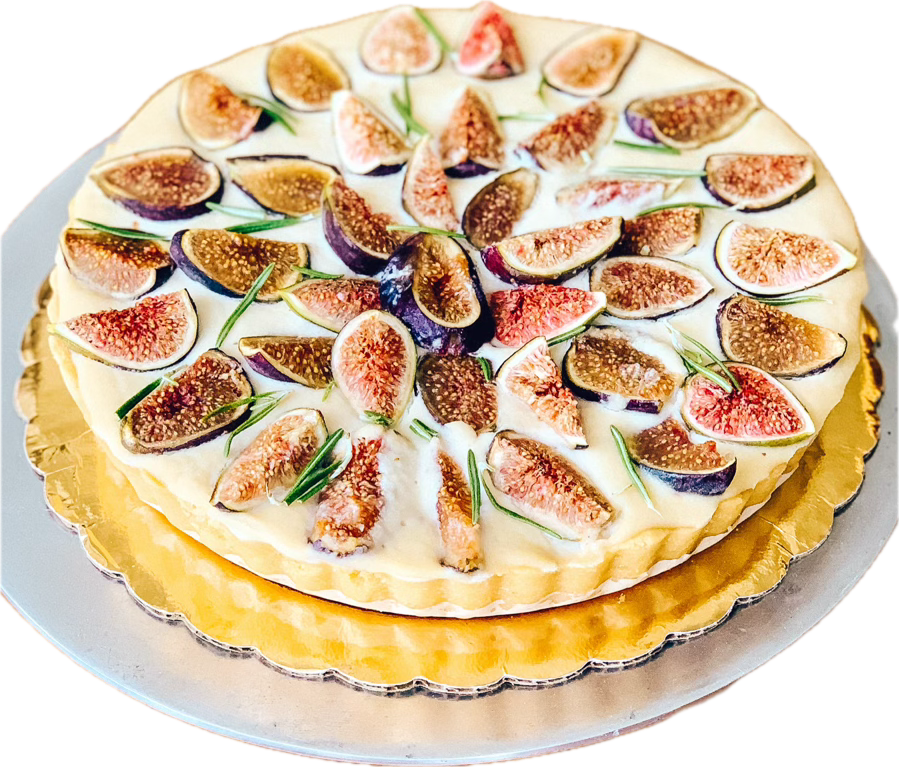
The Fig Tart is designed for the moment when you want to showcase the figs themselves — soft filling that doesn't compete, open-faced presentation, lighter eating that lets the fruit be the centerpiece
The Fig Cheesecake is designed for the moment when you want a dense, rich dessert experience — the filling is substantial and architectural, the figs become a beautiful topping rather than the structural centerpiece, and the spiced pistachios elevate it into Persian-Mediterranean territory worth saving for a dinner-party occasion.
Both rest on the same fruit — the same 11,000-year-old fig at its brief seasonal peak. The right choice is whichever fits the moment.
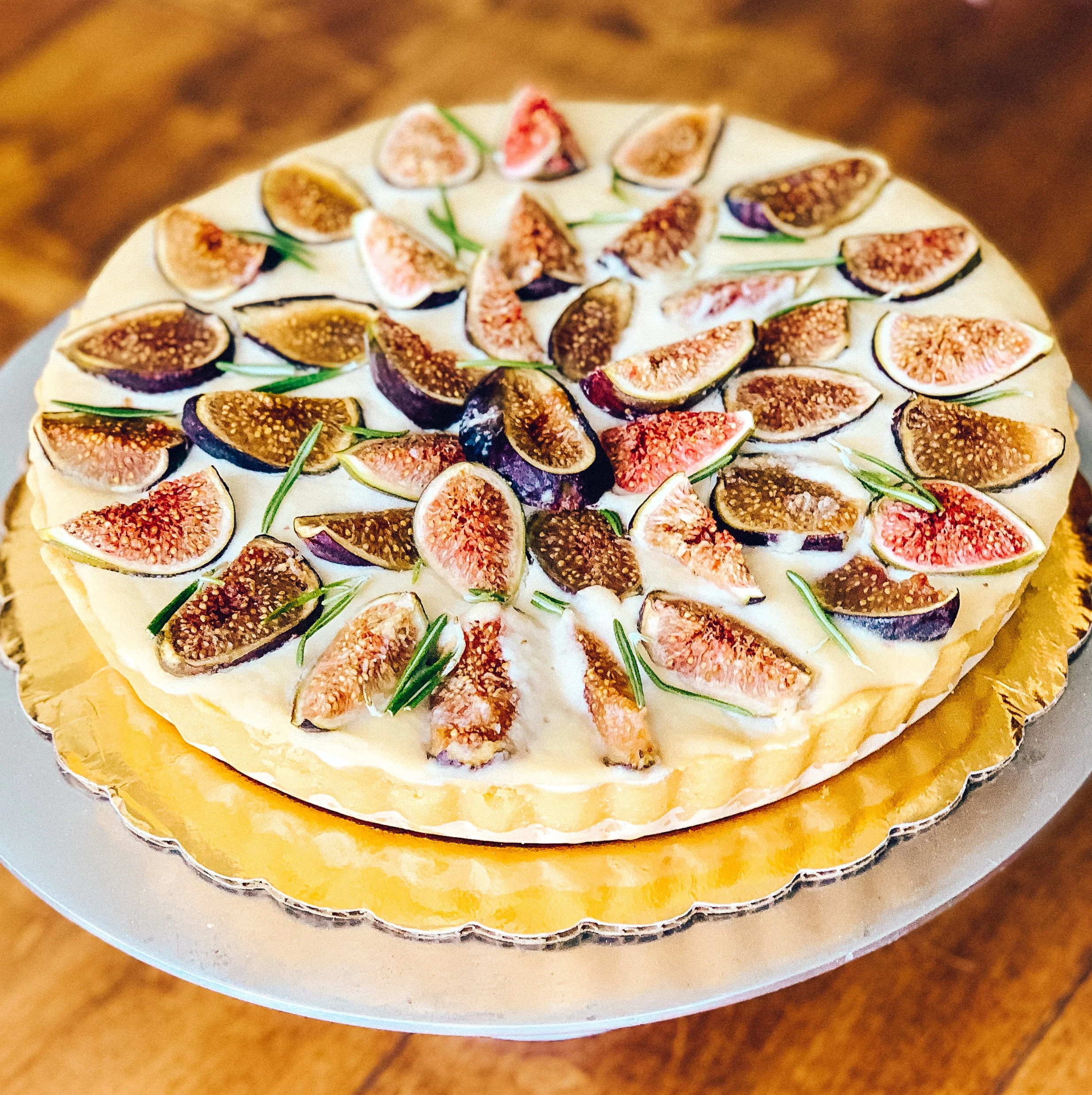
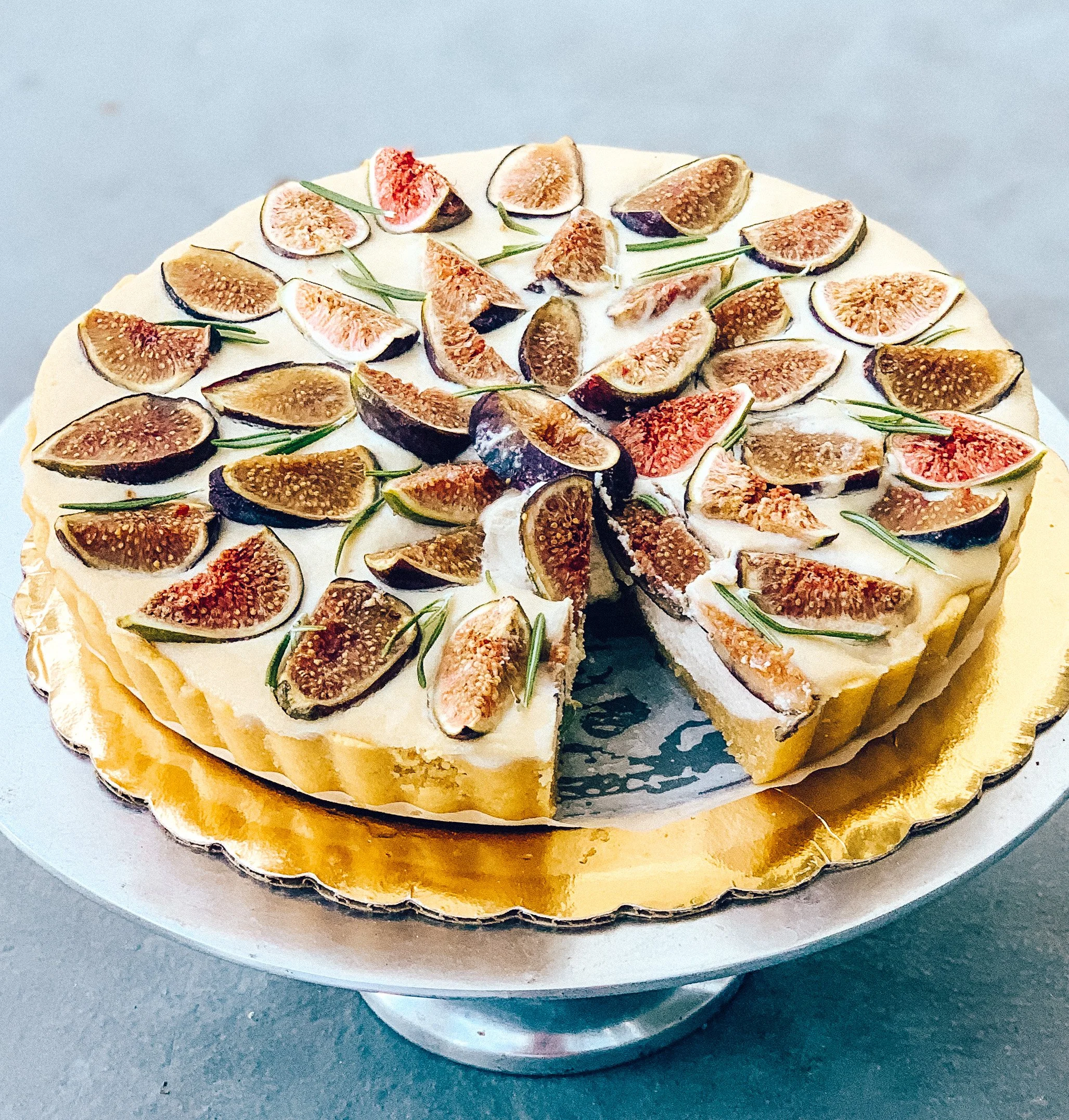
Fresh Fig Tart with Mascarpone, Honey, and Rosemary
An open-faced late-summer tart — almond crust, silky raw mascarpone-and-crème-fraîche filling, fresh figs, raw honey drizzle, fresh rosemary
Serves 8–10 (one 9-inch tart) · 25 min active · 1 hr 30 min total · late summer / early autumn (fresh fig peak) · afternoon to early evening
Ingredients
Almond crust
2 cups + ¼ cup blanched almond flour
½ tsp sea salt
2 tbsp coconut oil, melted (or grass-fed butter, melted)
1 tbsp pure maple syrup
1 large pasture-raised egg
Mascarpone filling (light and spoonable)
¾ cup raw grass-fed mascarpone, room temperature
¾ cup raw grass-fed crème fraîche, room temperature (or substitute additional mascarpone for a richer, less tangy version)
¼ cup raw honey (mild-flavored, like clover or orange blossom)
1 tbsp fresh lemon juice
zest of 1 lemon
1 tsp pure vanilla extract (or seeds of half a vanilla bean)
pinch sea salt
Fig topping and finishing
1 ½ to 2 pints fresh figs (Black Mission, Brown Turkey, Adriatic, Kadota, or a mix)
2–3 tbsp raw honey, for drizzling
1 small sprig fresh rosemary
Optional garnish
2 tbsp toasted hazelnuts or pistachios, lightly crushed
food-grade dried rose petals or lavender blossoms
food-grade fresh edible flowers (violets, pansies, calendula, nasturtium)
pinch flaky sea salt
Method
Make the almond crust. Preheat the oven to 350°F (175°C). Lightly grease a 9-inch tart pan with a removable bottom.
In a food processor, pulse the almond flour and salt to combine. Add the melted coconut oil (or butter), maple syrup, and egg.
Pulse until the mixture forms a cohesive dough that holds together when pinched but isn't wet.
Press evenly across the bottom and up the sides of the prepared pan, aiming for a ⅛-inch thickness. Smooth the top edge. Prick the bottom with a fork in several spots.
Bake 10–12 minutes, until lightly golden at the edges. Do not overbake — almond flour browns quickly.
Cool completely on a wire rack, at least 30 minutes. A warm crust will melt the filling — non-negotiable cooling step.
Make the mascarpone filling. In a medium bowl, gently whisk together the room-temperature mascarpone and crème fraîche until smooth.
Add the honey, lemon juice, lemon zest, vanilla, and salt. Whisk gently just until smooth and combined. Don't overmix — vigorous whisking can split mascarpone or cause it to weep.
Taste and adjust — add a small additional drizzle of honey if needed (mascarpone's natural sweetness varies by producer).
Assemble. Spoon the filling into the completely cooled crust. Smooth to the edges with an offset spatula. Place in the fridge to set.
Prep the figs. Rinse gently and pat dry. Remove the tough stem ends. Halve smaller figs; quarter larger ones. A mix of halves and quarters gives the best visual texture.
Arrange the figs across the surface, cut-side up to show the pink-and-magenta interiors. Concentric circles, a casual scatter, or a rustic pile — all work. The figs should slightly overlap in places.
Finish. Drizzle with raw honey. The honey will pool slightly in the cut surfaces and catch the light.
Tuck the rosemary sprig at the edge of the tart for scent and visual contrast.
Scatter optional crushed nuts, dried rose petals or lavender, and fresh edible flowers if using. Finish with a pinch of flaky sea salt.
Refrigerate a few hours before serving to firm the filling and let the flavors integrate. Serve cold or slightly cool — not warm.
Variation: Cashew mascarpone (dairy-free). For a plant-based version, replace the dairy mascarpone filling with: 2 ½ cups raw cashews (soaked 2–4 hours, drained), ½ cup full-fat coconut cream (the thick portion of a chilled can), ½ cup plus 2 tbsp pure maple syrup, 2 tbsp coconut oil (melted), 2 tbsp fresh lemon juice, 2 tsp pure vanilla extract, 1 tsp sea salt. Combine all in a high-speed blender (Vitamix or equivalent). Blend on high 2–3 minutes, scraping down repeatedly, until completely silky-smooth. Refrigerate the filling 30 minutes to firm, then spread into the cooled crust. Then place in the freezer to set for a few hours.
Storage: Best the day it's made. Refrigerator up to 3 days, though the figs begin to weep after 4–6 hours. The crust alone keeps at room temperature 2-3 days; the dairy mascarpone alone keeps refrigerated 5 days. Assemble the full tart up to 4 hours before serving for best texture. You can keep this in the freezer up to a month, but it is best to assemble the fresh figs and nut toppings the day of serving.
Nourishment Notes
Fresh figs are one of the oldest cultivated fruits in human history — archaeological evidence from the Jordan Valley dates fig cultivation to roughly 9,400 BCE, predating wheat and barley by several thousand years. The Romans and Greeks considered figs sacred; Hebrew scripture names them alongside grapes and olives as the three core fruits of the Mediterranean table. When you eat a fresh fig, you are eating something the human body has been adapted to for over 11,000 years. They carry exceptional fiber and mineral density (calcium, potassium, magnesium), polyphenol concentrations comparable to summer berries, and contain ficin — a proteolytic enzyme that gently supports digestion of the rich filling underneath. Black Mission figs are the deepest-colored and most widely available; Brown Turkey are sweeter and more delicate; Adriatic and Kadota are pale-green-skinned with strawberry-pink interiors.
The mascarpone-and-crème-fraîche filling is structurally the lighter of the two great Italian fresh-dairy dessert preparations. Mascarpone is one of the foundational fresh dairy preparations of northern Italian cookery, with documented use across Lombardy and Piedmont since at least the 16th century. Traditional mascarpone is roughly 75% butterfat — the richest fresh cheese available. Adding crème fraîche to half the mascarpone brings the bright tang and slight cultured complexity that pairs especially well with fresh figs. Crème fraîche carries live cultures (Lactococcus lactis and Lactobacillus) that support gut microbiome diversity in the same way traditional yogurts and kefir do. The result is a soft, spoonable filling — closer to a French crème pâtissière alternative than to a dense cheesecake — that lets the figs sit visibly on top as the architectural centerpiece.
Raw, unfiltered honey is meaningfully different from commercial honey — live enzymes (glucose oxidase, invertase), regional pollen signature, propolis traces, and a glycemic curve gentler than refined sugar when delivered in a fat-and-protein matrix. Drizzled at the end rather than baked into the filling, honey retains its enzymes and aromatic complexity entirely. Rosemary carries rosmarinic and carnosic acids — both studied for anti-inflammatory and neurologically protective effects — and its scent alone, released as the sprig sits on the tart, has been shown to improve memory and cognitive performance in controlled studies. Edible flowers (violets, calendula, nasturtium, pansy) carry small concentrations of specific flavonoids: calendula is anti-inflammatory; violets have been used in traditional European herbalism for soothing the respiratory system; nasturtium contains glucosinolate compounds similar to those in watercress and arugula.
As a seasonal food, this tart belongs to the brief window of late August through early October — the body adapted to encounter nutrient-dense seasonal foods like fresh figs in windows, not year-round, and eating them at peak is the right circadian choice. Late-summer eating is the slow transition out of peak warmth into harvest density: the body begins to ask for slightly richer foods, grounding fats, and the polyphenol-dense fruits of the late harvest. Figs are almost a perfect answer to that request, and grass-fed mascarpone (rich in fat-soluble vitamins and saturated fats) provides the structural fat that helps the figs' polyphenols become bioavailable. As a circadian food, this is an afternoon dessert — the natural sugars of figs and honey metabolize most gracefully during daylight, and dairy fat in the filling settles best when paired with active digestive fire. A late-afternoon tea with fresh mint or sparkling water lands cleanly. Edible flowers, when used, must be food-grade — never use florist or supermarket floral-section flowers, which are sprayed with pesticides not rated for food consumption.
Storage: Best the day it's made. Refrigerator up to 2 days.
Sourcing: Fresh figs from a local farmers' market or your own backyard tree at peak season — varietal options (Black Mission, Brown Turkey, Adriatic, Kadota) often available at smaller stone-fruit farm stands. Almond flour: ideally a small-batch organic mill (Honeyville Farms or Anthony's Organic are the best widely-available options, both stone-ground from California almond growers; King Arthur Baking organic almond flour also meets the standard). Raw grass-fed mascarpone and crème fraîche: a local raw-dairy producer or Amish creamery is the gold standard — Amish farms across Pennsylvania, Ohio, Indiana, and Wisconsin produce exceptional raw fresh dairy through cow-shares, roadside stands, and Amish-run grocery markets (look for the Weston A. Price Foundation's raw-milk finder at realmilk.com to locate one near you). For shipped options, Bellwether Farms (small-scale California sheep dairy) is the rare commercial-scale producer that meets the structural standard; Vermont Creamery's mascarpone and crème fraîche are widely available and acceptable as a fallback. Raw honey from a local apiarist within 30 miles of where you live (the closer the source, the more meaningful the regional pollen signature); for shipped options, Really Raw Honey or a single-source wildflower from your nearest small-batch apiary. Food-grade edible flowers from a local organic farmers' market vendor specifically labeled food-grade, or grown at home (violets and nasturtiums are easy windowsill crops); Marx Foods and Gourmet Sweet Botanicals ship nationally if local isn't available. Coconut oil and butter: small-batch from a quality producer like Nutiva (organic, virgin) or Kerrygold (Irish grass-fed butter — widely available, genuinely high-quality).
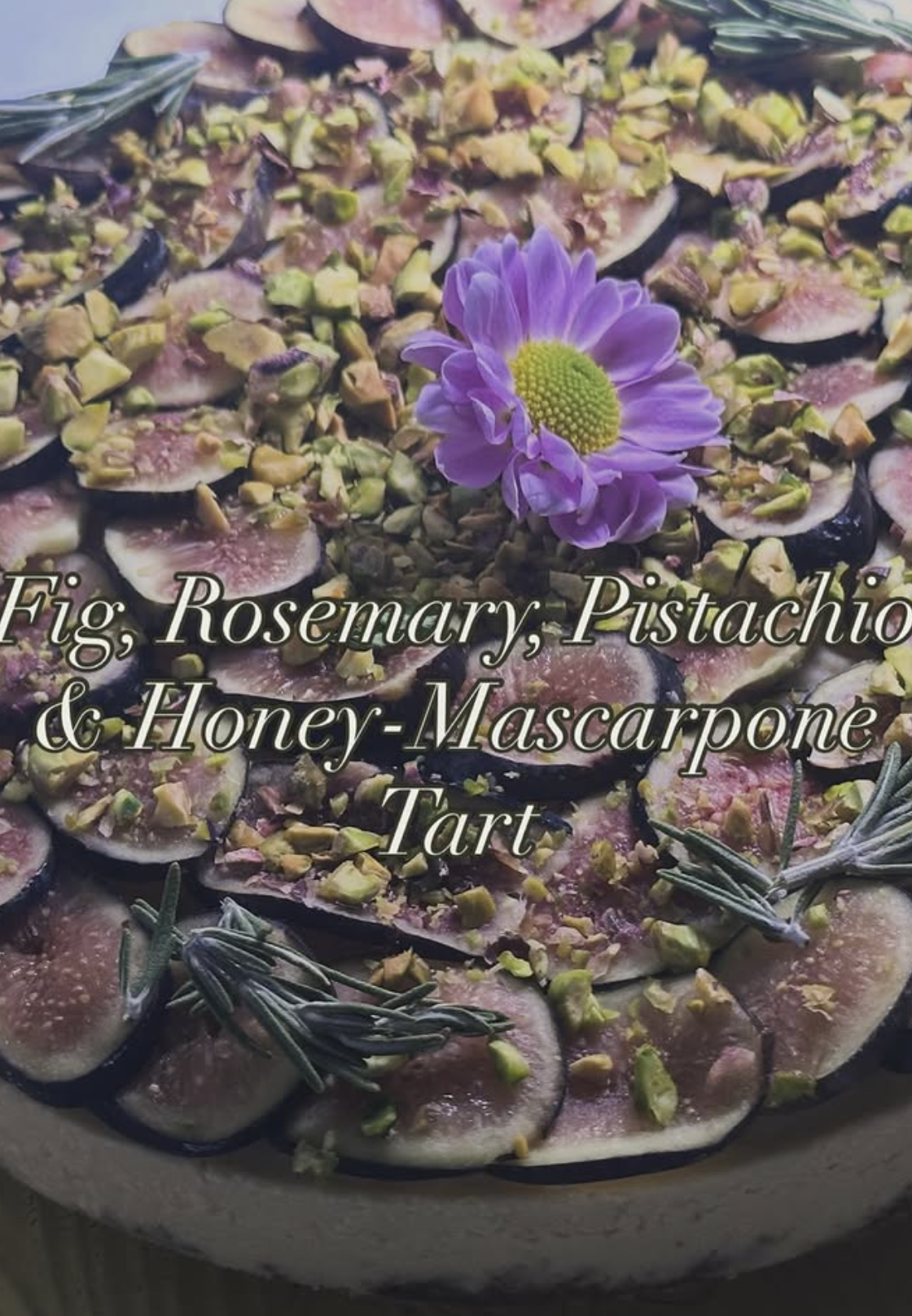
Fresh Fig Cheesecake with Honey and Spiced Pistachios
A no-bake fig cheesecake — date-bound almond-ghee crust, dense cream-cheese-mascarpone-cream filling, fresh figs, raw honey, pan-fried slivered pistachios with cinnamon and cardamom
Serves 10–12 (one 9-inch cheesecake) · 30 min active · 4–5 hr total (incl. freezer set) · late summer / early autumn (fresh fig peak) · early evening or after-dinner
Ingredients
Almond-date crust
2 ½ cups blanched almond flour
2 medjool dates, pitted (softened in hot water 5 minutes if firm)
1 tbsp grass-fed ghee (or melted grass-fed butter)
1 tbsp pure maple syrup
1 large pasture-raised egg
pinch sea salt
Cream cheese-mascarpone-cream filling (dense and sliceable)
2 cups raw or full-fat cultured cream cheese, room temperature
½ cup raw grass-fed mascarpone, room temperature
1 cup raw heavy cream
½ cup raw honey (mild-flavored)
2 tbsp fresh lemon juice
zest of 1 lemon
2 tsp pure vanilla extract
pinch sea salt
Fig topping
1 ½ to 2 pints fresh figs (Black Mission, Brown Turkey, Adriatic, Kadota, or a mix)
2–3 tbsp raw honey, for drizzling
1 small sprig fresh rosemary
Spiced pistachio garnish (the structural finishing element)
½ cup slivered raw pistachios
1 tbsp grass-fed ghee or coconut oil
½ tsp ground Ceylon cinnamon
¼ tsp ground green cardamom
pinch sea salt
1 tsp raw honey or pure maple syrup (optional, for slight glaze)
Optional finishing
pinch flaky sea salt
food-grade dried rose petals or lavender blossoms
food-grade fresh edible flowers (violets, calendula, nasturtium)
Optional pairing
pistachio ice cream (homemade or quality raw-dairy version)
Method
Make the almond-date crust. Preheat the oven to 340°F (170°C). Lightly grease a 9-inch springform pan or tart pan with a removable bottom.
In a food processor, combine the almond flour, softened dates, ghee, maple syrup, egg, and salt.
Pulse until the mixture forms a cohesive dough that holds together when pinched. The dates should be fully broken down and distributed throughout.
Press evenly across the bottom (and slightly up the sides if using a springform), aiming for a ⅛-inch thickness. Prick the bottom with a fork in several spots.
Bake 10–14 minutes, until lightly golden at the edges. The lower oven temperature is intentional — date sugars caramelize quickly and a higher temp will over-brown the crust.
Cool completely on a wire rack, at least 30 minutes. A warm crust will melt the filling — non-negotiable cooling step.
Make the filling. In a high-speed blender or food processor, combine the room-temperature cream cheese, mascarpone, heavy cream, honey, lemon juice, lemon zest, vanilla, and salt.
Blend on medium-high until completely silky-smooth — about 1–2 minutes. Scrape down the sides as needed. The filling should be glossy and uniform, with no visible cream cheese lumps.
Pour the filling into the completely cooled crust. Smooth the top with an offset spatula.
Set in the freezer at least 3 hours (or overnight). The filling firms beautifully during freezing while remaining sliceable when slightly thawed before serving.
Make the spiced pistachios. While the cheesecake sets, heat the ghee in a small skillet over medium-low heat.
Add the slivered pistachios and toss to coat in the ghee. Cook 3–4 minutes, stirring constantly, until the pistachios turn golden and become fragrant. Watch carefully — pistachios go from golden to burnt quickly.
Remove from heat. Sprinkle in the cinnamon, cardamom, and salt. Toss to coat evenly. Drizzle with optional honey or maple syrup if using and toss again.
Transfer to a plate to cool. The pistachios will crisp further as they cool.
Prep the figs (just before serving). Rinse gently and pat dry. Remove the tough stem ends. Halve smaller figs; quarter larger ones. A mix of halves and quarters gives the best visual texture.
Assemble and finish. Remove the cheesecake from the freezer 15 minutes before serving to soften slightly.
Arrange the fig pieces across the surface, cut-side up to show the pink-and-magenta interiors. Concentric circles, a casual scatter, or a rustic pile — all work. The figs should slightly overlap in places.
Drizzle generously with raw honey. The honey will pool slightly in the cut surfaces and catch the light.
Scatter the spiced pistachios evenly across the top.
Tuck the rosemary sprig at the edge for scent and visual contrast.
Optional finishing: scatter dried rose petals or lavender, fresh edible flowers, and a pinch of flaky sea salt.
Slice with a warm dry knife (run under hot water and dried between cuts). Serve cold or slightly cool — not warm.
Optional pairing: Serve each slice alongside a small scoop of pistachio ice cream.
Variation: Cashew-coconut filling (dairy-free). For a plant-based version, replace the dairy filling with: 2 ½ cups raw cashews (soaked 4+ hours, drained), 1 cup full-fat coconut cream (the thick portion of two chilled cans), ½ cup raw honey or pure maple syrup, ⅓ cup coconut oil (melted), 2 tbsp fresh lemon juice, zest of 1 lemon, 2 tsp vanilla extract, pinch sea salt. Combine all in a high-speed blender (Vitamix or equivalent — a standard blender will not achieve the right texture). Blend on high 2–3 minutes, scraping down repeatedly, until completely silky-smooth. Pour into the cooled crust and freezer-set as above.
Storage: Best within 24 hours of assembly. Refrigerator up to 2 days, though the figs begin to weep after 4–6 hours. The crust + filling alone (without garnish) can be frozen well-wrapped up to 1 month; thaw overnight in the refrigerator and garnish fresh just before serving.
Nourishment Notes
Fresh figs are one of the oldest cultivated fruits in human history — archaeological evidence from the Jordan Valley dates fig cultivation to roughly 9,400 BCE, predating wheat and barley by several thousand years. The Romans and Greeks considered figs sacred; Hebrew scripture names them alongside grapes and olives as the three core fruits of the Mediterranean table. They carry exceptional fiber and mineral density (calcium, potassium, magnesium), polyphenol concentrations comparable to summer berries, and contain ficin — a proteolytic enzyme that gently supports digestion of the rich filling underneath. The pairing of figs with rich foods is not coincidence; traditional kitchens understood this for thousands of years before the enzyme was named.
The cream-cheese-and-mascarpone-and-cream filling is structurally one of the richest preparations in the European fresh-dairy dessert tradition — combining three different fresh dairies, each contributing a distinct quality. Cream cheese provides the structural body and slight tang; mascarpone provides the silky butterfat (mascarpone is roughly 75% butterfat, the richest fresh cheese available); heavy cream thins the texture to a silky mouthfeel that distinguishes this filling from a denser baked cheesecake. The freezer-setting method — rather than baking — produces a smooth, sliceable texture closer to high-end ice cream cake than to a traditional New York cheesecake. Raw, grass-fed dairy is structurally and nutritionally distinct from commodity supermarket versions: live enzymes (lactase, lipase, phosphatase) remain intact, the fat-soluble vitamin profile (A, D, E, K2) is concentrated by grass-feeding, and the butyrate content supports gut barrier integrity.
The spiced pistachio garnish pulls this cheesecake firmly into Persian-Mediterranean flavor territory. Pistachios have been cultivated in Persia and Mesopotamia for at least 5,000 years, and the spice combination of cinnamon and cardamom is foundational across Persian, Mughal, and Ottoman dessert traditions — it appears in bastani (Persian saffron-pistachio ice cream), halwa, baklava, and many of the great Middle Eastern sweet preparations. Pan-frying the slivered pistachios in ghee with the spices is the structural step that distinguishes this from a generic chopped-pistachio garnish — the gentle frying releases the volatile oils in the spices and toasts the pistachios to a deeper, more complex flavor profile. Pistachios are nutritionally distinctive among tree nuts (substantial complete plant protein, vitamin B6, copper, manganese, and the carotenoid lutein, which is unusual in tree nuts).
Raw, unfiltered honey is meaningfully different from commercial honey — live enzymes (glucose oxidase, invertase), regional pollen signature, propolis traces, and a glycemic curve gentler than refined sugar when delivered in a fat-and-protein matrix. Drizzled at the end rather than baked into the filling, honey retains its enzymes and aromatic complexity entirely. Rosemary carries rosmarinic and carnosic acids — both studied for anti-inflammatory and neurologically protective effects — and its scent alone, released as the sprig sits on the cheesecake, has been shown to improve memory and cognitive performance in controlled studies.
As a seasonal food, this cheesecake belongs to the brief window of late August through early October — the body adapted to encounter nutrient-dense seasonal foods like fresh figs in windows, not year-round, and eating them at peak is the right circadian choice. As a circadian food, this is an early-evening or after-dinner dessert — substantially richer than the lighter fig tart, this cheesecake's dense dairy fat and concentrated sweetness call for a dinner-party occasion or celebration meal rather than an afternoon tea. The substantial fat content helps the figs' polyphenols become bioavailable, and the body settles such richness most gracefully when the meal preceding it has been substantial. The pairing with pistachio ice cream amplifies both the Persian-Mediterranean flavor signature and the structural fat content — meant for moments worth celebrating.
Storage: Best within 24 hours. Refrigerator up to 2 days. Crust + filling alone (without garnish) can be frozen 1 month; thaw overnight and garnish fresh.
Sourcing: Fresh figs from a local farmers' market or your own backyard tree at peak season. Almond flour: Honeyville Farms or Anthony's Organic, stone-ground from California almond growers. Raw cream cheese, raw mascarpone, and raw heavy cream: a local raw-dairy producer or Amish creamery is the gold standard — Amish farms across Pennsylvania, Ohio, Indiana, and Wisconsin produce exceptional raw fresh dairy through cow-shares, roadside stands, and small Amish-run grocery markets; the Weston A. Price Foundation's raw-milk finder (realmilk.com) helps locate one near you. The dairy is the architectural centerpiece of this filling, so quality matters most here. For shipped fallbacks: Bellwether Farms ships nationally with quality intact; Kalona Supernatural's organic non-homogenized cream is the best widely-available cream option; for cream cheese, Organic Valley Grassmilk is acceptable when local raw isn't available. Grass-fed ghee: Pure Indian Foods is the gold standard (genuinely traditional, single-source); Ancient Organics is an excellent California-based small-batch alternative. Slivered raw pistachios: Sicilian (Bronte DOP) or Iranian if you can find them at a specialty importer like Gustiamo or Sahadi's; otherwise California-grown unsalted from Santa Barbara Pistachio Company or Fiddyment Farms (both small California growers that ship direct). Raw honey from a local apiarist within 30 miles of where you live; for shipped options, Really Raw Honey or a single-source wildflower from a small-batch apiary. Food-grade edible flowers from a local organic farmers' market vendor specifically labeled food-grade, or grown at home; Marx Foods and Gourmet Sweet Botanicals ship nationally. Pistachio ice cream: a small-scale local creamery using raw or grass-fed milk is the right choice; if making at home, the structural fat in the cheesecake pairs especially well with a custard-based ice cream from raw cream and pistachio paste (look for Sicilian pistachio paste from Gustiamo for the best version).