Wild Sea Bass with Romesco & Green Herb Sauce
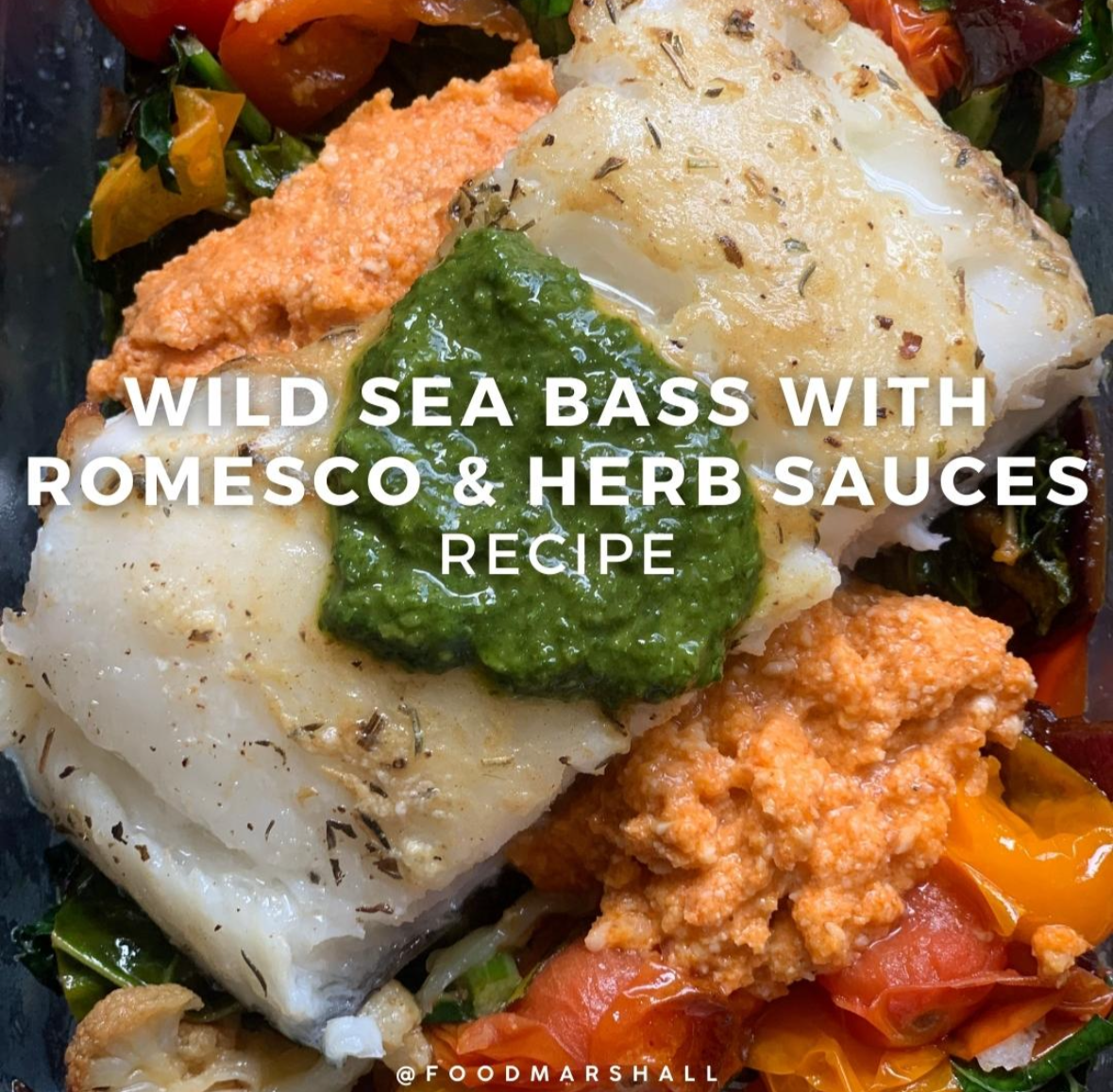
A weeknight Mediterranean dinner — wild fish brushed with herbed Dijon, served over a swoosh of romesco with a drizzle of fresh herb sauce.
Season: Late spring through early autumn
Cuisine: Spanish-Mediterranean · Farm-to-Table
Yield: Serves 4
Active: 30 min · Total: 1 hr 10 min
Best eaten: midday or early afternoon
This is the dish that makes a weeknight feel like a dinner out. Wild-caught sea bass — clean, mild, fast-cooking — brushed with a Dijon-herb glaze and oven-roasted in fifteen minutes flat, served over a swoosh of red romesco with a drizzle of bright green herb sauce. Three-component plating, restaurant-style, but the work is honest: roast a couple of red peppers, blend two sauces, brush a piece of fish, bake. Forty-five minutes start to finish, including the slow-roast on the peppers.
The dish sits inside the Seven Sauces logic I've written about — the romesco and green herb sauce here are made fresh for this dinner, but if you've already got jars of them in the fridge from a Sunday cook session, the active time on this plate drops to ten minutes. That's the value of building a sauce library: the dinners assemble themselves once the foundations are made.
Ingredients
Romesco Sauce
2 organic red bell peppers
2 tbsp red wine vinegar (or raw apple cider vinegar)
Juice of ½ organic lemon
⅓ cup cold-pressed extra virgin olive oil
¼ cup sprouted almonds, pine nuts, or cashews
½ tsp Pimentón de la Vera (Spanish smoked paprika DOP)
Sea salt and freshly ground black pepper, to taste
Green Herb Sauce
½ cup cold-pressed extra virgin olive oil
½ cup fresh parsley
¼ cup fresh cilantro
¼ cup fresh mint
1 clove garlic
Juice of 1 organic lemon
1 tbsp Dijon mustard
Sea salt and freshly ground black pepper, to taste
Sea Bass
4 wild-caught sea bass fillets (5–6 oz each)
2 tbsp extra virgin olive oil
1 tbsp Dijon mustard
Juice of ½ organic lemon
1 tsp fresh rosemary, minced
1 tsp fresh thyme, minced
1 tsp fresh sage, minced
Sea salt and freshly ground black pepper
Sub: wild salmon, halibut, or cod fillets work in place of sea bass. For a nut-free romesco, omit the nuts and add a small roasted tomato to maintain body. Bell peppers can be roasted ahead and stored in olive oil up to a week.
Method
Roast the peppers. Preheat the oven to 450°F. Place the bell peppers whole on a sheet pan and roast 20–25 minutes, turning once, until the skins are deeply charred. Transfer to a covered bowl and let steam 10 minutes. Peel the peppers and remove the seeds.
Romesco. Place the pepper flesh in a food processor with vinegar, lemon, olive oil, nuts, paprika, salt, and pepper. Blend until smooth. Taste, adjust salt and acid.
Green herb sauce. Blend all herb sauce ingredients in a food processor until emulsified but with some texture remaining. Taste, adjust.
Reduce the oven to 400°F.
Glaze the fish. Whisk together olive oil, Dijon, lemon juice, herbs, salt, and pepper. Brush generously over the sea bass fillets, covering them completely.
Bake the fish on a parchment-lined sheet pan 12–15 minutes, until just opaque and flaking gently when tested with a fork.
Plate. Spoon a generous swoosh of romesco across each plate. Place a fillet on top. Drizzle with green herb sauce. Serve with roasted cauliflower, asparagus, broccoli, baby potatoes, or sautéed peppers and onions.
Nourishment Notes
Wild-caught sea bass delivers long-chain omega-3 fatty acids — primarily EPA and DHA — in a form the human body uses directly without conversion, unlike the alpha-linolenic acid (ALA) found in plant sources. ALA must be converted to EPA and DHA by the body, and the conversion rate is notoriously inefficient — typically less than 5% in adults, lower in those with metabolic dysfunction. Eating preformed EPA and DHA from wild fish bypasses this bottleneck entirely. DHA is particularly significant: it concentrates in retinal photoreceptors, neuronal membranes, and mitochondrial membranes, where it functions both as a structural lipid and as a kind of biological antenna for light absorption. The DHA in the photoreceptors of the retina is what allows the visual cycle to detect and process incoming light — a remarkable example of how the body uses dietary fat as functional infrastructure for sensory processing. Wild fish are also among the richest food sources of vitamin D₃ in its bioavailable form, alongside selenium, iodine, and B12. Wild vs. farmed fish is not a marginal distinction: farmed fish are typically grain-fed (corn, soy, or fish-meal pellets), which produces meat with substantially altered fatty-acid ratios — much higher omega-6, lower omega-3, often containing antibiotic residues and synthetic dyes (pink salmon farmed). Look for "wild-caught" or "U.S. Atlantic" sea bass; avoid Chilean sea bass (an unrelated, deep-water species often harvested unsustainably).
The romesco sauce contributes lycopene from the roasted peppers — and critically, lycopene is one of the carotenoids whose bioavailability increases substantially with cooking and pairing with fat. Roasting breaks down the cell walls and converts lycopene from its trans form to the more bioavailable cis form; the olive oil ensures it's actually absorbed. Almonds bring vitamin E (specifically alpha-tocopherol), magnesium, and monounsaturated fats. Smoked paprika contributes capsaicinoids and a small carotenoid load of its own. The green herb sauce layers in chlorophyll-rich greens, the polyphenol load of mint and parsley, and the digestive support of Dijon and lemon. Cilantro is doing functional work — the leaf concentrates compounds that bind heavy metals (mercury, lead, aluminum) and aids their excretion, which is a particularly useful pairing with fish, since wild-fish consumption does carry some mercury exposure. Eating cilantro alongside fish is not a coincidence in Mediterranean and Asian culinary tradition; it is one of the oldest examples of food-as-medicine pairing.
The combination is genuinely a study in how to maximize the bioavailability and clean burn of marine omega-3s — pair them with antioxidant-rich vegetables that protect the fragile fatty acids from oxidation. Long-chain omega-3s like DHA are highly susceptible to oxidation (this is why fish oil supplements go rancid quickly), and the polyphenols in roasted peppers, fresh herbs, lemon juice, and olive oil form a protective antioxidant matrix that allows the omega-3s to be absorbed and incorporated into membranes without being damaged in transit.
As a circadian and seasonal food, this is midday or early-afternoon eating at its best. Peak solar exposure and the marine omega-3s combine to support mitochondrial efficiency and circadian alignment — DHA in particular is most actively incorporated into membranes during daylight hours. Late spring through early autumn is the right window — wild sea bass is at its peak, bell peppers and herbs are abundant, and the clean Mediterranean flavors suit the season's longer evenings. The dish makes a complete weekly-rotation centerpiece: served once a week through the warm months, paired with a different roasted vegetable each time, it ensures the table cycles through both quality marine protein and the polyphenol density of seasonal produce.
Storage: sauces keep refrigerated up to 3 days. Cooked fish is best eaten the day of, but leftovers fold beautifully into a salad the next day with the remaining romesco as dressing. Roasted peppers can be made up to a week ahead and stored in olive oil; this dramatically reduces the day-of work. The full plate scales linearly for retreats — for 8 guests, double everything. For 12+, work in sauce batches and roast fish on two sheet pans simultaneously.