Sea bass with tomato butter and cauliflower puree
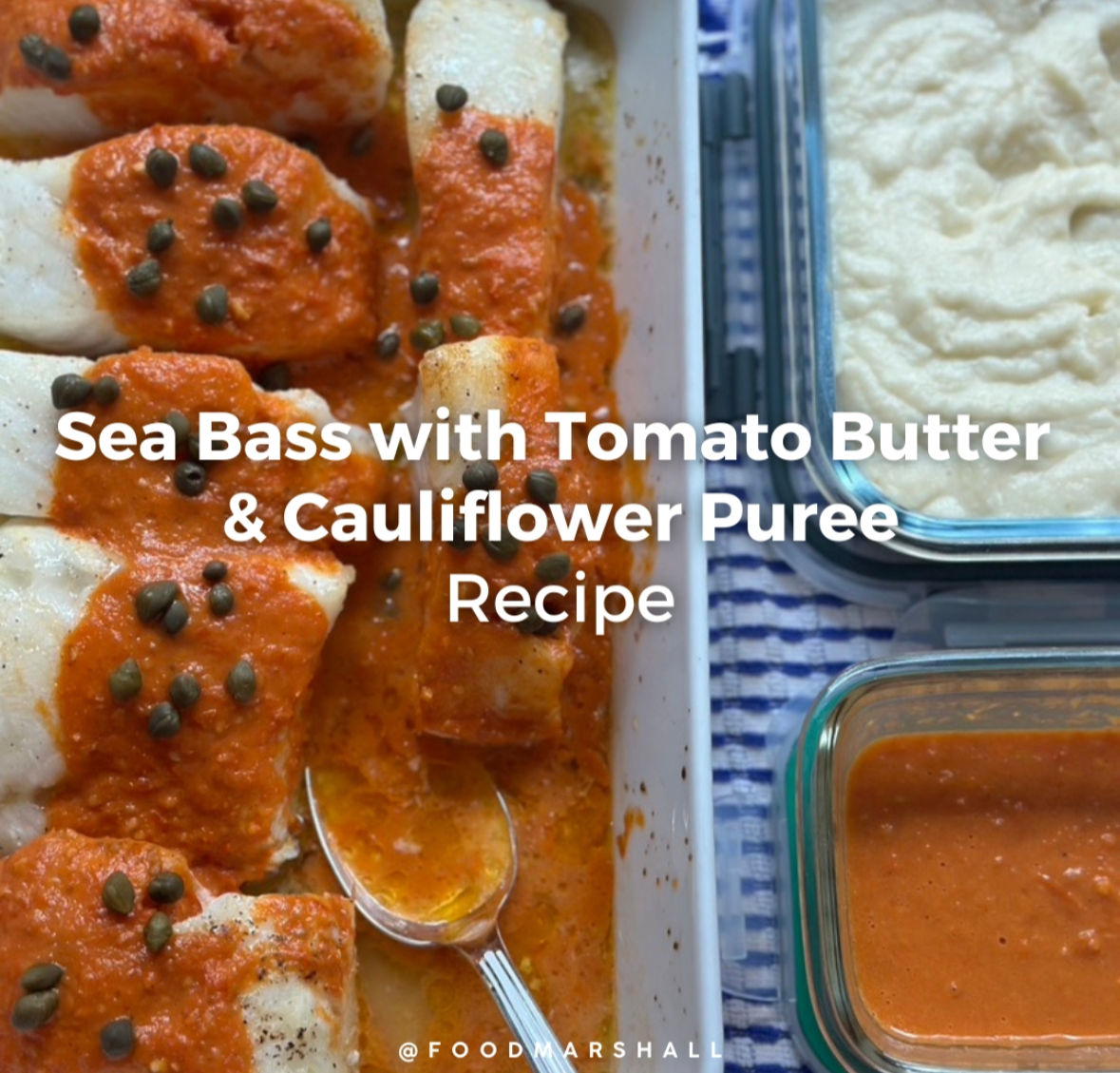
A composed Mediterranean plate — pan-seared sea bass, glossy roasted-tomato butter sauce, silky cauliflower purée, finished with briny capers
Serves 4 · 35 min active · 1 hr 15 min total · year-round (peak winter) · early evening
Ingredients
Cauliflower purée
1 large head cauliflower, trimmed and cut into florets (about 6 cups)
4 garlic cloves, peeled (or 1 whole head garlic, roasted — see method)
½ cup raw heavy cream (or full-fat coconut cream for dairy-free)
3 tbsp grass-fed butter (or extra virgin olive oil for dairy-free)
1 tbsp extra virgin olive oil
1 tsp sea salt
½ tsp freshly ground white pepper (or black)
pinch freshly grated nutmeg (optional)
Tomato butter sauce
2 cups cherry tomatoes, halved (or 4 medium ripe tomatoes, quartered)
4 garlic cloves, peeled and lightly smashed
3 tbsp extra virgin olive oil
1 tsp sea salt
½ tsp freshly ground black pepper
pinch crushed red pepper flakes (optional)
¼ tsp dried oregano (or 1 tsp fresh thyme leaves)
4 tbsp grass-fed butter, cold and cubed
1 tbsp fresh lemon juice
1 tbsp fresh basil leaves, torn
Sea bass
4 wild-caught sea bass fillets (6 oz each, skin on or off)
1 tsp Himalayan pink salt
½ tsp freshly ground black pepper
2 tbsp extra virgin olive oil
2 tbsp grass-fed butter
2 sprigs fresh thyme
Caper finish
3 tbsp salt-packed or brined capers, drained and rinsed
1 tbsp extra virgin olive oil (for crisping, optional)
Garnish
additional fresh basil leaves
pinch flaky sea salt
lemon wedges, for serving
Method
Make the cauliflower purée. Bring a large pot of salted water to a boil. Add the cauliflower florets and garlic cloves. Boil 12–15 minutes, until completely tender when pierced with a fork.
Optional: roasted garlic version. Instead of boiling raw garlic with the cauliflower, roast a whole head — slice off the top, drizzle with olive oil, wrap in parchment, roast at 375°F for 40 minutes until soft and caramelized. Squeeze the roasted cloves out of their skins and add to the blender with the cauliflower for a deeper, sweeter flavor.
Drain the cauliflower thoroughly. Press gently with a clean kitchen towel to remove excess water. Excess water produces a watery purée — this step is structurally important.
Transfer to a high-speed blender or food processor. Add the cream, butter, olive oil, salt, pepper, and nutmeg.
Blend on high until completely silky-smooth and glossy, scraping down the sides as needed (1–2 minutes). The texture should resemble a fine French purée de chou-fleur — silky and pourable, not chunky.
Taste and adjust seasoning. Keep warm in a covered saucepan over very low heat (or rewarm gently before serving).
Make the tomato butter sauce. Preheat the oven to 400°F (205°C).
On a parchment-lined baking sheet, combine the halved cherry tomatoes, smashed garlic cloves, olive oil, salt, pepper, red pepper flakes (if using), and oregano (or thyme). Toss to coat.
Roast 25–30 minutes, until the tomatoes have collapsed and caramelized at the edges and the garlic is soft.
Transfer the roasted tomatoes and garlic (with all the pan juices) to a blender or food processor. Blend until smooth.
With the motor running on low, add the cold cubed butter one piece at a time, allowing each piece to emulsify before adding the next. This is the structural step that produces the glossy, silky tomato butter sauce — adding all the butter at once produces a broken or oily sauce.
Add the lemon juice and torn basil. Pulse briefly to combine.
Taste and adjust seasoning. Keep warm in a small saucepan over very low heat.
Crisp the capers (optional but recommended). Heat 1 tbsp olive oil in a small skillet over medium heat. Add the drained capers and cook 2–3 minutes, stirring, until they bloom and crisp slightly. Transfer to a paper-towel-lined plate. This step intensifies their briny depth and gives them a slight crunch that contrasts with the soft fish.
Cook the sea bass. Pat the fillets very dry with paper towels (essential for proper searing). Season both sides generously with salt and pepper.
Heat the olive oil in a large heavy skillet (cast iron or stainless) over medium-high heat until shimmering but not smoking.
Add the sea bass fillets, skin-side down (or what was the skin side). Cook 4–5 minutes without moving — a deep golden crust should form.
Flip carefully with a thin spatula. Add the butter and thyme sprigs to the pan. As the butter melts and foams, tilt the pan and spoon the foaming butter over the fish, basting continuously.
Cook 2–3 minutes more, until the fish flakes easily with a fork (internal temperature 140°F). Remove from heat.
Plate. Spoon a generous portion of cauliflower purée onto each plate, smearing with the back of a spoon to create a wide base.
Place a sea bass fillet on the cauliflower or alongside it.
Spoon the tomato butter sauce generously over the fish.
Scatter the crispy capers across the fish and around the plate.
Finish. Garnish with fresh basil leaves and a pinch of flaky sea salt. Serve immediately with lemon wedges alongside.
Optional accompaniment: roasted vegetables. This plate also takes especially well to a side of roasted seasonal vegetables — winter root vegetables (carrots, parsnips, fennel) roasted at 425°F for 25 minutes; or summer vegetables (zucchini, eggplant, bell pepper) roasted at the same temperature for 20 minutes. A simple wilted greens preparation (lacinato kale or chard sautéed with garlic and olive oil) also pairs beautifully.
Variation: Dairy-free cauliflower purée. Replace the heavy cream and butter with: ¼ cup raw cashew cream (¾ cup cashews soaked 4 hours, blended with ¾ cup filtered water and strained) and 3 tbsp additional extra virgin olive oil. Blend with the boiled cauliflower as in the main method. The texture is structurally similar — slightly less rich but still silky.
Storage: Best eaten same day. Cauliflower purée alone keeps refrigerated 4 days; reheat gently with a small splash of cream to restore the silky texture. Tomato butter sauce keeps refrigerated 5 days. Cooked sea bass doesn't reheat well — eat the day it's cooked.
Nourishment Notes
Wild-caught sea bass — particularly the European varieties (Dicentrarchus labrax, the European sea bass found in the Mediterranean and Eastern Atlantic) and the American black sea bass (Centropristis striata, found along the US Atlantic coast) — is one of the cleaner small-to-medium fish available in modern kitchens. Avoid Chilean sea bass (which is actually Patagonian toothfish and has substantial sustainability concerns) and farmed Asian sea bass varieties. Wild Pacific or Atlantic options carry meaningful omega-3 fatty acids (EPA and DHA), substantial vitamin B12, selenium, and high-quality protein with relatively low mercury accumulation compared to larger predator fish like tuna or swordfish. The flesh is delicate, white, slightly sweet — taking especially well to butter-baste and gentle Mediterranean preparations rather than aggressive seasoning.
The pan-sear-then-butter-baste technique on the sea bass is borrowed directly from classical French cuisine bourgeoise — searing first for the golden crust, then finishing with butter, herbs, and continuous basting. Each spoonful of hot foaming butter that lands on the fish contributes flavor, moisture, and the slight nutty depth of beurre noisette. The same approach drives French poisson meunière, English fish and brown butter, and Italian pesce al burro. Sea bass's mild sweetness takes especially well to this technique because the butter doesn't compete with strong fish flavor.
The tomato butter sauce is structurally one of the great Mediterranean compound sauces — a roasted-tomato base mounted with cold butter (a technique called monter au beurre in French cookery) to produce a glossy, silky emulsion. The structural step is the cold butter cubed and added gradually with the blender running on low — this allows the milk solids and water in the butter to emulsify with the tomato pulp and oils into a stable sauce rather than a broken oily one. The same technique drives French beurre blanc (white wine butter sauce), Italian salsa di pomodoro al burro (a Marcella Hazan classic), and the great American chef-driven tomato butter preparations. Roasting the tomatoes first concentrates their sugars and develops Maillard browning compounds that raw or quickly-cooked tomatoes can't produce — the deep, almost caramelized flavor depth of this sauce is the result.
Cauliflower purée is one of the most undervalued vegetable preparations in modern American kitchens despite being a staple of French cuisine classique for over 200 years. Properly made cauliflower purée — boiled until completely tender, drained thoroughly, then blended with cream and butter into a silky pourable texture — reads on the palate as remarkably similar to mashed potatoes but with substantially more nutritional density and significantly less starch. Cauliflower contains substantial fiber, vitamin C, vitamin K, folate, and the glucosinolate compounds that the body converts to sulforaphane (the most studied compound in cruciferous vegetables for its protective effects). Cooking with butter or olive oil makes the fat-soluble compounds more bioavailable. The roasted-garlic option deepens the flavor substantially without altering the texture.
Capers — the unopened flower buds of the Mediterranean caper bush (Capparis spinosa) — are one of the foundational seasoning ingredients across Mediterranean cookery, appearing in Greek, Italian, French, Spanish, Levantine, and North African preparations. Salt-packed capers (rinsed before use) carry deeper, more complex flavor than brined ones; both work structurally for this plate. Crisping the capers briefly in olive oil is the small finishing step that elevates them from a standard garnish to a structural textural element — the slight crunch and concentrated saltiness contrasts with the soft fish, smooth cauliflower, and silky tomato butter for a more complex eating experience.
The composed-plate architecture of fish + sauce + purée + textural finish is structurally the foundation of modern Mediterranean restaurant cooking, particularly the Provençal and Italian Riviera traditions where each component occupies a distinct position on the palate. Each element here serves a specific function: the sea bass is the protein and structural centerpiece; the tomato butter is rich, glossy, and bright; the cauliflower purée is silky and grounding; the capers are briny and textural. Eating bites that combine multiple elements produces a more complex flavor experience than any single component alone — and the visual contrast (orange sauce, white purée, capers as dark dots) is what makes this plate genuinely elegant.
Storage: Best eaten same day. Cauliflower purée 4 days refrigerated; tomato butter sauce 5 days; sea bass should be eaten the day cooked.
Sourcing: Wild-caught sea bass from a local fishmonger or fish market is the gold standard — look for clear, bright eyes (if whole), firm flesh, and a clean ocean smell with no fishiness; ask specifically for wild-caught Atlantic black sea bass (US East Coast, in season May–November) or wild European sea bass (often labeled "branzino" or "loup de mer" — Mediterranean, in season year-round) and avoid Chilean sea bass (Patagonian toothfish) due to substantial sustainability concerns. For shipped options, Sea to Table (sustainable wild fish from US small-boat fisheries, ships flash-frozen) or Vital Choice (Alaska-based sustainable fisheries, wide selection) are the top-tier choices. Cauliflower from a local farmers' market or your CSA share at peak season — autumn-winter heirloom varieties (Cheddar orange, Graffiti purple, Romanesco) carry significantly more flavor than commodity supermarket cauliflower; backyard cauliflower is a rewarding cool-season crop. Cherry or heirloom tomatoes from a local farmers' market at peak summer; for off-season, Bionaturae or Mutti whole peeled tomatoes (Italian, jarred or in glass) work structurally as a substitute. Raw heavy cream from a local raw-dairy producer or Amish creamery — Amish farms across Pennsylvania, Ohio, Indiana, and Wisconsin produce exceptional raw fresh dairy through cow-shares, roadside stands, and Amish-run grocery markets; the Weston A. Price Foundation's raw-milk finder (realmilk.com) helps locate one near you. For shipped options, Kalona Supernatural's organic non-homogenized cream is the best widely-available cream option; Organic Valley Grassmilk is acceptable as a fallback. Grass-fed butter from a local Amish creamery is the gold standard; for shipped options, Kerrygold Reserve (Irish grass-fed, widely available) or Vermont Creamery cultured butter. Capers: salt-packed capers from Sicily or Pantelleria from a specialty importer like Gustiamo or Eataly; brined capers from Bionaturae or local Italian delis as the widely-available alternative. Extra virgin olive oil: small-producer single-estate harvest-dated bottle from a quality importer like Gustiamo, Eataly, or Olio2Go; never grocery-shelf brands. Garlic from a local farmers' market — heirloom hardneck varieties (Music, German Red, Spanish Roja) carry significantly more flavor than commodity supermarket garlic. Fresh basil from a windowsill pot grown at home or a farmers' market herb vendor.