Raw "Twix" Bars
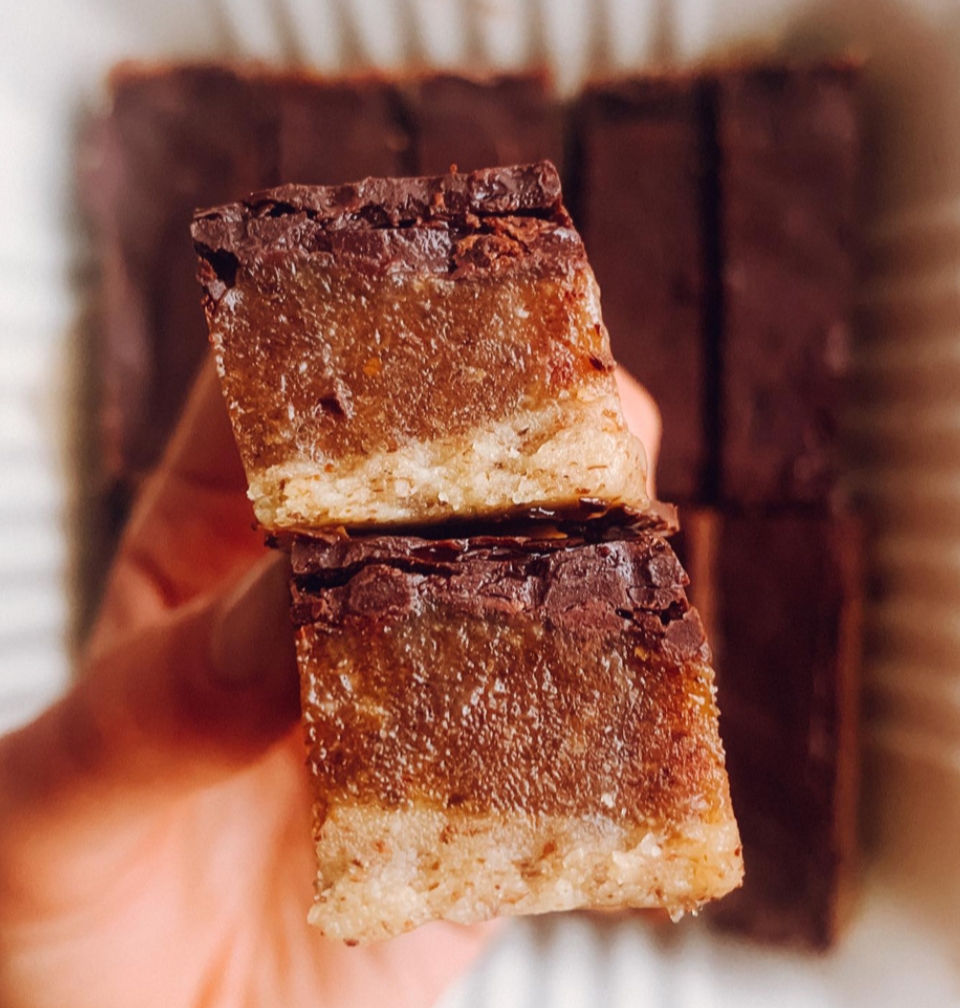
The British shortbread-caramel-chocolate bar, returned to its honest ingredients — almond shortbread, date-almond caramel, raw cacao chocolate.
Season: Year-round (especially winter)
Cuisine: Reimagined Classics · Raw
Yield: One 8×8 pan, about 16 bars
Active: 30 min · Total: 2 hr+ (incl. setting time)
Best eaten: afternoon
Ingredients
Shortbread Biscuit Layer
¾ cup blanched almond flour
½ cup coconut flour
¼ tsp baking soda
¼ tsp sea salt
¼ cup coconut oil, melted
3 tbsp raw honey, warmed (or pure maple syrup)
¼ tsp vanilla bean powder
Date-Almond Caramel
12 medjool dates, pitted (soaked in hot water 10 min if firm)
½ cup almond butter (single-ingredient: just almonds, maybe salt)
¼ cup coconut oil
2 tbsp coconut cream
1 tbsp pure maple syrup
1 tsp vanilla extract
1 tbsp mesquite powder (optional but recommended — deepens the caramel notes substantially)
pinch sea salt
Raw Chocolate Coating
½ cup raw cacao butter, melted
½ cup coconut oil, melted
1 cup raw cacao powder
½ cup pure maple syrup
1 tsp vanilla bean powder
¼ tsp flaky sea salt (for finishing)
Sub: replace the raw cacao coating with one 2.5 oz quality dark chocolate bar (75%+) melted with 1 tbsp coconut oil — faster, glossier finish, and lower set-temperature. Pascha, Eating Evolved, Raaka, or Hu Kitchen.
Variation — nut-and-seed shortbread base (richer, more substantial):Replace the almond flour and coconut flour shortbread with: 1 cup raw cashews, 1 cup raw almonds, ½ cup unsweetened coconut shreds (or additional cashews/almonds), pinch sea salt, ¼ tsp vanilla bean powder, ¼ cup pure maple syrup. Pulse all in a food processor until the mixture forms a cohesive dough that holds together when pressed. Press into the parchment-lined pan; this version doesn't require baking — just freeze 30 minutes while you make the caramel.
Method
Preheat the oven to 350°F. Line an 8×8 baking dish with parchment paper, leaving overhang on two sides.
Shortbread. In a medium bowl, combine almond flour, coconut flour, baking soda, and salt. Add melted coconut oil and warmed honey; stir thoroughly until no dry flour remains and a soft dough forms. If the mix sticks to the spatula, dip the spatula in melted coconut oil between presses. Press evenly and firmly into the prepared pan. Bake 10–12 minutes until starting to turn golden brown. Cool completely before adding the caramel — about 30 minutes.
Caramel. In a food processor, combine soaked drained dates, almond butter, coconut oil, coconut cream, maple syrup, vanilla, optional mesquite, and salt. Process 2–3 minutes, scraping down, until completely smooth and glossy — the caramel should be thick, rich, deeply sweet, with the almond butter's savoriness coming through.
Layer the caramel. Spread the caramel evenly over the cooled shortbread base with an offset spatula, into the corners. Freeze 1–2 hours until completely firm — do not skip this; warm caramel will not hold the chocolate coating.
Lift, then slice. Use the parchment overhang to lift the firm shortbread-caramel block onto a cutting board. Cut into 16 bars (4×4 grid) with a sharp knife. Place the bars on a parchment-lined sheet pan with space between each.
Raw chocolate coating. In a double boiler over low heat (staying below 110°F to preserve the raw integrity), melt the cacao butter and coconut oil together. Whisk in the cacao powder, maple syrup, vanilla bean powder, and a pinch of salt until completely smooth and glossy. Cool slightly to thicken — about 5 minutes — so it coats rather than runs off.
Coat. One bar at a time, dip each bar into the chocolate (use two forks to lift and turn) or spoon chocolate over the top of each bar to fully coat. Sprinkle each with a pinch of flaky sea salt while the chocolate is still wet.
Set. Refrigerate 10–15 minutes until the chocolate hardens. If you over-freeze the chocolate it may crack when you cut into it — refrigerator-set is the right firmness.
Nourishment Notes
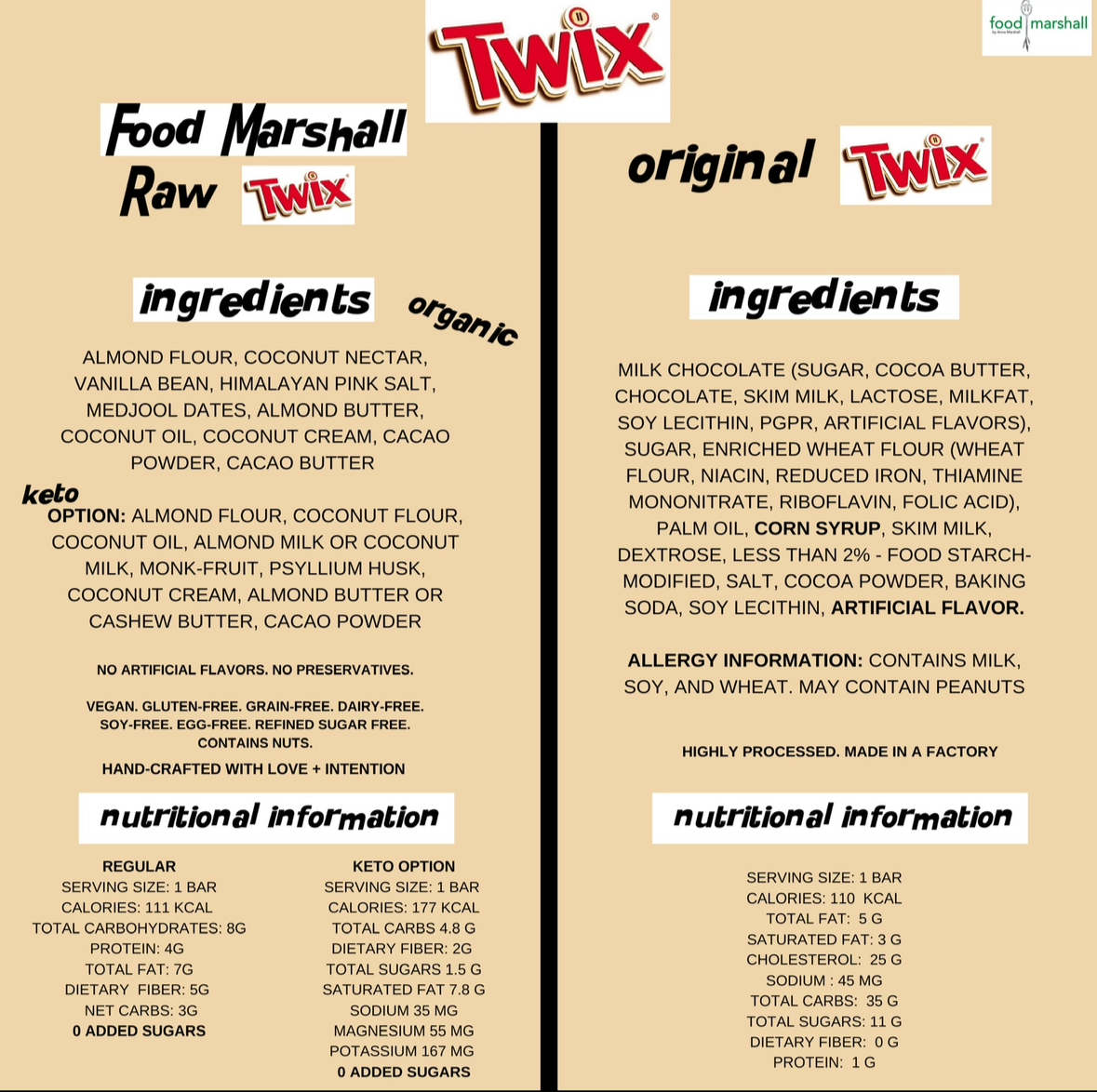
A traditional Twix bar is built on enriched wheat flour, palm oil, refined sugar, corn syrup, hydrogenated palm kernel oil, milk powder, soy lecithin, artificial flavor, and TBHQ (a synthetic antioxidant). It is a confection with no nutritional weight and a glycemic load designed for repeat consumption. This version is a different food entirely. The shortbread base is built on almond flour and coconut flour — almond flour bringing vitamin E (full tocopherol complex), magnesium, and monounsaturated fats, coconut flour adding remarkably high fiber bulk (about 40% by weight) that produces a far gentler glycemic curve than wheat-based shortbread. Raw honey carries live enzymes, propolis (antimicrobial bee resin), and a gentler glycemic impact than refined sugar — particularly when delivered within a fat-and-protein matrix as it is here. The date-almond caramel is the structural transformation that makes this bar work. Dates deliver fructose and glucose within a fiber matrix (particularly soluble pectin) that slows absorption significantly, alongside potassium, magnesium, copper, B vitamins, and polyphenols. Almond butter contributes monounsaturated fats and additional vitamin E, magnesium, and protein. The mesquite powder optional addition is genuinely beautiful — mesquite is the ground pod of a native desert tree used by the Sonoran Desert peoples (particularly the Tohono O'odham) as a staple food for centuries, carrying a natural caramel-malty flavor and supporting blood sugar moderation.
Raw cacao butter and raw cacao powder together produce a chocolate coating that is genuinely plant medicine. Cacao butter is the cocoa bean's natural fat, with a melting point just below body temperature (which is why raw chocolate melts the instant it touches your tongue) — pale yellow, carrying stearic and palmitic acid alongside the bean's polyphenols, retaining its full aromatic profile when kept under 110°F. Raw cacao powder is among the most polyphenol-dense plant foods on earth — flavanols, theobromine (a slow, sustained cardiovascular opening that feels different from caffeine's sharper edge), magnesium, iron, and the specific flavonoid complexity that modern processed chocolate has lost. The coconut oil throughout — in the shortbread, the caramel, and the chocolate coating — delivers medium-chain triglycerides and lauric acid for cellular energy and satiety.
As a circadian and seasonal food, this bar is afternoon dessert at its best — the substantial fat and fiber matrix surrounding the dates and maple produces a gentle glycemic curve, but the bar still carries meaningful sweetness and is best metabolized in daylight hours. The chocolate-caramel-shortbread profile is distinctly cold-weather food by tradition, making this bar particularly satisfying in autumn and winter. A single bar is genuinely satisfying — the polyphenol density and the substantial fat content means the body registers the bar as food rather than as a sugar trigger. Useful for travel, lunchboxes, retreat-week pantry, and end-of-dinner offerings with strong tea or espresso.
Storage: refrigerator 2 weeks, freezer 3 months. Bring to refrigerator temperature before serving — frozen bars are too hard to bite cleanly.
Sourcing: Blanched almond flour and coconut flour: ideally from a small-batch organic mill — Honeyville Farms or Anthony's Organic are the best widely-available options, both stone-ground from California growers. Raw cashews and raw almonds (for the variation): One Degree Organic Foods or Big Tree Farms; avoid bulk-bin supermarket cashews which are often steamed rather than truly raw. Medjool dates: California-grown from a small-batch grower like Bautista Family Organic Date Ranch or Joolies (small Coachella Valley producer); avoid commercial bulk dates which are often pasteurized. Single-ingredient almond butter: small-batch from Big Spoon Roasters (North Carolina), Once Again Nut Butter, or freshly ground at a local co-op grocery; avoid commercial almond butters with added oils or sugars. Coconut oil: Nutiva (organic, virgin, single-source) is the widely-available standard. Coconut cream: Native Forest Organic Simple (guar-gum-free) or Aroy-D pure coconut milk in cartons (Thai, single-ingredient). Raw cacao butter and raw cacao powder: Sunfood, Navitas Organics, or Big Tree Farms — all ethically sourced, raw-processed (kept under 115°F to preserve enzymes and polyphenols), and traceable to specific cacao-growing cooperatives. Pure maple syrup from a local sugarbush or small Vermont/Quebec producer — Crown Maple, Runamok, or any small-scale producer at the farmers' market; avoid commercial maple "table syrup." Raw honey from a local apiarist within 30 miles of where you live — the closer the source, the more meaningful the regional pollen signature; for shipped options, Really Raw Honey or a single-source wildflower from a small-batch apiary. Mesquite powder: Casa de Mesquite (Sonoran Desert small-batch) or Z Natural Foods. Vanilla bean powder: Singing Dog Vanilla (organic, single-origin Madagascar or PNG) is the gold standard for genuinely high-quality vanilla. Flaky sea salt: Maldon (English flake salt, widely available and genuinely high-quality) or a small-batch hand-harvested option like Jacobsen Salt Co. (Oregon) or Amagansett Sea Salt (New York). For the dark chocolate sub: Pascha (organic, allergen-free, single-source Peruvian cacao), Eating Evolved (real ingredients, low-sugar), Raaka (small-batch Brooklyn, unroasted cacao) — these are the genuinely high-quality dark chocolate brands worth using.