Homemade Raw Mozzarella with Garden Caprese (and a Bonus Ricotta from the Whey)
A traditional Italian cheesemaking technique using raw cow's milk, vinegar, and rennet to produce fresh mozzarella in about an hour — followed by a small bonus ricotta from the leftover whey, then served as the simplest, most honest summer Caprese with garden tomatoes and fresh basil.
Yield: 2–3 mozzarella balls (4–6 oz each) + ½–1 cup bonus ricotta · Active: 60 min · Total: 90 min · Year-round (ideal in late summer when garden tomatoes peak) · Cuisine: Traditional Italian, southern peasant dairying
A note from the kitchen
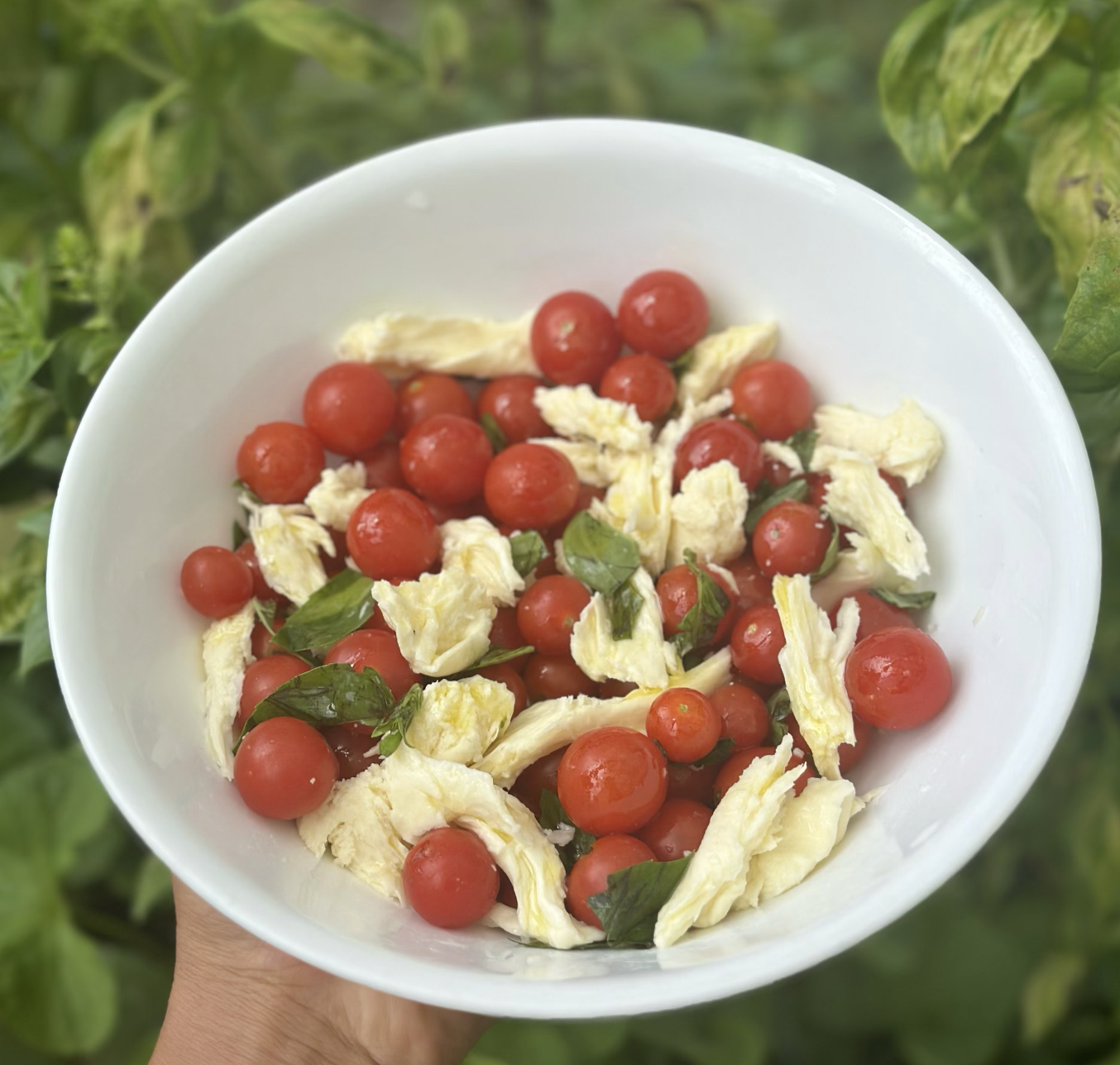
Quick note before the recipe: the mozzarella shown here was made from a Jersey cow I milked directly — straight from the source. There's no substitute for that quality of milk. The beautiful thing about this technique is that two gallons of raw milk give you fresh, cohesive, stretchy mozzarella in about an hour, plus a small bonus ricotta from the leftover whey — and both are at their peak within 24 hours.
A note on the ricotta yield, which I want to be honest about: the ricotta from mozzarella whey is genuinely a bonus, not a full second cheese. Because the mozzarella process uses vinegar (acid) plus rennet to coagulate the milk, much of the whey protein gets pulled into the mozzarella curd itself, leaving the leftover whey relatively protein-depleted. Expect about ½–1 cup of ricotta from the whey of 2 gallons of milk — a beautiful little gift, but not the same yield you'd get from making ricotta as a primary project, or from the whey of a rennet-only hard cheese (like cheddar or parmesan).
For a more substantial ricotta project — where ricotta is the goal, not the bonus — see the dedicated ricotta tutorial in the Spaghetti Squash Collection. For now, this is the elegant, ancestral two-for-one technique that southern Italian dairying traditions have practiced for centuries: a primary cheese plus whatever bonus the whey will give.
There's something deeply satisfying about a meal that is fully farm-to-table — milk from the cow, tomatoes and basil from the garden, nothing outsourced (except the sea salt and olive oil).
— Anna aka Food Marshall
Part One — Quick Mozzarella
Yield: 2–3 mozzarella balls, about 4–6 oz each · Active: 45 min
Ingredients
2 gallons fresh raw cow's milk (whole, not skimmed; from a local farm or Amish dairy — see sourcing notes) 1 cup raw apple cider vinegar OR distilled white vinegar (5% acidity — see notes) 2 cups filtered water (for diluting the vinegar) ¼ tsp liquid rennet (vegetable rennet works; animal rennet produces a slightly more traditional flavor) ¼ cup cool filtered water (for diluting the rennet) 1–2 tsp non-iodized cheese salt or fine sea salt
A note on the acid choice
I use vinegar in this recipe because it's accessible and what most home cooks have on hand. A few important things to know:
The acidity matters. Most grocery-store vinegars (white distilled, raw apple cider, brands like Bragg's) are 5% acetic acid — and that's what this recipe assumes. Some "cleaning vinegars" are 6% or higher and shouldn't be used for cheesemaking — they'll over-acidify the milk and produce tough, crumbly curds that won't stretch properly. Check the label.
Citric acid powder may be more reliable. Many serious home cheesemakers use citric acid (1½ tsp per gallon, dissolved in cold water) instead of vinegar — citric acid hits the target pH more predictably, batch to batch, and produces a cleaner flavor without any vinegar tang. I haven't fully tested citric acid in my own kitchen yet, but based on the cheesemaking literature, it's worth experimenting with if you're making mozzarella regularly. New England Cheesemaking Supply Company's classic 30-minute mozzarella recipe uses citric acid as the default for this reason.
For now, vinegar at 5% acidity is what this recipe is built around — and it works beautifully when the milk is good and fresh.
Equipment
Large heavy-bottomed stainless steel pot (8-quart minimum) Accurate thermometer (instant-read or candy thermometer) Slotted spoon or skimmer Large bowl for hot water (170–180°F) Cheesecloth or butter muslin Colander Heat-safe rubber gloves (optional but useful for stretching)
Method
Prep the milk. Pour the raw milk into the heavy-bottomed pot. Place over medium-low heat. Heat slowly, stirring gently with a wooden or plastic spoon, until the milk reaches 90°F. Slow heating is structurally important — fast heating scorches the bottom and changes the protein structure.
Add the vinegar mixture. Combine the 1 cup of vinegar with 2 cups of filtered water. Pour the diluted vinegar slowly into the warmed milk while stirring gently. The milk will begin to look slightly curdled. (If your milk is looking very acidic but the curds aren't forming, this can mean your vinegar is weaker than 5% — add 1–2 more tbsp of vinegar before moving on.)
Add the rennet. Dilute the rennet in ¼ cup of cool filtered water. Pour the diluted rennet over the surface of the milk and stir very gently for 30 seconds. Don't over-stir — vigorous stirring breaks the curds prematurely.
Rest. Remove the pot from heat, cover, and let sit undisturbed 5–10 minutes. The curds will form and separate from the green-yellow whey.
Test the curds. They should look like soft custard and pull cleanly away from the pot edges when tilted. If still milky, let sit another 5 minutes.
Cut the curds. With a long knife, cut the curds into 1-inch cubes — make horizontal cuts in one direction, then perpendicular, then carefully sweep the knife at an angle to cut the bottom layer.
Heat slowly. Return the pot to low heat. Slowly warm the curds-and-whey mixture to 105°F, stirring gently every minute or two. This takes about 10 minutes. The slow heating is what firms up the curds.
Drain the curds. Line a colander with cheesecloth. Pour the curds into the colander, reserving the whey in a separate large pot or bowl (essential for making the bonus ricotta in Part Two — use it within 2–3 hours).
Heat water for stretching. Heat 4 cups of water to 170–180°F in a large bowl.
Stretch the mozzarella. Take a portion of the drained curds and lower them into the hot water using a slotted spoon. Let sit 30 seconds, then with a spoon (or gloved hands), begin to stretch and fold the curds in the hot water.
The curds will go from a crumbly cheese-like texture to a smooth, stretchy, taffy-like consistency. This is the structural moment that defines proper mozzarella — the heat triggers the protein rearrangement that gives the cheese its characteristic stretch.
If the cheese isn't stretching properly: this can mean the milk wasn't acidic enough. Add a tablespoon of vinegar to the hot stretching water and try again — sometimes a little more acid in the stretch step is what unlocks the stretch.
Sprinkle with cheese salt as you stretch.
Form the cheese. When the cheese is smooth and stretchy, shape into balls (about 4–6 oz each) by tucking the edges underneath. Place finished balls in a bowl of cool water (or whey for richer flavor) to set their shape.
Repeat with remaining curds, working in small batches.
Cool. Once all the cheese is shaped, transfer the balls to a brine of cool water plus 1 tsp salt (or whey plus salt) and refrigerate 30 minutes before serving.
Storage: Refrigerator in the brine 1 week. Mozzarella is at peak flavor and texture within the first 24 hours after making.
Part Two — Bonus Ricotta from the Mozzarella Whey
Yield: ½–1 cup ricotta from the whey of 2 gallons of milk · Active: 30 min
A note on yield expectations
The ricotta from mozzarella whey is genuinely a bonus, not a full second cheese. Here's why:
When you make rennet-only hard cheeses (cheddar, gouda, parmesan), the milk is coagulated primarily through enzymatic action without dropping the pH significantly. The whey leaves the curd with most of the albumin and globulin proteins still suspended — about 0.6–0.8% protein content. From a gallon of that whey, you can typically get 1–2 cups of ricotta. This is why traditional Italian dairying speaks of ricotta as a "true second cheese."
But mozzarella is different. The vinegar-plus-rennet process acidifies the milk to roughly pH 5.2 — and at that lower pH, more of the whey proteins precipitate into the mozzarella curd itself, rather than staying in the whey. The leftover whey is structurally protein-depleted (typically less than 0.4% protein). Plus the whey is already acidic, which complicates the second precipitation step.
The result: from the whey of 2 gallons of milk, expect roughly ½–1 cup of bonus ricotta — beautiful, delicate, perfect for spreading on bread or topping the Caprese, but not enough for a lasagna's worth of stuffing.
For larger ricotta yields, see the dedicated ricotta tutorial in the Spaghetti Squash Collection — that recipe makes ricotta as a primary project (3–4 cups from a gallon of fresh whole milk) rather than as a bonus from another cheese's whey.
Use the whey within 2–3 hours of making the mozzarella. Older whey becomes too acidic and produces poor curds.
Ingredients
All the leftover whey from the mozzarella (about 1½ gallons) 1 cup raw whole milk (optional, but strongly recommended — increases yield meaningfully) 2–3 tbsp white vinegar or fresh lemon juice (only if curds don't form naturally) ¼ tsp fine sea salt, to taste
Method
Heat the whey. Pour the reserved whey into a large stainless steel pot. Add 1 cup of fresh raw milk if using (it boosts the yield meaningfully — about 50% more cheese for the same effort, since fresh milk adds back the casein protein that was already removed by the mozzarella process).
Heat slowly over medium heat, stirring minimally to avoid breaking curds, until the temperature reaches 195–200°F. Use a double boiler if you have one — it prevents scorching at the bottom.
Do not let it boil. Boiling produces grainy ricotta with a flat flavor.
Watch for curds. At 195–200°F, tiny white curds should naturally form and rise to the surface as the heat coagulates the remaining whey proteins.
If curds don't form naturally: stir in 1–2 tbsp vinegar or lemon juice gently. Curds should appear within 30 seconds.
Rest. Remove the pot from heat and let sit undisturbed 10–15 minutes for the curds to consolidate.
Drain. Line a colander with butter muslin or fine cheesecloth. Gently ladle (don't pour — pouring agitates the curds) the curds into the lined colander, allowing the whey to drain into a bowl beneath.
Drain to texture. Drain at room temperature 1–6 hours depending on desired texture: 1 hour for soft, spreadable ricotta; 3–4 hours for medium-firm; 6+ hours for firm, sliceable ricotta.
Salt. Transfer the drained ricotta to a bowl. Stir in salt to taste.
Optional: stir in raw cream. For an extra-luxurious finish, stir in 1–2 tbsp raw cream — it makes the ricotta smoother, creamier, and heartier. Divine.
Store. Refrigerate in an airtight container. Use within 7–10 days, or freeze up to 2 months (texture becomes slightly grainier when thawed).
Storage: Refrigerator 7–10 days. Freezer up to 2 months.
Final whey use: The twice-strained whey (after both cheeses) is still nutritionally useful: use in baking (substitute for water), smoothies, soup stocks, or as garden fertilizer. Don't use for fermentation projects — it's been heated past the temperature where wild bacteria survive.
Part Three — Garden Caprese (the Simplest Way to Honor This Cheese)
The fresh mozzarella you've just made is structurally far superior to anything from a grocery store — proper-day fresh, properly milky, properly creamy. The honest serving is the simplest one.
Yield: 2–4 servings · Active: 5 min
Ingredients
2 large ripe garden tomatoes (heirloom varieties — Cherokee Purple, Brandywine, Pink Brandywine, Green Zebra), thickly sliced 6–8 small balls fresh mozzarella (or 1 large ball, sliced) ½ cup fresh basil leaves (whole leaves from a garden plant, not chopped or chiffonade) 3 tbsp single-estate extra-virgin olive oil (a fruity, peppery early-harvest oil if you have it) Pinch flaky sea salt Freshly cracked black pepper
Method
Slice the tomatoes about ½-inch thick. Don't peel; the skin holds the structure together.
Arrange tomato slices on a wide plate or platter, slightly overlapping.
Tear the mozzarella into small pieces (or slice if using small balls) and tuck between the tomato slices.
Scatter the whole basil leaves across the platter — leave them whole rather than chopping; this preserves their aromatic oils.
Drizzle generously with olive oil. Use the best olive oil you have — this is the dish where olive oil quality shows.
Finish with a generous pinch of flaky sea salt and a few cracks of black pepper.
Serve immediately at room temperature. Don't refrigerate before serving — cold tomatoes lose their flavor structurally.
That's it. The four ingredients (tomato, mozzarella, basil, olive oil) plus salt and pepper are doing the work — the rest is just decoration.
Optional flourishes (if you want to dress it up):
A small dollop of the bonus ricotta on each plate, alongside the mozzarella — turns the Caprese into a mini cheese tasting
A few thin slices of prosciutto or speck draped over the platter — adds salt-and-fat depth for a heartier lunch
A balsamic drizzle (aged 12+ years from Modena) — adds sweetness and acidity, traditional in some Italian regions but not all
A scattering of toasted pine nuts — adds crunch and a buttery resin note that pairs with the basil
Nourishment Notes
The two-cheese, single-afternoon technique has been the structural foundation of European peasant dairying for at least 2,000 years. Greek, Roman, and southern Italian latte fresco traditions all developed around the same insight: a single batch of milk produces both a primary cheese and (when the whey allows) a secondary cheese, with virtually no waste. The Italian word ricotta literally means "re-cooked" — the word names the technique, not just the cheese. Mozzarella has been documented in southern Italian cookery (Campania, Apulia) since at least the 12th century; the older buffalo-milk version (mozzarella di bufala) traces to the introduction of water buffalo to the Italian peninsula. The cow's-milk version drafted here (fior di latte) is the more accessible American variation but uses the same technique.
Raw milk is structurally and nutritionally distinct from commodity supermarket milk. Pasteurization — particularly ultra-pasteurization at 280°F — denatures the milk's enzymes (lactase, lipase, phosphatase, alkaline phosphatase) and rearranges its protein structure to the point where rennet doesn't coagulate it properly. This is why making mozzarella from supermarket ultra-pasteurized milk fails structurally; the proteins simply don't form proper curds. Raw or low-temperature-pasteurized (vat-pasteurized at 145°F) milk preserves the enzyme structure and protein integrity needed for cheesemaking. Raw milk additionally carries the live bacterial cultures (Lactobacillus, Lactococcus, Streptococcus) that contribute the tangy, complex flavor of traditional fresh cheese — supermarket pasteurized milk produces a flatter, less complex result.
Vinegar (or lemon juice, or citric acid) plus rennet is the structural acid-plus-enzyme combination that defines this style of mozzarella. The acid lowers the milk's pH to the point where the casein proteins begin to clump; the rennet (a complex of enzymes including chymosin, traditionally extracted from the stomach lining of young ruminants but now also available from microbial or vegetable sources) finishes the structural rearrangement that produces stretchy, cohesive curds. Without rennet, you get a soft acid-set cheese (paneer or queso fresco); with rennet, you get the structural protein arrangement that allows mozzarella to stretch when heated. Both Junket and New England Cheesemaking Supply Co. sell quality liquid rennet for home use.
Why hard-cheese whey produces more ricotta than mozzarella whey: this is genuinely worth understanding for anyone serious about home cheesemaking. The whey from a rennet-only hard cheese (cheddar, parmesan, gouda) leaves the curd with most of the albumin and globulin proteins still suspended — these are the precursors to ricotta. But in mozzarella, the vinegar acidifies the milk, which causes more of the whey proteins to precipitate into the primary curd itself. The leftover whey is structurally protein-depleted, and the small amount of ricotta you get from it is genuinely a bonus, not a full second cheese.
Whey ricotta from any source is one of the great frugal European cheeses — a cheese produced from what would otherwise be discarded. Nutritionally, ricotta is structurally distinct from mozzarella: while mozzarella captures most of the casein protein (the dominant milk protein at about 80% of milk's total protein), ricotta captures the whey proteins (albumin and globulin) that remain in the liquid after casein has been removed. Whey proteins have a substantially different amino acid profile from casein — particularly higher concentrations of branched-chain amino acids (leucine, isoleucine, valine) and the sulfur-containing amino acids (cysteine, methionine). This is why ricotta has been valued historically as an especially digestible, building-block protein for children, recovering invalids, and elderly diners across Italian peasant cookery.
The garden Caprese is the structural argument for why this whole project is worth doing. Italian summer cookery is built around the principle that great ingredients need almost nothing — and the four ingredients here (peak heirloom tomato, fresh mozzarella, garden basil, single-estate olive oil) plus salt and pepper produce a dish that no restaurant version can match. The mozzarella's milky-fresh flavor against the tomato's sun-ripened sweetness, with the basil's volatile aromatic oils carrying the high notes, and the olive oil's grassy-peppery fat tying it all together — this is one of those rare dishes where the cooking technique matters less than the sourcing of the ingredients themselves. Heirloom tomatoes, vine-ripened in long summer daylight, carry meaningfully more lycopene, vitamin C, and total antioxidant load than commodity hothouse varieties. Fresh garden basil (genuinely picked from a plant, not from a plastic clamshell) carries higher concentrations of its aromatic terpenes — linalool, eugenol, estragole — than greenhouse-shipped basil. Combined with the mozzarella's complete protein and fat-soluble vitamin profile, plus the olive oil's monounsaturated fats and oleocanthal, this simple plate is structurally one of the most nutritionally complete meals possible.
Storage
Mozzarella keeps in brine 1 week in the refrigerator. Peak flavor and texture is within the first 24 hours.
Bonus ricotta keeps refrigerated 7–10 days. Freezer up to 2 months (texture grainier when thawed).
Garden Caprese should be assembled and eaten immediately at room temperature.
Sourcing
Raw cow's milk: This is the structural foundation of this entire project — and quality matters enormously. The gold standard is a local raw-dairy producer or Amish creamery that delivers fresh, low-temperature, grass-fed milk. Amish farms produce exceptional raw fresh milk through cow-shares, roadside stands, and Amish-run grocery markets. The Weston A. Price Foundation's raw-milk finder (realmilk.com) is the best resource for locating one near you — and worth the effort of driving an hour each way once a month to source. Where raw milk is illegal, look for vat-pasteurized (low-temperature, 145°F) glass-bottled milk from a small-scale producer, or local farm-share programs. Avoid ultra-pasteurized milk at all costs — the structural protein damage prevents proper coagulation.
Vinegar (for the mozzarella): Look for 5% acidity. Distilled white vinegar from any grocery store, or Bragg's raw apple cider vinegar with the mother. Avoid "cleaning vinegars" (6%+ acidity) — they over-acidify the milk and produce tough curds. Avoid vinegar with added sugar, color, or flavoring.
Citric acid powder (alternative to vinegar): Anthony's Goods organic citric acid, NOW Foods citric acid, or any cheesemaking supply company. Use 1½ tsp per gallon of milk, dissolved in cold water before adding. Most reliable acidifier for mozzarella, batch to batch.
Liquid rennet: New England Cheesemaking Supply Co. (cheesemaking.com — gold-standard supplier for home cheesemaking) or Junket. Vegetable rennet for vegetarian preparations; calf rennet for traditional flavor.
Non-iodized cheese salt: Mountain Rose Herbs, New England Cheesemaking Supply Co., or any specialty cheesemaking supply. Regular table salt's iodine interferes with the bacterial cultures and can produce off-flavors.
Cheesecloth and butter muslin: Any cheesemaking supply or kitchen specialty shop. New England Cheesemaking Supply Co., Cultures for Health, or Anthony's Goods. A thrift-store-found unbleached cotton tablecloth works beautifully as a more sustainable alternative.
Heirloom garden tomatoes: From your own garden at peak season, or a local farmers' market vendor with named varieties (Cherokee Purple, Brandywine, Pink Brandywine, Green Zebra, Sungold cherry). Avoid commodity supermarket tomatoes which are picked underripe and gas-ripened, producing dramatically less flavor.
Fresh basil: From a windowsill pot grown at home, or a farmers' market herb vendor. The difference between summer-grown garden basil and hothouse-shipped basil is substantial.
Single-estate extra-virgin olive oil: Small-producer, harvest-dated bottle from a quality importer. Frantoia (Sicilian), Castelvetrano, McEvoy Ranch (California), Brightland for shipped options. Specifically look for early-harvest oils (October–November bottling) for the brightest, most peppery flavor.
Flaky sea salt: Maldon (English flake salt, widely available and genuinely high-quality), Jacobsen Salt Co., Baja Gold Sea Salt, or Vera Salt for small-batch options.
Pairs Well With
For the gathering: Serve the Caprese alongside other simple Italian-summer plates — a bowl of olives marinated in olive oil with rosemary and garlic, a crusty sourdough or grain-free seed bread or crackers, a board of cured meats (prosciutto di Parma, finocchiona, soppressata), and a simple summer salad of arugula, peach, and shaved Parmigiano-Reggiano.
For the meal context: Caprese works at every register — appetizer, lunch, side dish, or dinner course. The Caprese plus the bonus ricotta on bread, a green salad, and a glass of wine is a complete summer dinner. For a heartier meal, serve alongside a roast chicken or grilled fish.
Why This Project Is Worth Doing
The conventional supermarket mozzarella has been hollowed out by industrial cheesemaking. Pre-grated mozzarella with cellulose anti-caking agents. Whole-milk mozzarella made from ultra-pasteurized milk that's been stripped of its enzymes. "Fresh" mozzarella in plastic tubs, often weeks old, never as creamy or milky-fresh as actual fresh-made cheese. The gap between supermarket mozzarella and homemade fresh mozzarella from raw milk is genuinely vast.
Making mozzarella at home is one of the most rewarding kitchen projects you can take on — 60 minutes of active work, two simple ingredients (milk, plus a bit of vinegar and rennet), and a result that's structurally superior to anything you can buy. Once you've made it once, the technique is permanent. You'll never look at supermarket mozzarella the same way again.
This is also one of the most ancestral kitchen practices left in modern home cooking. Cheesemaking is one of humanity's oldest food technologies — ways of preserving milk that predate agriculture itself. The vinegar-plus-rennet method drafted here is essentially the same technique that southern Italian peasant women have used for centuries to turn the day's milk into cheese before it spoiled. To make mozzarella at home is to participate in a 2,000-year-old food tradition that the industrial supply chain never fully replaced.