Garden Ribbon Salad with Spiralized Beet, Carrot, Zucchini, Cucumber, and Fresh Ricotta
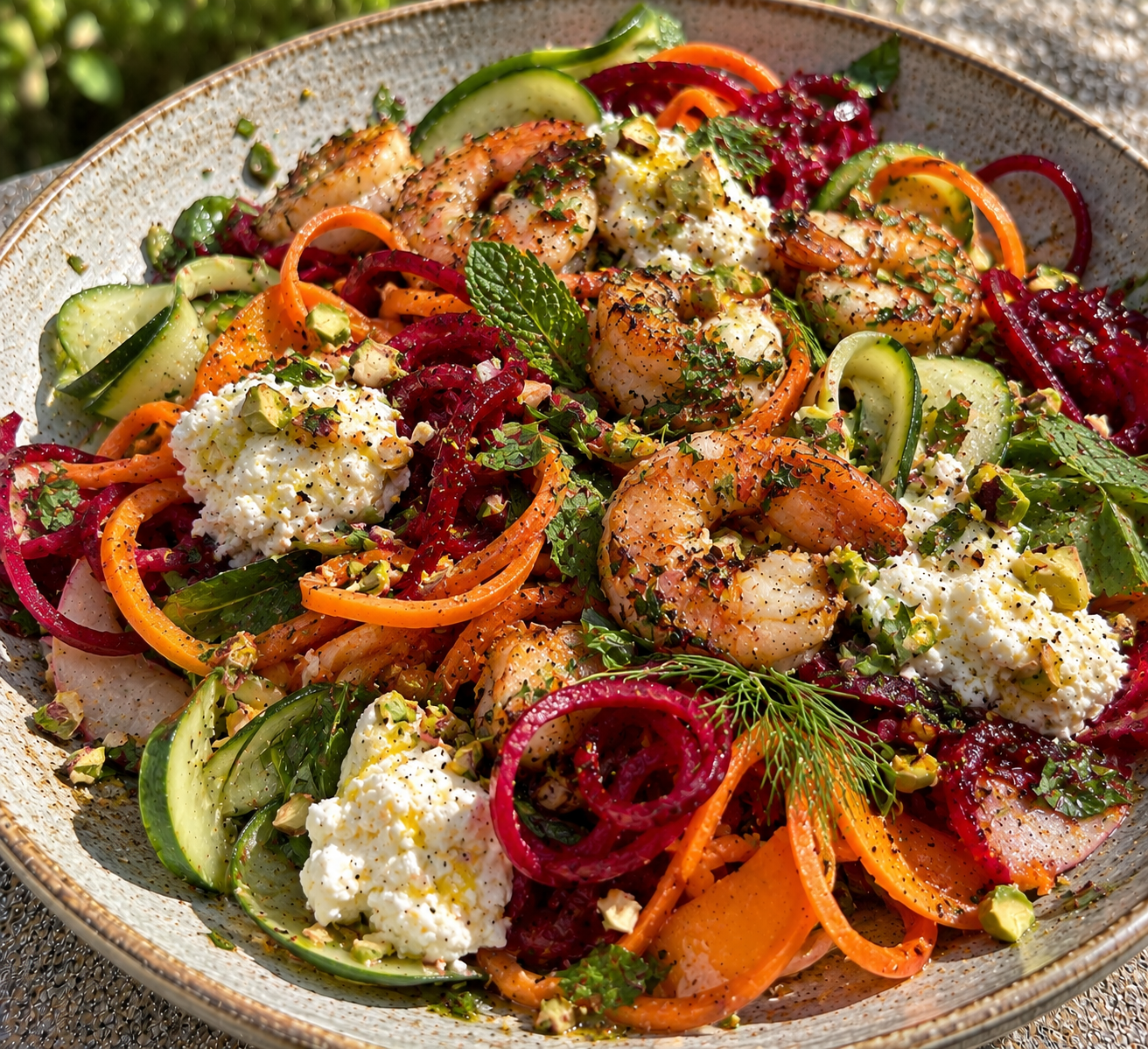
Tender garden greens tangled with ribbons of crimson beet, bright orange carrot, pale-green zucchini, and cool cucumber, topped with dollops of homemade ricotta, edible flowers, and fresh herbs, all in a simple citrus dressing.
Yield: Serves 4–6 · Active: 30 min · Total: 35 min (plus 25 min for homemade ricotta) · Best in North America in summer, when zucchini, cucumbers, and edible flowers are at their peak · Best eaten: midday or early evening
Ingredients
Salad
6 cups mixed garden greens (lettuce, arugula, and fresh herbs)
1 medium beet (red, golden, or Chioggia), peeled and spiralized
1 large carrot, peeled and spiralized
1 medium zucchini, spiralized
1 English or 2 Persian cucumbers, shaved into ribbons with a vegetable peeler
½–¾ cup fresh ricotta, homemade or farmstead (see below)
¼ cup edible flowers (calendula, nasturtium, borage, or pansy)
2 tbsp fresh herb leaves (dill, mint, and parsley)
Citrus dressing
6 tbsp extra virgin olive oil
3 tbsp fresh lemon juice (or sour mandarin juice)
Optional: zest of ½ lemon and 1 tsp raw honey
¾ tsp Baja Gold sea salt
A pinch of freshly cracked black pepper
Substitutions:
Golden beets work alongside or in place of red, and they don't stain the other ribbons. Their slightly sweeter flavor is lovely with ricotta.
For dairy-free, make a cashew ricotta: blend 1 cup soaked cashews with 2 tbsp lemon juice, 2 tbsp water, and ¼ tsp salt until creamy.
No spiralizer? Shred the beet and carrot on the large holes of a box grater, and shave the zucchini into ribbons with a vegetable peeler, like the cucumber.
Method
Make the ribbons. Spiralize the beet, carrot, and zucchini, and shave the cucumber into long ribbons with a vegetable peeler, stopping when you reach the seeds.
Drain the watery ribbons. Toss the zucchini noodles with a pinch of salt and let them sit in a colander 10 minutes, then pat them dry. Lay the cucumber ribbons on a clean towel and pat dry. This keeps the salad crisp instead of watery.
Make the dressing. Whisk the olive oil, lemon juice, zest and honey (if using), salt, and pepper.
Toss. In a large bowl, gently toss the greens, carrot, zucchini, and cucumber with most of the dressing. In a separate small bowl, toss the beet ribbons with the rest. Beets stain everything they touch, so keeping them separate keeps the other ribbons bright.
Plate. Pile the greens and ribbons on a platter, then nestle the beet ribbons in and around them.
Finish. Spoon dollops of ricotta across the top, and scatter with edible flowers and fresh herbs. Serve right away.
Bonus: Homemade Fresh Ricotta
Twenty minutes and three ingredients: the easiest cheese to make at home.
Makes about 1½ cups · Active: 20 min · Total: 25–55 min
½ gallon raw, grass-fed whole milk (or pasteurized whole milk, not ultra-pasteurized)
3 tbsp fresh lemon juice (or 2 tbsp white wine vinegar)
½ tsp Baja Gold sea salt
Heat the milk. Pour it into a large stainless steel pot and heat it slowly over medium heat, stirring occasionally so it doesn't scorch, until it reaches 185°F. The surface will steam and a thin skin will form. Use a thermometer, since the temperature matters.
Curdle. Take the pot off the heat, and gently stir in the lemon juice and salt for about 30 seconds. The milk will separate into white curds and pale yellow whey.
Rest. Cover and let it stand 10 minutes, so the curds firm up.
Drain. Line a colander with cheesecloth (or a clean cotton towel), set it over a large bowl, and pour in the curds.
For wet, fluffy ricotta: drain 5 minutes.
For thicker, spreadable ricotta: drain 30 minutes.
For a dense, sliceable cheese: drain 1 hour, pressing it lightly with a clean weight.
Store. Use it right away, or refrigerate it in a sealed container up to 5 days (it's best within 2). Save the whey; it's lovely in smoothies, soups, or baking.
How it works: Heating the milk to 185°F changes the shape of its proteins, and the acid makes them clump together into curds. Vinegar gives a slightly tangier ricotta, and lemon juice a sweeter, more delicate one. Either way, it tastes completely different from supermarket ricotta: sweeter, cleaner, and full of pure milk flavor.
Storage
The assembled salad is best eaten right away, since the beets bleed onto the ricotta and the greens wilt. The components keep well separately: the spiralized beet and carrot up to 3 days, the zucchini and cucumber ribbons up to 2 days (patted dry and stored with a paper towel), the dressing up to 1 week, and the ricotta up to 5 days, all refrigerated.
A note on honey: The raw honey in the dressing stays raw, since it's never heated. Honey shouldn't be given to babies under 12 months.
Nourishment Notes
Mixed garden greens — vitamin K, vitamin A, folate, and magnesium.
Beets — betalains (the vivid pigments behind their color), folate, manganese, and dietary nitrates, which support healthy blood flow. Eating them raw preserves their heat-sensitive folate, vitamin C, and betalains, which break down with long cooking.
Carrots — beta-carotene, made more absorbable by the olive oil.
Zucchini — vitamin C, potassium, and lutein.
Cucumber — hydration, vitamin K, and potassium.
Fresh ricotta — calcium, protein, and vitamins A and K2, especially from grass-fed milk. Traditional Italian ricotta is made by re-cooking the whey left over from making harder cheeses (ricotta means "re-cooked"). The homemade version here heats whole milk instead, for a fresher, milkier cheese. Both are excellent. Sheep's milk ricotta, the most traditional Italian version, is richer and sweeter, with mostly A2-type casein. Bellwether Farms makes a lovely one in the U.S.
Edible flowers — color and beauty, plus their own plant compounds. Calendula petals carry carotenoids, nasturtium gets its peppery bite from glucotropaeolin (a glucosinolate, like those in cruciferous vegetables), borage flowers bring a delicate cucumber flavor, and pansies are mildly grassy and stunning.
Extra virgin olive oil — oleocanthal and other polyphenols, plus it helps you absorb the vegetables' fat-soluble vitamins.
Lemon — vitamin C, which helps your body absorb the iron in the beets and greens.
Fresh herbs — vitamin K and aromatic compounds.
As a circadian and seasonal food, this salad is at its most vibrant in spring and summer, when edible flowers are blooming and garden vegetables are at their freshest. It makes a beautiful centerpiece for a midday meal or an early-evening farm-to-table dinner.
For your cycle: The beets' folate and nitrates and the greens' magnesium make this light, bright salad especially lovely in the follicular and ovulatory phases. Pair it with grilled fish or chicken for a complete meal.
Sourcing
Greens, beets, carrots, zucchini, cucumbers, and herbs — organic, from a farmers' market or your own garden
Edible flowers — organic, food-grade, and pesticide-free, from a farmers' market, a specialty grower, or your own garden (never from florists)
Milk (for homemade ricotta) — raw, grass-fed whole milk from a farmer you know and trust, or organic, grass-fed, non-homogenized whole milk (not ultra-pasteurized)
Store-bought ricotta — fresh, whole-milk ricotta with no gums or stabilizers, like Bellwether Farms sheep's milk ricotta
Cashews (for dairy-free) — organic (every cashew sold has been heat-treated, even "raw" ones)
Lemons — organic (you're using the zest)
Raw honey (optional) — organic, local, and unfiltered
Extra virgin olive oil — organic, single-estate, harvest-dated, in dark glass
Salt — Baja Gold sea salt; Maldon for finishing
— Anna aka Food Marshall