Beef Brisket Tacos
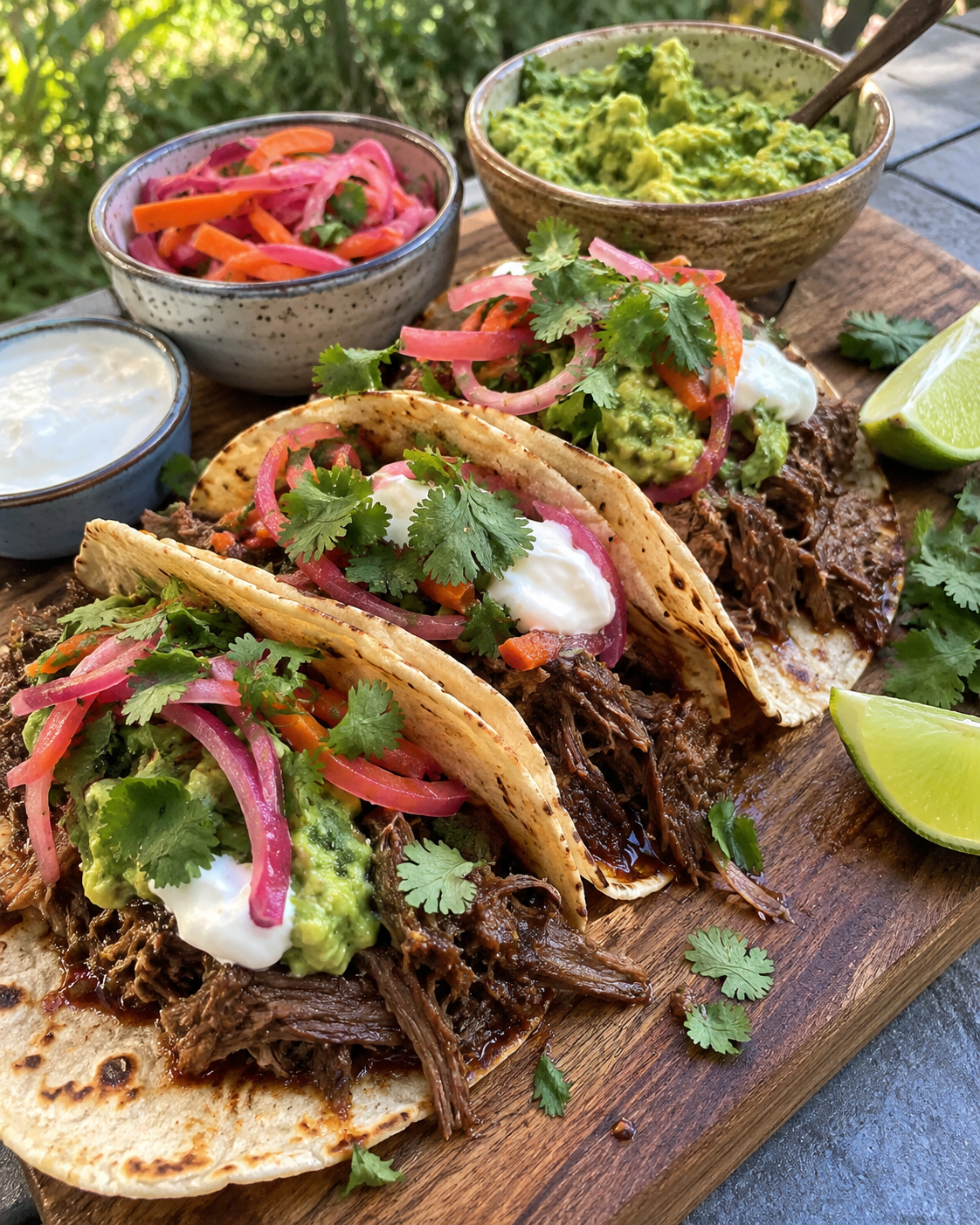
Grass-fed brisket braised low and slow for 8 hours in bone broth with smoked paprika and garlic, then shredded and piled onto warm cassava tortillas with guacamole, a choice of cultured raw cream or cashew sour cream, and bright quick-pickled vegetables.
[hero image — tacos on a wooden board with shredded brisket, fresh cilantro, lime wedges, small bowls of guacamole and pickles]
Yield: Serves 6–8 · Active: 45 min · Total: 8½ hours, mostly hands-off (plus 1 hour to overnight marinating) · Year-round · Best eaten: midday or early evening
Your Game Plan
The day before: Start the cultured sour cream (it needs 12–24 hours), make the pickled vegetables, and marinate the brisket.
About 8½ hours out: Sear the brisket, and get it into the oven.
About 1 hour out: Make the tortillas (or the cashew sour cream, if you're using it).
Just before serving: Shred the brisket, make the guacamole, and warm the tortillas.
Ingredients
Brisket
3 lb grass-fed beef brisket
2 tsp Baja Gold sea salt
1 tsp freshly cracked black pepper
2 shallots, minced
4 garlic cloves, minced
2 tsp smoked paprika
2 tbsp grass-fed butter or tallow
4 cups beef bone broth
Optional finishing: 2 tbsp tomato paste, a pinch of cayenne, the juice of 1 lime, and the juice of 1 orange
Homemade cassava tortillas (makes about 8)
1 cup cassava flour (not tapioca flour)
2 tbsp extra virgin olive oil (or melted coconut oil)
½ tsp Baja Gold sea salt
½ cup warm water, plus more as needed
Or use store-bought: cassava tortillas (like Siete) or sprouted corn tortillas.
Guacamole
2 ripe avocados, mashed
1 Roma tomato, finely diced
1 small jalapeño, seeded and finely diced
½–1 tsp smoked paprika
¼ cup fresh cilantro, chopped
2 tbsp fresh lime juice
Pinch of Baja Gold sea salt
Optional tropical twist: ½ cup diced mango or pineapple (both are shipped in from the tropics in northern climates)
Sour cream: choose one
Cultured raw cream sour cream (the simplest of all): 2 cups raw grass-fed heavy cream, plus an optional 1 tbsp whey (strained from yogurt or kefir), cultured buttermilk, or kefir, to help it culture in a cool kitchen
Cashew sour cream (dairy-free): 1 cup cashews (soaked 4+ hours and drained), ¼–¾ cup filtered water, 2 tbsp fresh lemon juice, 2 tsp raw apple cider vinegar, ½ tsp each garlic powder and onion powder, and ½ tsp Baja Gold sea salt
Quick-pickled vegetables
¾ cup raw apple cider vinegar
¾ cup filtered water
1 tbsp Baja Gold sea salt
Optional: 2 tsp coconut sugar
2 watermelon radishes (or 6 regular radishes), thinly sliced
2 carrots, julienned
½ small red onion, thinly sliced
To serve: fresh cilantro and lime wedges
Method
Culture the sour cream (if using raw cream, 12–24 hours ahead). Pour the raw cream into a clean glass jar, and stir in the whey, buttermilk, or kefir (if using). Cover it with a clean cloth, or set the lid on loosely, so it can breathe. Leave it at room temperature 12–24 hours, until thick and pleasantly tangy, then refrigerate.
Make the pickled vegetables (at least 2 hours ahead, or overnight). Whisk the vinegar, water, salt, and coconut sugar (if using) until dissolved, and pour it over the radishes, carrots, and onion in a glass jar. Refrigerate at least 2 hours.
Marinate the brisket (1 hour to overnight). Rub the brisket all over with the salt, pepper, shallots, garlic, and smoked paprika. Refrigerate at least 1 hour, or overnight.
Sear. Heat the oven to 250°F. Take the brisket out of the fridge 30 minutes ahead. Heat the butter in a large Dutch oven over medium-high heat, and sear the brisket on all sides, about 3–4 minutes per side, until deeply browned.
Braise. Pour in the bone broth; it should come about halfway up the brisket. Cover and braise in the oven for 8 hours, until completely fall-apart tender.
Shred. Move the brisket to a cutting board, let it cool 15 minutes, then shred it with two forks, discarding any large pieces of fat. Skim the fat from the cooking liquid. If you're using the finishing touches, stir the tomato paste, cayenne, lime juice, and orange juice into a splash of the cooking liquid. Toss the shredded meat with enough liquid to keep it moist, but not wet.
Make the tortillas. Whisk the cassava flour and salt, rub in the olive oil with your fingers, then add the warm water a little at a time, mixing until the dough comes together. Knead briefly until smooth. Divide it into 8 balls, and roll each between two sheets of parchment to about ⅛ inch thick. Cook on a dry cast iron skillet over medium heat, 1–2 minutes per side, pressing gently with a spatula, until light brown spots appear. Stack them in a clean towel to keep warm.
Make the cashew sour cream (if using). Blend all the ingredients until completely smooth, adding water until it's thick and creamy. Refrigerate to thicken.
Make the guacamole. Mash the avocados, and stir in the tomato, jalapeño, paprika, cilantro, lime juice, salt, and mango or pineapple (if using). Make it just before serving.
Build the tacos. Pile the brisket onto warm tortillas, and top with guacamole, sour cream, pickled vegetables, and fresh cilantro. Serve with lime wedges.
Storage
Shredded brisket: refrigerated up to 4 days in its cooking liquid, or frozen up to 3 months. It's even better the next day, once the flavors deepen and the fat firms up for easy skimming.
Pickled vegetables: refrigerated up to 3 weeks; they get even better over the first week.
Cultured raw cream sour cream: refrigerated up to 1–2 weeks.
Cashew sour cream: refrigerated up to 5 days.
Tortillas: best fresh, but they keep wrapped in a towel for several hours. Rewarm them in a dry skillet.
Guacamole: best within an hour. Press parchment directly onto the surface to slow browning.
Nourishment Notes
Brisket is the cut behind Texas barbecue and Jewish holiday brisket alike, and it shines with the same long, low cooking in both traditions. It comes from the breast of the cow, a hard-working muscle with plenty of connective tissue, along with a generous layer of fat. The collagen in that connective tissue needs sustained low heat (around 250°F for 6–10 hours) to melt into gelatin, which is what gives brisket its silky, pull-apart texture. Higher temperatures or shorter cooking times leave it dry and chewy.
That long, slow braise turns a tough cut into one of the most nourishing forms of red meat. Grass-fed brisket brings heme iron, zinc, B12, B6, and creatine, and the bone broth adds glycine and proline. Cassava tortillas are a grain-free option made from the South American root vegetable. They're naturally gluten-free and gentle on digestion, a clean way to carry everything else.
Each accompaniment does real work, too. The avocado's healthy fats help your body absorb the tomato's lycopene and the carotenoids in the cilantro. Cultured raw cream is one of the simplest ferments you can make: left on the counter overnight, the lactic acid bacteria naturally present in raw cream multiply and thicken it into sour cream. It keeps raw cream's native enzymes, like lipase, along with butyrate, fat-soluble vitamins (A, D, E, and K2), and live cultures, unlike most commercial sour cream, which is often ultra-pasteurized or thickened with gums. The cashew version plays the same cooling, tangy role that crema does in Mexican taco traditions, with zinc, copper, and magnesium from the nuts.
The quick-pickled vegetables are what lift these tacos out of being a heavy, one-note meat dish. Acid is what your palate reads as freshness in a rich meal, and Mexican taco traditions almost always include some kind of pickled accent, from pickled onions to escabeche carrots. Apple cider vinegar's acetic acid has also been shown to slow digestion slightly and soften the rise in blood sugar after a meal, an old way of making rich meals feel lighter.
As a circadian food, these tacos are best at midday or in the early evening, when your digestion is most active. The build-your-own setup makes them perfect for a family gathering or weekend lunch, with the brisket cooked and shredded a day ahead.
For your cycle: The brisket's heme iron, zinc, and B12 make these especially restorative during the menstrual phase, and the lime, tomato, and pickled vegetables bring vitamin C to help your body absorb that iron.
Sourcing
Brisket — 100% grass-fed and grass-finished, from Alderspring Ranch, White Oak Pastures, US Wellness Meats, or a local farm
Beef bone broth — homemade from grass-fed beef bones (see my Broths 101), or Bonafide Provisions (organic, sold frozen)
Raw cream — from a farmer you know and trust, with a healthy herd on pasture
Cassava flour — organic, finely ground, with nothing added; Otto's Naturals makes one
Store-bought tortillas — cassava tortillas (like Siete) or sprouted corn tortillas, with simple ingredients and no seed oils
Avocados, tomatoes, jalapeños, cilantro, shallots, garlic, radishes, carrots, red onion, limes, and oranges — organic, from a farmers' market
Cashews — organic (every cashew sold has been heat-treated, even "raw" ones)
Tomato paste — organic, in glass, with no added sugar (Bionaturae or Jovial)
Raw apple cider vinegar — organic, with the mother (Bragg)
Smoked paprika and cayenne — organic and non-irradiated (Pimentón de la Vera DOP for the smoked paprika)
Grass-fed butter or tallow — organic, cultured butter from 100% grass-fed cows, or tallow rendered from grass-fed suet
Coconut sugar (optional) — organic
Extra virgin olive oil — organic, single-estate, harvest-dated, in dark glass
Salt — Baja Gold sea salt
— Anna aka Food Marshall