Broths 101 — A Foundation
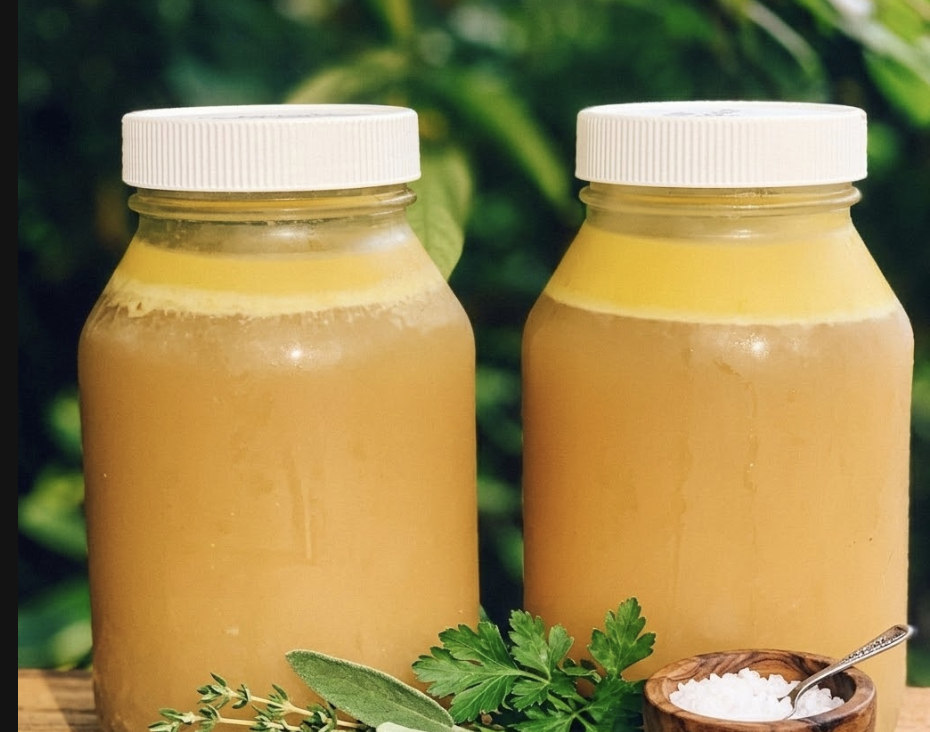
Four broths, four use cases. The single kitchen practice that pays back the most.
Season: Year-round (foundational)
Cuisine: Heritage · Universal
Yield: 3–4 quarts each
Best used: Daily, in everything
There is no kitchen practice that returns more, dollar for dollar and minute for minute, than making your own broth. Every traditional culture built some version of this dish into the daily rhythm — Jewish chicken soup, Vietnamese phở base, French bouillon de poule, Mexican caldo de pollo, Italian brodo, Korean seolleongtang, Japanese dashi. The broth was the foundation; the grain or noodle or meat was the addition. This post is the foundation document for that practice, with four broths and one shared nutritional logic.
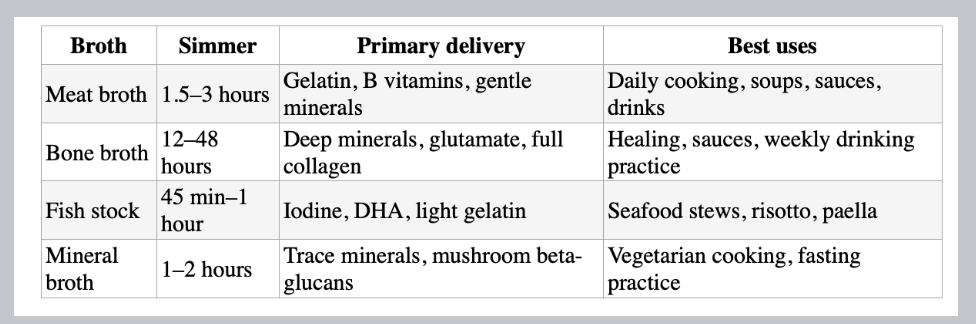
1. Meat Broth — The Daily Default
Gentler than bone broth, faster than bone broth. The cooking liquid for rice, the base for every soup, the warm cup with salt in the morning.
Ingredients
1 whole pasture-raised chicken (3.5–4 lbs)
Filtered water to cover (about 3–4 quarts)
2 tbsp Redmond Real Salt or Celtic sea salt
A few sprigs each of fresh thyme, sage, parsley, rosemary
Optional: 1 onion (halved), 2 carrots, 2 celery stalks, 1 head garlic (halved horizontally)
Method
Place the whole chicken in a large stockpot. Cover with filtered water by 2 inches. Add salt, herbs, and aromatics if using.
Bring to a boil, then immediately reduce to lowest heat — only the occasional small bubble breaking the surface. A hard boil produces cloudy broth and disrupts the collagen-to-gelatin conversion.
Skim the foam that rises in the first 30 minutes — these are concentrated impurities.
Simmer 90 minutes minimum to 3 hours.
Strain through a colander, then through fine mesh or cheesecloth for clearer broth.
Pull the chicken meat off the carcass while still warm; reserve in the fridge for soups, salads, or dinners. Save the bones in a labeled freezer bag for bone broth.
Refrigerate in glass mason jars. It should gel when cold — this is the diagnostic that the broth is doing what it should.
2. Bone Broth — The Deep Cook
The broth for medicinal use, the morning cup with salt and ghee. Simmers an order of magnitude longer than meat broth and extracts a fundamentally different nutrient profile.
Note: bone broth is not gentle. The long simmer extracts free glutamate alongside the minerals, and people who are histamine-sensitive or recovering from severe gut dysfunction sometimes find bone broth too strong and prefer meat broth. Trust your body's response.
Ingredients
3–4 lbs mixed pasture-raised bones (chicken feet for gelatin, oxtails for flavor, marrow bones for fat-soluble vitamins, knuckle bones for collagen)
Filtered water to cover by 2 inches (about 4–5 quarts)
2–3 tbsp raw apple cider vinegar with the mother — essential for mineral extraction
1 tbsp sea salt (more to taste at the end)
Optional aromatics: 1 onion, 2 carrots, 2 celery stalks, 1 head garlic, bay leaves, peppercorns
Method
Optional first step: roast the bones at 400°F for 30 minutes for deeper flavor. Marrow and knuckle bones especially benefit; chicken feet do not need roasting.
Place bones in a large stockpot. Cover with cold filtered water by 2 inches.
Add apple cider vinegar. Let stand 30 minutes — the mild acid begins extracting minerals from the bone matrix before any heat is applied.
Bring to a boil, then immediately reduce to the lowest possible simmer. Skim the foam in the first 60 minutes.
Simmer 12–24 hours (chicken bones) or 24–48 hours (beef and lamb bones). A slow cooker on Low works well; a pressure cooker on the broth setting produces equivalent results in 4–6 hours and is the most fuel-efficient option by a wide margin.
Add aromatics in the last 2 hours only. Earlier addition makes them bitter from over-extraction.
Strain. Bones can be re-simmered once for a slightly weaker but still useful second batch. Marrow from roasted bones can be scooped out and spread on toast — pure bioavailable fat-soluble vitamin payload.
Refrigerate. A proper bone broth gels firmly when cold — almost like jelly. If it doesn't gel, the simmer was too short or the bone-to-water ratio too thin.
3. Fish Stock — The Quick One
The broth most home cooks have never made. Cooks in under an hour, costs almost nothing, and produces the best risotto, paella, bouillabaisse, and seafood stew base imaginable. Wild-caught fish only; brief simmer.
Ingredients
2–3 lbs fish frames, heads (gills removed), and trimmings — wild-caught, white-fleshed (snapper, halibut, cod, sea bass). Avoid oily fish (salmon, mackerel, tuna) for general stock.
Filtered water to cover (about 2–3 quarts)
1 small onion, halved
2 celery stalks
1 leek, white part only
A few sprigs fresh parsley and thyme
1 bay leaf
½ cup dry white wine (optional, brightens)
1 tbsp sea salt
Black peppercorns
Method
Rinse fish frames thoroughly in cold water until the water runs clear. This removes blood that would otherwise turn the stock cloudy and bitter.
Place all ingredients in a stockpot. Cover with cold filtered water.
Bring to a bare simmer. Do not boil. Skim foam continuously in the first 15 minutes — fish stock requires more skimming than meat or bone broth.
Simmer 45 minutes maximum. Longer than an hour and the bones release glue-like compounds and bitter notes.
Strain through fine mesh or cheesecloth.
Use within 2 days or freeze immediately. Fish stock does not keep as long as meat or bone broth.
4. Mineral Broth — The Vegetarian Alternative
For the vegetarian household, the alternating week, or the periodic broth fast. Not a replacement for the connective-tissue amino acids of meat broth — there is no plant-based source of glycine and proline at those concentrations — but an essential broth in its own right.
Ingredients
1 medium onion, quartered
1 head garlic, halved horizontally
2 large carrots, chopped
3 celery stalks with leaves
1 leek, sliced
1 medium parsnip, chopped
¼ head green or savoy cabbage, chopped
1 cup dried mushrooms (shiitake, porcini, or a mix) — with their soaking water
1 strip kombu (4–6 inches)
1 sweet potato, chopped (optional, for sweetness and beta-carotene)
A handful fresh parsley and thyme
1 bay leaf
1 tbsp sea salt
Black peppercorns
1 tbsp raw apple cider vinegar
Filtered water to cover (4–5 quarts)
Method
Optional first step: roast the vegetables (except mushrooms and seaweed) at 400°F for 30 minutes for deeper flavor. This is the move that transforms a thin vegetable broth into something approaching the depth of a meat broth.
Soak the dried mushrooms in 2 cups warm water for 20 minutes. Reserve the soaking water — it carries the most concentrated mushroom flavor.
Combine all ingredients including the mushroom soaking water in a stockpot. Cover with filtered water.
Bring to a simmer. Cook gently 1 to 2 hours.
Strain. Press the vegetables firmly to extract their full liquid.
Refrigerate. Will not gel — there is no collagen — but should still feel mineral-rich and full-bodied.
Nourishment Notes
What broth solves, nutritionally, is the imbalance of an exclusively muscle-meat diet. Muscle meat is rich in methionine, an amino acid that drives growth and that the body must balance with adequate glycine to clear from the methylation cycle. Glycine is the dominant amino acid in connective tissue — bones, skin, tendons, cartilage — and is produced by the long, slow cook that converts collagen to gelatin. A modern diet of boneless skinless chicken breast and lean ground beef, eaten without the connective-tissue components, runs chronically low in glycine. The traditional pairing of muscle meat with broth corrects the imbalance. Glycine is also the rate-limiting amino acid for glutathione (the master antioxidant), the dominant amino acid in collagen at roughly 33 percent by weight, and a primary inhibitory neurotransmitter — which is why glycine consumed 1 to 2 hours before bedtime improves sleep onset and depth in clinical trials.
The mineral extraction from bone broth specifically depends on the apple cider vinegar. The mild acid pre-treats the bone matrix before heat is applied, beginning the extraction of calcium, magnesium, phosphorus, potassium, and trace minerals locked in the hydroxyapatite crystal structure. Without the vinegar, much of this content stays bound in the bone and is discarded. Pasture-raised bones carry meaningfully more fat-soluble vitamins and a cleaner mineral profile than confined-flock bones, which carry residue of grain mycotoxins and the dietary inflammation of industrial poultry. The pastured difference in broth is even more pronounced than in muscle meat. Real salt — Redmond, Celtic, Himalayan — pairs functionally with this mineral extraction; refined table salt is sodium chloride only and contributes nothing else.
As a seasonal practice, broth is one of the few foods that fits every time of day and every part of the year. A warm cup with salt and ghee in the morning sets a high-protein anchor. Bone broth before bed delivers glycine for sleep. During illness, broth is often the only food digestion can comfortably accept. During fasting, it keeps minerals and electrolytes steady while extending the protocol. In autumn and winter, broth-based soups warm the body through the cold months when traditional cultures used them most heavily; in spring and summer, the same broths become the cooking liquid for grains, the poaching liquid for fish, the reduction for sauces. Every traditional culture that hunted or husbanded animals consumed every part — bones, hide, connective tissue. Modern industrial processing routes muscle meat to the grocery store and bones to fertilizer. Broth restores the missing half.
Storage: refrigerate in glass mason jars up to 5 days; freeze up to 3 months. When freezing in glass, leave 1.5 inches headspace and freeze with the lid loose for the first 24 hours to prevent breakage. Wide-mouth jars freeze more reliably than narrow-mouth. Bones can be re-simmered once for a weaker second batch before being discarded.