Grain-Free Chocolate Swirl Banana Bread with Honey Cream Cheese Frosting and Mango-Passion Fruit Jam
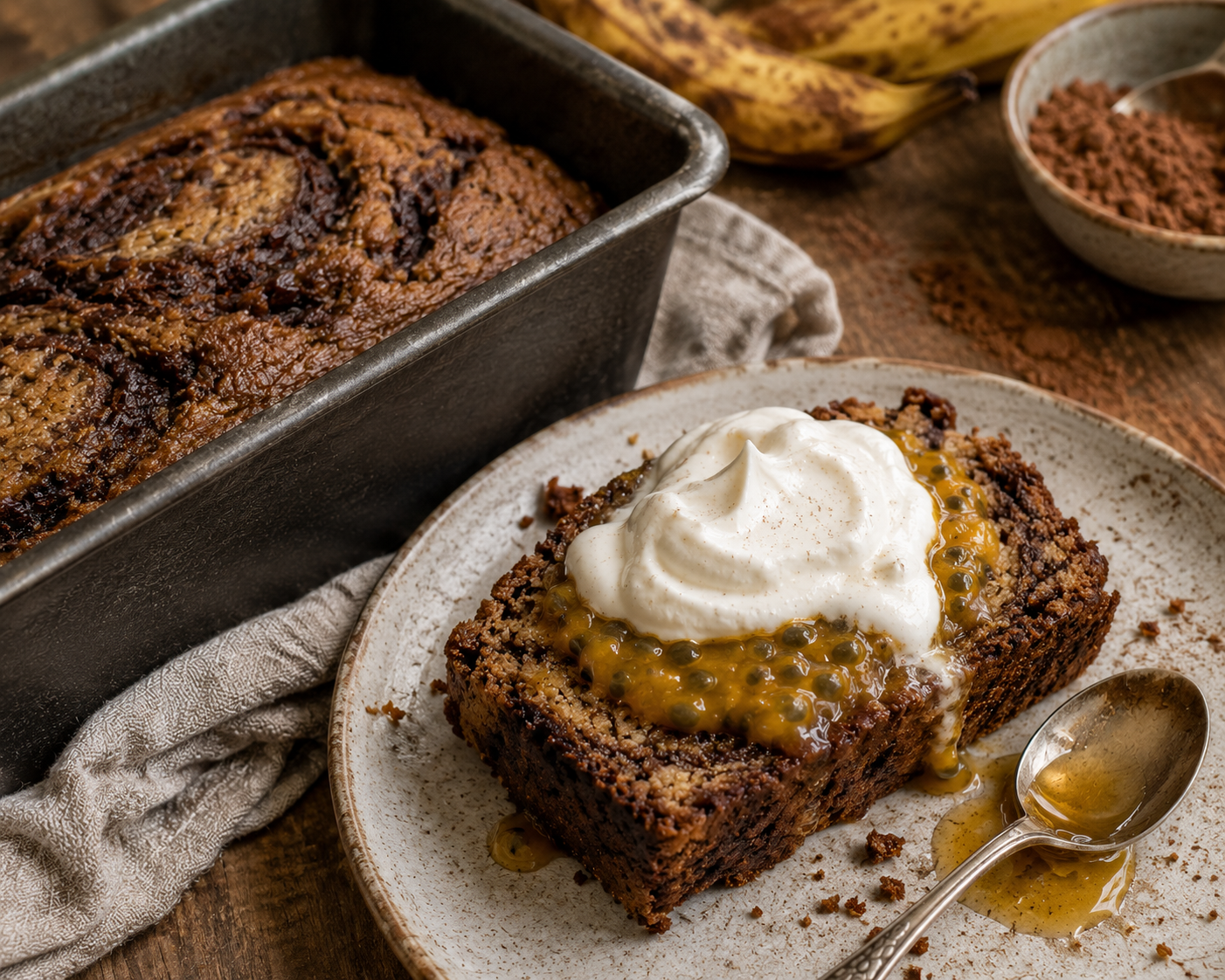
Grain-Free Chocolate Swirl Banana Bread with Honey Cream Cheese Frosting and Mango-Passion Fruit Jam
Built for a 9×5 loaf rather than the standard 8×4 pan, this is a deeply rich, breakfast-substantial bake that proves grain-free baking can deliver more nourishment, more protein, and more flavor than any conventional banana bread.
Yield: One 9×5 loaf, serves 10–12 · Active: 20 min · Total: 1 hr 30 min
A note from the kitchen
This is the substantial version of banana bread — what banana bread becomes when you remove the refined flour and rebuild from real ingredients with structural integrity. Eight small tropical bananas (or four standard-size bananas), eight pasture-raised eggs, dark chocolate chips folded into the batter in dark ribbons. The result is denser, more breakfast-anchored, and structurally richer in protein, fat-soluble vitamins, and minerals than anything wheat-based.
A few notes worth mentioning prior to baking:
The banana sizing matters. If you're using small/baby tropical bananas (the kind you find at Latin American grocers, farmers' markets in tropical climates, or specialty stores), you'll need about 8 of them. If you're using standard supermarket Cavendish bananas (the large yellow ones most American grocery stores carry), 4 is the right count. Both produce roughly 2 cups of mashed banana. Adjust your count based on which type you're using.
The frosting and jam aren't optional embellishments — they're structural. Coconut flour can produce a slightly dry mouthfeel without adequate fat and a topping. The whipped honey cream cheese frosting brings the moisture-and-fat balance the loaf needs to read as substantial breakfast bread rather than a plain baked good; the tropical mango-passion fruit jam adds bright fruit acid that cuts the loaf's richness and ties together the chocolate's bitter notes. Make the loaf, the frosting, and the jam all on a Sunday afternoon, and you have a week of substantial breakfasts and afternoon snacks ready to go.
Use truly ripe bananas. The bananas should be deeply spotted, almost fully brown — not just yellow with a few spots. Fully ripe bananas have converted most of their starch to natural sugars, which makes the loaf sweeter without needing added sweetener and produces the deep banana flavor that defines the bake. If your bananas aren't fully ripe yet, leave them on the counter another 2-3 days before baking. Small tropical bananas typically ripen faster than Cavendish — within 3–5 days of purchase if not refrigerated.
Ingredients
For the bread:
8 small/baby ripe bananas (deeply spotted, almost brown) OR 4 standard-size bananas, mashed (about 2 cups)
8 large pasture-raised eggs
½ cup grass-fed ghee, melted (or grass-fed butter, melted)
1 cup raw sprouted almond butter (smooth, drippy)
½ cup coconut flour
1 tbsp pure vanilla extract
½ tsp baking soda
¼ tsp sea salt
For the chocolate swirl:
¾ cup dark chocolate chips or chopped dark chocolate (70%+ cacao)
2 tbsp coconut sugar
1 tsp ground Ceylon cinnamon
For the whipped honey cream cheese frosting (strongly recommended):
8 oz raw or grass-fed cream cheese, fully softened to room temperature
3 tbsp raw honey
¼ cup raw heavy cream from grass-fed cows
Pinch sea salt
For the mango-passion fruit jam (optional, for serving):
1 cup fresh mango, diced
½ cup fresh passion fruit pulp (about 6–8 passion fruit)
2 tbsp raw honey
1 tbsp fresh lime juice
For finishing:
Optional: shaved dark chocolate, fresh sliced bananas, or fresh berries
Method
Prep the pan. Preheat the oven to 350°F. Line a 9×5-inch loaf pan with parchment paper, leaving overhang on two sides to lift the loaf out later.
Mix the wet ingredients. In a large bowl, whisk together the mashed bananas, eggs, melted ghee, almond butter, vanilla, and sea salt until completely smooth and uniform.
Add the coconut flour and baking soda. Whisk in the coconut flour and baking soda until fully integrated. Let the batter rest 2–3 minutes — coconut flour hydrates slowly, and the batter will set up noticeably during this brief rest. This is structurally important; skipping it produces a wetter final loaf.
Prepare the chocolate swirl. In a small bowl, toss the chocolate chips with the coconut sugar and Ceylon cinnamon until evenly coated.
Layer and swirl. Pour half the batter into the prepared pan. Sprinkle half the chocolate mixture evenly over the top. Pour the remaining batter on top. Sprinkle the remaining chocolate mixture over. Use a butter knife or skewer to gently swirl through the batter in a figure-8 pattern — don't over-swirl; you want distinct dark ribbons of chocolate visible rather than fully integrated chocolate flecks.
Bake. Bake at 350°F for 60–70 minutes, until a toothpick inserted in the center comes out clean (a few melted chocolate streaks are fine; raw batter is not). This loaf needs the longer bake time — coconut flour absorbs significant moisture and the substantial banana-and-egg load adds further wetness. If the top browns too quickly, loosely cover with foil for the last 15 minutes.
Cool completely. Cool in the pan 20 minutes, then carefully lift out using the parchment overhang and transfer to a wire rack. Cool completely (at least 1 hour) before frosting — applying frosting to a warm loaf will melt the frosting into the bread and ruin the structural appeal.
Make the whipped honey cream cheese frosting. In a stand mixer with the whisk attachment (or with a hand mixer), beat the softened cream cheese on medium-high until completely smooth and light, about 2 minutes. Add the raw honey, raw heavy cream, and pinch of sea salt. Beat 3–4 more minutes until light, fluffy, and pourable but not runny.
Make the mango-passion fruit jam (optional). Combine the diced mango, passion fruit pulp, raw honey, and lime juice in a small saucepan over medium-low heat. Cook 10–15 minutes, stirring occasionally, until the mango softens and the mixture thickens to a jammy consistency. Cool completely before serving.
Frost and serve. Spread the frosting generously over the cooled loaf with an offset spatula, or serve the frosting alongside, slice by slice. Top each slice with a spoonful of mango-passion fruit jam. Garnish with shaved dark chocolate, fresh banana slices, or fresh berries if desired.
Variations
Cashew butter version: Substitute the almond butter with smooth cashew butter for a softer, more dessert-like texture. The cashew butter blends more silkily into the batter and produces a slightly sweeter, more luxurious result.
Dairy-free version: Replace the ghee with unrefined coconut oil. Skip the cream cheese frosting entirely, or make a coconut-cream-based frosting (whipped chilled coconut cream + 3 tbsp raw honey + 1 tsp vanilla). For the chocolate swirl, ensure the dark chocolate is dairy-free (some 70%+ chocolates contain milk solids).
Chocolate-only swirl variation: Skip the cinnamon and coconut sugar from the swirl. Use 1 cup of chopped dark chocolate folded directly into the batter for a more uniform chocolate distribution rather than distinct ribbons.
Toasted coconut variation: Fold ½ cup toasted unsweetened shredded coconut into the batter for additional tropical depth. Top with extra toasted coconut after frosting.
Pineapple-coconut variation (tropical/subtropical climates): Replace the mango-passion fruit jam with a pineapple-coconut compote (1 cup fresh pineapple diced + ½ cup full-fat coconut cream + 2 tbsp raw honey + pinch sea salt, simmered 10 minutes). Beautiful for tropical-climate kitchens where pineapple grows locally year-round (Hawaii, Florida, Mexico, Costa Rica, Central America).
Apple-cinnamon compote variation (autumn-winter in temperate climates): Replace the mango-passion fruit jam with a warm apple-cinnamon compote (2 cups peeled diced apples + 2 tbsp raw honey + 1 tsp Ceylon cinnamon + 1 tbsp fresh lemon juice + pinch nutmeg, simmered 12–15 minutes until apples are tender).
Berry compote variation (spring-summer in temperate climates): Replace the mango-passion fruit jam with a fresh berry compote (2 cups mixed berries + 2 tbsp raw honey + 1 tbsp lemon juice, simmered 10–12 minutes). Beautiful for temperate climates when berries are at peak (May–September in most of North America).
Espresso variation: Add 1 tbsp instant espresso powder to the wet ingredients. The espresso doesn't make the loaf taste like coffee — it deepens the chocolate flavor dramatically. Beautiful with the cream cheese frosting and a small espresso on the side.
Two-loaf brunch batch: Double all ingredients and bake in two 9×5 pans simultaneously (same baking time). The loaf scales linearly and freezes beautifully — perfect for a brunch board of 6+ guests, or for portioning a week of breakfasts.
Sourcing
Ripe bananas:
Small tropical banana varieties (Burro, Manzano, Red Dacca, Ladyfinger, Saba, Niño) are the gold standard — they have deeper flavor, sweeter natural sugars, and the slightly more complex flavor profile that defines tropical bananas in their native climates. Use 8 small bananas.
Standard supermarket Cavendish bananas work fine as the everyday alternative — use 4 large ones.
Both should be deeply spotted, almost brown — not just yellow with a few spots. The flavor and natural sweetness peaks at full ripeness.
Organic when possible — conventional bananas are heavily sprayed.
Small tropical varieties are most readily available at Latin American grocers, farmers' markets in tropical climates, or specialty produce stores.
Store overripe bananas at room temperature; if they're getting too ripe before you're ready to bake, peel and freeze them for later baking.
Pasture-raised eggs:
"Pasture-raised," not "free-range" or "cage-free."
Deep orange yolks — the visual indicator that the hens foraged on real pasture.
From a local farmer at the farmers' market when possible.
Recently laid (within 2 weeks).
8 eggs is a substantial commitment — worth sourcing from a small farm where the difference shows.
Grass-fed ghee:
From pasture-raised, grass-fed cows. Real ghee is butter that has been slowly simmered until the milk solids brown lightly and separate from the butterfat, then strained off.
Organic when possible.
In a glass jar (not plastic — ghee pulls plasticizers from packaging over time).
Deep yellow-gold color — the visual indicator of grass-fed source dairy.
Smells faintly nutty and caramelized, never rancid.
Raw sprouted almond butter:
100% sprouted almonds — the only ingredient should be "sprouted almonds" (a small amount of sea salt is acceptable).
Sprouted/soaked-and-dehydrated almonds have meaningfully reduced phytic acid and enzyme inhibitors, making the minerals (magnesium, zinc, iron, calcium) more bioavailable.
Smooth, drippy consistency.
Raw or low-temperature processed.
Organic when possible.
Stored cool in a glass jar.
Avoid almond butter with palm oil, hydrogenated oils, sugar, or "natural flavors."
Coconut flour:
100% coconut flour — the only ingredient on the label should be "coconut flour."
Organic when possible.
Pale ivory color, finely ground.
Recently milled — coconut flour absorbs moisture from the air and clumps if exposed.
Stored cool in a sealed glass container.
Dark chocolate (70%+ cacao):
Single-origin or fair-trade when possible — beyond ethics, single-origin chocolate has more complex flavor.
Ingredient list should be: cacao mass, cacao butter, sugar (preferably coconut sugar, pure cane sugar, or maple sugar), vanilla. The shorter the list, the better.
70%+ cacao for the structural balance — sweeter chocolate makes the loaf overly sweet; bitter chocolate (over 90%) loses its swirl character.
Avoid chocolate with soy lecithin, dairy emulsifiers, "natural flavors," or vegetable oils.
Coconut sugar:
100% coconut sugar — the only ingredient should be coconut sugar (from coconut palm sap).
Organic when possible.
Single-origin when available.
Avoid coconut sugar blended with cane sugar or other sweeteners.
Ceylon cinnamon:
Ceylon cinnamon (Cinnamomum verum, "true cinnamon") over cassia cinnamon — Ceylon has a more delicate flavor and dramatically lower coumarin content.
Single-origin and organic when possible.
Freshly ground when possible.
Pure vanilla extract:
100% vanilla extract from real vanilla beans (Madagascar, Tahitian, or Mexican).
The ingredient list should be: vanilla beans, alcohol, water. Nothing else.
Avoid "imitation vanilla" or "vanilla flavoring" — typically synthetic vanillin from wood pulp.
Raw cream cheese (or grass-fed cream cheese):
Raw if available where it's legally sold (state-by-state legal status varies — check realmilk.com), or minimally-pasteurized otherwise.
From cows on pasture year-round when possible.
The shortest possible ingredient list — ideally just cultured cream and salt.
Avoid cream cheese with gums, stabilizers, or "natural flavors."
Full-fat (never low-fat or fat-free).
Raw heavy cream:
From cows on pasture year-round when legally available. State-by-state legal availability varies; check realmilk.com.
If unavailable, minimally-pasteurized full-fat heavy cream from grass-fed cows.
The shortest possible ingredient list — ideally just cream.
Avoid ultra-pasteurized cream entirely (which has had its raw enzymes and Wulzen factor destroyed).
Raw honey:
Light, raw honeys for the frosting — orange blossom, acacia, wildflower, or clover.
100% raw honey — should crystallize over time (a sign of structural integrity).
From a small local apiary when possible.
Avoid commercial filtered honey with extended shelf-life.
Fresh mango:
Heavy for size, fragrant at the stem, slightly soft to the touch.
Heritage varieties (Ataulfo, Kent, Keitt, Alphonso, Carabao, Manila) for deeper flavor than the generic Tommy Atkins.
Local farmers' market or specialty grocer during peak season (April–August in most U.S. growing regions; year-round in Mexico, Costa Rica).
Avoid mangoes that are still green-hard (won't ripen properly indoors) or those with soft brown spots (overripe).
Fresh passion fruit:
Heavy for size, with wrinkled, dimpled skin — wrinkly is ripe, smooth is underripe.
Deep purple or yellow varieties both work; purple has a slightly more intense flavor.
Local farmers' market or specialty Latin American grocer during peak season (varies regionally — March–August in Mexico, year-round in tropical climates).
The pulp + seeds inside are both edible; the seeds add a beautiful crunch to the jam.
Sea salt:
Baja Gold mineral sea salt (third-party tested at 29.5–31.5% sodium, harvested from the Sea of Cortez, solar-dried) or any equivalent unrefined mineral-rich sea salt for the loaf and jam.
Fleur de sel for finishing if desired — hand-harvested by skimming the delicate top layer of French salt pans.
Storage
Room temperature: The loaf keeps 2-3 days at room temperature wrapped in beeswax wrap or sealed in a glass container. Unfrosted is more shelf-stable than frosted.
Refrigerator: The frosted loaf keeps 5–7 days refrigerated, sealed in a glass container. Brings best texture to room temperature 15–20 minutes before serving.
Freezer: Individual slices freeze beautifully for up to 3 months — wrap each slice in parchment paper, then in a freezer bag. Warm gently in a 300°F oven for 5–7 minutes, or at room temperature.
Frosting storage: The whipped honey cream cheese frosting keeps 4 days refrigerated. Bring to room temperature 20 minutes before re-whipping for best texture.
Mango-passion fruit jam storage: 1 week refrigerated, sealed in a glass jar. Also excellent on full-fat yogurt, raw cheese, alongside roast pork or grilled chicken, or as a spread on grain-free crackers.
To gift: Wrap individual slices in parchment paper and arrange in a small glass container. The mango-passion fruit jam in a small jar tied with twine makes a beautiful real-food gift alongside.
Pairs Well With
For the morning: A cup of strong pour-over coffee, an espresso, or a substantial cup of black or green tea. For warm pairings, a large mug of raw cacao made with raw heavy cream and a touch of honey.
For the afternoon: A slice with herbal tea (chamomile, lemon balm, rooibos) for a substantial mid-afternoon nourishment break, or with a glass of cold raw milk (where legally available) for the most ancestrally-aligned pairing.
For a brunch board: A large slice with the whipped honey cream cheese frosting, a spoonful of mango-passion fruit jam, fresh seasonal fruit (sliced figs, fresh berries, citrus segments), and a small pile of raw nuts. Beautifully composed centerpiece for a Sunday brunch gathering.
For a breakfast plate: A slice of the loaf alongside soft-scrambled pasture-raised eggs (cooked in grass-fed butter), a small serving of full-fat raw yogurt with the mango-passion fruit jam, and/or a cup of bone broth.
For dessert presentation: Warm a slice gently, top with whipped honey cream cheese frosting, drizzle with melted dark chocolate, scatter fresh raspberries, and finish with a small pinch of flaky sea salt.
For seasonal context: The tropical fruit version (with mango-passion fruit jam) is genuinely seasonal in tropical and subtropical bioregions — Costa Rica, Hawaii, and similar climates where mango and passion fruit grow within that region year-round. In temperate climates (most of the U.S., Canada, Northern Europe), use the berry compote variation in spring/summer when local berries are at peak, the warm-spice variation in autumn-winter when nothing tropical grows locally. The principle: eat what grows in your bioregion when it grows. Tropical fruit in a New York winter is an occasional indulgence, not a structural eating pattern.
Why This Loaf
This banana bread format proves that healthy baking doesn't sacrifice anything — it actually delivers more protein, more fat-soluble vitamins, and more mineral density than any conventional banana bread, while keeping all the deep banana-and-chocolate flavor that defines the bake.
— Anna aka Food Marshall