Thai Beef and Mushroom Stir-Fry with Rainbow Vegetables and Coconut Cauliflower Rice
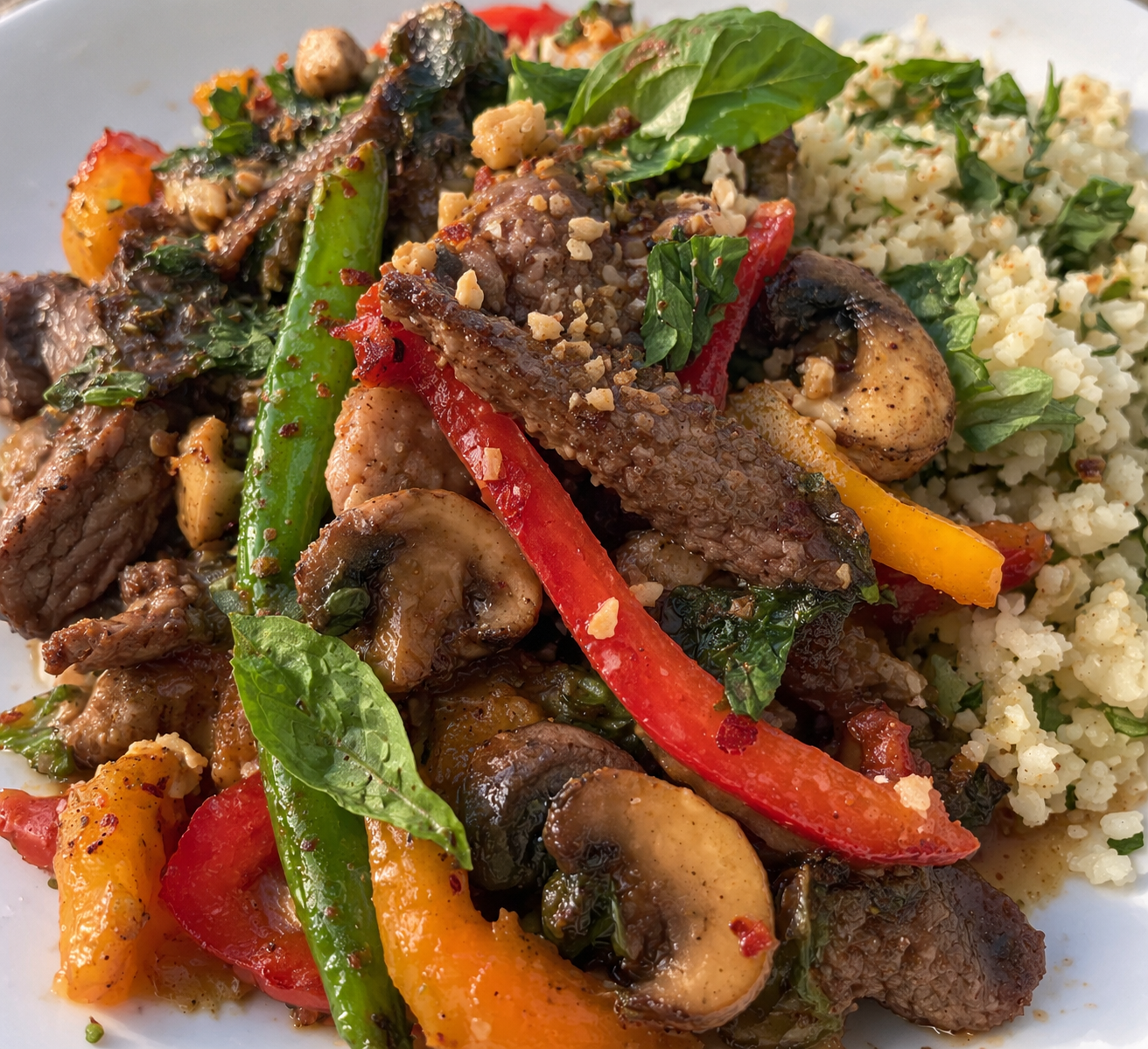
Thinly sliced grass-fed beef seared in a blazing-hot wok with cremini mushrooms and a rainbow of crisp vegetables, tossed in a glossy, sweet-sour-savory lime and ginger sauce, and finished with handfuls of Thai basil, cilantro, and mint. It's served over fragrant coconut cauliflower rice. Fast, vibrant, and soy-free.
Yield: Serves 4–6 · Active: 40 min · Total: 45 min (plus 15–30 minutes marinating) · Year-round (bell peppers and snap peas peak in North America in summer; in fall and winter, swap in broccoli, Napa cabbage, and more mushrooms) · Best eaten: early evening
Recipe 1: Thai Beef and Mushroom Stir-Fry with Rainbow Vegetables
Ingredients
Beef marinade
1½ lb grass-fed flank steak, skirt steak, or sirloin, sliced very thinly against the grain (¼ inch thick)
2 tbsp coconut aminos
1 tbsp fresh lime juice
1 tbsp raw honey
2 garlic cloves, finely minced
1 tbsp fresh ginger, finely grated
1 tsp toasted sesame oil
1 tsp arrowroot powder (optional, for a silky coating)
Stir-fry sauce
3 tbsp coconut aminos
2 tbsp fresh lime juice, plus the zest of 1 lime
2 tbsp raw honey
2 tbsp raw apple cider vinegar
1 tbsp fish sauce
1 tbsp toasted sesame oil
1 tsp arrowroot powder, dissolved in 1 tbsp cold water (for a glossy sauce)
Rainbow vegetables
1 red bell pepper, thinly sliced
1 yellow bell pepper, thinly sliced
1 medium red onion, thinly sliced
2 medium carrots, thinly sliced on the bias
8 oz cremini mushrooms, sliced
8 oz snap peas or snow peas, strings removed
2 baby bok choy, quartered lengthwise (or 4 cups thinly sliced Napa cabbage)
6 garlic cloves, thinly sliced
2 tbsp fresh ginger, finely grated
2–3 Thai bird chilies (or 1 jalapeño), thinly sliced (seeded for milder heat)
3 green onions, cut into 2-inch pieces
To finish
½ cup fresh Thai basil, torn (it's what gives the dish its Thai character)
¼ cup fresh cilantro, chopped
2 tbsp toasted white or black sesame seeds
Optional: 2 tbsp fresh mint, torn
Optional: ¼ cup roasted cashews, roughly chopped
Fresh lime wedges and flaky sea salt
Cooking fat
3–4 tbsp grass-fed beef tallow, virgin coconut oil, or grass-fed ghee
Method
Slice the beef. Slice it very thinly against the grain. Freezing it for 20 minutes first makes thin slicing much easier.
Marinate. Toss the beef with the coconut aminos, lime juice, honey, garlic, ginger, sesame oil, and arrowroot. Let it marinate 15–30 minutes at room temperature.
Make the sauce. Whisk everything together in a small bowl, and set it near the stove. Stir-fries move fast.
Prep everything. Slice all the vegetables, garlic, ginger, chilies, and green onions before you start cooking. Once the wok is hot, there's no time to chop.
Heat the wok. Heat a large wok or heavy cast iron skillet over the highest heat for 3–4 minutes, until smoking.
Sear the beef. Add 2 tbsp tallow, then the beef in a single layer, working in batches if needed (crowded meat steams instead of searing). Sear 60–90 seconds without moving it, then flip and cook 30–45 seconds more, until browned but not fully cooked through. Move it to a plate. Don't clean the wok; the browned bits add flavor.
Stir-fry the vegetables. Add 2 more tbsp tallow and return the wok to the highest heat.
Add the carrots and red onion, and stir-fry 90 seconds.
Add the mushrooms, and stir-fry 2–3 minutes, until they release their moisture and start to brown.
Add the bell peppers, and stir-fry 90 seconds.
Add the snap peas and bok choy, and stir-fry 90 seconds, until tender-crisp.
Add the garlic, ginger, and chilies, and stir-fry 30–45 seconds, until fragrant.
Combine. Return the beef and any juices to the wok. Give the sauce a quick stir (the arrowroot settles) and pour it in. Toss constantly 60–90 seconds, until the sauce thickens and coats everything glossily. Add the green onions and toss briefly.
Finish. Take the wok off the heat, and toss in the Thai basil, cilantro, and mint. The residual heat wilts the herbs slightly.
Tips for great stir-fry
Preheat the wok or skillet 3–4 minutes before adding the fat.
Prep everything before you start cooking (chefs call this mise en place).
Don't crowd the pan; sear the beef in batches.
Move fast: once the pan is hot, the whole stir-fry takes 8–10 minutes.
Toss constantly once the sauce goes in.
About fish sauce: Real fish sauce is one of the most important ingredients in Southeast Asian cooking. Look for one made from just anchovies and sea salt, like Red Boat, and avoid those with added sugar, hydrolyzed vegetable protein, or preservatives.
Recipe 2: Coconut Cauliflower Rice
Cauliflower rice gently sautéed with coconut milk, ginger, and garlic, and finished with fresh cilantro and lime zest. Bright, fragrant, and the perfect base for the stir-fry.
Ingredients
1 large head cauliflower (about 2 lb), riced (or 4 cups riced cauliflower)
2 tbsp virgin coconut oil
1 shallot, finely minced
4 garlic cloves, finely minced
1 tbsp fresh ginger, finely grated
½ cup full-fat coconut milk (with no guar gum)
1 tbsp coconut aminos
1 tsp Baja Gold sea salt
½ tsp freshly cracked black pepper
3 tbsp fresh cilantro, chopped
Zest of ½ lime
Optional: 2 tbsp toasted coconut flakes
Flaky sea salt
Method
Rice the cauliflower. Cut it into large florets and pulse in a food processor 15–20 times, until it looks like rice. Don't over-process it into a paste.
Sauté the aromatics. Melt the coconut oil in a large skillet over medium heat. Cook the shallot 3–4 minutes, until softened, then add the garlic and ginger for 30–45 seconds, until fragrant.
Add the cauliflower. Toss it to coat in the aromatic fat, and cook 3–4 minutes, stirring occasionally.
Add the coconut milk. Pour in the coconut milk and coconut aminos, and season with salt and pepper. Cook uncovered 5–7 minutes, stirring occasionally, until the cauliflower is tender-crisp and most of the liquid is absorbed. Don't overcook it; you want distinct, rice-like grains, not mush.
Finish. Take it off the heat, and toss in the cilantro and lime zest. Scatter with toasted coconut and flaky salt.
To Serve
Spoon the coconut cauliflower rice into warm, shallow bowls and ladle the stir-fry generously over the top with its glossy sauce. Scatter with Thai basil, cilantro, toasted sesame seeds, and chopped cashews, and serve with lime wedges at the table.
Storage
Stir-fry: refrigerated up to 3 days. It's best fresh, since reheating softens the vegetables; reheat it in a hot skillet for 3–4 minutes.
Coconut cauliflower rice: refrigerated up to 4 days. Reheat it gently with a splash of coconut milk.
Stir-fry sauce: refrigerated up to 1 week in a sealed jar, or frozen up to 3 months.
Leftover transformations:
Toss leftover stir-fry and cauliflower rice with pastured eggs and green onions, for a Thai-style breakfast "fried rice."
Wrap leftover stir-fry in lettuce cups with fresh Thai basil, for lunch.
Blend leftover sauce with coconut milk and vegetables, for a quick soup base.
Nourishment Notes
Grass-fed beef — complete protein, heme iron, B12, zinc, and CLA, with more omega-3s than conventional feedlot beef.
Cremini mushrooms — beta-glucans, ergothioneine, and B vitamins, plus vitamin D when they've been exposed to sunlight.
Rainbow bell peppers — vitamin C (a single pepper provides more than a day's worth), beta-carotene, and lutein, with each color bringing different carotenoids.
Snap peas — folate, vitamin K, vitamin C, and fiber.
Bok choy and cauliflower — glucosinolates, vitamin C, vitamin K, and calcium, plus choline from the cauliflower.
Carrots — beta-carotene, potassium, and fiber.
Red onion, garlic, and green onions — quercetin, allicin, and prebiotic fibers.
Fresh ginger — gingerols, well studied for easing nausea and menstrual cramps.
Thai bird chilies — capsaicin and vitamin C.
Thai basil, cilantro, and mint — eugenol, vitamin K, and aromatic compounds traditionally used to support digestion.
Lime — vitamin C, d-limonene, and hesperidin.
Fish sauce — deep umami flavor from naturally fermented anchovies.
Coconut aminos — soy-free umami.
Sesame seeds and toasted sesame oil — calcium, magnesium, lignans, and vitamin E.
Raw apple cider vinegar — acetic acid for blood-sugar balance.
Grass-fed beef tallow — a stable, flavorful fat for high-heat cooking.
Coconut oil and coconut milk — lauric acid and medium-chain fats.
Cashews (if using) — magnesium, copper, and zinc.
For your cycle: The beef's heme iron and zinc make this especially restorative during the menstrual phase, the peppers' and lime's vitamin C helps your body absorb that iron, and ginger is well studied for easing cramps.
Sourcing
Flank, skirt, or sirloin steak — 100% grass-fed and grass-finished, from Alderspring Ranch, White Oak Pastures, or US Wellness Meats
Cremini mushrooms, bell peppers, carrots, snap peas, bok choy, red onion, garlic, ginger, green onions, cilantro, mint, and limes — organic, from a farmers' market
Thai basil and Thai bird chilies — organic, from an Asian grocer or farmers' market (Thai basil also grows easily in a windowsill pot)
Coconut aminos — organic and soy-free, like Coconut Secret
Fish sauce — made from just anchovies and sea salt, like Red Boat
Toasted sesame oil — organic and cold-pressed, in glass
Raw apple cider vinegar — organic, with the mother (Bragg)
Raw honey — organic, local, and unfiltered
Arrowroot powder — organic, with nothing added
Full-fat coconut milk — organic, made with just coconut and water, with no guar gum (Native Forest Simple comes in BPA-free cans)
Sesame seeds — organic and unhulled; toast them fresh in a dry skillet for 3–4 minutes
Cashews (optional) — organic; toast them in a dry skillet before serving
Grass-fed beef tallow — rendered from grass-fed suet, or from US Wellness Meats
Virgin coconut oil — organic, virgin, and unrefined
Ghee — grass-fed ghee
Baja Gold sea salt
— Anna aka Food Marshall