Baked Lemon Mascarpone Cheesecake with Fresh Berry Sauce
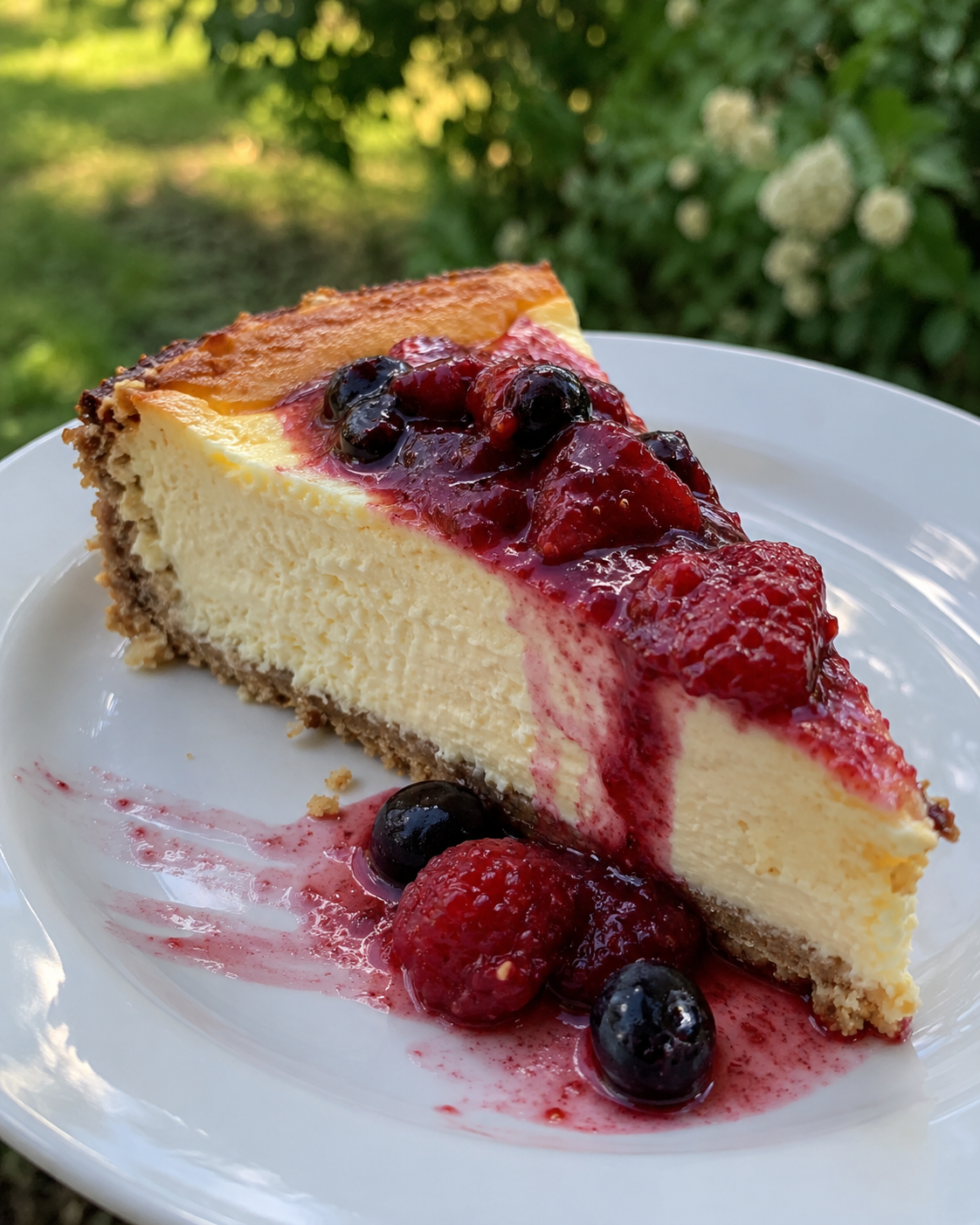
The Italian baked cheesecake tradition, served at peak strawberry season, with raspberry and mixed-berry sauce variations.
Yield: One 9-inch cheesecake, serves 10–12 · Active: 25 min · Total: Overnight chill (or 4 hours minimum) · Best in North America from late spring into early summer, when strawberries peak (raspberries peak from late June through August) · Best eaten: afternoon to early evening
Ingredients
Almond flour crust
3 cups fine-ground blanched almond flour
2 pasture-raised eggs, at room temperature
¼ cup pure maple syrup
¼ cup grass-fed ghee, melted (or raw butter)
2 tbsp coconut sugar
½ tsp Baja Gold sea salt
Mascarpone filling
3 cups mascarpone, at room temperature
1 cup raw-milk sour cream, at room temperature
4 pasture-raised egg yolks
Optional: 1 whole pasture-raised egg, for a firmer, cleaner slice
¾ cup pure maple syrup (or raw honey)
Juice and zest of 2 lemons
1 tbsp pure vanilla extract
Pinch of Baja Gold sea salt
Choose a sauce
Strawberry (late spring into early summer): 2 cups fresh strawberries, hulled and halved · 2 tbsp maple syrup or raw honey · 1 tbsp fresh lemon juice · pinch of salt · optional 1 tsp vanilla
Raspberry (late June through August): 2 pints fresh raspberries · 4 tbsp coconut sugar (or 2 tbsp raw honey) · juice of ½ lemon
Mixed berry coulis (full summer): 3 cups mixed berries (strawberries, raspberries, blueberries, and blackberries) · maple syrup to taste
To serve (optional): fresh halved strawberries, fresh mint leaves, whipped raw cream or homemade vanilla ice cream, and a light dusting of lemon zest
Method
Make the crust. Preheat the oven to 350°F. Line the bottom of a 9-inch springform pan with parchment and lightly grease the sides with melted ghee. Combine the almond flour, coconut sugar, and salt in a bowl. Add the melted ghee, maple syrup, and eggs, and mix with a fork or your hands until a soft dough forms. Press it firmly and evenly into the bottom of the pan, working it slightly up the sides (about ½ inch).
Bake the crust 10 minutes, until lightly golden. Let it cool slightly while you make the filling, and lower the oven to 325°F.
Make the filling. In a large bowl, whisk the mascarpone and sour cream until smooth. Both must be at room temperature, or the filling will be lumpy. If they're cold, set the bowl over a larger bowl of warm water for a few minutes, stirring, until softened.
Add the eggs. Whisk in the egg yolks (and the whole egg, if using) one at a time, fully incorporating each before adding the next. Then add the maple syrup, lemon juice and zest, vanilla, and salt. Whisk just until smooth; overbeaten batter traps air and cracks during baking.
Fill. Pour the filling into the pre-baked crust and smooth the top.
Bake low and slow. Set a pan of hot water on the rack below the cheesecake; the steam helps prevent cracking. Bake at 325°F for 55–65 minutes, until the edges are set but the center still has a slight wobble when the pan is gently jostled. The top may develop a light golden skin, which is normal.
Cool slowly. Turn off the oven and leave the cheesecake inside with the door cracked for 30 minutes. Then move it to a wire rack and let it cool completely at room temperature.
Chill. Cover and refrigerate at least 4 hours; overnight is better. The cheesecake is even better the day after, as the filling firms, the flavors deepen, and the texture turns silkier.
Make your sauce.
Strawberry: Warm the strawberries, maple syrup, lemon juice, salt, and vanilla (if using) in a small saucepan over medium-low heat for 5–8 minutes, stirring occasionally, until the berries soften. Mash with a fork for a chunky sauce, or pulse briefly for a smoother one.
Raspberry: Simmer the raspberries with the coconut sugar and lemon over medium heat until completely broken down.
Mixed berry coulis: Simmer the berries with maple syrup 8–10 minutes, and blend briefly with an immersion blender if you'd like it smoother.
Raw option: Skip the heat, and blend fresh berries with sweetener, lemon, and salt until still textured. It's brighter, and it preserves the berries' vitamin C.
Cool all sauces completely before serving.
Serve. Run a thin knife around the edge of the pan before releasing the springform. Slice with a warm, dry knife (run it under hot water and dry it between cuts for clean lines). Serve each slice with a generous spoonful of sauce, and add fresh strawberries, mint, and whipped cream or ice cream, if you like.
Storage: Refrigerated, covered, up to 5 days; the flavor is at its best on day two or three. For the best texture, don't freeze the whole cheesecake, though individual slices can be wrapped and frozen up to 1 month. All three sauces keep up to 5 days refrigerated.
Nourishment Notes
This is the older European baked cheesecake tradition, not the American cream cheese version, which was popularized in the early 20th century and is built around commercial cream cheese and refined sugar. Italian baked cheesecakes, like torta di ricotta, crostata di mascarpone, and dolce di formaggio, depending on the region, have been made in Italian kitchens for centuries, built around mascarpone, ricotta, or a blend, with eggs to bind, honey for sweetness, and lemon for brightness. Mascarpone is thought to date to 16th-century northern Italy, and cheesecakes themselves date back to ancient Rome. It's a truly ancestral dessert, and if your body tolerates dairy well, it's worth keeping in your spring repertoire.
Mascarpone is the heart of the recipe, and sourcing matters more here than for almost any other ingredient. It's technically not a cheese but a thickened cream: heavy cream is gently heated with citric or tartaric acid, then strained, for a rich product that's about 40–45% fat. When the cream comes from grass-fed, pasture-raised cows, mascarpone brings the full complement of fat-soluble vitamins (A, D, E, and K2), plus butyrate, the short-chain fatty acid that feeds the cells lining your gut. (Because mascarpone is made by heating cream with acid, it's never truly raw, but grass-fed cream still makes all the difference.) A baked cheesecake made with industrial cream cheese is a very different food nutritionally.
Raw sour cream contributes live cultures and the gentle acidity that balances the richness. Commercial sour cream in the U.S. often adds stabilizers like carrageenan and guar gum, which traditional sour cream doesn't need.
Pasture-raised egg yolks bind the filling without gelatin or starch, and they bring choline (important for liver and brain health), lutein and zeaxanthin (visible in their deep orange color), and the full spectrum of fat-soluble vitamins.
Fresh lemon, both juice and zest, does a lot of the work here. Its brightness keeps the richness from becoming overwhelming, and the d-limonene in the zest has been studied for its role in supporting the liver's detoxification pathways. Two lemons is better than one.
Strawberries at peak season carry more vitamin C by weight than oranges, plus anthocyanins and ellagic acid, with an unusually low glycemic load for a sweet fruit. Their pairing with dairy is centuries old: strawberries and cream are a classic European combination, with the fruit's acidity cutting the richness of the cream, and the cream's fat buffering the fruit's natural sugar. Raspberries bring a tarter brightness and ellagitannins, and a mixed-berry coulis layers each berry's distinct anthocyanins into one sauce.
As a seasonal food, this cheesecake belongs to late spring and early summer, when the days have fully opened, a time many traditions see as the body's season of greatest energy and appetite. Dairy from cows grazing on new spring grass is also at its most nourishing, richest in beta-carotene, conjugated linoleic acid, and vitamin K2. As a circadian food, this is an afternoon or early-evening dessert. Rich desserts land best in daylight hours, so a slice at three or four in the afternoon with tea or coffee is ideal. For dinner, serve it as part of the meal rather than hours afterward, while digestion is still active.
Sourcing
Mascarpone — made from grass-fed cream, with no stabilizers like carrageenan, modified food starch, or guar gum, from a local dairy or Vermont Creamery
Sour cream — raw and cultured, from a farmer you know and trust, or organic, cultured sour cream from grass-fed cows, with no stabilizers
Eggs — organic and pasture-raised, with deep orange yolks
Almond flour — organic, fine-ground, and blanched (keep it in the fridge); sprouted, blanched almond flour when available
Grass-fed ghee or raw butter — grass-fed ghee, or raw butter from a farmer you know and trust
Maple syrup, raw honey, and coconut sugar — organic Grade A dark maple syrup; organic, local, unfiltered raw honey; organic coconut sugar
Strawberries, raspberries, and mixed berries — organic, from a farmers' market in season (strawberries consistently rank near the top of EWG's Dirty Dozen)
Lemons and mint — organic (you're using the zest)
Vanilla — organic pure vanilla extract
Baja Gold sea salt
— Anna aka Food Marshall