Harissa Lamb Patties with Cucumber Feta Salad
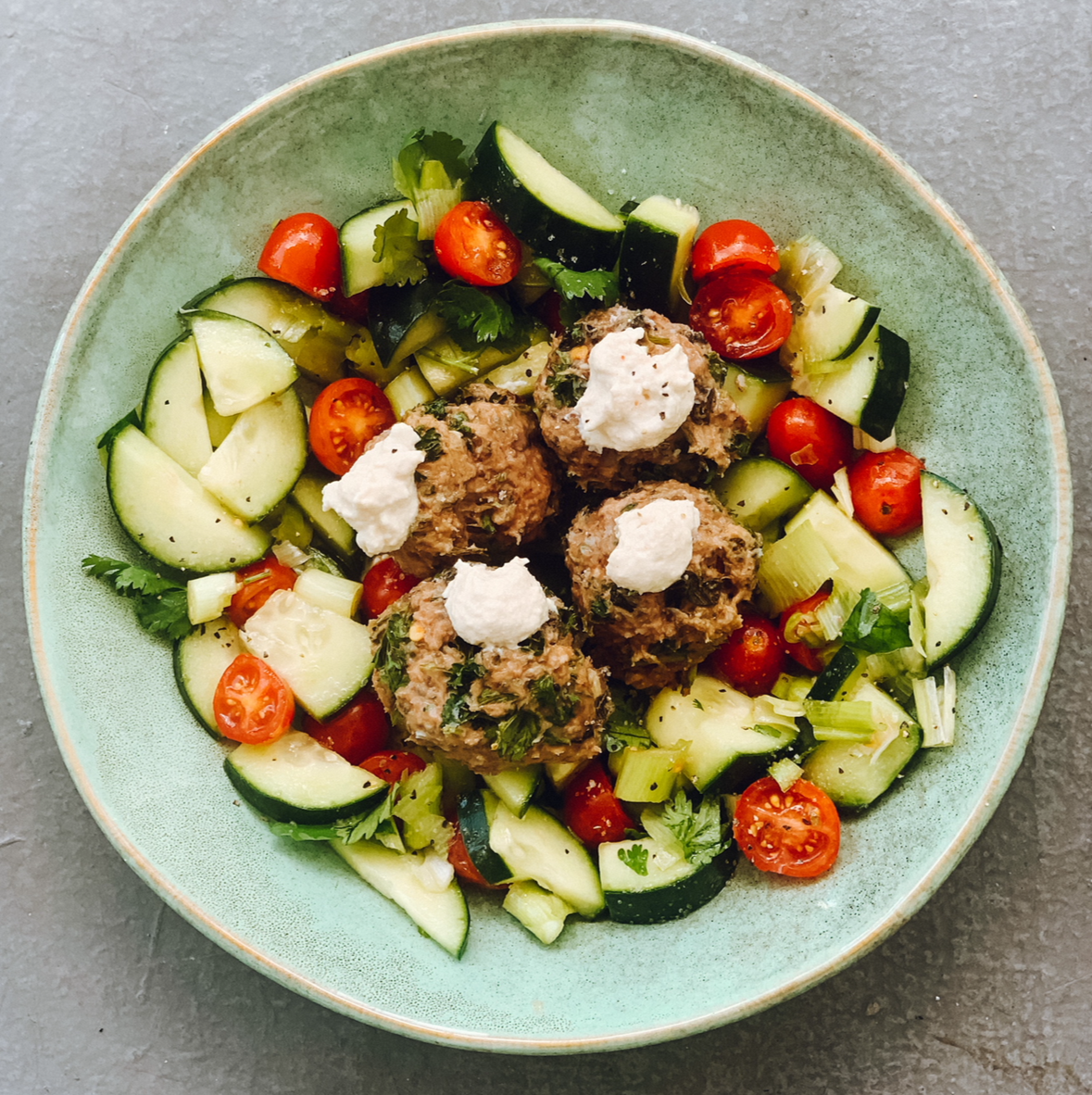
A spring crossing of North African spice and Mediterranean salad
Season: Spring · early Summer · Cuisine: Moroccan-Mediterranean · Yield: Serves 4 (or 6–8 as part of a mezze spread) · Active: 20 min · Total: 30 min · Best eaten: midday or early evening
Ingredients
Harissa Lamb Patties
1⅓ lbs grass-fed, grass-finished ground lamb
1 tsp real Tunisian harissa paste (more to taste)
1 tsp smoked paprika (Pimentón de la Vera)
¾ tsp ground cumin
½ tsp sea salt
¼ tsp freshly ground black pepper
2 tbsp single-estate extra virgin olive oil, for the pan
Harissa Yogurt Sauce
1 cup sheep's milk yogurt (or whole-milk goat or grass-fed cow yogurt)
1 small cucumber, finely diced or grated (about ½ cup)
1 tsp harissa paste
1 small garlic clove, microplaned
zest of ½ lemon, 1 tbsp fresh lemon juice
1 tbsp single-estate extra virgin olive oil
¼ tsp sea salt
Cucumber Feta Salad
1½ cups pea shoots or arugula (or both)
1 cucumber (English or Persian), sliced into quarter-moons
½ red onion, sliced into thin rings
1 cup crumbled sheep's milk feta
2 tbsp single-estate extra virgin olive oil
1 tbsp raw apple cider vinegar or fresh lemon juice
Optional: halved cherry tomatoes, torn fresh mint and parsley, a sprinkle of sumac
To serve (choose one)
4 sourdough buns, halved and toasted
Large butter lettuce or romaine leaves (grain-free wrap)
A platter for plated portions
Method
Yogurt sauce. Whisk together yogurt, cucumber, harissa, garlic, lemon zest and juice, olive oil, and salt. Refrigerate while you make the patties — flavors marry better with at least 15 minutes of rest.
Patty mixture. Combine ground lamb, harissa, smoked paprika, cumin, salt, and pepper. Mix gently with hands until spices are evenly distributed without overworking. Optionally pan-fry a tiny pinch to taste-test the seasoning.
Shape. Divide into 8 smaller or 4 larger patties about ¾-inch thick. Press a shallow dimple into the center of each — this keeps them flat rather than puffing into balls. Chill 10 minutes if time allows.
Salad. Toss pea shoots or arugula with cucumber, red onion, feta, olive oil, vinegar, and a pinch of salt. Add herbs and optional tomatoes at the end so they stay bright.
Sear. Heat olive oil in a heavy skillet (cast iron is ideal) over medium-high. Add the patties without crowding (work in batches if needed). Sear undisturbed 4 minutes until a deep brown crust forms, then flip and cook 3–4 minutes more for medium. Lamb dries out quickly — err on the side of under rather than over.
Rest. Rest the patties 2–3 minutes while you assemble plates.
Plate. Spoon a generous dollop of yogurt sauce on each plate; place patties over; mound the cucumber-feta salad alongside. Scatter fresh herbs, finish with flaky salt, a thread of olive oil, and an optional pinch of sumac.
Nourishment Notes
Pasture-raised, grass-finished lamb carries iron, zinc, B12, selenium, and conjugated linoleic acid in concentrations that exceed most muscle meats — and unlike beef, ground lamb at the supermarket still tends to come from animals raised on grass for most of their lives. Look specifically for "grass-finished" rather than just "grass-fed," which often means grain-finished in the final weeks. Sheep's milk yogurt and feta carry a different casein profile from cow milk — naturally closer to A2 beta-casein, which makes them more digestible for many dairy-sensitive people. Sheep milk is higher in fat per volume than cow or goat milk, richer in omega-3 fatty acids when the ewes have grazed varied forage, and contains meaningful short-chain fatty acids. Sheep yogurt is thicker, tangier, and genuinely more nourishing than cow yogurt.
Harissa is the distinctive ingredient here, and it is worth taking seriously. Traditional Tunisian harissa is sun-dried red chilies pounded with garlic, caraway, coriander, cumin, and olive oil — often briefly fermented before use, which develops complexity in the way all slow ferments do. The chile brings capsaicin, which has documented metabolism-supportive and circulation-stimulating effects. The full nutritional picture is more complex: caraway and coriander contribute anti-inflammatory terpenes; garlic contributes allicin; cumin supports digestion; olive oil carries polyphenols. In the Maghreb, harissa is understood as digestive medicine as much as flavor — a small spoonful with a meal stimulates digestive enzymes and supports the breakdown of rich foods like lamb. Use a real fermented harissa rather than a generic supermarket "harissa-flavored" product. Smoked Pimentón de la Vera, made from peppers dried over oak smoke for two weeks in western Spain, delivers carotenoids and vitamin A precursors alongside its distinctive flavor.
As a seasonal food, lamb belongs to spring. Across four thousand years of recorded agricultural history, ewes have lambed in late winter and early spring, with the first young animals ready to eat as the first warm evenings arrive. Every pastoral tradition in the Northern Hemisphere — Persian, Greek, Levantine, North African, Anglo-Saxon — treats spring lamb as a celebrated food. Pea shoots, arugula, and fresh herbs bring the peak-spring green load and support the liver's phase-two detoxification of the rich meal. Lamb is a dense, fat-forward protein best metabolized during daylight hours; midday or early evening is the ideal window, while there is still significant light on the table.
Storage: Leftover patties keep 2–3 days refrigerated and reheat in a dry skillet over low heat — or eat cold the next day, crumbled over a salad with the leftover yogurt sauce. Leftover yogurt sauce is exceptional on everything for the next few days — eggs, roasted vegetables, salads. The lamb mixture can be made up to 24 hours ahead; flavors improve overnight.
Sourcing: Grass-fed, grass-finished ground lamb is the structural foundation of this dish — sourcing matters here. Local pasture-raised lamb from a small farm at the farmers' market is the gold standard; many small-scale sheep farms across the country sell direct, and lamb is one of the cuts where regenerative grazing produces dramatically better flavor and nutritional density. For shipped options, Shepherd's Way (Wisconsin family farm), Elysian Fields Farm (Pennsylvania, the same farm that supplies Thomas Keller's restaurants), or White Oak Pastures (Georgia regenerative farm with exceptional lamb). Avoid commodity supermarket lamb labeled simply "grass-fed" — most is grain-finished in the final weeks; look specifically for "grass-finished" or "100% grass-fed." Australian and New Zealand lamb is generally pasture-raised throughout life and a reasonable widely-available option, though local US small-farm lamb is the genuine gold standard. Real Tunisian harissa: New York Shuk (small-batch, properly fermented, traditional Tunisian recipe — the gold standard widely available in the US), Mina (made in Morocco with real Tunisian process, widely available), or Belazu Rose Harissa (UK small-batch, exceptional). Avoid generic supermarket "harissa-flavored" products which often contain industrial seed oils, preservatives, or artificial flavors and lack the structural fermentation that defines real harissa. Smoked Pimentón de la Vera: La Chinata or La Dalia (both small Spanish producers from the La Vera region in western Spain, oak-smoked for two weeks following traditional methods); avoid commodity smoked paprika which is often industrially flash-smoked. Sheep's milk yogurt: local sheep dairy at the farmers' market is the gold standard (small sheep dairies are increasingly common across New England, the Pacific Northwest, and the Midwest); for shipped, Bellwether Farms (small-scale California sheep dairy, the rare commercial-scale producer that meets the structural standard) or Old Chatham Sheepherding Company (Hudson Valley, New York). Sheep's milk feta: imported Greek feta PDO (Protected Designation of Origin — only real Greek feta from sheep or sheep-goat blend) from a specialty importer like Eataly, Buon'Italia, or Murray's Cheese; Mt. Vikos and Real Greek Feta are widely-available options that meet the structural standard. Avoid commodity "feta" made from cow milk, which is structurally a different cheese. Cucumbers: heirloom varieties from a local farmers' market or backyard garden — Persian (Beit Alpha) and English (Hothouse) are ideal for this preparation due to thin skin and minimal seeds; backyard cucumber is a productive late-summer crop. Pea shoots and arugula: local farmers' market or your CSA share at peak spring — both are easy windowsill or backyard crops, ready to harvest in 2–3 weeks from seed. Red onion from local farmers' market. Heirloom hardneck garlic (Music, German Red, Spanish Roja) from local farmers' market. Single-estate extra virgin olive oil — small-producer, harvest-dated bottle from a quality importer like Gustiamo, Eataly, or Olio2Go; for this dish specifically, a fruity-peppery North African olive oil (Tunisian or Moroccan) is structurally authentic. Raw apple cider vinegar: local small-batch from a farmers' market, or Bragg's "with the mother." Lemon: local farmers' market or backyard tree (Meyer lemons in subtropical regions). Cumin: small specialty importer like Burlap & Barrel (single-origin, traceable to specific farms — they have an exceptional Indian cumin) or Diaspora Co. Sumac: Burlap & Barrel's wild Turkish sumac is exceptional and dramatically more flavorful than commodity supermarket sumac. Sourdough buns (if using): local sourdough bakery (every region has them — significantly higher quality than supermarket bread); for shipped, Backwoods Bread Bakery or Acme Bread Company are well-established small-batch options. Flaky sea salt: Maldon (English flake salt) or Jacobsen Salt Co. (Oregon).