Hawaiian Macadamia-Crusted Wild Fish with Tropical Mango-Passionfruit Salsa
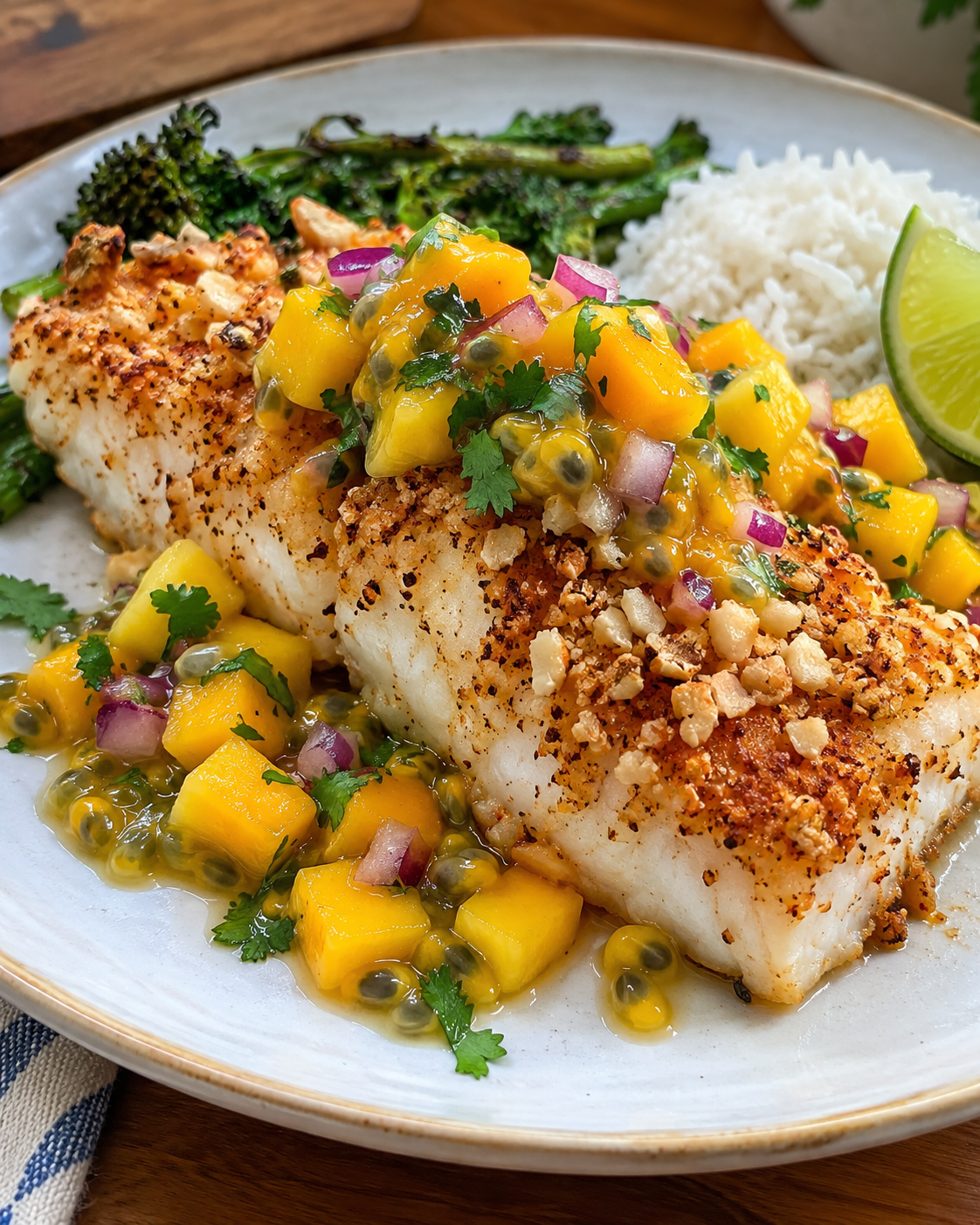
Crispy macadamia-coconut crusted fish over coconut-cilantro rice, crowned with a bright salsa of mango, papaya, and lilikoi (passionfruit). A sunny, island-inspired plate that comes together in about 40 minutes.
Yield: 4 servings · Active: 30 min · Total: 40 min · Spring and summer (year-round in the tropics) · Cuisine: Hawaiian-inspired, Pacific coastal · Best eaten: midday or early evening, outdoors if you can
Macadamias are the star of the crust. They're native to coastal Australia, where Aboriginal peoples ate them for thousands of years, and were brought to Hawaii in the 1880s, where they became one of the islands' signature crops. Buttery and sweet, they toast into a golden crust that pairs naturally with coconut, citrus, and tropical fruit.
The salsa contains Lilikoi (Hawaiian passionfruit), which brings a tropical, floral tang that mango alone can't. If you can't find it, mango, papaya, and lime on their own are still delicious.
For the fish, mahi-mahi (the name means "very strong" in Hawaiian) is the classic island choice, and ono (wahoo), barramundi, or wild salmon all work beautifully too.
Serve it over coconut-cilantro rice, or cauliflower rice for a grain-free plate, with a simple side of sautéed greens.
Ingredients
Macadamia-Crusted Fish
4 fish fillets (6 oz each, about 1 inch thick): mahi-mahi, ono (wahoo), barramundi, or wild salmon
1 cup raw macadamia nuts
½ cup unsweetened coconut flakes (or shredded coconut)
2 tbsp cassava flour or arrowroot (for binding)
1 tsp Baja Gold sea salt
½ tsp freshly ground black pepper
¼ tsp smoked paprika (optional, adds depth)
2 pasture-raised eggs, beaten
1 tbsp Dijon mustard (stirred into the eggs)
3 tbsp virgin coconut oil, for searing
Optional: 1 tbsp grass-fed butter, for basting at the end
Mango-Papaya-Passionfruit Salsa
1 large ripe mango (Ataulfo, also sold as Honey or Champagne, or Alphonso), finely diced
1 small ripe papaya, finely diced
¼ cup fresh passionfruit (lilikoi) pulp, about 4 fruits (or 2-3 tbsp unsweetened frozen passionfruit pulp)
½ cup fresh cilantro, chopped
¼ cup fresh mint, chopped
1 small red onion or shallot, finely diced
1 small Fresno chile or jalapeño, finely minced (seeds removed for less heat)
Juice of 1 lime
1 tbsp raw honey (only if your mangoes aren't fully ripe)
¼ tsp Baja Gold sea salt
Coconut-Cilantro Rice (or Cauliflower Rice for Grain-Free)
1½ cups jasmine or basmati rice, rinsed (or 4 cups riced cauliflower)
1 (13.5 oz) can full-fat coconut milk (use just ½ cup for cauliflower rice)
½ cup filtered water (skip for cauliflower rice)
½ tsp Baja Gold sea salt
½ cup fresh cilantro, chopped
1 tbsp grass-fed butter or coconut oil
Garnish: extra passionfruit pulp · lime wedges · fresh cilantro · toasted coconut flakes · optional sliced avocado
Swaps: Pistachios or pecans work in place of macadamias for a less buttery, more savory crust. For dairy-free, skip the optional butter. For nut-free, use pumpkin seeds plus extra coconut. For grain-free, use the cauliflower rice.
Method
Stage 1 · Make the Salsa (it needs 15 minutes to come together)
In a glass bowl, combine the mango, papaya, passionfruit pulp, cilantro, mint, red onion, chile, lime juice, optional honey, and salt.
Toss gently and let it rest at room temperature 15-30 minutes. Adjust the salt and lime to taste.
Stage 2 · Cook the Coconut-Cilantro Rice
For rice: Rinse the rice in a sieve until the water runs clear. Combine the rice, coconut milk, water, and salt in a saucepan and bring to a boil. Reduce to a low simmer, cover, and cook 15-18 minutes until the liquid is absorbed. Let it sit off the heat, covered, 5 minutes, then fluff with a fork and fold in the cilantro and butter. Keep covered and warm.
For cauliflower rice: Heat the coconut oil in a skillet over medium heat. Add the riced cauliflower and salt and cook 5-7 minutes until tender. Stir in the ½ cup coconut milk and cook 2 minutes more, then fold in the cilantro.
Stage 3 · Make the Macadamia-Coconut Crust
In a food processor, pulse the macadamias and coconut flakes into a coarse crumb, about 8 short pulses. Stop there, or the macadamias will turn into nut butter. You want texture, not paste.
Transfer to a shallow bowl and stir in the cassava flour, salt, pepper, and optional smoked paprika.
Stage 4 · Bread and Sear the Fish
Prep. Pat the fillets dry with paper towels and season lightly with salt and pepper.
Egg wash. In another shallow bowl, beat the eggs with the Dijon.
Bread. Dip each fillet in the egg mixture, let the excess drip off, then press it firmly into the macadamia crust on both sides so it sticks.
Sear. Heat the coconut oil in a large heavy skillet (cast iron or stainless) over medium heat until it shimmers. Nuts and coconut brown fast, so medium heat keeps the crust golden instead of scorched. Add the fillets without crowding the pan (work in two batches if needed) and cook 3-4 minutes per side, turning once carefully with a thin metal spatula, until the crust is deep golden brown.
Check doneness. The fish is ready when it's opaque and flakes easily, about 135-140°F for mahi-mahi, ono, or barramundi, or 125-130°F for salmon. For fillets thicker than an inch, slide the skillet into a 400°F oven for 4-6 minutes to finish.
Baste (optional). Add the butter in the last 30 seconds and spoon it over the fish.
Rest the fillets on a wire rack for a minute (paper towels steam the crust soft).
Stage 5 · Plate and Serve
Spoon the coconut-cilantro rice (or cauliflower rice) onto each plate.
Top with a fillet of macadamia-crusted fish.
Crown it generously with the mango-papaya-passionfruit salsa.
Garnish with a drizzle of extra passionfruit pulp, lime wedges, cilantro, toasted coconut flakes, and optional avocado.
Serve right away while the crust is crisp.
Nourishment Notes
Macadamia nuts are a standout among nuts. About 80% of their fat is monounsaturated (much like olive oil), they're the lowest in omega-6 of any common nut, and they're rich in palmitoleic acid (an omega-7 fat), which is rare outside macadamias and sea buckthorn. They also bring thiamine, manganese, and copper.
Mahi-mahi, ono, barramundi, and wild salmon deliver complete protein, selenium, B12, and iodine. Wild salmon is by far the richest in omega-3s (EPA and DHA) and vitamin D, while the others carry more modest amounts. As mid-size fish, they also carry much less mercury than big predators like swordfish or bigeye tuna.
Coconut in three forms (oil, milk, and flakes) is foundational across Pacific Islander cooking. Coconut oil is rich in lauric acid, a medium-chain fat, and virgin unrefined oil keeps its polyphenols and gentle coconut aroma. Coconut milk's richness helps carry fat-soluble nutrients, and the flakes add fiber and crunch.
The salsa is a tropical antioxidant bowl. Mango brings beta-carotene, vitamin C, and folate. Papaya adds vitamin C, beta-carotene, folate, and small amounts of papain, a protein-digesting enzyme. Passionfruit brings vitamin C, beta-carotene, and fiber, and its seeds contain piceatannol, a polyphenol related to resveratrol. Cilantro adds chlorophyll, mint brings menthol, the chile brings capsaicin, and lime adds vitamin C and d-limonene.
Coconut-cilantro rice reflects modern Hawaii. Rice arrived with Chinese and Japanese immigrants in the 1800s and is now at the heart of local island plates, and jasmine or basmati cooked in coconut milk turns fragrant and faintly sweet. Cauliflower rice is the grain-free option, gentler on blood sugar and a natural match for the macadamia and coconut.
As a circadian and seasonal food, this plate lands best at midday or early evening, when digestion is strongest. It's at its peak from spring through summer, when tropical fruit is at its best and warm-weather meals belong outside. Year-round in the tropics; in cooler months elsewhere, frozen mango and frozen passionfruit pulp both work beautifully.
Pair with: chilled coconut water with lime, cold-brewed hibiscus tea, sparkling water with a spoonful of passionfruit pulp, or a glass of crisp, dry white wine.
Sourcing (essential picks)
Mahi-mahi and ono — U.S. troll- or pole-caught (from Hawaii or the Atlantic), a more selective method than longlining. Frozen-at-sea is excellent
Barramundi — nearly all barramundi sold in the U.S. is farmed; look for responsibly farmed fish, ideally from land-based recirculating systems
Wild salmon — wild Alaskan, from Vital Choice or a trusted fishmonger
Macadamia nuts — raw and unsalted, Hawaiian-grown from Big Island farms such as Hamakua Macadamia Nut Co. or MacFarms. Keep them in the fridge
Coconut flakes — organic, unsweetened, and sulfite-free
Coconut oil — organic, virgin, and unrefined
Coconut milk — full-fat, with just coconut and water; Native Forest Simple comes in BPA-free cans
Passionfruit (lilikoi) — fresh from Hawaii or a farmers' market when you can find it; otherwise, frozen 100% passionfruit pulp. Check the label, since many brands add sugar
Mango — organic Ataulfo (peak roughly February through July) or Alphonso (peak April through June)
Papaya — organic. Much conventional Hawaiian papaya is genetically engineered, and certified organic papaya is always non-GMO
Pasture-raised eggs — from a local farm where the hens truly range on pasture, or Alexandre Family Farm (Regenerative Organic Certified)
Cassava flour — Otto's Naturals; or organic arrowroot
Dijon mustard — Edmond Fallot, stone-ground in Burgundy by a family mill since 1840, with no sugar
Rice — organic basmati or jasmine. Basmati from India, Pakistan, or California tends to be lower in arsenic, and rinsing helps too
Cauliflower, cilantro, mint, chiles, red onion, and limes — organic, from a farmers' market
Smoked paprika (optional) — Pimentón de la Vera DOP
Raw honey (optional) — local, unfiltered
Grass-fed butter (optional) — cultured butter from 100% grass-fed cows, or raw butter from a local dairy
Baja Gold sea salt
Storage
Best eaten the day it's cooked, since the macadamia-coconut crust loses its crunch overnight. The salsa keeps 2 days refrigerated and is excellent on grilled chicken, eggs, or as a dip with cassava chips. The coconut rice keeps 3 days. For 8 or more guests, double the recipe and cook the fish in two skillets at once. Make ahead: the salsa can be made 4 hours ahead, and the macadamia crust mix keeps in the fridge 3 days. Cook the fish right before serving.
— Anna aka Food Marshall