Custard Tart with Plum Compote and Almond-Hazelnut Shortbread Crust
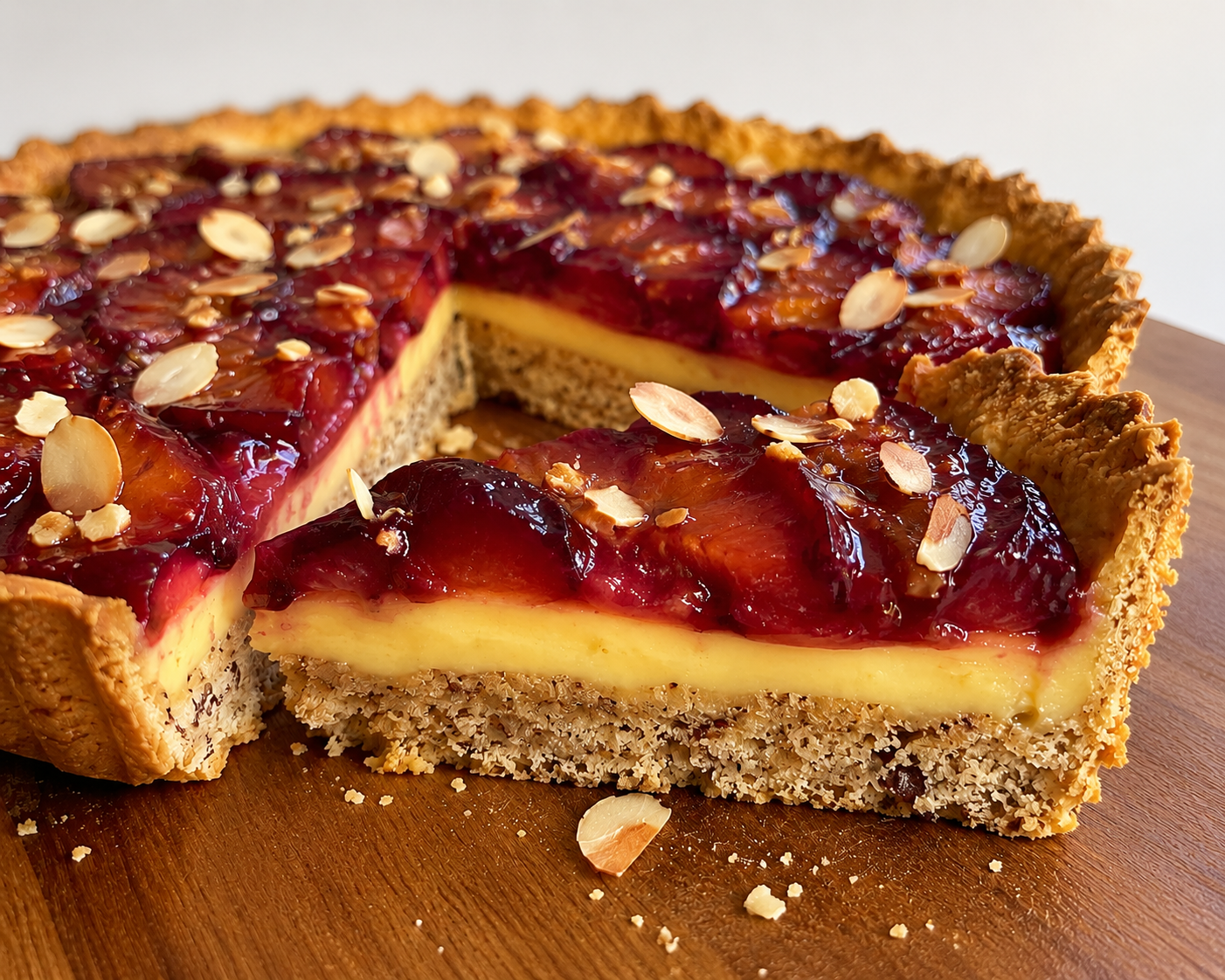
A grain-free almond-hazelnut shortbread crust, a silky raw-cream egg custard filling sweetened with raw honey, and a glossy warm plum compote spooned over the top.
The whole thing is grain-free, refined-sugar-free, full of fat-soluble vitamins, complete protein from the egg yolks, polyphenols and fiber from the plums, and healthy MUFA fats from the nut crust.
Yield: 8 servings (one 9-inch tart)
Active: 45 min · Total: 5 hr (with chilling)
Late summer (peak plum season)
Ingredients
For the almond-hazelnut shortbread crust
1 cup blanched almond flour (finely ground)
½ cup hazelnut flour (or pulse raw hazelnuts in a food processor until fine)
3 tbsp cassava flour
3 tbsp raw honey
4 tbsp grass-fed butter, melted and cooled slightly
1 large pasture-raised egg yolk
1 tsp pure vanilla extract
Pinch of Baja Gold sea salt
Optional: 1 tsp finely grated lemon zest (adds brightness)
For the raw cream custard filling
2 cups raw cream (or whole raw milk for a lighter set, or a 50/50 blend of both)
5 pasture-raised egg yolks
3 tbsp raw honey (preferably local, light-colored such as orange blossom or wildflower)
1 vanilla bean (seeds scraped) or 1 tsp pure vanilla extract
Pinch of Baja Gold sea salt
For the plum compote
6 ripe plums (Italian prune plums, Santa Rosa, or any ripe summer plum), pitted and quartered
2-3 tbsp raw honey (or pure maple syrup)
Juice of half a lemon
1 small cinnamon stick (or ½ tsp ground cinnamon)
1 strip lemon peel (no white pith)
Splash of water (about 2 tbsp)
Optional: 1 star anise pod (for a more complex spice profile)
Optional: pinch of Baja Gold sea salt (deepens the fruit flavor)
For finishing (optional)
A few mint leaves or basil leaves (basil pairs surprisingly beautifully with plum)
Toasted slivered almonds, pistachios, or chopped hazelnuts for crunch
A drizzle of raw honey if extra sweetness is desired
Edible flowers for visual drama (pansies, nasturtium, borage)
Method
Make the crust
Preheat the oven to 350°F. Lightly grease a 9-inch tart pan with a removable bottom.
Combine the dry ingredients. In a medium bowl, whisk together the almond flour, hazelnut flour, cassava flour, and sea salt.
Combine the wet ingredients. In a small bowl, whisk together the melted butter, raw honey, egg yolk, vanilla, and optional lemon zest until smooth.
Form the dough. Pour the wet ingredients into the dry and mix with a fork until a soft, slightly sticky dough forms.
Press into the tart pan. Press the dough evenly across the bottom and up the sides of the tart pan, about ¼-inch thick. Use your fingers and the bottom of a flat measuring cup to compact it firmly. The dough should come slightly above the rim of the pan (it will settle during baking).
Blind-bake the crust. Prick the bottom all over with a fork. Bake for 12–15 minutes until the edges are deeply golden and the bottom is set. If the crust puffs up during baking, gently press it back down with the back of a spoon while still warm. Let cool completely before adding the custard.
Make the custard
Warm the cream. Gently warm the raw cream with the scraped vanilla bean seeds and pod in a saucepan over the lowest heat possible — just until it reaches a bare steam, never letting it boil or simmer (boiling damages the raw fats and beneficial enzymes).
Dissolve the honey into the warm cream. Whisk the raw honey directly into the warm cream until fully dissolved. This is the technique that creates the cleanest set and most even sweetness throughout the custard.
Whisk the yolks. In a separate bowl, whisk the egg yolks with the pinch of sea salt until pale and slightly thickened.
Temper the cream into the yolks. While whisking the yolks constantly, slowly drizzle in the warm honey-cream in a thin stream until fully combined. If using vanilla extract instead of a vanilla bean, add it now.
Strain. Pour the custard through a fine-mesh strainer into a measuring cup with a pour spout. This catches any cooked egg bits and ensures a perfectly silky texture.
Pour into the cooled crust. Carefully pour the custard into the cooled, blind-baked crust. Fill almost to the rim of the crust.
Bake in a water bath. Place the tart pan on a sheet pan. Pour hot water onto the sheet pan around the tart (about ½-inch deep) — this is your water bath. Reduce oven temperature to 300°F. Bake 35–45 minutes, until the custard is just set with a faint wobble in the center (it will continue setting as it cools). The edges should be set; the very center should still have a slight tremor when the pan is gently shaken.
Cool and chill. Carefully remove the tart from the water bath and let cool to room temperature on a wire rack (about 1 hour). Then refrigerate, uncovered, for at least 3 hours and ideally overnight. The custard sets fully during this chilling period.
Make the PLUM COMPOTE
Simmer the compote. Combine the plums, raw honey, lemon juice, cinnamon stick, lemon peel, optional star anise, optional salt, and splash of water in a small saucepan over medium-low heat. Cook 12–15 minutes, stirring occasionally, until the plums have broken down into a loose, glossy compote with the skins curling slightly. The texture should be jammy but not solid.
Pull aromatics and cool slightly. Remove the cinnamon stick, star anise, and lemon peel. Let the compote cool until warm (not hot) — this is the temperature you want for serving.
Plate
Remove the tart from the pan. Run a thin knife around the edge if needed. Lift out the removable bottom and place the tart on a serving plate.
Spoon the warm compote over the chilled tart. Cover the top of the tart with the warm compote, allowing some custard to peek through at the edges for visual contrast. The warm-over-cold contrast is the structural finish of the dessert.
Garnish. Scatter optional toasted slivered almonds or chopped hazelnuts, a few small mint or basil leaves, and edible flowers if using. Finish with a tiny drizzle of raw honey if extra sweetness is desired.
Serve immediately. Slice with a sharp knife wiped clean between cuts.
Variations
With fig compote (August–October): Substitute the plums with 8 ripe figs, halved, cooked with the same honey-lemon-cinnamon base. Beautifully late-summer.
With apricot compote (May–July): Substitute 8 ripe apricots, halved and pitted, cooked with the same honey-lemon-cinnamon base. The slight tartness pairs beautifully with the raw cream custard.
With cherry compote (May–July): Substitute pitted Bing or Rainier cherries cooked the same way.
With raspberry-rose compote: Substitute 2 cups fresh raspberries, simmered with raw honey, lemon, and 1 tsp rosewater. Spring/early summer.
With pear compote (autumn): Substitute 4 ripe pears, peeled and diced, simmered with raw honey, lemon, and a pinch of cinnamon. Beautiful for fall.
Ricotta version: Replace 1 cup of the cream with 1 cup whole-milk raw ricotta for a more substantial, cheesecake-like filling. Italian-Mediterranean character.
Greek yogurt version: Replace 1 cup of the cream with 1 cup whole-milk grass-fed Greek yogurt. Produces a denser, slightly tangier set — closer to a yogurt cheesecake.
Chocolate version: Whisk 2 oz finely chopped 85% dark chocolate into the warm cream until melted and fully incorporated.
Citrus version: Add 1 tbsp finely grated orange or lemon zest to the cream while warming (or directly to the yolks if not warming). Beautiful with a blood orange compote in winter.
Sourcing
Raw cream. From a small grass-fed dairy. Look for Organic Pastures (California), Raw Farm (California), or check your state's raw dairy regulations and local farmers' markets. The cream should be deep yellow (a sign of grass-fed dairy and beta-carotene), not stark white.
Pasture-raised eggs. From a small farm or trusted farmer's market source. Yolks should be deep orange (a sign of pasture access and varied diet), not pale yellow.
Blanched almond flour. Look for finely ground blanched almond flour (skins removed) — not almond meal. Quality brands include Bob's Red Mill Super-Fine Blanched Almond Flour, Anthony's Goods, King Arthur Baking, or Wellbee's. Single-ingredient: just almonds. Store in the refrigerator once opened to prevent rancidity.
Hazelnut flour. Bob's Red Mill sells hazelnut flour, or pulse raw whole hazelnuts in a food processor until finely ground (don't over-process or you'll get hazelnut butter).
Cassava flour. Look for Otto's Naturals or a quality single-ingredient cassava flour.
Raw honey. Local, unfiltered, single-origin when possible. For the custard filling, use a lighter honey (orange blossom, wildflower, clover) so it doesn't overwhelm the vanilla. For the plum compote, a darker honey (buckwheat, chestnut) adds welcome complexity.
Grass-fed butter. From cows on pasture year-round. Vital Farms, Organic Valley Pasture Butter, or local artisan brands.
Vanilla bean. Madagascar bourbon vanilla beans are the gold standard. Look for plump, oily, fragrant beans.
Ripe plums. From a farmer's market in peak summer. Italian prune plums (oval, deep purple) hold their shape best for compote; Santa Rosa, black plum, or pluot varieties also work beautifully. The plums should yield slightly to pressure but not be mushy.
Sea salt. Baja Gold mineral sea salt throughout.
Storage
Crust (unfilled, baked): Room temperature in an airtight container up to 2 days, or freezer up to 1 month.
Custard tart (filled, baked): Refrigerator up to 3 days, covered loosely with plastic wrap or a domed cake cover. The texture is best within 24–48 hours.
Plum compote: Refrigerator up to 1 week, sealed in a glass jar. Can be warmed gently before serving.
Scraped vanilla bean pod: Rinse and dry the pod after use. Store in a small jar of raw honey or in dried form for future infusions — the pod still carries significant vanilla flavor.
Why This Dessert
Most modern desserts deliver concentrated refined sugar, industrial seed oils, and refined grain flour — a structural combination that spikes blood sugar, depletes minerals, and inflames the body. This tart inverts that structure entirely.
The grain-free almond-hazelnut crust delivers vitamin E, magnesium, MUFA fats, and slow-burning energy without the blood sugar spike of wheat flour. The raw cream custard delivers the fat-soluble vitamins A, D, K2, beta-carotene, and CLA from grass-fed dairy — and the source quality of raw cream remains genuinely superior even after gentle baking. The choline, lutein, and complete protein from pasture-raised yolks anchor the filling nutritionally.
This is the kind of dessert built on real fats, real eggs, real honey, and real fruit. It's celebratory and nourishing simultaneously.
— Anna aka Food Marshall