Korean-Style Short Ribs with Sesame-Cabbage Stir-Fry and Grain-Free Cauliflower Rice
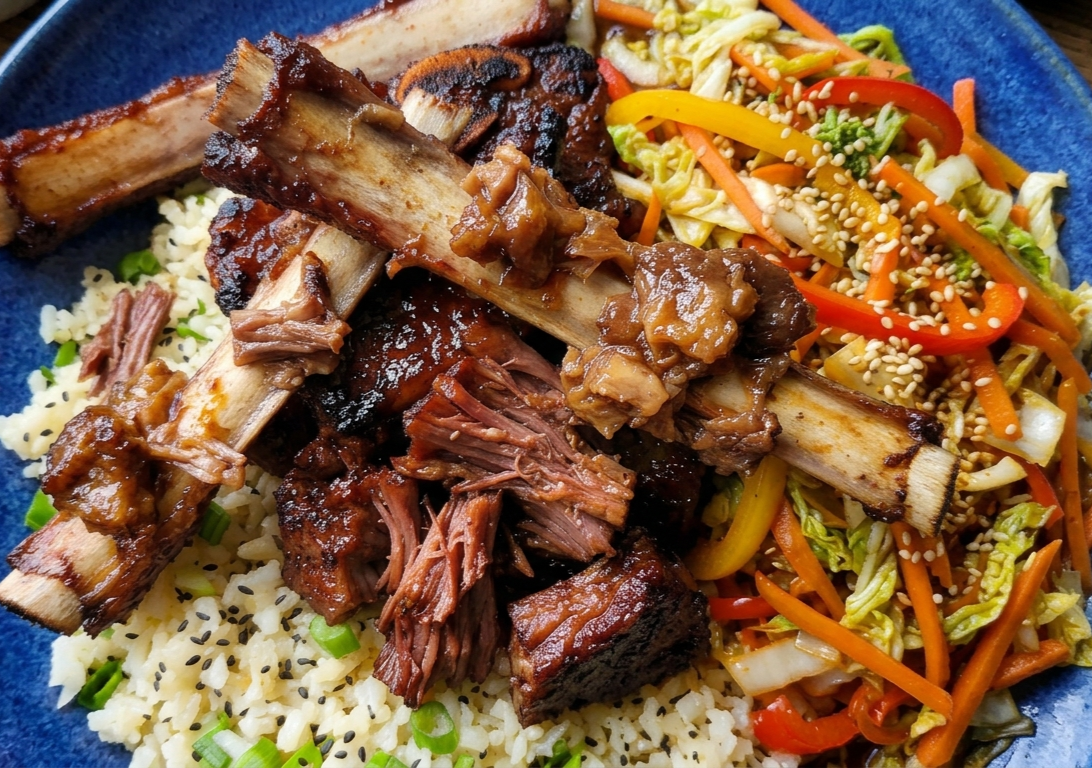
Grass-fed beef short ribs marinated in coconut aminos, ginger, garlic, and pear, then grilled or seared until deeply caramelized; sesame-cabbage stir-fry with coconut aminos and toasted sesame oil; and grain-free cauliflower rice as the base.
Yield: 4-6 servings · Active: 40 min · Total: 1 hr 15 min (plus 4-24 hr marinade for short ribs) · Year-round · Best eaten: early evening
Complete Menu
Coconut Aminos Korean-Style Short Ribs (Gluten-Free Galbi)
Sesame-Cabbage Stir-Fry with Coconut Aminos
Grain-Free Cauliflower Rice
Optional accompaniments: sliced scallions, fresh cilantro, toasted sesame seeds, homemade kimchi (see Sourcing), sliced perilla or shiso leaves, lettuce cups for wrapping.
Recipe 1 — Coconut Aminos Korean-Style Short Ribs
Yield: 4-6 servings · Active: 20 min · Total: 30 min (plus 4-24 hr marinade)
Ingredients
Short ribs
3 lb grass-fed beef short ribs — flanken-style cut across the bone (thin ½-inch strips), or English cut (thick, bone-in) — see notes
Marinade (traditional Korean galbi, reimagined without soy or sugar)
½ cup coconut aminos
¼ cup fresh Korean or Bosc pear, grated (essential — tenderizes the meat)
¼ cup fresh apple, grated (traditional Korean tenderizing technique)
3 tbsp toasted sesame oil
3 tbsp extra virgin olive oil
6 garlic cloves, finely minced
2 tbsp fresh ginger, finely grated
1 medium yellow onion, finely grated
2 tbsp raw apple cider vinegar
1 tbsp raw honey (optional)
1 tsp gochugaru (Korean chili flakes) — see Sourcing
1 tsp freshly cracked black pepper
1 tsp sea salt
To finish
3 scallions, thinly sliced
1 tbsp toasted sesame seeds
Fresh cilantro
Lettuce leaves for wrapping (optional but traditional)
Method
Marinade prep:
Prep the ribs. If using flanken-style (thin cross-cut), rinse briefly and pat dry. If using English cut (thick, bone-in), leave whole — cooking method will differ.
Blend the marinade. In a food processor or blender, combine grated pear, grated apple, minced garlic, grated ginger, grated onion, coconut aminos, sesame oil, olive oil, raw apple cider vinegar, optional honey, gochugaru, pepper, and salt. Blend until smooth.
Marinate. Place ribs in a large glass container or bowl. Pour the marinade over. Toss to coat every piece. Cover and refrigerate at least 4 hours (12-24 hours ideal — the pear and apple enzymes tenderize the meat).
Cook the ribs (choose your method):
Option A — Grilling (traditional Korean method, best flavor):
4a. Bring to room temp. Remove ribs from refrigerator 30 minutes before grilling.
5a. Heat the grill. Charcoal grill preferred; gas grill works. Heat to high (450-500°F).
6a. Grill. For flanken-style: grill 2-3 minutes per side until deeply caramelized and slightly charred at the edges. The thin strips cook fast — don't overcook. For English cut: grill 4-5 minutes per side, then move to a cooler zone and cook 15-20 more minutes covered until internal temp reaches 135°F for medium-rare.
Option B — Pan-searing (for indoor cooking):
4b. Bring to room temp. Same as above.
5b. Heat the skillet. Heat a cast iron skillet over medium-high heat until smoking hot. Add 2 tbsp olive oil.
6b. Sear. For flanken-style: 2-3 minutes per side. For English cut: 4-5 minutes per side, then transfer to a 400°F oven for 15-20 minutes until 135°F internal.
Rest. Transfer to a warm platter. Rest 5-8 minutes. Garnish with sliced scallions, toasted sesame seeds, and fresh cilantro. Serve with lettuce cups for wrapping.
Recipe 2 — Sesame-Cabbage Stir-Fry with Coconut Aminos
Yield: 4-6 servings · Active: 15 min · Total: 15 min
Ingredients
1 small napa cabbage (about 1½ lb), roughly chopped into 2-inch pieces (or use green cabbage)
2 medium carrots, thinly julienned
1 red bell pepper, thinly sliced
4 scallions, cut into 2-inch pieces
3 garlic cloves, thinly sliced
1 tbsp fresh ginger, finely grated
3 tbsp extra virgin olive oil
1 tbsp toasted sesame oil
3 tbsp coconut aminos
1 tbsp raw apple cider vinegar
1 tbsp fresh lime juice
1 tsp gochugaru (Korean chili flakes) or red pepper flakes (optional)
1 tsp sea salt
2 tbsp toasted sesame seeds
Fresh cilantro or shiso leaves for garnish
Method
Heat the pan. Heat the olive oil in a wok or large cast iron skillet over medium-high heat until shimmering.
Sauté aromatics. Add sliced garlic and grated ginger. Cook 30 seconds until fragrant.
Add hard vegetables first. Add sliced carrots and red bell pepper. Cook 2-3 minutes until softening.
Add cabbage. Add the chopped cabbage in batches. Cook 4-5 minutes, tossing frequently, until the cabbage is wilted but retains some crunch.
Add scallions and seasonings. Add scallions, coconut aminos, raw apple cider vinegar, lime juice, salt, and optional chili flakes. Toss to coat everything.
Finish. Drizzle with toasted sesame oil (added at the end to preserve the flavor). Toss briefly. Transfer to a serving platter.
Garnish. Sprinkle with toasted sesame seeds and fresh cilantro or shiso leaves.
Recipe 3 — Grain-Free Cauliflower Rice
Yield: 4-6 servings · Active: 10 min · Total: 15 min
Ingredients
1 large head cauliflower, cut into florets (about 5-6 cups) — or use pre-riced cauliflower
2 tbsp extra virgin olive oil
1 shallot or ½ small onion, finely minced
2 garlic cloves, finely minced
1 tsp sea salt
¼ tsp freshly cracked black pepper
1 tbsp fresh flat-leaf parsley, finely chopped
1 tsp toasted sesame oil (optional, for Asian character)
1 tsp coconut aminos (optional, for umami)
1 tbsp fresh lime juice (for brightness)
optional add-in: chopped macadamia nuts
Method
Rice the cauliflower. Pulse the cauliflower florets in a food processor until they resemble rice grains. Don't process into a paste.
Sauté aromatics. Heat olive oil in a large skillet over medium heat. Add minced shallot and cook 2 minutes until softened. Add garlic and cook 30 seconds until fragrant.
Cook the cauliflower. Add riced cauliflower and salt. Cook 5-6 minutes, stirring occasionally, until tender but not mushy. It should look like fluffy rice.
Finish. Add pepper, optional sesame oil, optional coconut aminos, and lime juice. Toss to combine. Garnish with fresh parsley.
Plating the Complete Meal
Serve family-style on a large platter or serving board: pile the cauliflower rice on the center; arrange the sesame-cabbage stir-fry alongside; top with the grilled or seared short ribs. Garnish with sliced scallions, sesame seeds, fresh cilantro, and lettuce leaves for wrapping. Traditional Korean-style eating involves each person taking a lettuce leaf, adding a spoonful of cauliflower rice, a piece of short rib, some cabbage stir-fry, and any garnishes, then folding into a wrap. Serve with kimchi and additional coconut aminos or gochugaru at the table.
Variations for the Whole Meal
With ground beef or other grass-fed/pasture-raised meat: Substitute short ribs with grass-fed skirt steak (2-inch strips, marinated the same way), pasture-raised pork shoulder (cubed and marinated), or bone-in chicken thighs (marinated 4-8 hours)
Sourcing
Grass-fed beef short ribs — flanken-style (thin cross-cut, ½-inch strips) is traditional for Korean galbi. English cut (thick, bone-in) works for a heartier braise. Sources: local butcher, farmers' market, or shipped from grass-fed producers. Ask specifically for flanken-cut when ordering
Fresh Korean or Bosc pear — Korean pears (also called Asian pears) are ideal but Bosc pears work beautifully. Firm, sweet, meaty
Fresh napa cabbage — firm, dense heads with white ribs and tender green leaves. Farmers' market or Asian grocer
Green or red bell pepper — organic, firm
Fresh carrots — organic, firm, bright color
Fresh scallions — organic, firm white bulbs, vibrant green tops
Fresh cilantro — vibrant green, from a farmers' market
Fresh shiso or perilla leaves (optional) — from an Asian grocer, traditional in Korean cooking
Coconut aminos — single-ingredient (fermented coconut sap and sea salt), no soy, no additives
Toasted sesame oil — cold-pressed, single-ingredient, in a dark glass bottle
Toasted sesame seeds — organic. Or toast raw seeds yourself
Raw apple cider vinegar — with the mother
Fresh ginger and garlic — organic, plump ginger rhizomes, hardneck garlic
Gochugaru (Korean chili flakes) — the traditional Korean chili powder for kimchi and galbi. Look for gochugaru that's not blended with additives, sugars, or MSG. Available at Korean grocers or specialty Asian markets. Not the same as generic red pepper flakes — has a distinctive fruity-smoky character
Homemade or raw kimchi (optional accompaniment) — traditionally fermented, live cultures. Look for kimchi at Korean grocers or high-quality fermented food producers. Avoid pasteurized kimchi (no live cultures)
Cauliflower — firm, dense heads with tight florets
Fresh lettuce (for wrapping) — butter, romaine, or red leaf lettuce
Single-estate extra virgin olive oil — for cooking
Baja Gold sea salt for cooking; flaky finishing salt for garnishing
Whole and ground spices (organic, non-irradiated, single-origin) — always chosen fresh from whole seeds when possible for meaningfully brighter flavor and bioactive compound retention
Storage
Cooked short ribs: Refrigerated up to 4 days, sealed. Reheat gently. Freezes up to 3 months
Marinade (before use): Refrigerated up to 5 days
Sesame-cabbage stir-fry: Refrigerated up to 3 days, sealed
Cauliflower rice: Refrigerated up to 4 days, sealed. Excellent cold or reheated
Marinade with ribs (before cooking): Refrigerated 12-24 hours ideal. Do not freeze marinated raw meat
Support for the Female Infradian Rhythm
This meal is deeply supportive during menstrual and luteal phases (Days 18-5) when protein and iron are especially important. Grass-fed beef short ribs deliver exceptional bioavailable heme iron, B12, zinc, and complete protein — essential for iron replenishment during menstruation. Cabbage delivers sulforaphane and DIM precursors for estrogen metabolism support during follicular phase. Ginger's anti-inflammatory support is particularly meaningful for menstrual cramping. Toasted sesame seeds deliver lignans that support hormone balance, calcium, and magnesium (essential for luteal-phase mood and cramp prevention). Coconut aminos support blood-sugar stability (compared to sugar-heavy commercial teriyaki sauces). Fresh cilantro binds heavy metals. The whole meal is warm, grounding, satisfying — exactly what the body craves during the more inward-facing cycle phases.
Nourishment Notes
Grass-fed beef short ribs — heme iron, B12, zinc, and CLA. Grass-fed beef delivers concentrated heme iron (highly bioavailable), B12, zinc, and conjugated linoleic acid (CLA — substantially higher in grass-fed vs. grain-fed animals). Bone-in short ribs specifically add glycine, proline, and gelatin from the collagen breakdown during cooking. Beef short ribs from pasture-raised animals have a fundamentally different fatty acid profile than commodity feedlot beef — meaningfully more omega-3s and CLA, less inflammatory omega-6.
Pear and apple (marinade tenderizing) — enzymes and fiber. Traditional Korean cuisine uses grated pear and apple as natural meat tenderizers — their enzymes (particularly protease enzymes) break down muscle protein at a cellular level. This is why authentic Korean galbi doesn't require industrial tenderizing agents or sugar-heavy commercial marinades. The fruit fiber also delivers pectin and polyphenols to the finished dish.
Coconut aminos — subtle umami with lower glycemic impact than soy sauce. Fermented coconut sap and sea salt — provides the umami depth that traditional soy sauce delivers, without soy (which is inflammatory for many people) and with a lower glycemic load.
Napa cabbage — sulforaphane, vitamin K, and folate. Cruciferous compound support for estrogen metabolism through Phase 2 liver detoxification, plus vitamin K, folate, and vitamin C. Napa cabbage is more delicate than green cabbage — cooks faster and provides gentler cruciferous compounds.
Fresh ginger and garlic — gingerols, allicin, and anti-inflammatory compounds. Ginger is one of the best-studied natural anti-inflammatories for menstrual pain. Garlic delivers allicin (formed when garlic is crushed), organosulfur compounds, and prebiotic inulin fiber.
Toasted sesame seeds and oil — lignans, calcium, magnesium, and vitamin E. Sesame delivers lignans (sesamin and sesamolin) that support hormone balance, particularly for female estrogen metabolism. Sesame is also one of the highest plant sources of calcium and magnesium.
Bell pepper — vitamin C and beta-carotene. Red bell peppers deliver more vitamin C per ounce than citrus, plus beta-carotene and capsanthin.
Carrots — beta-carotene and fiber. Cooked carrots deliver bioavailable beta-carotene (converts to vitamin A in the body) and fiber.
Gochugaru (Korean chili flakes) — capsaicin and traditional Korean umami. Capsaicin has documented anti-inflammatory and thermogenic effects. Traditional Korean gochugaru has a fruity-smoky character distinct from generic chili flakes.
Homemade kimchi (optional accompaniment) — live probiotic cultures, sulfur compounds, and traditional fermented depth. Raw fermented kimchi delivers Lactobacillus and other beneficial bacteria that support gut microbiome diversity. Traditional Korean fermented cabbage has been used for centuries as both food and preventive medicine.
Extra virgin olive oil — oleic acid and polyphenols. Amplifies absorption of fat-soluble compounds throughout the meal.
Cauliflower — sulforaphane and cruciferous support. Cauliflower delivers sulforaphane and folate. Riced cauliflower makes an excellent grain-free base that doesn't impose flavor and picks up the seasonings around it.
— Anna aka Food Marshall