Lamb and Apricot Kebabs, with a Dukkah Meatball Variation
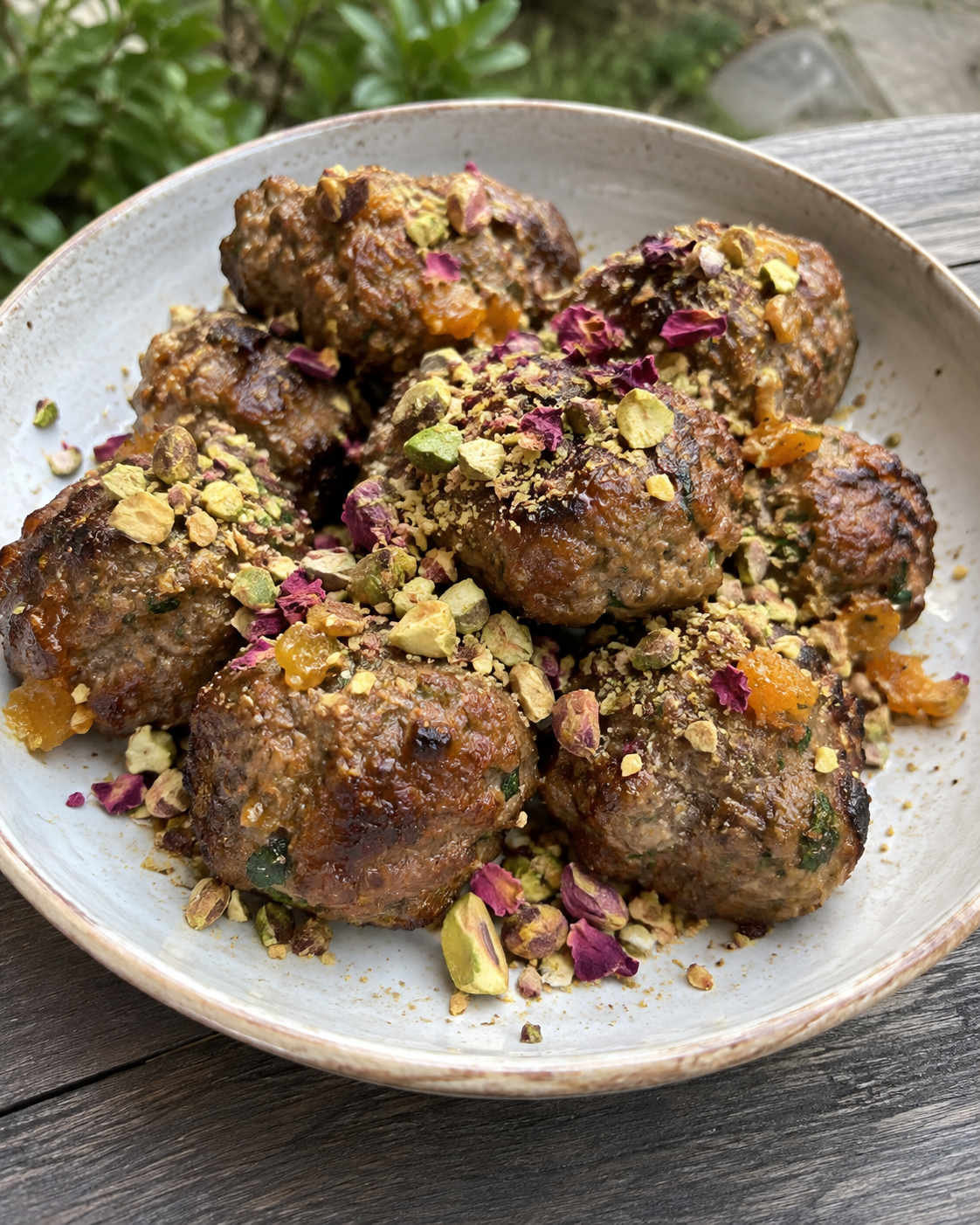
A delicious pairing: lamb and dried fruit. Tender lamb, marinated overnight in a warmly spiced apricot sauce, grilled on skewers or baked as herb-and-dukkah meatballs, then finished with mint, pistachios, pomegranate, and rose petals.
Yield: Serves 8–10 · Active: 45 min · Total: 1½ hours, plus marinating overnight · Best in North America in spring and early summer, during lamb season · Best eaten: early evening
Ingredients
Apricot-curry marinade (can be made up to 3 days ahead)
11 oz unsulfured dried apricots
2½ cups water
2 tbsp grass-fed butter or ghee
1 medium onion, finely chopped
3 garlic cloves, minced
1 tbsp curry powder
1 tsp ground cumin
1 tsp Baja Gold sea salt
¼ tsp cayenne, or to taste (for gentle warmth, not heat)
3 tbsp raw apple cider vinegar
Optional: 1 tbsp raw honey, if the apricots are very tart
Kebabs (for the grill or broiler)
3 lb pasture-raised lamb leg or shoulder, cut into 1½-inch cubes
Metal skewers (or bamboo skewers, soaked in water 30 minutes)
Dukkah meatballs (for the oven)
3 lb pasture-raised ground lamb (shoulder is best, for its fat)
⅓ cup dukkah, plus more for sprinkling
1 pasture-raised egg
¼ cup fresh flat-leaf parsley, finely chopped
¼ cup fresh cilantro, finely chopped
2 tbsp fresh mint, finely chopped
2 garlic cloves, grated
Zest of 1 lemon
¼ cup pistachios, finely chopped
3 tbsp unsulfured dried apricots (or Medjool dates), finely chopped
1 tsp Baja Gold sea salt and ½ tsp black pepper
To garnish: torn mint and cilantro, pomegranate arils (optional, and stunning), 2 tbsp chopped pistachios, food-grade dried rose petals (optional), lemon wedges, and flaky sea salt
Swaps: Ground bison or beef works in place of the ground lamb in the meatballs, though the flavor will be milder. The marinade is also wonderful on chicken thighs.
Method
1. Make the apricot-curry marinade.
Simmer the apricots in the water, covered, for 20–25 minutes, until very soft and the liquid has reduced by about half. Let them cool slightly, then save about 1 cup of the cooking liquid.
Blend the apricots with the rest of their liquid into a thick, glossy purée (about 2 cups).
Melt the butter in a skillet over medium-low heat, and cook the onion 6–8 minutes, until soft and translucent, without browning. Add the garlic, curry powder, cumin, salt, and cayenne, and cook 1 minute, until fragrant.
Stir in the apricot purée, vinegar, and about 1 cup of the reserved cooking liquid, and simmer, partly covered, for 10 minutes, until it's as thick as a loose jam. Thin it with more cooking liquid if needed. Taste it: it should be rich, fruity, and aromatic, with gentle warmth and a bright tang. Add the honey only if it's too tart. Let it cool to room temperature.
2A. Kebabs
Marinate. Toss the lamb with about two-thirds of the marinade in a large glass or ceramic bowl, and refrigerate at least 4 hours, ideally overnight. Save the remaining third for serving, and keep it away from the raw meat.
Prep the grill. Heat a charcoal or gas grill to medium-high, or set an oven rack 6 inches below the broiler and heat it to high.
Thread. Lift the lamb out of the marinade, letting the excess drip off, and thread 5–6 cubes onto each skewer, leaving a little space between them. Discard the used marinade.
Grill 2–3 minutes per side, 8–12 minutes total, until deeply charred outside and medium-rare to medium inside (130–140°F). To broil, set the skewers on a rack over a rimmed sheet pan, and broil 2–3 minutes per side.
Rest 5 minutes, loosely tented. The lamb keeps cooking as it rests, so err on the side of pulling it early.
2B. Dukkah meatballs
Mix. Combine the ground lamb, dukkah, egg, herbs, garlic, lemon zest, pistachios, chopped apricots, salt, pepper, and ⅓ cup of the marinade. Mix gently with your hands, just until combined; overworked meat turns tough. Save the rest of the marinade for basting and serving.
Shape. Heat the oven to 400°F. Roll the mixture into 24–28 balls (about 2 tbsp each), and set them on a parchment-lined sheet pan.
Bake 12 minutes, then brush each meatball with marinade, and bake 6–8 minutes more, until glossy and cooked through (160°F). For extra browning, broil 1–2 minutes, watching closely.
Rest 5 minutes.
3. Serve. Gently warm the reserved marinade in a small saucepan. Pile the kebabs or meatballs on a large platter, and spoon the warm apricot sauce over and around them. Scatter with mint, cilantro, pistachios, pomegranate, rose petals, and a sprinkle of dukkah, and finish with flaky salt and black pepper. Tuck lemon wedges around the edge, and pass the extra sauce at the table.
Serve It With
Grilled vegetable skewers: zucchini, red onion, bell peppers, and cherry tomatoes, brushed with olive oil and grilled alongside the lamb
Shirazi salad: the classic Persian salad of finely diced cucumber, tomato, and red onion, with lime juice, olive oil, and dried mint
Charred eggplant with yogurt and garlic, in the style of Persian borani
Cumin-roasted carrots with a drizzle of honey, or grilled asparagus in spring
A platter of fresh herbs and radishes (sabzi khordan), with mint, basil, tarragon, and green onions, the way they're served at every Persian table
My Massaged Kale Tabbouleh or Loaded Turmeric-Roasted Cauliflower
Persian Jeweled Rice, basmati, or cauliflower rice, with a bowl of thick sheep's milk yogurt and pickled vegetables (torshi)
Storage
The marinade keeps refrigerated up to 3 days, and it's even better the next day. Marinated raw lamb keeps up to 24 hours. Cooked lamb keeps up to 3 days; thinly sliced cold kebab over a salad with warm apricot sauce makes a wonderful next-day lunch. Leftover meatballs reheat well, covered, at 325°F for 10 minutes, or are delicious cold.
A note on honey: The honey in the marinade is simmered, so it's no longer raw. Honey shouldn't be given to babies under 12 months.
Nourishment Notes
Pasture-raised, grass-finished lamb is rich in iron, zinc, B12, selenium, complete protein, and CLA, and grass-finished lamb has more omega-3s. Many lambs today are still finished on grain, so "grass-finished" is the label to look for. Leg is leaner and best for kebabs, while shoulder is richer and best for meatballs, since its fat bastes the meat as it cooks.
Dried apricots are the defining ingredient. Drying concentrates their nutrients, so they're a good source of vitamin A (as beta-carotene), iron, copper, potassium, and fiber. Apricots were first cultivated in Central Asia and China, and they've been central to Persian, Turkish, Armenian, and Central Asian cooking for thousands of years. Choose organic, unsulfured apricots, which are brown rather than bright orange. Their bright color comes from sulfur dioxide, a preservative some people are sensitive to, and unsulfured apricots have a deeper, more caramel-like flavor.
Curry powder is the aromatic backbone of the marinade: a blend of turmeric, cumin, coriander, fenugreek, and other warming spices that took shape in British India in the 1700s and 1800s, and traveled with Indian and Southeast Asian cooks to South Africa. Its turmeric brings curcumin, and the black pepper in many blends helps your body absorb it. Choose a fresh blend, since curry powder loses its fragrance as it sits. Raw apple cider vinegar tenderizes the meat and balances the apricots' sweetness.
Dukkah, an Egyptian blend of toasted nuts, seeds, and spices, binds the meatballs like breadcrumbs, while adding hazelnuts' vitamin E, sesame's calcium, and the warmth of coriander and cumin. Pistachios are central to Persian cooking (Iran is one of the world's top pistachio growers), and bring vitamin B6, potassium, and lutein. Parsley, cilantro, and mint are a nearly constant trio in Persian cooking, served fresh at every meal as sabzi khordan to balance rich meats. And pomegranate and dried rose petals are the final Persian flourish: pomegranate brings punicalagins and ellagic acid, and food-grade rose petals (never from florists, whose roses are sprayed) bring a subtle floral note that makes the dish unforgettable.
As a circadian and seasonal food, this is a celebration dinner, best begun in the late afternoon or early evening, while there's still light on the table, and balanced with plenty of vegetables and greens. Spring into early summer is its natural season, when lamb is at its best. It's a centerpiece for Nowruz, Easter, or Passover, a spring birthday, or any Sunday afternoon when you want to cook something ancient and beautiful for ten people.
For your cycle: The lamb's heme iron, zinc, and B12 make this especially restorative during the menstrual phase, and the apricots add iron, too.
Sourcing
Lamb — pasture-raised and grass-finished leg, shoulder, or ground lamb, from a local farm, US Wellness Meats, or White Oak Pastures
Dried apricots — organic and unsulfured
Curry powder, cumin, and cayenne — organic, non-irradiated, and freshly blended
Dukkah — homemade (see my Dukkah recipe)
Pistachios — organic, California or Sicilian
Eggs — organic and pasture-raised
Onion, garlic, herbs, lemons, and vegetables — organic, from a farmers' market
Pomegranates — organic
Dried rose petals (optional) — organic and food-grade (never from florists)
Raw apple cider vinegar — organic, with the mother (Bragg)
Raw honey (optional) — organic, local, and unfiltered
Butter or ghee — organic, cultured butter from 100% grass-fed cows, or grass-fed ghee
Sheep's milk yogurt — like Bellwether Farms
Salt — Baja Gold sea salt; Maldon for finishing
— Anna aka Food Marshall