Pistachio-Crusted Berry Ricotta Cheesecake
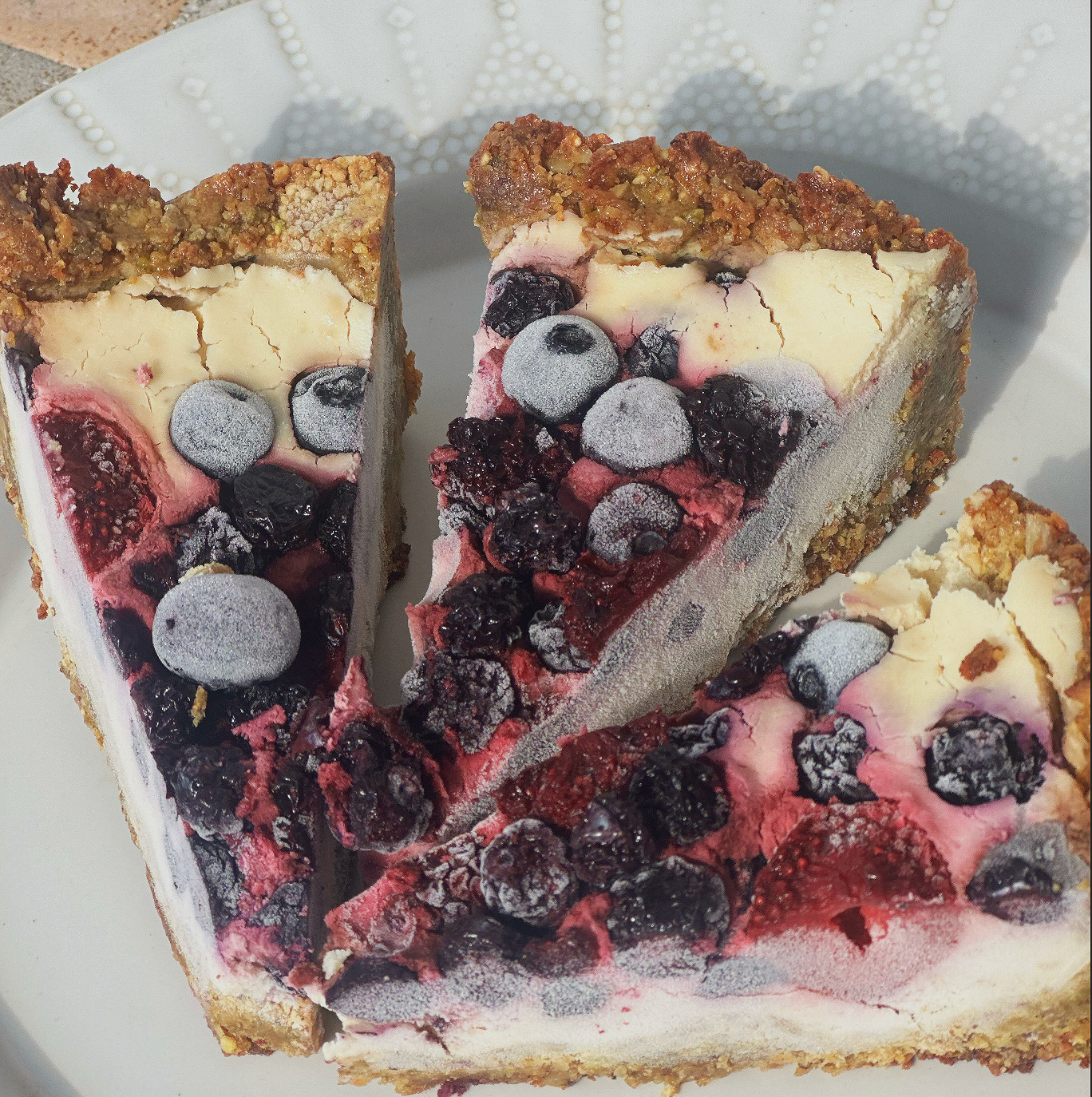
Pistachio-Crusted Berry Ricotta Cheesecake
Italian-leaning summer dessert — toasty pistachio-almond crust, lightly sweetened lemon-ricotta filling, warm berry compote
Serves 8–10 · 25 min active · 4 hr total · summer (peak berry season) · early afternoon or after-dinner
Ingredients
Pistachio crust
1 ½ cups raw pistachios
1 cup raw almonds (or cashews, coconut flakes, or additional pistachios)
2 tbsp coconut oil, melted (plus extra for greasing)
1 pasture-raised egg
1 tbsp raw local honey
pinch Himalayan pink salt
Lemon-ricotta filling
2 cups grass-fed full-fat ricotta (raw or fresh-strained)
juice and zest of 1 large lemon
¼ cup raw local honey
1–2 tsp pure vanilla extract (start with 1)
pinch sea salt
Warm berry topping
2–3 cups mixed fresh organic berries (strawberries halved, raspberries, blueberries, blackberries)
2 tbsp raw local honey or pure maple syrup (optional)
1 tsp fresh lemon juice (optional, brightens the flavor)
pinch sea salt
Garnish
¼ cup raw pistachios, lightly crushed
additional fresh berries
fresh mint leaves
pinch flaky sea salt
Method
Prep the pan. Preheat the oven to 350°F (175°C). Grease a 9-inch pie dish or 8-inch springform pan with melted coconut oil.
Make the crust. In a food processor, combine the pistachios, almonds (or alternative), melted coconut oil, egg, honey, and salt. Process until the mixture forms a cohesive dough-like consistency that holds together when squeezed in your palm.
Press the crust evenly into the bottom and slightly up the sides of the prepared pan.
Bake the crust 10 minutes, until just set but not browned. Watch carefully — the high pistachio content can over-toast quickly.
Cool completely on a wire rack (about 30 minutes).
Make the filling. While the crust cools, in a food processor or with a hand mixer, blend the ricotta, lemon juice, lemon zest, honey, vanilla, and salt until smooth and creamy.
Taste and adjust — add the second teaspoon of vanilla if desired.
Spread the filling evenly over the cooled crust. Smooth the top with an offset spatula.
Make the warm berry compote. In a small saucepan over low heat, combine the berries, honey (if using), lemon juice (if using), and a pinch of salt.
Cook 3–5 minutes, stirring gently, until the berries release their juice slightly and warm through. Some berries should stay whole; some should burst. Don't overcook — the texture should read as fresh-warmed, not jam-like.
Cool the berries 10 minutes (or until just slightly warm — not hot), then pour over the ricotta filling.
Set. Place the cheesecake in the freezer for 1 hour to set, or refrigerate for 3–4 hours.
Garnish. Just before serving, top with crushed pistachios, additional fresh berries, fresh mint leaves, and a pinch of flaky sea salt.
Slice with a clean dry knife and serve.
Storage: Refrigerator up to 4 days. Freezer up to 1 month, well-wrapped. Best within 24 hours of assembly for the freshest berry topping.
Nourishment Notes
The pistachio-and-almond crust is structurally one of the most flavorful grain-free crusts available. Pistachios bring the slightly sweet, faintly resinous depth that distinguishes them from other tree nuts; almonds bring the tighter, more compact texture and slight bitterness from the skin (when raw rather than blanched). Used together at this ratio, the crust achieves a depth of flavor and a textural integrity that neither nut alone produces. The crust binds with the egg-and-honey combination, parbakes lightly to develop additional toastiness, and provides the structural floor for the soft filling above.
Grass-fed ricotta is one of the most undervalued fresh dairy products in modern American kitchens. Traditional ricotta — particularly sheep's-milk varieties like Italian ricotta di pecora and ricotta romana — is structurally distinct from the heavily processed commercial ricotta sold in most American supermarkets. Quality ricotta has a slightly grainy texture (the curds are visible), a clean, milky-sweet flavor, and substantially higher fat and protein content than industrial ricotta. Bellwether Farms, BelGioioso, and Calabro produce ricotta that approaches the traditional Italian standard. Best of all, raw or grass-fed ricotta is increasingly available at farmers' markets and direct from small dairies.
The Italian crostata di ricotta tradition — sweetened ricotta filling on a tart crust, often with citrus or fruit — has been a staple of Sicilian, Roman, and Neapolitan dessert tradition for centuries. The Sicilian version, cassata, evolved into one of the great Italian-American special-occasion desserts; the Roman torta di ricotta is the simpler everyday cousin. Both rest on the same architectural principle: ricotta's slightly sweet, milky body acts as a perfect structural backdrop for stronger flavors (citrus, fruit, nuts, chocolate). The version here pulls from the crostata simplicity rather than the more elaborate cassata.
The warm berry compote technique is structurally distinct from a cooked jam. Traditional jams rely on long cooking with substantial sugar to produce a thick, gelatinous consistency; the warmed-berry approach here keeps the berries mostly intact, releasing their juice without breaking down the structure or amplifying the sweetness beyond what's already in the fruit. The result reads as fresh-warmed berries rather than jam — and the texture of partially-burst berries with intact ones provides a more complex eating experience than either fully fresh or fully cooked. The lemon juice brightens the flavor without altering the texture.
Storage: Refrigerator up to 4 days. The crust may soften slightly over time; consume within 2 days for best texture.